Why Most Software Projects Fail Before They Even Begin
Michael CaliHead of Marketing
Michael is passionate about showcasing what is truly possible when you partner with us. With data-driven insights, he boosts our exposure to Australian businesses that share our commitment to being at the forefront of tech innovation. His main goal is connecting our team with the market of innovators to deliver software ‘magic’!

Most software projects don’t fail because of poor code.
They fail because of poor partnerships.
The difference between a project that delivers real business impact and one that stalls, overruns, or underdelivers is rarely technical capability alone. It comes down to how well the business and its development partner work together.
In today’s environment, building software is no longer the hard part. Aligning strategy, commercial models, delivery approach, and ongoing evolution is where success is won or lost.
Too often, organisations approach software development like a procurement exercise – selecting a vendor, defining a scope, and expecting a predictable output.
But modern software doesn’t work that way.
It requires collaboration, transparency, and a shared commitment to outcomes, not just deliverables.
For decision-makers, the challenges are familiar:
- Budget Burn Without Return – Investment is consumed during the build, with little left to optimise, evolve, or scale.
- Strong Build, Weak Adoption – A technically sound product that fails to gain traction with users or stakeholders.
- Lack of Visibility – Progress is unclear, risks are hidden, and decisions are made without real insight.
The most successful organisations don’t just hire developers.
They build partnerships designed to deliver long-term value.
This is the shift – from buying software to building capability.
In this guide, we outline the principles that underpin high-performing software partnerships and how to structure your next project for measurable success.
Prioritise Viability over Vision
Don’t fall into the trap of trying to launch a fully-featured platform on day one. The most successful products start as the most focused, not the most complex. Use a “Must Have” framework to identify the core functionality that solves your user’s most urgent problem.
Invest for ROI, Not Just Launch
A common mistake is treating the release as the finish line. In reality, the first release is just your foundation. Data consistently shows that post-launch enhancements, driven by real user behaviour, deliver a significantly higher ROI than pre-launch development.
Align Your Commercial Model
Choosing the wrong model can create friction before a single line of code is written. Whether it’s a Fixed Price for defined deliverables or Time & Materials for agile innovation, your structure must align with your risk profile and need for flexibility.
Growth is a Design Principle
Building great software is only half the equation; the other half is adoption. Your marketing and distribution strategy should run alongside development, not follow it. If your solution is internal, define the required behavioural changes; if it’s revenue-generating, define exactly why they will switch from their current solution.
Demand the “Transparency Triangle”
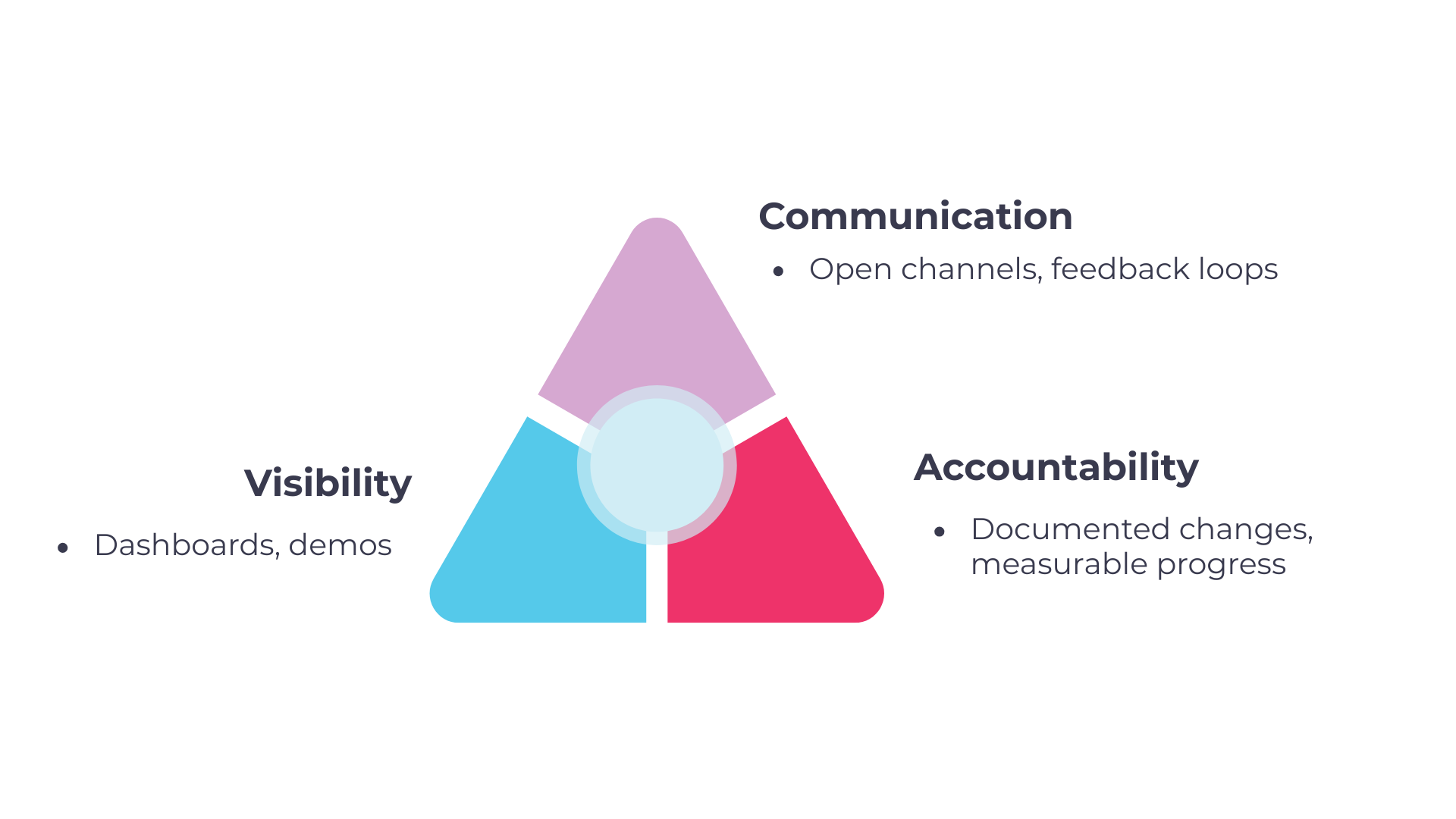
Trust is earned through transparency. We preach the Transparency Triangle: Communication, Visibility, and Accountability. When visibility is poor, issues remain hidden until they escalate. True partnership means having the right to see demonstrable progress through every sprint.
Software is a strategic investment, not a cost centre.
Don’t let your next project become another legacy liability.
Ready to build for the future?
Fill in the form below to download the full E-book: Partnering for Success with a Software Development Agency
Or contact us today to discuss how we can help you modernise your legacy systems with secure, AI-powered applications that drive measurable success.
About The Author
