Why AI Governance Is No Longer Optional for Business Leaders
Burkhard BergerStrategic Content Author
Burkhard Berger is the founder of Novum™. He helps innovative B2B companies implement modern SEO strategies to scale their organic traffic to 1,000,000+ visitors per month. Curious about what your true traffic potential is?

Most companies adopted AI quickly. The governance part came second…or hasn’t come at all yet. For a while, that seemed perfectly fine. But then the side effects started showing because there was no real AI governance in place – shadow AI, policy confusion, reputational risk. And this is the uncomfortable part for most leadership teams.
That is exactly what we will help you with. We will show you 7 reasons why it belongs on every business leader’s agenda and share 5 strategies for building a comprehensive AI governance framework to bring control back.
What Is AI Governance?
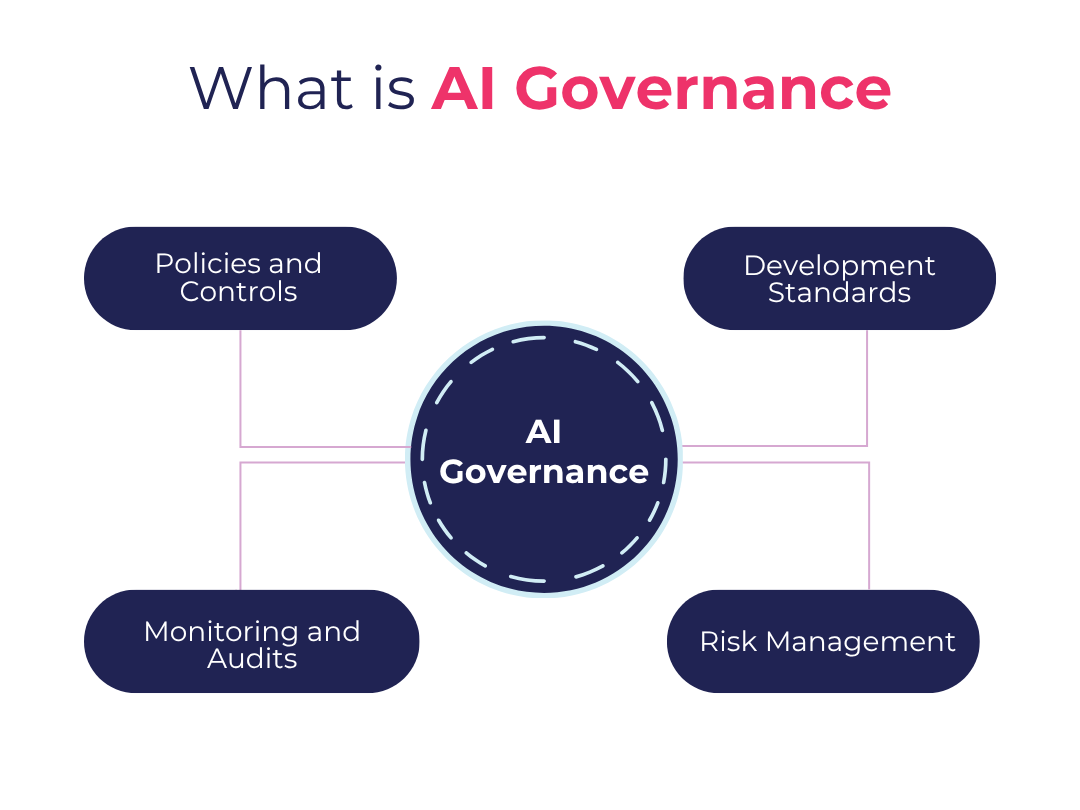
AI governance encompasses the set of policies and controls that define how your organisation builds, deploys, and monitors artificial intelligence. It determines who can approve an AI use case and what data the system can access.
AI governance aims at setting the rules for reviewing outputs and responding when AI initiatives produce a result they shouldn’t have. For business leaders, it is the difference between “we use AI” and “we apply responsible AI innovation in a way we can defend to a regulator or an AI ethics board.”
6 Foundational AI Governance Principles Business Leaders Should Follow
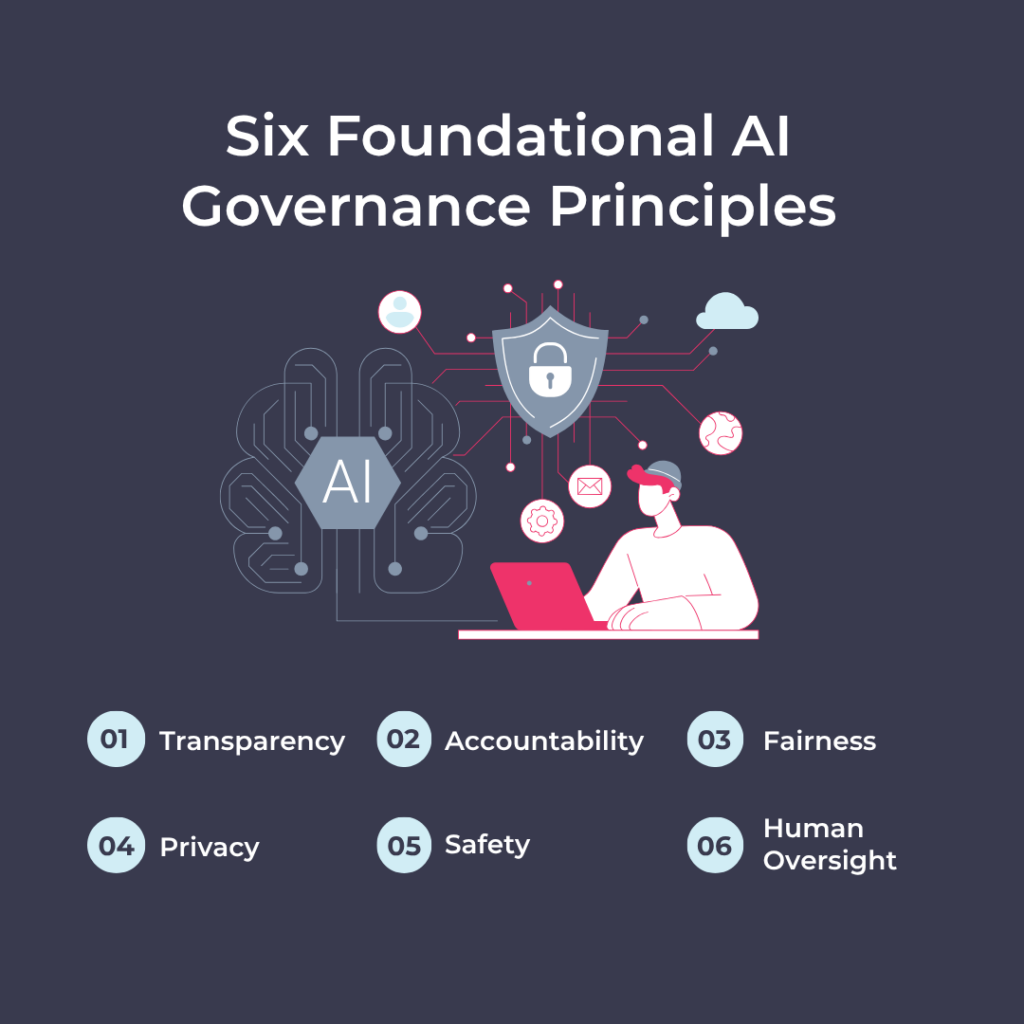
Most government and industry AI governance programs are built on these 6 principles.
1. Transparency
If your AI makes a decision that affects a customer, that customer should get a straight answer about how the AI-driven decision was made. That means your team needs to document which data the model uses and what logic drives its outputs.
Regulators are asking for the same thing. The organisations that can clearly explain how their AI systems operate right now are in a much better spot than the ones still figuring out what their models actually do inside the system.
2. Accountability
Every transparent AI system needs a named person or team behind it. When something goes wrong – and eventually something will – there has to be someone whose actual job includes investigating and fixing it. Not an undefined committee. A named individual with the authority to pull the model offline if needed.
Accountable AI governance processes also mean keeping records of every version of every model. If a decision gets questioned later, your organisation needs to show the data that the model had at the time. Accountability should never become a vague idea of collective responsibility where everyone is involved, but nobody is actually accountable for the outcome.
3. Fairness and Non-Discrimination
A hiring model trained on 10 years of CVs from a company that has always leaned toward certain demographics will keep that pattern going unless someone tests for it. That is how bias gets built into AI. Not through bad intentions, but through unexamined historical data.
Fairness means testing models across different population groups before they go live. And you have to continue testing it after deployment, because a model that was fair on day one can drift as the data it processes shifts over the following months.
4. Privacy and Data Protection
An AI model that processes customer data has to meet the same privacy and ethical considerations as any other data governance practices in the business. The Australian Privacy Act applies. GDPR applies if you deal with EU residents.
Data minimisation matters – only feed the model what it genuinely needs. Consent matters – make sure the data was collected for a purpose that covers AI processing. Organisations that integrate AI into existing systems need the data flowing into those models within the same legal and ethical boundaries as everything else in the organisation.
5. Safety and Reliability
A model that is accurate 95% of the time still gets it wrong 5% of the time. In a product recommendation engine, that is a minor annoyance. In a healthcare or financial application, that 5% carries real consequences.
Safety defines what failure is acceptable in each AI use case. Reliability means the system performs the same way under production conditions with real data volumes and real edge cases as it did during testing. Those two things together tell you if a model is ready for deployment or not quite there yet.
6. Human Oversight
Some decisions should never be fully automated. A model can score or recommend. But when the outcome significantly affects someone’s finances or legal standing, a human should review the output before it becomes final.
The European Union’s AI Act requires this for high-risk applications. Australian regulatory guidance is heading in the same direction. The human oversight mechanism also applies to continuous monitoring – automated systems can drift without anyone noticing if there is no regular check on whether the model is still performing the way it was intended to.
Why Responsible AI Governance Belongs on Every Business Leader’s Agenda: 7 Key Reasons
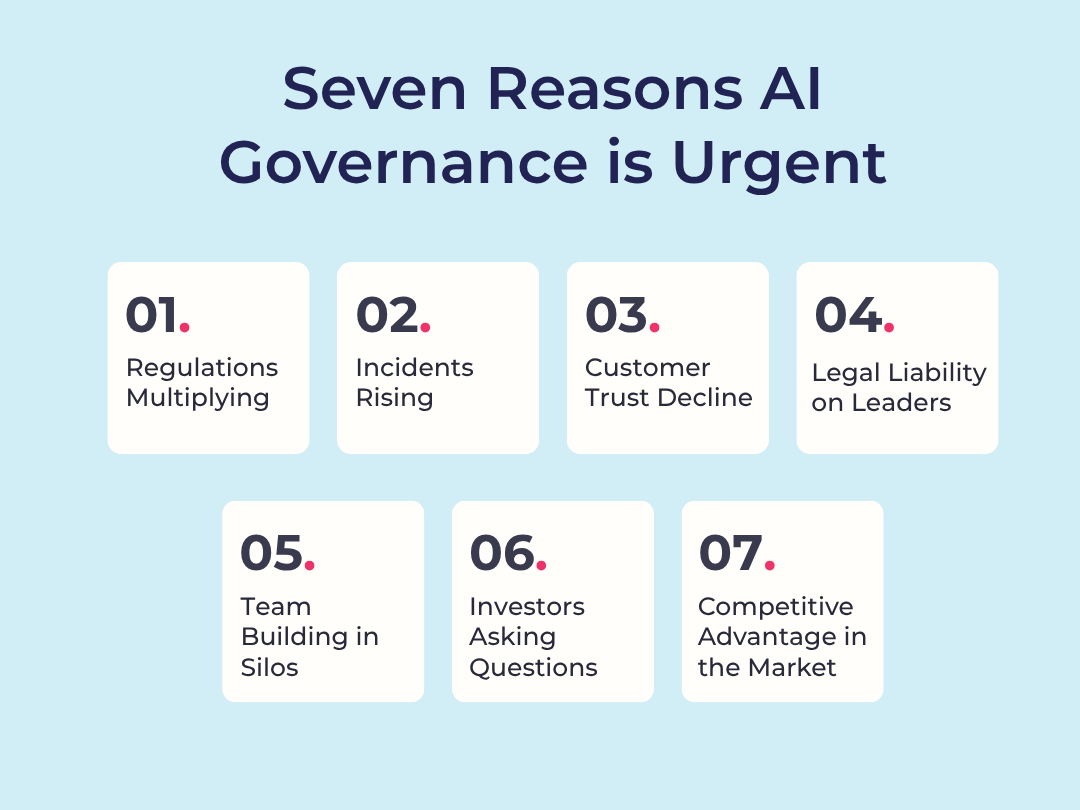
Here are 7 reasons AI governance has shifted from a future task to something that needs attention now.
1. AI Regulations Are Multiplying and Penalties Are Getting Specific
The EU AI Act is live, with tiered compliance requirements based on risk level. Australia’s AI Ethics Framework is being tightened, and the government is pushing for mandatory controls for high-risk AI.
In the US, state-level AI legislation is picking up speed. Stanford’s 2025 AI Index Report shows that US AI regulatory activity more than doubled in a single year. For Australian businesses that operate internationally or serve customers in regulated markets, the rules already exist. They are getting more detailed every quarter.
2. AI-Related Incidents Are Rising Faster Than Most Teams Can Respond To
The same Stanford report tracked a 56.4% increase in AI-related incidents in one year. Data leaks through AI tools. Biased outputs affecting real people. Automated decisions that the deploying organisation couldn’t explain after the fact. Most of these happened at companies that were actively using AI technologies but hadn’t put governance around it yet.
The rate at which teams adopt new AI tools means the number of ungoverned AI applications inside an average organisation is growing faster than any policy team can track without a structured framework behind them.
3. Customers Are Paying Attention to How Companies Use Their Data
Public trust in AI companies dropped from 50% to 47% in Stanford’s most recent measurement. The percentage looks small. The trend doesn’t.
Customers increasingly want to know whether their data is being used to train models. They want to know whether AI influenced a decision about their account. And they want to know what recourse they have if something goes wrong.
Businesses that can answer those questions clearly – because governance gave them the structure to – hold a real advantage over competitors that can’t.
4. Ungoverned AI Creates Legal Liability That Falls on Leadership
When an existing AI system produces a discriminatory outcome or leaks sensitive data, the liability falls on the organisation that deployed it. Increasingly, it is on the leadership team that approved its use without adequate oversight.
Directors and officers’ liability is extending to AI decisions in multiple jurisdictions. In Australia, this ties directly to existing obligations under the Corporations Act and the Privacy Act. A business leader who signs off on AI application deployment without governance is taking on a type of personal risk that simply didn’t exist three years ago.
5. Internal Teams Are Building AI in Silos Without Shared Standards
Marketing adopted an AI content tool. Customer service launched a chatbot. Product is training a recommendation model on customer data. Finance is running forecasting experiments. Each team picked its own tools and set its own rules for data access and review standards.
Without central governance, one team might send customer data to a third-party API, even though another team would have flagged it right away. And the longer this goes without a shared set of rules, the harder it becomes to align everything later.
6. Investors and Board Members Are Starting to Ask About AI Risk
AI governance is appearing in board-level discussions and investor due diligence. According to Deloitte’s 2025 State of AI report, only 1 in 5 companies has a mature governance model for autonomous AI agents – even while agentic AI adoption is growing.
Boards want to know whether AI risk is managed. Investors want to know what happens if a model produces a harmful output. For companies headed towards funding rounds or IPOs, a documented AI governance framework is becoming as expected as a cybersecurity policy.
7. Governance Gives You a Competitive Edge in Regulated Industries
In healthcare and financial services – two of the largest markets in Australia – procurement processes now include specific questions about effective AI governance. Government agencies are heading the same way.
A company that can show documented policies and audit trails for its AI systems qualifies for contracts that ungoverned competitors get excluded from. This matters especially for companies that build technology strategies for government clients, where AI governance documentation is now a hard requirement in many RFP responses.
How to Implement AI Governance Framework for Long-Term Success: 5 Proven Strategies
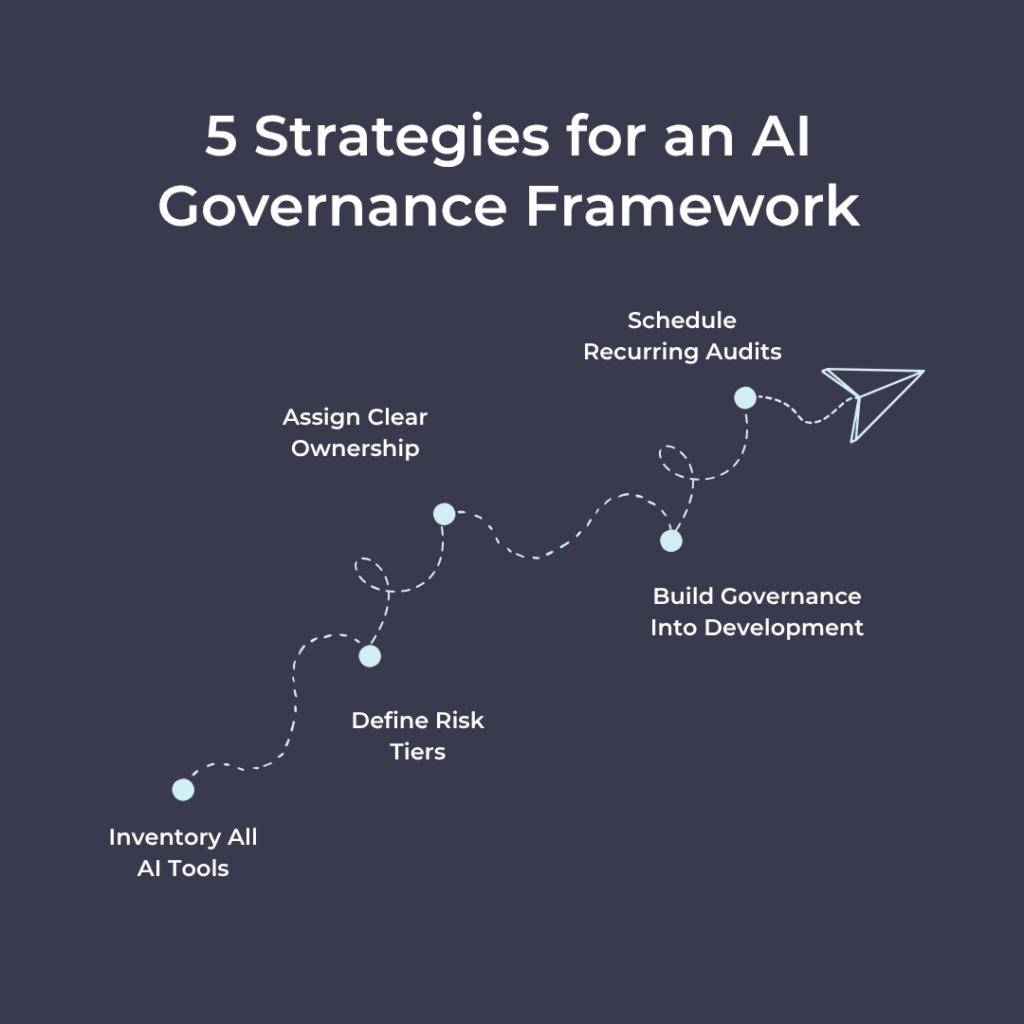
Knowing the principles and the reasons gets you half the way. The other half is actually building AI governance practices that work inside your organisation.
1. Start With a Full Inventory of Every AI Tool and Model in Use
Most organisations are genuinely surprised by how many AI tools are running across their teams when they count them properly. Individual departments adopt tools without a central IT sign-off all the time. Your CRM probably added AI features in a recent update. Your email platform might be drafting replies using AI. None of those went through a formal review.
71% of organisations now use generative AI regularly in at least one business function. That speed of adoption means the AI inventory at most organisations is bigger than leadership thinks.
- Send a short survey to every department, five questions max. Ask what AI tools they use and whether IT approved the tool or the team adopted it independently.
- Don’t forget AI features embedded in existing software. A CRM that added AI summarisation in a recent update counts. Pepper Cloud, for instance, ships with reporting, automation, and customer support built natively into the platform. An email platform using AI for reply suggestions counts too. These get missed because nobody actively “adopted” them.
- Create a central register. Assign each tool a risk tier based on what data it touches and what decisions it affects. A social media caption tool is lower risk than a model scoring insurance claims.
- Update the register every quarter. New tools get adopted constantly. A 6-month-old inventory is already missing entries.
2. Define Risk Tiers So Not Every AI Application Gets the Same Scrutiny
A tool that writes social media posts doesn’t need the same governance review as a risk-management model that decides whether a customer qualifies for a loan. Treating them the same way makes governance so slow that teams start avoiding it entirely. Risk tiering puts governance effort where it actually matters.
- Set up three tiers. Low risk covers internal tools with no customer data. Medium risk covers customer-facing tools or anything processing personal data. High risk covers anything that affects decisions about a person’s finances or legal position.
- Map every tool in your inventory to a tier. In most organisations, 60-70% of AI usage falls into low risk. That means the governance effort concentrates on the 30-40% that genuinely need it.
- Define the specific requirements for each tier. Low risk might need a one-page usage policy. High risk might require bias testing and quarterly audits.
- Re-check tier assignments once a year or whenever a tool’s scope changes. A marketing chatbot that starts handling customer complaints just moved up a tier.
3. Assign Clear Ownership for Each AI System’s Outcomes
If a model produces a biased output and nobody specifically owns that model’s performance, the response is slow and accountability is unclear. Every AI system – at least the medium-risk and high-risk ones – needs a named owner.
Someone responsible for monitoring outputs and managing incidents. Not a committee. A person. And that person needs actual authority to pause the system if it is producing results that don’t meet the organisation’s standards.
- Name a specific governance owner for each medium-risk and high-risk AI system. Put their responsibilities in writing – output monitoring, incident response, periodic review.
- Give that person the authority to halt the system without multiple levels of approval. In an active incident, waiting for sign-off costs time.
- Factor AI governance ownership into performance reviews. If it is a named responsibility but doesn’t appear in how someone gets evaluated, it will be their lowest priority.
- Build a short escalation path. The owner should know exactly who to contact in legal and in executive leadership when they identify an issue beyond their own scope.
4. Build Governance Checkpoints Into the Development Process, Not After Deployment
The approach that fails most often: building the model first, then running a governance review right before launch. By that point, the data choices are already set, and the architecture is fixed. Changing anything big means months of rework. Governance should be part of the responsible AI development process from the start.
- Add a governance review gate at project kick-off, before any data gets collected. This is where the risk tier gets assigned, and the required governance steps for that tier are decided.
- Make bias and fairness testing a required gate before any model reaches production. Not optional. Not “if there’s time.” A gate that the model has to pass before deployment gets approved.
- Set up automated monitoring for model drift after deployment. A model that was accurate and fair at launch can degrade within months as the data quality it processes changes.
- Record every governance decision made during development. If a regulator asks 6 months from now why a specific dataset was used, the project record should have the answer ready.
5. Schedule Recurring Audits for Model Performance, Bias, and Data Drift
Governance that only happens at launch is not a framework. AI models shift over time. The data they process changes. The regulatory compliance requirements they operate under change.
Recurring audits throughout the AI lifecycle find the problems that launch-day reviews can’t anticipate. How often depends on risk – quarterly for high-risk systems, every six months for medium, annually for low.
- Set audit dates at the start of each year for every high-risk and medium-risk system. Get them on the calendar now so they don’t keep getting pushed back.
- Each audit should cover model accuracy against a current test set and output distribution across demographic groups.
- Store audit reports in a central location linked to your AI inventory. If a regulator asks for evidence of governance activity, you should be able to pull the last 3 audit reports for any given system within an hour.
- Use audit findings to update AI governance policies. If an audit uncovers a risk type you hadn’t planned for, add it to the framework instead of treating it as a one-time fix.
5 Businesses Worth Studying for Their AI Governance Approach
AI governance is still a work in progress for most organisations. These 5 businesses are already a few steps ahead, and there is a lot that leaders can learn from what they have done.
1. OKRs Tool
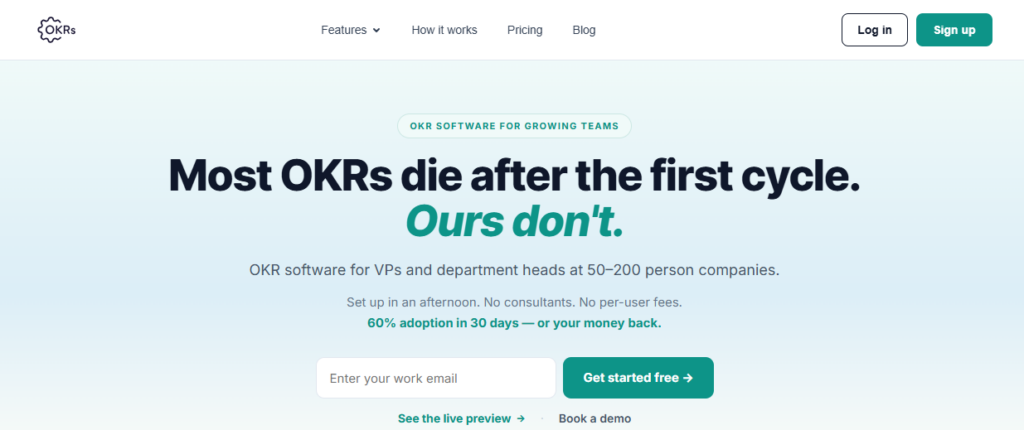
OKRs Tool treats AI like a structured assistant inside performance planning, not a free-thinking contributor.
When teams draft quarterly objectives, the workflow forces every AI-assisted suggestion into a review stage before it can be attached to an OKR cycle. Nothing generated by AI goes straight into an active performance plan. It must pass a human validation step where managers confirm that the objective matches measurable outcomes already defined in the system.
They also separate drafting from approval in a very deliberate way. Employees can use AI to refine wording, but final OKRs can only be published through a manager-level approval flow that is logged and time-stamped.
Another important workflow choice is how performance data is accessed. AI suggestions are only allowed after the user has selected a reporting period manually. There is no automatic pull of historical performance data into AI prompts. That keeps interpretation anchored to human selection, not system inference.
The governance pattern here is simple. AI helps with drafting, but it never participates in final performance decisions without explicit human confirmation inside a controlled workflow.
2. Brondell

The water filtration collection by Brondell has internal workflows for customer support and product guidance that are built around strict separation between AI-assisted responses and technical escalation paths.
When a customer inquiry comes in, frontline support teams can use AI to draft responses for basic installation or maintenance questions. However, anything related to water quality concerns or product malfunction automatically routes out of the AI-assisted workflow and into a technical specialist queue.
They also maintain a hard rule inside their service process where AI-generated responses can’t be sent to customers without passing a compliance review layer for specific categories like health-related concerns or system failures.
Another operational detail is how product information updates are handled. When engineering updates filtration specifications, support teams must manually refresh approved response templates before AI tools can use that updated data. There is no automatic syncing from engineering documents into customer-facing AI responses.
The governance principle here is workflow segmentation. AI is allowed in early response drafting, but escalation points and sensitive categories are completely removed from its control.
3. Spotminders
The internal tracking workflow of Spotminders’ trackable passport covers is built around strict verification cycles rather than continuous monitoring.
When a passport status changes in the system, the update enters a verification queue where a second user confirmation is required before the status becomes active in the system. This applies even for simple transitions like marking a passport as “in use.”
They also avoid automated status inference entirely. Employees must manually update each state change, and AI is not used to predict or suggest lifecycle movement based on past patterns.
Another workflow constraint is audit traceability. Every update requires the user to attach a reason code from a fixed list. Free-text explanations are not accepted in high-trust tracking scenarios. This creates a controlled chain of responsibility where no single action moves through the system without a deliberate human checkpoint and a recorded justification.
The governance approach here is a verification-first workflow design that prioritises traceability over automation speed.
4. Mesothelioma.net

This educational resource on peritoneal mesothelioma by Mesothelioma.net shows that their internal content workflow is structured around staged editorial control rather than continuous publishing.
Every article begins in a research drafting stage where contributors compile source material. That draft can’t move forward until it passes a medical review checkpoint where qualified reviewers validate terminology, claims, and condition accuracy.
Once approved, content enters a separate formatting stage where structure is standardised across all condition pages. Editors are not allowed to modify medical claims during this stage. Their role is limited to formatting consistency and readability.
After publication, updates are handled through a controlled revision queue. Even minor edits require re-validation if they involve treatment information or diagnostic descriptions. That prevents uncontrolled changes from slipping into live content.
The governance pattern here is staged responsibility. Each workflow step has a defined purpose, and content can’t progress without passing the appropriate control layer.
5. Custom Sock Lab

Custom Sock Lab’s performance athletic socks have an operational workflow that is built around strict order validation before manufacturing begins.
When a customer submits a custom order, it first enters a pre-production validation queue. This step checks whether design inputs match production constraints such as stitch density limits and fabric compatibility rules. Orders that fail validation are sent back to customer service for correction instead of moving forward.
Design approval is also separated from production scheduling. Even after validation, orders can’t enter manufacturing until a production manager assigns them to a batch based on complexity level and material type. This prevents incompatible designs from entering the same production run.
Another workflow control is how custom requests are handled. If a customer submits a design outside predefined placement zones, the system flags the order for manual redesign support.
The governance structure here is built into operational sequencing. Nothing reaches the factory floor without passing staged validation, approval, and batching steps that separate creativity from production risk.
Conclusion
If AI is influencing decisions in your organisation, then AI governance already exists, whether it is structured or not. The only real difference now is whether it is intentional or accidental. So start small with AI governance best practices. Name ownership. Map usage. Define accountability where AI touches decisions.
At 4mation, we develop AI applications and integrations with governance built into the development process from the start. Our team works with OpenAI and Google alongside Microsoft and AWS, and every project includes documentation that supports your compliance and governance requirements.
If your organisation is adopting AI and needs a development partner that treats responsible AI practices as seriously as performance, we’d like to talk.
About The Author
