The Strategic Blueprint: Reclaiming 50% of Staff Capacity Through Educational Institution Automation
Michael CaliHead of Marketing
Michael is passionate about showcasing what is truly possible when you partner with us. With data-driven insights, he boosts our exposure to Australian businesses that share our commitment to being at the forefront of tech innovation. His main goal is connecting our team with the market of innovators to deliver software ‘magic’!

In the modern academic landscape, every educational institution faces a trio of mounting pressures: escalating operational costs, a tightening labour market for qualified professionals, and rising student expectations for a seamless, consumer-grade digital experience. To maintain academic operational efficiency, leaders must look beyond basic digitisation and staff capacity.
The fundamental challenge is rarely a shortage of software; it is an excess of systemic friction. When a registrar’s office is bogged down by manual spreadsheet reconciliation and faculty members lose 40% of their day to administration, the institution’s core mission is compromised.
This guide provides the framework for higher education digital transformation, designed to bridge the internal capability gap and reduce workloads by up to 50% through a strategy-first approach.
Eliminating the Hidden Budget Tax
Most schools suffer from poor technical architecture. Over the last decade, departments have often purchased off-the-shelf solutions in isolation. The result is a fragmented ecosystem where data is trapped in silos, creating a “manual tax” on your staff.
Financial Leakage
Paying for redundant licences across disparate departments.
Integration Tax
Staff spending hours manually migrating data between the Learning Management System (LMS) and the Student Information System (SIS)
Adoption Barrier
When staff are forced to remember multiple login credentials, they inevitably revert to Excel, stalling your digital evolution.
The Strategy: The Core-and-Satellite Model
School executives must shift the institution towards a unified data environment:
Identify your Source of Truth
Usually, your SIS (Student Information System) or a Central Data Warehouse.
Audit for Redundancy
If two departments use different project management tools, mandate a single platform to improve cross-departmental collaboration.
The 80% Rule
Any tool that fails to achieve 80% active usage within six months should be decommissioned or re-evaluated for its User Experience (UX).
Reducing Workload by 30-50% Through Intelligent Automation
Moving Beyond Digital Paper
Digitising a form is not automation but just faster manual work. True automation is Intelligent Automation (IA), which reimagines the process entirely.
High-Impact Use Cases for 2026
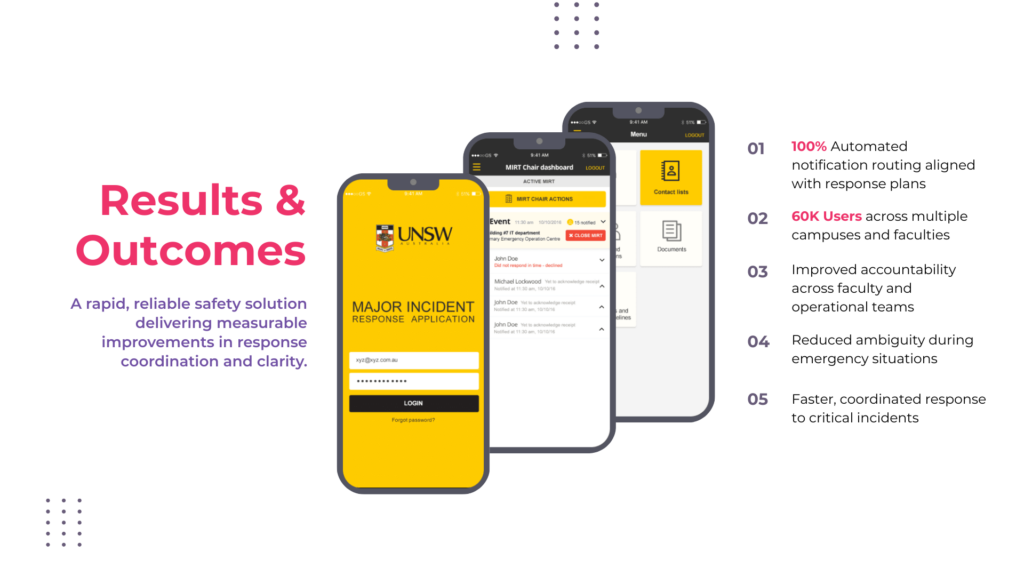
A purpose-built emergency response platform designed for speed, precision, and reliability.
By combining rapid delivery with precision workflow design, they moved from reactive coordination to structured, automated emergency response management.
Real-Time Reporting for School Leaders
The Data Trust Gap
You cannot lead what you cannot measure. In most cases, by the time a school identifies an issue, students have already disengaged.
Building the Executive Dashboard
A trusted reporting environment requires three layers:
- Automated data entry to remove human error.
- APIs that push data to the dashboard every 15 minutes, not every 15 days.
- Moving from “What happened?” to “What will happen?” (Predictive Analytics).
| Metric | Impact | Targeted Goal |
| Utilisation Rate | Facilities & Staff Efficiency | 85%+ |
| Intervention Speed | Student Retention | <24 Hours from Risk Event |
| Admin-to-Faculty Ratio | Financial Sustainability | 30% reduction in overhead |
Safe AI Implementation: Governance and Ethics in Education
The Governance-First Approach
AI should not be a “black box” project managed solely by IT; it must be a governance-led initiative. The risk extends beyond data privacy to algorithmic bias and institutional reputation.
Establishing the AI Ethics & Safety Board
Before deploying a single tool, create a cross-functional committee to ensure AI is compliant and ethical:
The Academic Lead: To safeguard pedagogical integrity and prevent the “AI-washing” of education.
The Legal & Compliance Officer: To map AI workflows against local Data Privacy Acts (such as the Australian Privacy Principles or GDPR).
The Student Representative: To maintain transparency regarding how student data is utilised for predictive analytics.
Defining “Low-Risk” vs. “High-Risk” Use Cases
Executives must categorise AI initiatives to allocate oversight resources effectively.
| Risk Level | Example Use Case | Oversight Required |
| Low (Administrative) | AI-assisted grading, admissions screening, retention, and “at-risk” labelling. | Standard data privacy check. |
| Medium (Supportive) | 24/7 Chatbots for campus FAQs, financial aid guidance. | Monthly accuracy audit (Human-in-the-loop). |
| High (Evaluative) | AI-assisted grading, admissions screening, retention, and “at-risk” labelling. | Rigorous bias testing and manual appeal process. |
The Quick Wins for Capacity Building
To achieve a 30-50% workload reduction, focus on these high-impact, safe areas:
Intelligent Document Processing (IDP)
Use AI to instantly “read” and verify thousands of incoming transcripts or enrolment documents.
Hyper-Personalised Enrolment Communications
AI that analyses a prospective student’s interests to generate tailored follow-up sequences, increasing conversion without increasing headcount.
Predictive Logic
AI that flags drops in student engagement (e.g., missed LMS logins), allowing counsellors to intervene proactively.
Bridging the Internal Capability Gap: Technical Strategy and Audits
The most common hurdle for non-technical executives is the feeling that “we don’t have the people to do this.” Your IT team is likely overwhelmed with maintenance, and your administrative staff are not systems architects.
The Solution: Technical Strategy & Audit
You wouldn’t build a new campus wing without an architect; you shouldn’t build a digital ecosystem without a technical roadmap.
| External Audit: Bring in an objective partner to assess your current Technical Debt. | The Roadmap: Define a 12-to-24-month sequence of quick wins (Automation) and structural changes (System Consolidation). | Upskilling vs. Hiring: Focus on training your current staff to become power users of the new automated workflows rather than hiring expensive developers. |
A Self-Assessment for Executives
Where does your institution sit today?
- Level 1 (Reactive): We buy tools when someone screams loud enough. Data is in Excel.
- Level 2 (Active): We have a few automated portals, but they don’t talk to each other.
- Level 3 (Integrated): Core systems (SIS/LMS) share data. We have real-time dashboards.
- Level 4 (Optimised): AI handles routine admin. Staff focused on high-value student engagement. 80%+ adoption.
The ROI of the Modern Institution
Digital transformation for an educational executive is not merely about technology; it is about capacity building.
By closing the capability gap and conducting a strategic audit, you are:
Increasing digital uptake by making tools more intuitive and easier to use.
Boosting operational efficiency by removing the “Manual Tax.”
Improving learning outcomes by ensuring your staff focus on students, not spreadsheets.
Final Thought for the Board: If you could reclaim 40% of your staff’s time starting next semester, what would your institution achieve?
Or contact us today to discuss how we can help you modernise your legacy systems with secure, AI-powered applications that drive measurable success.
About The Author
