AI Readiness: 2026 Checklist for Australian Organisations
Jowena BorralDigital Marketing Specialist
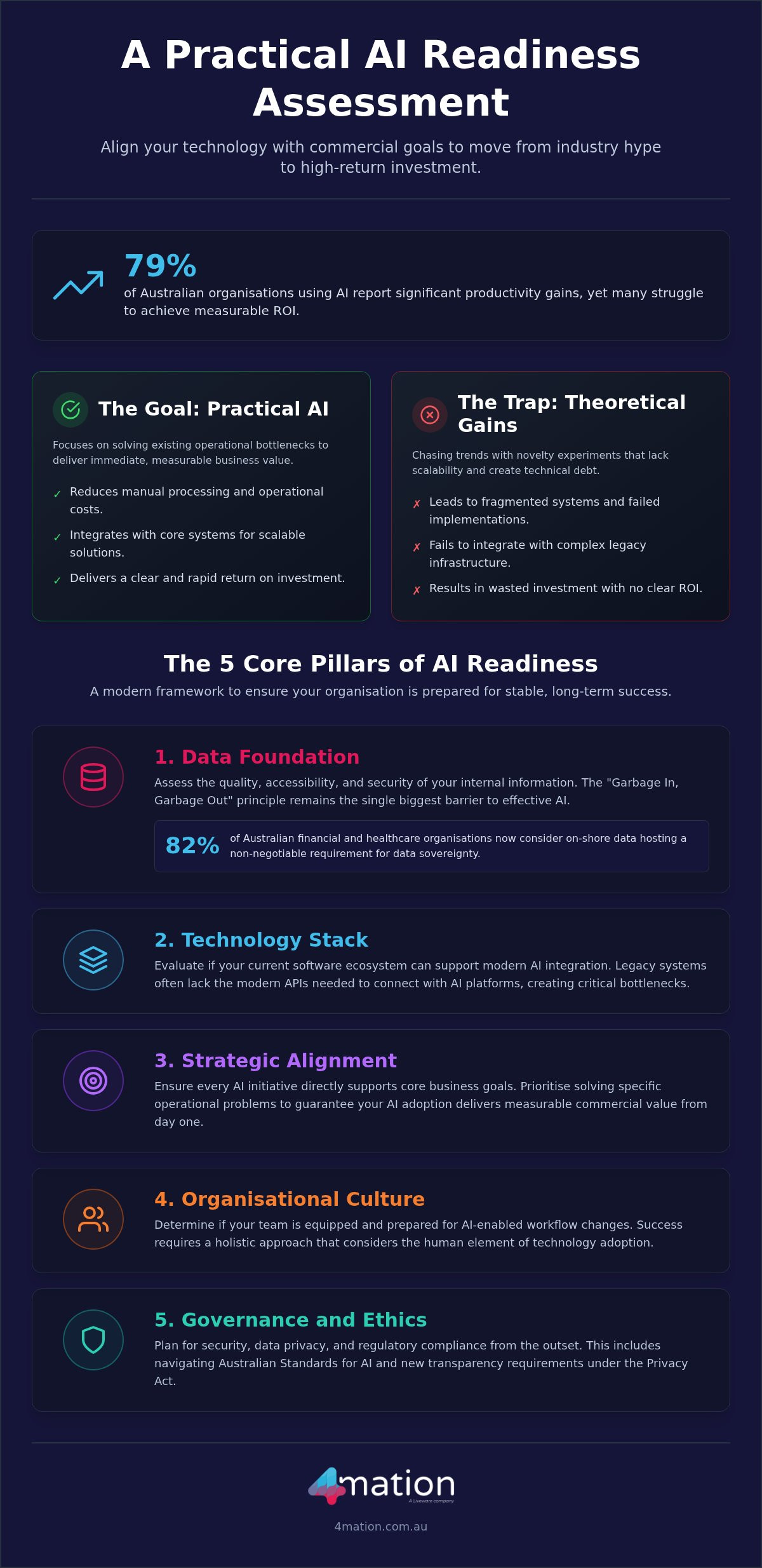
While 79% of Australian organisations using artificial intelligence report significant productivity gains, the gap between initial experimentation and measurable ROI remains a significant hurdle. You likely feel the pressure to integrate AI into your operations, yet the fear of overinvesting in hype or compromising data security is a valid concern for any commercially minded leader. It’s common to worry that complex legacy systems might not support modern integration, or that the rapid pace of change will leave your investment obsolete before it delivers value.
This article provides a practical AI readiness assessment for companies operating in the 2026 Australian market. We’ll move beyond the buzzwords to offer a structured checklist designed to help you identify high-ROI use cases and ensure your technology investments deliver certain, measurable results. We’ll also examine how to navigate the new Australian Standards for AI and the transparency requirements coming into effect this December under the Privacy Act. By the end of this guide, you’ll have a clear roadmap to transition from AI curiosity to a position of competitive advantage and operational excellence.
Key Takeaways
- Learn how an AI readiness assessment for companies aligns your technology with commercial goals to prevent wasted investment on industry hype.
- Identify the five core pillars of a modern framework, focusing on data quality, security, and the capability of your current software ecosystem.
- Prioritise specific operational problems, like reducing manual processing, to ensure your AI adoption delivers measurable business value from the start.
- Build a controlled implementation roadmap using a Proof of Concept to validate your strategy before you commit to large-scale deployment.
- Understand how a business-first partnership helps you transition from strategic evaluation to reliable, long-term technical delivery.
What is an AI Readiness Assessment and Why Does Your Company Need One?
An AI readiness assessment for companies is a strategic evaluation of an organisation’s data, technology, and internal culture to determine its ability to deploy Artificial intelligence (AI) effectively. It’s a methodical process that ensures technology serves your commercial objectives rather than becoming an expensive distraction. Without this initial audit, organisations risk falling into the trap of “AI for AI’s sake,” which often leads to fragmented systems and failed implementations.
Skipping this foundational step creates a high risk of technical debt. When software is rushed into production without a clear understanding of the underlying data quality, the result is usually a solution that requires constant, costly remediation. We see this frequently when businesses try to chase trends without first stabilising their core infrastructure. A disciplined assessment provides the certainty needed to invest with confidence, positioning your organisation as a stable leader in a volatile market. Ultimately, AI readiness is the intersection of data maturity and strategic intent.
Moving Beyond the Hype: Practical AI vs. Theoretical Gains
Many Australian organisations are currently distracted by generative AI experiments that provide novelty but lack scalability. While these tools can be impressive, they often fail to integrate with complex legacy systems. We focus on “Practical AI,” which prioritises solving existing operational bottlenecks. This approach shifts the focus from theoretical gains to measurable business value. By treating AI as a tool for operational efficiency rather than a fleeting trend, you ensure that every dollar spent contributes directly to your bottom line.
The Commercial Value of Early Assessment
Early evaluation allows your leadership team to identify “low-hanging fruit” use cases that offer immediate ROI. For example, automating high-volume manual data entry can provide a rapid return on investment while proving the technology’s viability. A structured AI consulting phase reduces delivery risk by identifying technical constraints before you sign long-term contracts. This process provides the evidence required to set realistic expectations for board members. It replaces ambiguity with a clear roadmap, ensuring that your path to modernisation is both achievable and controlled.
The 5 Core Pillars of a Modern AI Readiness Framework
Success in artificial intelligence isn’t achieved through a single software purchase. It requires a holistic AI readiness assessment for companies that evaluates five interdependent pillars. By looking beyond the technical layers, you ensure your organisation is prepared for the operational shifts that AI integration brings. These pillars provide a structured roadmap to move from initial curiosity to stable, long-term business value.
- Data Foundation: Assessing the quality, accessibility, and security of your internal information.
- Technology Stack: Evaluating if your current software ecosystem can support modern AI integration.
- Strategic Alignment: Ensuring AI initiatives directly support core business goals.
- Organisational Culture: Determining if your team is prepared for AI-enabled workflow changes.
- Governance and Ethics: Planning for security, privacy, and compliance from day one.
Data Maturity: Is Your Information AI-Ready?
The “Garbage In, Garbage Out” principle remains the most significant barrier to effective AI. If your data is siloed, inconsistent, or poor quality, even the most sophisticated models will produce unreliable results. For Australian financial and healthcare institutions, data sovereignty is particularly critical; 82% of these organisations now consider on-shore data hosting a non-negotiable requirement. We work with you to audit your information landscape, ensuring your data is centralised and clean before deployment begins.
Technology and Infrastructure: Modernising Your Software Foundation
Legacy systems often lack the modern APIs required to communicate with AI platforms. A scalable AI application relies on robust cloud infrastructure and a flexible software architecture. A comprehensive AI readiness assessment for companies also evaluates your legacy builds to ensure they don’t become bottlenecks. If your current system feels restrictive, exploring legacy system modernisation services is often the first practical step toward a high-performance tools foundation.
People and Culture: The Often Overlooked Pillar
Technology only delivers value when your people know how to use it. Many organisations face a skills gap that can lead to “AI anxiety” or resistance to new workflows. Managing this change requires clear communication from leadership and a focus on how AI augments, rather than replaces, human capability. Preparing your team for these shifts is essential for long-term stability; for example, educational leaders like Trainetics Academy highlight the importance of mastering communication to navigate future business challenges. If you’re unsure where to start with your internal roadmap, you can speak with our consultants to discuss a tailored approach for your organisation.
Finally, governance isn’t just about security; it’s about compliance. With new transparency requirements under the Privacy Act coming into effect on December 10, 2026, organisations must disclose how they use personal information in automated decisions. Addressing these regulatory shifts early removes risk and builds trust with your customers while ensuring your strategic goals remain on track.
AI Readiness Checklist for Australian Business Leaders
A structured AI readiness assessment for companies provides the clarity needed to move from experimentation to execution. It serves as a commercial filter, ensuring you only invest in projects that offer a tangible return. By following a methodical checklist, you can identify where your organisation stands and what specific gaps need closing before you commit to a full-scale build.
- Step 1: Define specific business problems AI could solve, such as reducing manual processing in finance or logistics.
- Step 2: Audit your current data landscape to ensure information is high quality, secure, and accessible.
- Step 3: Review your existing software architecture to identify necessary integration points and API capabilities.
- Step 4: Assess internal talent to determine where current skills suffice and where external expertise is required.
- Step 5: Establish a governance framework to manage risk, privacy, and long-term compliance.
Strategic Audit: Defining Your “Why”
Every successful project begins by asking if a proposed AI solution reduces costs, increases revenue, or improves the customer experience. It’s easy to fall into the trap of solving problems we think AI should solve, rather than addressing existing operational bottlenecks. We work with you during AI consulting to validate these use cases against your commercial goals. Strategy must precede the selection of any AI model.
Technical Audit: Measuring Your Integration Capacity
Your readiness depends heavily on whether your current systems have the necessary APIs for seamless communication. High levels of technical debt can stall new development, making it difficult to scale even a successful Proof of Concept. We evaluate the scalability of your cloud environment and the stability of your core software development foundation. This ensures that any new AI application integrates cleanly with your legacy tools without creating future maintenance burdens.
Compliance Audit: Security and Governance
With the new transparency requirements under the Privacy Act taking effect on December 10, 2026, governance is no longer optional. You must consider how user data is protected and ensure your solution aligns with the Australian Government’s AI ethics principles. This audit identifies the ethical implications of your proposed solution early. By planning for security and privacy from day one, you build a resilient system that protects your organisation’s reputation and long-term stability.
Identifying Gaps and Building Your AI Implementation Roadmap
An AI readiness assessment for companies provides the raw data needed to build a controlled implementation roadmap. Once you’ve identified your technical and cultural gaps, the next step is to transform those findings into a prioritised list of actions. This methodical transition ensures you don’t waste resources on speculative projects that lack a clear path to commercial value. By following a structured plan, you move from the uncertainty of hype to the stability of measurable results.
Prioritising Use Cases for Quick Wins
We recommend using a “Complexity vs. Value” matrix to select your initial projects. High-value, low-complexity tasks provide the “quick wins” necessary to build stakeholder confidence and demonstrate immediate ROI. Often, internal-facing tools like AI Agents are the best starting point. They allow you to refine your processes and data handling in a controlled environment. This approach avoids the common mistake of trying to “boil the ocean” with over-ambitious first phases that carry higher delivery risk.
Modernising Legacy Systems for AI Success
Legacy applications are frequently the biggest bottleneck in any AI roadmap. Rather than a total rebuild, we often suggest wrapping legacy systems in modern APIs to facilitate AI integration. This strategy allows you to leverage existing business logic while preparing the foundation for scalable AI applications. Deciding whether to refactor or rebuild depends on your long-term growth goals and the current level of technical debt. A methodical modernisation approach reduces risk and ensures your core infrastructure remains a functional business asset.
A Proof of Concept (PoC) is essential for validating your assumptions before committing to large-scale development. It provides the concrete evidence needed to confirm that a solution will actually reduce manual processing or improve efficiency as intended. To execute these roadmaps, many organisations find they have a temporary talent gap. You can bridge this gap through staff augmentation, which provides the specialist expertise required without the overhead of permanent hiring.
Finally, remember that AI is not a set-and-forget technology. Your roadmap must include a plan for continuous improvement and the ongoing maintenance of your models. As data evolves, your systems require regular tuning to maintain their accuracy and commercial relevance. If you’re ready to turn your assessment results into a functional strategy, contact our team today to discuss your implementation roadmap.
Partnering with 4mation for a Pragmatic, Business-First AI Strategy
Navigating the transition from strategy to execution requires a partner who understands both the technical intricacies and the commercial realities of your business. At 4mation, we leverage 25 years of experience to help organisations move beyond the initial AI readiness assessment for companies and into the delivery of functional, high-quality software. We position ourselves as a “safe pair of hands” in an industry often clouded by hype, focusing on stable, secure solutions that drive measurable growth.
Our Practical AI Consulting and Development Process
Our methodology begins with collaborative workshops designed to identify and validate high-value use cases that align with your specific commercial goals. We don’t just suggest technology; we work with you to ensure that every proposed integration solves a genuine operational bottleneck. This journey moves from a comprehensive AI readiness assessment for companies to the creation of prototypes and, eventually, full enterprise integration. By exploring our AI Consulting services, you can gain deeper insight into how we structure these engagements to remove risk and ensure clarity.
We understand that technology investments can carry a sense of anxiety regarding budget and timelines. To alleviate this, we offer a Fixed-Cost Project guarantee. This model ensures your project is delivered on-time, on-budget, and bug-free, providing the certainty that board members and executives require. It’s a disciplined approach that prioritises accountability and long-term stability over the frantic energy of typical tech vendors.
Ensuring Long-Term Success with Ongoing Support
The delivery of your AI platform is only the beginning of its lifecycle. Artificial intelligence requires proactive monitoring and continuous improvement to maintain its accuracy as your data landscape evolves. Our Service Desk acts as “technology insurance” for your platforms, offering the ongoing maintenance and support needed to sustain peak performance. We don’t just build and leave; we stay present for every stage of your project’s journey to ensure your investment continues to deliver value.
If you’re ready to move from curiosity to a controlled, ROI-focused implementation, we can help you navigate the complexities of 2026’s regulatory and technical environment. Contact 4mation today to begin your assessment and build a foundation for reliable, scalable growth.
Transitioning from Strategy to Scalable AI Performance
Successful AI adoption in 2026 requires more than just technical curiosity; it demands a disciplined alignment of your data, culture, and commercial strategy. By conducting a thorough AI readiness assessment for companies, you can identify high-ROI use cases while ensuring compliance with the evolving Australian regulatory landscape. This structured approach removes the ambiguity often associated with modern technology investments, allowing you to focus on reducing manual processing and driving operational efficiency.
As an AWS Select Consulting Partner with 25 years of successful software delivery, 4mation provides the steady hand needed to navigate these complex integrations. We work with you to build secure, scalable solutions backed by our Fixed-Cost, bug-free guarantee. This model ensures your modernisation journey is controlled, predictable, and directly linked to your business outcomes.
Take the first step toward a future-proof organisation by speaking with our specialists. Book an AI Readiness Consultation with 4mation to validate your strategy and begin your implementation with certainty.
Frequently Asked Questions
How long does a typical AI readiness assessment take for a company?
A comprehensive assessment generally takes between two and four weeks depending on the complexity of your organisational structure. This timeframe allows our consultants to conduct deep-dive workshops, audit your data landscape, and review existing software architecture without disrupting your daily operations. For larger enterprises with multiple legacy silos, we take the necessary time to ensure the final roadmap is both accurate and achievable for your specific team.
Is my company too small to benefit from an AI readiness assessment?
No organisation is too small to benefit from a structured evaluation. Recent data shows that 43% of Australian SMEs reported some level of AI adoption by early 2026, and those who begin with an AI readiness assessment for companies avoid wasting limited capital on ineffective tools. For smaller firms, the focus is often on high-impact automation that reduces manual processing, helping you compete through significantly improved operational efficiency.
What is the most common gap identified during an AI assessment?
Poor data quality and fragmented information silos are the most frequent gaps we uncover. Many organisations have “dirty” data or valuable information trapped in legacy systems that aren’t currently AI-ready. Addressing these gaps early prevents the “Garbage In, Garbage Out” problem that stalls many projects. Other common issues include a lack of clear strategic intent and a disconnect between leadership’s vision and the technical team’s current capabilities.
Can we implement AI if we still use legacy software and systems?
You can successfully implement AI alongside legacy software by using modern integration strategies like wrapping old builds in APIs. You don’t always need a total rebuild to gain value from modern technology. We often work with organisations to modernise specific integration points, allowing new AI agents to communicate with older databases. This methodical approach reduces delivery risk while extending the functional lifespan of your existing technology assets.
How much does it cost to get an AI readiness assessment in Australia?
The cost of an assessment varies based on the scope of your infrastructure and the depth of the audit required. Some industry professionals report that fees depend on whether you require a high-level strategic overview or a deep technical data audit. While we don’t quote fixed industry prices, we recommend focusing on the potential ROI of the assessment. It’s a foundational investment that prevents the significant costs associated with failed implementations.
Do we need to hire a full-time AI specialist before we start?
You don’t need to hire a full-time specialist before starting your journey. Many organisations successfully bridge the talent gap through staff augmentation or by partnering with an experienced consulting firm. This allows you to access high-level expertise for the assessment and initial implementation phases without the long-term overhead of a permanent hire. For smaller teams, working with a digital confidence coach NZ can also be a practical way to ensure your existing staff feel comfortable using the devices and software required for these new systems. It’s often more practical to validate your use cases first before committing to new internal roles.
The primary risks include wasted capital, technical debt, and significant security vulnerabilities. Implementing technology without an AI readiness assessment for companies often leads to projects that fail to deliver measurable value or compromise sensitive customer data. With the Privacy Act transparency requirements taking effect in December 2026, an unvetted AI deployment could also lead to legal non-compliance and reputational damage that takes years for an organisation to repair.
How does 4mation’s approach to AI differ from other consulting firms?
Our approach is defined by a business-first mentality that prioritises ROI and operational stability over technical novelty. Unlike firms that focus purely on the hype of generative AI, we leverage 25 years of custom software expertise to ensure your solution is secure and scalable. We also offer a Fixed-Cost project guarantee, which provides the commercial certainty and accountability that many other consulting firms avoid, ensuring your modernisation project stays on track.
About The Author
