AI consulting in Sydney: costs for advice and delivery
Jowena BorralDigital Marketing Specialist
There is no single set cost for AI consulting in Australia. The price depends on the work involved and is provided after a quote request. Advice, strategy and implementation have different requirements, and your goals, data and systems all shape the scope. Start by defining the business problem you want AI to solve.
It’s reasonable to want cost clarity before committing. AI projects can range from assessing an opportunity to building and integrating a tailored solution. Understanding what a firm will deliver matters just as much as understanding its advice.
This guide explains what affects consulting costs, when to seek advice and what to expect from strategy through delivery. It also covers how privacy and regulation fit into the decisions, helping you assess the work ahead with greater confidence.
Key Takeaways
- Define the business problem and the outcome you want before deciding whether AI is the right fit.
- Compare advice, strategy and implementation by the work each includes, not just by the label attached to the service.
- Assess feasibility early by considering your data, existing systems and how the solution would fit into day-to-day operations.
- Build privacy and regulatory considerations into planning, especially when personal or health information is involved.
- Use a clear roadmap to connect a promising AI opportunity with practical delivery, measurable goals and appropriate oversight.
Business adoption and reported return on investment
AI investment makes commercial sense when it addresses a defined business problem. For a Sydney organisation, AI consulting can help identify opportunities, compare delivery options and connect development work to an operational outcome. The starting point is not a tool; it’s a task, decision or service experience that needs improvement.
The National AI Centre reported that 43% of Australian SMEs had some level of AI adoption between December 2025 and February 2026. In the same period, 54% of SME non-adopters said AI was not relevant to them. Those figures underline why discovery matters: adoption alone doesn’t show whether a use case fits a business.
Business value discovery turns an idea into a testable case. Map the current process, identify delays or rework, then define how you would measure a better outcome. For example, an organisation handling repeated customer enquiries could assess response times, escalation quality and staff workload before considering an AI-supported service.
- Choose one repeatable task, such as sorting incoming requests.
- Record its current cost, completion time or error points.
- Check whether suitable, accessible data supports the task.
- Set a target outcome before development begins.
These steps create a baseline for evaluating return on investment. Compare delivery and operating costs with measurable changes, such as reduced manual handling, faster processing or improved consistency. Include staff review and exception handling in your calculation. A system that saves time on routine work but creates extra checking may not deliver the expected value.
Mid-market businesses often need to balance operational gains with existing systems and team capacity. A practical first project might automate document classification for one business unit while leaving unusual cases to staff. This scope can reveal integration needs and workflow changes before a wider rollout.
For small businesses, AI use cases should solve a clear, frequent problem without adding unnecessary complexity. Examples include drafting initial responses to common enquiries, extracting key details from forms or summarising internal documents for staff. Have a person review outputs that affect customers, payments or important business decisions.
Government grant support depends on the specific program, not an automatic allowance for AI consulting. NSW or Australian programs may set their own eligibility rules, covered costs and application periods. Don’t include grant funding in a business case until the relevant criteria fit.
A structured AI consulting approach can help connect business priorities with feasible use cases, delivery steps and measures of value. That gives decision-makers a clearer basis for deciding what to test, what to defer and how to assess the result.
AI strategy development and implementation roadmaps
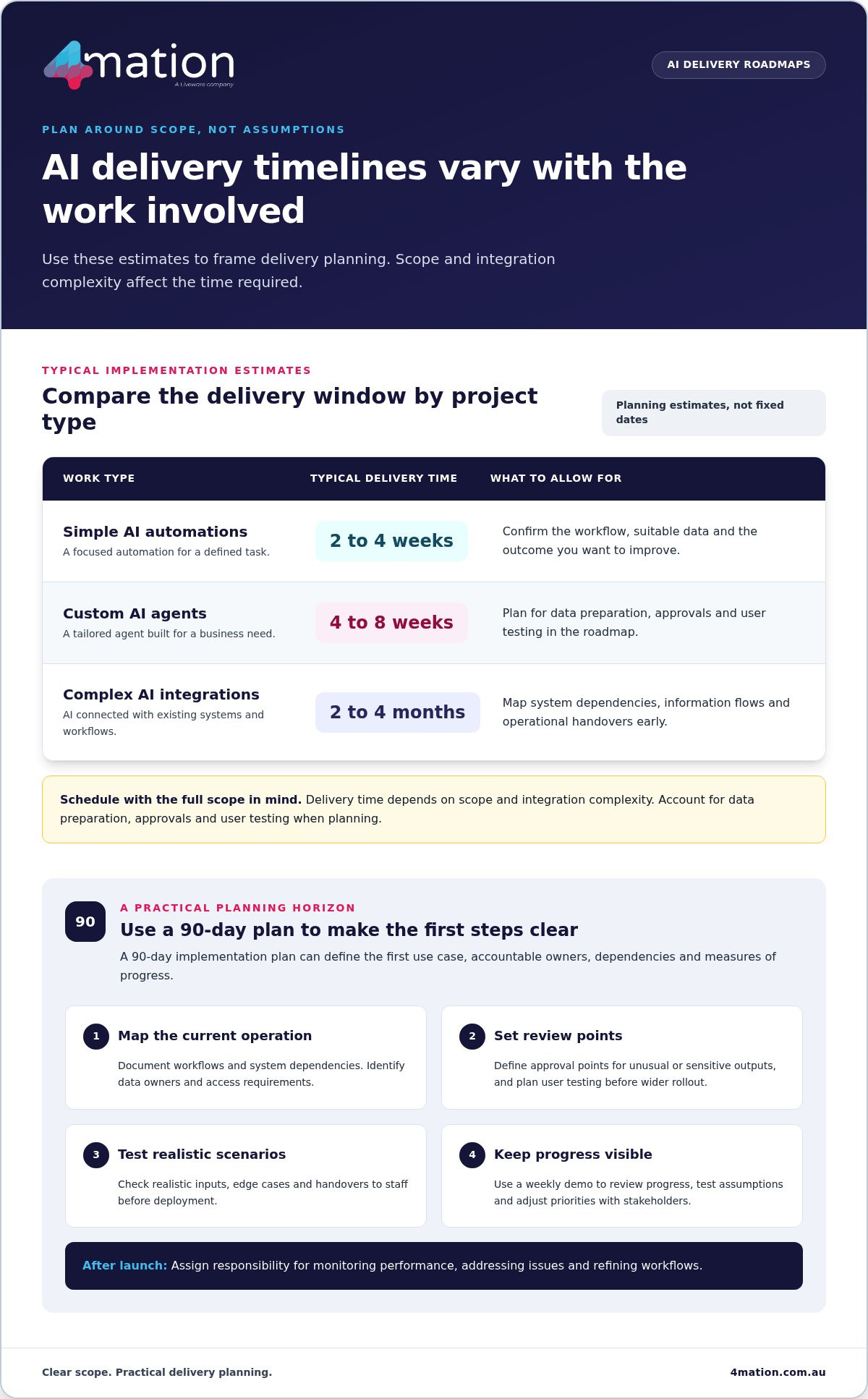
A useful AI strategy turns business priorities into sequenced delivery, not an unbounded technology project. A 90-day implementation plan can define the first use case, accountable owners, dependencies and measures of progress.
Enterprise AI integration
Enterprise implementation must account for how AI connects with existing systems and workflows. Map where information starts, where decisions happen and which systems need updates. For example, a customer service tool may need to draw on approved business information and pass complex enquiries to staff. This exposes integration dependencies before development begins.
Assess data quality, access controls, system interfaces and exception handling, then define a limited release to test the workflow with real users. A roadmap should show how each integration supports the business outcome, who owns decisions and what must be ready before deployment. This helps coordinate technology work with operational change.
- Document current workflows and system dependencies.
- Identify data owners and access requirements.
- Set approval points for unusual or sensitive outputs.
- Plan user testing before wider rollout.
Timelines and ROI measurement
Delivery time depends on scope and integration complexity. Simple AI automations typically take 2 to 4 weeks to implement. Custom AI agents typically take 4 to 8 weeks, while complex AI integrations typically take 2 to 4 months. Treat these as planning estimates, then account for data preparation, approvals and user testing in the project roadmap.
Measure ROI against a baseline established before implementation. Track the intended change, such as processing time, manual handling or service consistency, and include ongoing review effort, exception rates and system costs. A weekly demo during delivery gives stakeholders regular opportunities to review progress, test assumptions and adjust priorities.
Quality assurance should test realistic inputs, edge cases and handovers to staff. For a document workflow, test incomplete records and unclear details, then route failures for review rather than automatic processing. After launch, assign responsibility for monitoring performance, addressing issues and refining workflows. This keeps the solution aligned with operational needs as processes change.
A clear strategy connects business goals to implementation decisions and measurable outcomes. If you’re planning an AI roadmap, discuss your project requirements and the workflows you want to improve.
How many AI consulting firms does Sydney have?
RevenueBase’s August 2026 list counted 175 AI consulting firms headquartered in Sydney. That figure indicates a sizeable market, but it doesn’t show which firm suits your project. Compare the proposed work, technical capability and experience with systems like yours. Focus on fit and delivery approach, not directory position alone.
Which Sydney industries benefit most? The strongest candidates are businesses with repeatable tasks, substantial information flows or frequent customer enquiries. For example, a logistics team could assess document processing, while an online retailer could examine common service requests. The deciding factor is the workflow opportunity, not the industry label.
Start feasibility work by examining one existing process from input to outcome. Map the people involved, information used, decisions made and exceptions handled. A document review project, for instance, should account for unclear records and staff approval. This technical assessment helps establish whether AI can support the workflow and where human review remains necessary.
An AI readiness assessment often takes a few weeks. Use it to examine data quality, system access, integration requirements and operational ownership. Then document assumptions, dependencies and the evidence needed for a pilot. If existing data is incomplete or scattered, addressing that constraint may matter more than choosing an AI model.
Scope a fixed proposal around deliverables and boundaries. It should explain the use case, systems involved, responsibilities, testing approach and acceptance criteria. For example, specify whether a pilot handles one document type or several, and how exceptions are reviewed. Pricing depends on scope, data readiness, integration complexity and support requirements, and is provided after a quote request.
A pilot gives your team a controlled way to test the technical approach before wider implementation. Choose one workflow, define a baseline and agree on success measures before development starts. Track the intended change, such as processing time or staff review effort, alongside accuracy and exceptions. Use the findings to refine scope rather than expand automatically.
Engagement timelines depend on the work being assessed, system access and decision-making pace. An AI project can take six months without delivering results if goals remain unclear or approvals stall. Set review points, assign owners and decide what evidence will support continuation. This makes progress visible and helps leaders pause, adjust or proceed based on results.
For a Sydney business comparing firms, request a clear project scope that connects technical tasks with operational outcomes. Check whether the proposed pilot uses your existing workflows, identifies risks and defines how success will be assessed. A grounded feasibility process can help separate a useful opportunity from an idea that needs more preparation.
Privacy and regulatory considerations
AI systems can process personal information, so privacy decisions belong in the design, not just the final review. In Australia, identify what information each model receives, where it goes, who can access it and how long it remains available. A customer support assistant, for example, may encounter names, account details and sensitive messages.
Which risks and limitations should businesses consider? AI outputs can be inaccurate, inconsistent or unsuitable for a particular decision. Poor data quality, inappropriate access and unclear human oversight can also create privacy and operational risks. Define review points before deployment, especially for outputs affecting customers, employees or important decisions.
The federal Privacy Act applies to many private businesses that are APP entities. Businesses with annual turnover of A$3 million or less are generally exempt, although the exemption has exceptions. The Privacy and Personal Information Protection Act 1998 applies to NSW public sector agencies. The Health Records and Information Privacy Act 2002 covers health service providers and organisations handling health information within its scope.
Privacy laws do not create one identical checklist for every organisation. First, map the information used in each AI workflow. Then identify the organisation’s role, the information’s sensitivity and the relevant privacy obligations. A healthcare provider processing patient notes, for instance, needs to consider health information protections alongside its proposed AI use.
From 10 December 2026, covered organisations must describe in their privacy policy how automated decision-making uses personal information. Review AI-enabled decisions against that transparency requirement. If a model helps determine a customer’s next step, document the personal information involved and explain the process clearly in the policy.
Private AI and local language models may help organisations control where information is processed, but “local” alone does not establish privacy compliance. Assess data storage, access permissions, logging, model updates and whether information is retained or used elsewhere. Compare these controls with the workflow’s actual sensitivity and business requirements.
- Classify the information each workflow handles.
- Limit access to people and systems that need it.
- Test outputs using realistic, non-sensitive examples where possible.
- Keep human review for consequential or uncertain decisions.
- Assign an owner to monitor changes and handle incidents.
For an AI system that extracts details from health records, test incomplete entries and incorrect matches before operational use. Route uncertain results to qualified staff rather than relying on automatic decisions. This lets teams assess accuracy and privacy controls together while keeping accountability with people.
Compliance planning should also cover vendors, data flows and system integrations. Record which information moves between tools, what safeguards apply and who responds to errors. These steps help Australian businesses make informed decisions about AI builds without treating model selection as a substitute for privacy governance.
AI consulting companies and their services
Sydney firms differ in technical strengths, industry experience and delivery scope. To identify highly rated options, compare client feedback, previous projects and market presence against your business needs.
AI consulting services
Services can span opportunity assessment, strategy, governance, solution design, implementation and ongoing support. A finance team, for example, might need help assessing document workflows before integrating AI with existing systems. Clarify whether an engagement ends with recommendations or includes delivery, testing and operational support.
Ask how the proposed work will support a specific decision or outcome. A useful scope connects the business problem to the data, infrastructure and people involved. It should also explain how success will be assessed, who owns governance and what happens when an AI system produces an uncertain result.
Expertise and industry focus
Compare firms by the work they can demonstrate, not broad claims about AI expertise. Review client feedback, previous projects and market presence, then consider how closely their experience matches your industry and technical environment. A team familiar with finance workflows may understand document controls, while another may focus on customer-facing applications.
Industry knowledge matters because operational requirements differ. Healthcare, for instance, handles sensitive information, while a retailer may prioritise customer service and product data. Ask how the firm would assess your workflows, systems and governance needs. A relevant example should show the problem, approach and outcome.
Before choosing an engagement, clarify whether you need strategic advice, technical development or both. A strategy-only project can help prioritise opportunities; implementation must also address integrations, testing and staff adoption. For enterprise work, check how the proposed solution fits your infrastructure and existing governance processes.
Compare proposals by their assumptions and boundaries. Look for clear deliverables, decision points, responsibilities and a method for measuring results. For example, if a firm proposes an AI assistant for customer enquiries, establish which requests it handles, when people take over and how performance will be reviewed.
Reviews can help you understand client experience, but they don’t replace a close look at relevant work. Read feedback alongside project examples and the firm’s stated industry focus. Check whether those examples demonstrate delivery, governance and support, rather than only an initial concept or demonstration.
For your shortlist, record each firm’s service scope, industry experience, technical fit and approach to governance. This makes it easier to compare the actual work proposed and choose an engagement that matches your business priorities. Discuss your AI consulting requirements to explore a practical next step.
4Mation: Custom Software Development
4mation Technologies helps businesses turn AI opportunities into practical, tailored software solutions. Its Custom Software Development and AI Consulting & Implementation can support you when off-the-shelf approaches don’t fit your workflows or existing systems.
Start with the business outcome you want, such as reducing manual processing or improving customer experience. Together, you can assess the opportunity, shape an approach around your requirements and decide whether custom development, a web application or a mobile app best fits the need. This keeps the technology aligned with how your organisation works.
If you’re ready to explore an AI opportunity or scope a software project, contact 4mation to discuss your requirements.
Turn your AI opportunity into a practical next step
Move from interest to a decision by defining the business outcome you want to improve. For teams considering AI consulting in Sydney, a concise project brief can bring the right people together around the problem, the users affected and the change that would make a difference. It also gives your team a shared basis for discussing priorities and delivery.
4mation can work with you on AI Consulting & Implementation, Custom Software Development or Mobile App Development, depending on what your business needs to deliver. The right starting point may be advice, a tailored software solution or an application designed around a specific user journey. Keep the focus on fit with your organisation, rather than adding technology without a clear purpose.
Bring your goals and current challenges into an initial discussion. Together, you can explore a practical way forward for your business and its users. Contact 4mation about AI consulting to discuss your project. A considered first step can help your team build with purpose and confidence.
Frequently Asked Questions
How much does it cost?
The total depends on the engagement and is quoted after a request. For budgeting, separate the estimate into advice, software work, integration, validation and post-launch support. Ask which activities each stage includes and what would trigger a scope change. This gives finance and technology leaders a clearer view of how project decisions affect the overall investment, without treating an early estimate as a final commitment.
Looking for the Right AI Consulting Partner in Australia?
Look for a partner who will work within your organisation’s decision-making and delivery arrangements. Before an engagement begins, clarify who owns the resulting software, how your team receives technical documentation and what happens at handover. For example, nominate an internal product owner to approve priorities and a technology lead to coordinate access. These arrangements help your organisation retain context and manage the work after external specialists finish.
When Should You Hire an AI Consultant?
Consider engaging an AI consultant when a planned business change raises questions your team cannot resolve with its current expertise. A new customer portal, system replacement or expanding service operation may raise questions about where AI belongs. An adviser can help your leaders assess those choices before they become delivery decisions. Include a business owner and a technology representative so commercial goals and practical constraints both shape the recommendation.
What AI consulting services are available in Sydney?
Services may range from strategic advice to the design and delivery of AI-enabled software. A business seeking direction may need an assessment and prioritised recommendations, while a team with an approved use case may need a prototype or integrated application. The distinction matters: recommendations inform a decision, while implementation creates a system your staff can use. Agree on the intended output before choosing the engagement.
How much do AI consultants in Sydney charge?
Consultant charges depend on the work and are provided after a quote request. Clarify whether the proposal uses a fixed scope, staged work or time-based billing, and how it treats changes requested during delivery. Ask what responsibilities and outputs apply to each stage. This helps your finance team compare proposals on commercial terms, rather than headline fees that may cover different work.
How can a Sydney business choose an AI consultant?
Test the working relationship before committing to a larger engagement. Ask the proposed team to explain a technical recommendation in plain language, then describe its effect on staff and customers. Check that business and technology decision-makers can follow the reasoning and challenge assumptions. A clear explanation shows whether the team can connect technical choices with commercial priorities and communicate effectively with those responsible for delivery.
What are the steps to implement AI with a consulting firm?
After agreeing on the intended solution, prepare your organisation for day-to-day use. Assign a business owner, define who can access the system and document how staff should handle unusual outputs. Brief affected teams on what the tool does and where their judgement remains necessary. Set a process for reporting issues and approving changes. These arrangements help users adopt the solution consistently after it enters service.
About The Author
