AI Integration Guide for Australian Organisations
Michael CaliHead of Marketing
Michael is passionate about showcasing what is truly possible when you partner with us. With data-driven insights, he boosts our exposure to Australian businesses that share our commitment to being at the forefront of tech innovation. His main goal is connecting our team with the market of innovators to deliver software ‘magic’!

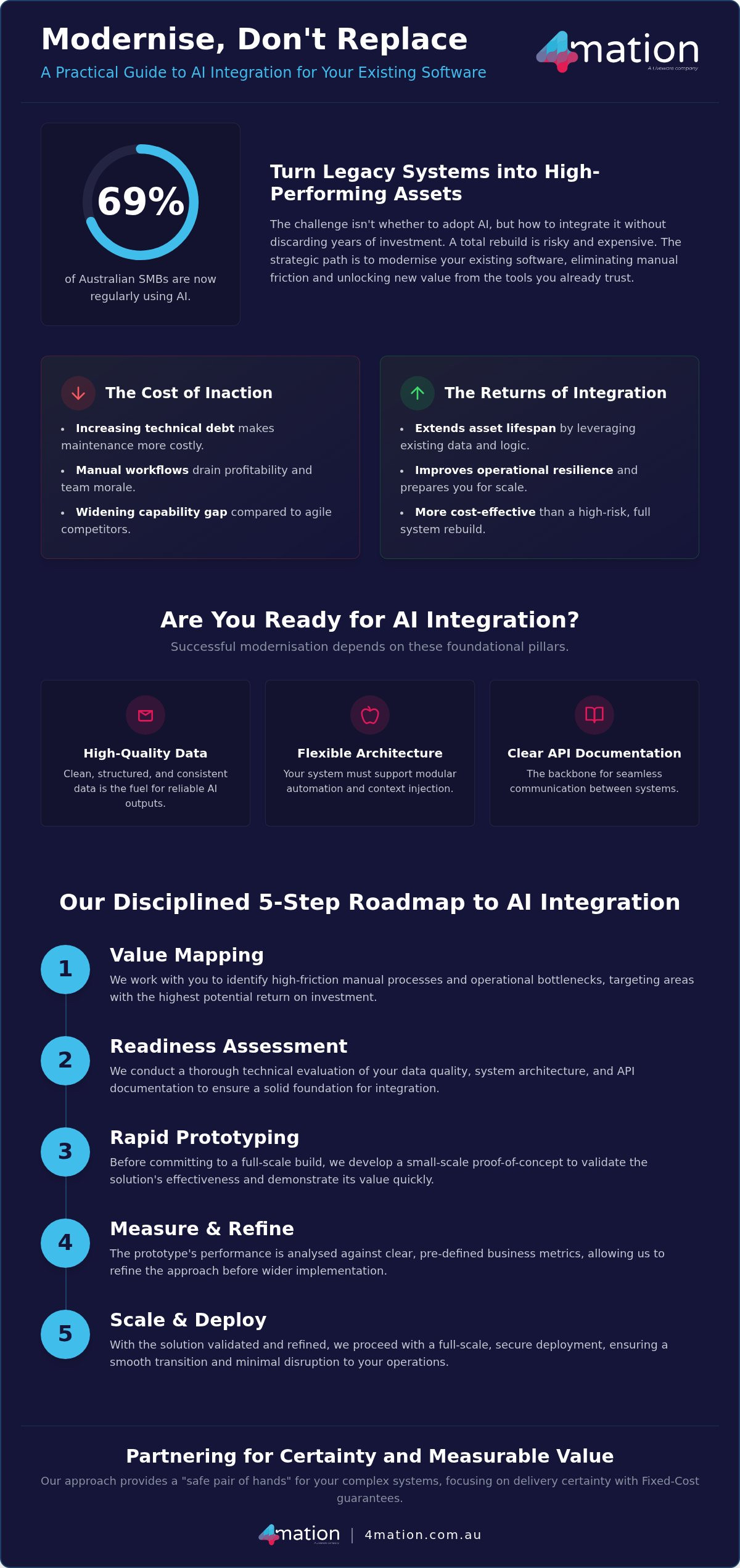
With 69% of Australian small to medium businesses now using AI regularly, the question for most executives is no longer if they should adopt the technology, but how to do it without discarding years of investment in their current systems. You’ve likely felt the frustration of manual processes slowing your team down, yet the prospect of a complete platform replacement feels both risky and prohibitively expensive. The most effective path forward isn’t a total rebuild; it’s a strategic approach to AI integration for existing software that turns your legacy tools into high-performing assets.
We understand that you need measurable results rather than technical experiments. You’re looking for a way to reduce operational friction and improve customer experiences while maintaining the stability your business relies on. This guide provides a practical roadmap to modernise your operations, ensuring you meet upcoming transparency requirements under the Privacy and Other Legislation Amendment Act 2024 before the December 2026 deadline. We’ll show you how to move from manual workflows to automated, intelligent operations that deliver a clear return on investment and a competitive edge in the Australian market.
Key Takeaways
- Learn how to identify and eliminate manual friction by modernising your current workflows with practical AI solutions.
- Discover a strategic framework for AI integration for existing software that extends the lifespan of your technology assets without the risk of a total rebuild.
- Understand the critical factors of software readiness, including data quality and API documentation, to ensure a seamless and secure implementation.
- Follow a disciplined 5-step roadmap, starting with value mapping and rapid prototyping, to validate your AI investments before full-scale deployment.
- Find out how partnering with an experienced local team provides delivery certainty through Fixed-Cost guarantees and a focus on measurable business value.
Beyond the Hype: Why Integrate AI into Your Existing Systems?
Maintaining manual, high-friction workflows carries a hidden cost that often outweighs the price of technology upgrades. Every hour your team spends on repetitive data entry or manual reconciliation is an hour lost to higher-value strategic work. While many leaders feel pressured to chase the latest trends, our focus remains on “Practical AI”. This means identifying specific operational bottlenecks and solving them with targeted technology. By prioritising AI integration for existing software, you can breathe new life into your current platforms without the disruption of a full-scale replacement.
Identifying Real-World Business Friction
To find the highest ROI, look for areas where your team is bogged down by repetitive tasks. This often includes manually analysing unstructured data from emails or invoices, which leads to significant bottlenecks. When customer response times lag because staff are cross-referencing multiple screens or hunting for information, you’ve found a prime candidate for AI systems integration. These friction points aren’t just inconveniences; they’re direct drains on your profitability and team morale.
We work with you to map these friction points and translate them into technical requirements. For instance, automating data extraction can reduce manual processing time by hours each day, allowing your staff to focus on complex problem-solving. If you’re unsure where to start, our AI consulting services help define a clear path toward measurable outcomes rather than speculative experiments. Together, we ensure every technical decision serves a commercial purpose.
The Cost of Inaction: Technical Debt vs. Modernisation
Choosing to delay modernisation doesn’t just stall growth; it actively increases your technical debt. As your competitors adopt more efficient workflows, legacy systems that lack intelligent automation become harder and more expensive to maintain. This burden creates a widening gap between your current capabilities and market expectations. However, you don’t always need to start from scratch. Modernising your existing assets is frequently more cost-effective than a total system rebuild, as it leverages the data and logic already built into your business over many years.
Modernising legacy software with AI is an investment in operational resilience, not just a technical upgrade. By integrating intelligent layers into your current tools, you ensure your technology remains a foundational business asset rather than a liability. This approach provides a “safe pair of hands” for your complex systems, allowing you to scale operations while keeping delivery risks low. Strategic AI integration for existing software ensures your organisation remains agile, stable, and ready for future growth.
Assessing Your Software Readiness for AI Integration
Successful modernisation doesn’t happen by accident. It requires a clear understanding of your current technical state. We define AI readiness as the intersection of high-quality data, architectural flexibility, and commercial alignment. Without these pillars, even the most sophisticated approach to AI integration for existing software will fail to deliver measurable business value.
Up-to-date API documentation is the backbone of a seamless transition. It allows different systems to communicate effectively without manual workarounds or fragile custom code. You must also evaluate whether your current infrastructure can handle the latency of real-time AI model calls. With newer flagship reasoning models like GPT-5.6 Sol requiring more processing time than their predecessors, slow response times can quickly degrade the customer experience you’re trying to improve. We help you navigate these technical trade-offs to find the right balance between model power and system performance.
Evaluating Legacy Architecture and Data Quality
Determining if your database structure can support context injection is a vital first step. This involves feeding specific business data into a model to ensure the output is relevant and accurate. Clean, structured data is the fuel for this process. If your data is siloed or inconsistent, the AI’s reliability will suffer. We recommend identifying specific modules that can be isolated for AI interaction. This modular approach to AI integration for existing software allows you to automate specific functions while minimising risk to your core system. If you’re ready to audit your internal systems, our AI Readiness: 2026 Checklist provides a structured way to evaluate these technical requirements.
Security and Governance in the Australian Landscape
For Australian organisations, data sovereignty and privacy are non-negotiable. With the new transparency requirements under the Privacy and Other Legislation Amendment Act 2024 taking effect on 10 December 2026, you must ensure your AI use is fully disclosed and compliant. Secure enterprise implementation protects your intellectual property by ensuring your data isn’t used to train public models. Following a framework like the AI Guide for Government can help establish the necessary governance structures for your internal policies.
4mation’s status as an Advanced Supplier in the NSW Government ICT Services Scheme reflects our commitment to these high standards of security and reliability. We work with you to ensure your transformation is both ambitious and safe. If you have concerns about your current system’s compatibility, chat with our team for a pragmatic assessment of your infrastructure. We’ll help you determine if your current setup is ready for the next step or if some foundational work is required first.
Strategic Integration Patterns: Finding the Right Fit
Selecting the correct pattern for AI integration for existing software is a commercial decision as much as a technical one. We believe that successful implementation starts with Solution Design, a critical phase where we align technology choices with your specific business goals. This disciplined approach ensures you don’t just add technology for its own sake, but rather build a system that delivers a measurable return on investment. The choice typically falls between treating AI as a specific feature or embedding it as a core capability across your entire workflow.
Choosing a pattern requires balancing speed, control, and budget. While third-party APIs from providers like OpenAI or Google offer rapid deployment, bespoke model development provides a unique competitive advantage for businesses with proprietary logic. We work with you to analyse these trade-offs, ensuring your choice supports long-term stability and scalability. By focusing on outcomes first, we help you navigate the technical ambiguity that often stalls modernisation projects.
Feature-Based Integration for Quick Wins
For many Australian organisations, adding AI as a feature is the most practical entry point. This involves integrating isolated tools into your current dashboard, such as a “summarise” button for long reports or an intelligent assistant to handle initial customer queries. These targeted additions provide immediate value with minimal disruption to your core architecture. Because these features are contained, they represent a low-risk way to prove the value of AI to your stakeholders before committing to larger transformations. You can explore how these tools function in practice through our specialised AI Agents and Chatbots services.
Bespoke vs. Off-the-Shelf AI Solutions
Rapid deployment is often best achieved by using existing models via API. With the release of flagship models like GPT-5.6 Sol in July 2026 and efficient alternatives like Gemini 3.6 Flash, you have access to immense reasoning power without the need for internal model training. However, if your business relies on highly specialised data or unique processes, a custom-built AI application may be necessary to protect your market position. This bespoke approach ensures the AI understands the nuances of your specific industry and operates within your exact parameters. To help you decide which path fits your current needs, we recommend reviewing our Generative AI Business Solutions Strategy, which outlines a pragmatic framework for Australian organisations in the current market.
A disciplined execution plan is what separates successful modernisation from failed technical experiments. We follow a structured roadmap designed to provide clarity and control at every stage. This process ensures that AI integration for existing software remains focused on solving your specific commercial challenges while minimising operational disruption.
- Step 1: Discovery and Value Mapping. We work with you to identify the specific workflows where automation will drive the most significant impact.
- Step 2: Proof of Concept (PoC). We validate your assumptions with a rapid, low-cost prototype before committing to full-scale development.
- Step 3: Data Preparation and Security Layering. We ensure your data is structured correctly and protected by enterprise-grade security to meet Australian privacy standards.
- Step 4: Integration and Iterative Deployment. We carefully graft the AI capabilities into your live ecosystem in manageable, low-risk stages.
- Step 5: Monitoring and Continuous Improvement. We track real-world performance and refine the system to ensure it continues to deliver value as your business evolves.
Defining Success Metrics and Commercial ROI
Measuring success requires looking beyond technical uptime. You need to know how the integration affects your bottom line and team productivity. We prioritise metrics that reflect actual business outcomes, such as a reduction in manual data entry errors or a decrease in the time taken to process complex customer enquiries. The only metric that matters in AI integration is the measurable improvement in your business operations. By establishing these benchmarks early, we ensure every technical milestone translates into a commercial win for your organisation.
Prototyping and Reducing Delivery Risk
The greatest risk in any software project is technical ambiguity. To mitigate this, we utilise a Rapid Prototype to test the core logic of your solution in a controlled environment. This approach allows us to uncover potential hurdles early and refine the user experience without significant upfront investment. Our Fixed-Cost guarantee provides additional certainty, ensuring your project stays on time and on budget. Moving from a successful PoC to a full integration becomes a predictable journey rather than a leap of faith.
If you’re ready to see how this roadmap applies to your specific systems, contact our team today to discuss your goals. Together, we’ll map out a path that delivers immediate value while future-proofing your technology assets.
Partnering for Certainty: The 4mation Approach
Choosing a technology partner is about more than technical skill; it’s about reliability and accountability. With 25 years of experience in the Australian market, 4mation provides a stable, local hand to guide you through the complexities of modernisation. We understand that executives face significant delivery risk when investing in new technology. To address this, we offer a Fixed-Cost, on-time, on-budget, and bug-free guarantee that removes the financial ambiguity often associated with custom software. Our approach to AI integration for existing software is built on this foundation of certainty, ensuring your project is a commercial success rather than a technical experiment.
We pride ourselves on a “Business-First” methodology. This means we start with your specific goals and operational challenges rather than just the technology itself. Our end-to-end capability allows us to support you from the initial strategy and design phases through to implementation and long-term maintenance. We position ourselves as a strategic ally, valuing long-term stability and measurable success over fleeting trends. This holistic view ensures that your integration is not a standalone tool, but a foundational asset that grows alongside your organisation.
Practical AI Focused on Your Outcomes
We work with you to solve complex problems through bespoke software solutions that deliver immediate value. By focusing on defined business problems, we’ve helped organisations like Ego Pharmaceuticals and Beatbox Music transform their operations and eliminate manual friction. We don’t believe in adding complexity for its own sake; every technical decision must serve a clear commercial purpose. You can explore the measurable results we’ve achieved for our partners in our case studies, where we demonstrate how we translate technical capabilities into operational advantages.
Long-Term Reliability and Technical Insurance
A successful launch is only the beginning of your modernisation journey. To maintain peak performance, your AI-enabled systems require proactive monitoring and consistent support. Our Managed Services and Technology Support act as technical insurance for your investment, ensuring high uptime and operational resilience. We monitor your infrastructure to identify and resolve potential issues before they impact your team or your customers. This ongoing commitment provides the peace of mind you need to scale your operations with confidence.
If you’re ready to move beyond the hype and start driving real business value, contact our team for a consultation. Together, we’ll build a practical, low-risk roadmap that delivers the AI integration for existing software your organisation needs to thrive in a competitive market.
Secure Your Competitive Advantage Through Practical Modernisation
Strategic AI integration for existing software is the most effective way to eliminate manual friction while protecting your long-term technology investments. By following a disciplined roadmap, you can move away from repetitive, high-cost workflows and toward a more agile, automated operation. We’ve seen that the most successful organisations don’t just chase trends. They focus on measurable outcomes that improve both team productivity and customer experiences.
With 25 years of experience delivering bespoke software for Australian organisations, 4mation acts as a safe pair of hands for your complex systems. As an Advanced Supplier in the NSW Government ICT Services Scheme, we provide the stability and accountability you need to innovate with confidence. Our Fixed-Cost, on-time, on-budget, and bug-free guarantee ensures your project stays on track and delivers the results you expect. You don’t have to navigate technical ambiguity alone.
Solve your complex business problems with 4mation’s practical AI solutions and start your journey toward a more efficient, future-proof business today.
Frequently Asked Questions
Is it secure to integrate AI into my existing business software?
Yes, integration is secure when you utilise private enterprise instances where your data isn’t used to train public models. We prioritise data sovereignty for Australian organisations to ensure compliance with the Privacy Act. By layering security protocols and using secure API connections, you can automate operations without exposing sensitive intellectual property. Our status as an Advanced Supplier in the NSW Government ICT Services Scheme reflects our rigorous approach to protecting your business assets.
How much does AI integration for existing software usually cost?
Costs vary based on the complexity of your current architecture and the specific outcomes you’re targeting. We provide a Fixed-Cost guarantee to ensure delivery certainty and prevent budget overruns. Instead of a single upfront fee, we recommend starting with a discovery phase and a rapid prototype. This approach allows you to validate the commercial value of AI integration for existing software before committing to a larger investment in full-scale modernisation.
How long does it take to add AI capabilities to a legacy system?
A typical integration follows a phased roadmap. A Proof of Concept often takes between four to six weeks to validate the core logic and assumptions. Full-scale deployment depends on the depth of the integration, but most organisations see measurable results within three to six months. We work with you to identify quick wins that provide immediate relief from manual friction while building toward long-term, workflow-wide capabilities that scale with your business.
Do I need to replace my whole software system to use AI?
No, you don’t need to replace your entire system. The primary goal of AI integration for existing software is to modernise your current assets by adding intelligent layers. We use APIs and microservices to graft AI capabilities onto your legacy platforms. This method extends the lifespan of your software and avoids the high cost and significant delivery risk associated with a total system rebuild, allowing you to maintain operational stability.
What kind of data do I need for successful AI integration?
Successful integration requires clean, accessible data, but it doesn’t all have to be perfectly structured. AI excels at processing unstructured information like emails, PDFs, and call transcripts. However, the quality of your underlying database determines the accuracy of the model’s outputs. We help you evaluate your data readiness and implement the necessary security layering to ensure your information is both useful for the AI and safe from external threats during the process.
Can AI integration help with manual data entry and processing?
Yes, reducing manual processing is one of the most immediate benefits of this technology. AI can automatically extract data from invoices, categorise customer enquiries, and update your records without human intervention. This shift allows your team to move away from repetitive, low-value tasks and focus on complex problem-solving. By automating these high-friction workflows, you improve operational speed while significantly reducing the risk of human error across your entire organisation.
How do I measure the ROI of an AI integration project?
You should measure ROI by tracking specific operational improvements rather than just technical performance. Look for metrics such as hours saved per week, a reduction in processing errors, or faster customer response times. We help you establish these benchmarks during the discovery phase to ensure every technical milestone translates into a commercial win. The ultimate goal is to achieve a measurable return through increased productivity and improved customer experiences that justify the investment.
What is the difference between an AI chatbot and deep system integration?
An AI chatbot is typically a surface-level tool designed for communication, while deep system integration embeds AI into your core workflows. Deep integration allows the AI to take action, such as updating databases or triggering business processes based on the data it analyses. While a chatbot can be a practical entry point, deep integration provides the workflow-wide capabilities needed to transform your legacy systems into high-performing, automated business assets that drive long-term value.
About The Author
