Custom Software Business Case: Australian Executive Guide
Edward WongHead of Pre-Sales Engineering
With over 20 years in the software development industry in both technical and leadership roles, Edward brings a wealth of experience to the 4mation team.
He is passionate about helping people succeed and empowering people to step up and show how awesome they can be.

The most expensive software your organisation will ever use isn’t the bespoke platform you build; it’s the off-the-shelf subscription that forces your staff into manual workarounds. While Australian IT spending is forecast to climb to $172.3 billion in 2026, many executives still struggle to justify the upfront cost of tailored solutions over the recurring technical debt of legacy systems. You’ve likely felt the frustration of trying to quantify the ROI of a more efficient workflow when the benefits seem intangible to a commercially focused board.
We understand that building a business case for custom software is less about explaining the code and more about demonstrating risk-controlled growth. You need a framework that translates technical requirements into measurable commercial value to secure funding and executive buy-in. This guide provides a clear roadmap for navigating that process with confidence. We’ll show you how to calculate the true cost of operational friction, leverage Australian R&D tax incentives, and present a delivery timeline that eliminates the anxiety of buyer’s remorse before the project even begins.
Key Takeaways
- Quantify the hidden financial impact of manual workarounds and legacy system friction on your organisation’s bottom line.
- Apply a rigorous build-versus-buy framework to determine if off-the-shelf subscriptions or bespoke platforms offer the best long-term total cost of ownership.
- Learn a proven methodology for building a business case for custom software that translates technical requirements into tangible ROI and revenue growth.
- Draft a compelling executive summary that clearly defines project scope and secures board-level confidence through commercial clarity.
- Mitigate delivery risk by selecting a local partner that provides fixed-cost certainty and a disciplined, outcome-oriented development process.
Identifying the Commercial Cost of the Status Quo
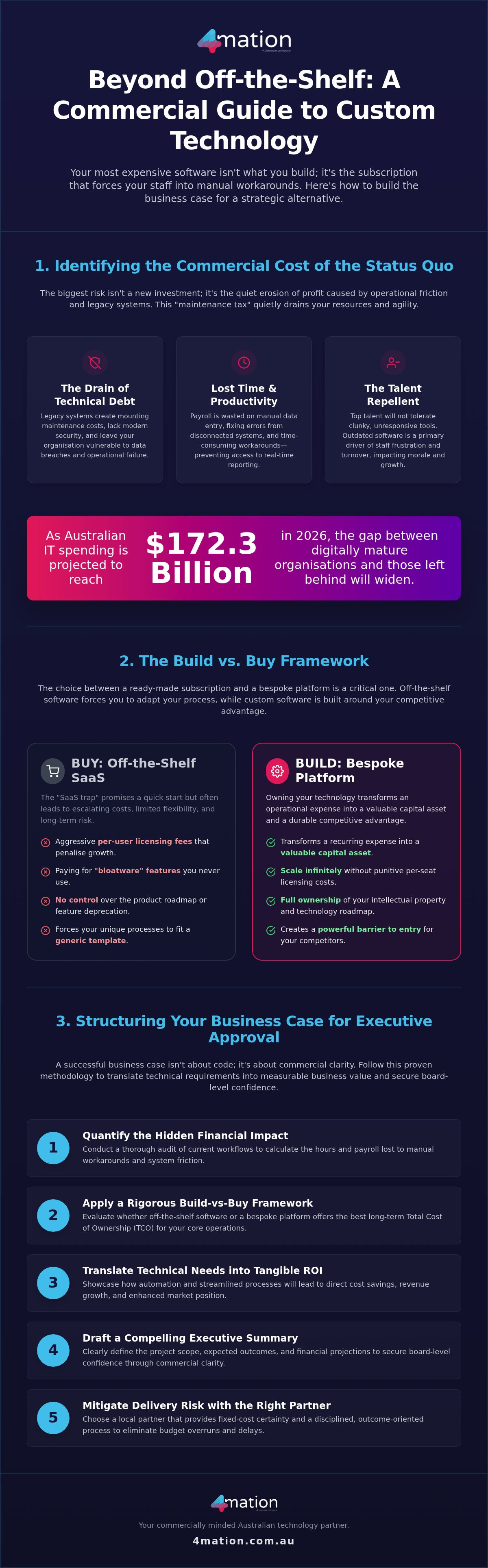
The most significant risk to your organisation’s growth isn’t a bold new investment; it’s the quiet erosion caused by the status quo. Many Australian executives view technology as a line-item expense, yet they often overlook the "maintenance tax" inherent in legacy systems. When you start building a business case for custom software, your primary objective is to expose the true cost of these inefficiencies. If your operations rely on manual workarounds or fragile spreadsheets, you’re losing more than just time; you’re losing the ability to scale in a market where agility is a prerequisite for survival.
The Hidden Drain of Technical Debt
Technical debt is the interest your business pays on past decisions to prioritise speed over stability. In a commercial context, it’s the mounting cost of maintaining legacy systems that no longer support your growth. These platforms often lack modern security protocols, leaving you vulnerable to threats that could compromise your data. Beyond the risk, outdated software is a primary driver of staff turnover. Top talent won’t stay in an environment where their productivity is throttled by clunky, unresponsive tools that make their daily tasks unnecessarily difficult.
Mapping Operational Inefficiencies
Identifying "dead time" starts with a thorough audit of your current workflows. You might find that a significant portion of your payroll is spent on manual data entry or fixing errors caused by disconnected silos. These inefficiencies prevent your leadership team from accessing accurate, real-time reporting. While structuring your business case, it’s essential to frame these issues as commercial liabilities. Quantifying the hours lost to these workarounds allows you to demonstrate how custom software development turns wasted effort into streamlined, automated value.
Delaying transformation doesn’t just stall progress; it creates an opportunity cost that your competitors will happily exploit. As Australian IT spending is projected to reach $172.3 billion in 2026, the gap between digitally mature organisations and those tethered to legacy systems will only widen. If you wait until your legacy systems fail completely, you won’t be investing in growth; you’ll be paying a premium for emergency repairs. By building a business case for custom software now, you position your organisation to capture market share while others are still wrestling with their spreadsheets.
The Build vs Buy Framework: Choosing the Right Path
Deciding between a ready-made subscription and a bespoke platform is one of the most consequential choices an executive can make. While off-the-shelf software promises a faster start, it often forces your business to adapt its unique processes to fit a generic template. When you’re building a business case for custom software, you must evaluate whether your core operations are a standard utility or a competitive differentiator. If your workflow is what sets you apart in the Australian market, buying a solution used by your competitors may actually erode your advantage.
When Off-the-Shelf SaaS Falls Short
The allure of low entry costs in Software-as-a-Service (SaaS) can quickly lead to the "SaaS trap." As your team grows, per-user licensing fees scale aggressively, often outstripping the actual value provided. Many organisations find themselves paying for "bloatware" features they never use while still needing expensive, brittle customisations to handle their specific requirements. You also lose control over the product roadmap. If the vendor decides to deprecate a feature your business relies on, you’re left with little recourse and significant operational risk. This lack of agility can be a silent killer for growth-focused companies.
The Strategic Value of Bespoke Intellectual Property
Owning your technology transforms a recurring operational expense into a valuable capital asset. Bespoke platforms allow you to scale your operations infinitely without the friction of per-seat costs. This ownership is a primary factor when Quantifying the ROI of bespoke software, as it directly impacts your company’s valuation. By securing your unique business logic within your own IP, you create a barrier to entry for competitors that a subscription model simply cannot provide.
Our custom software development experts specialise in identifying these high-value opportunities where ownership trumps a temporary fix. We help you move beyond the limitations of third-party software to build a foundation that is entirely your own. If you’re currently weighing up the long-term costs of a new subscription versus a tailored build, reach out to our team for a pragmatic assessment of which path best serves your commercial goals. Building a business case for custom software is ultimately about choosing the path that offers the highest degree of delivery certainty and long-term financial health.
Quantifying the ROI of Bespoke Software and AI
Translating technical vision into a commercial balance sheet is the most critical step in building a business case for custom software. While the previous sections focused on identifying friction and choosing the right path, this stage requires a disciplined look at how a tailored solution actively generates value. Quantifying the ROI of bespoke software typically reveals two primary value drivers for Australian organisations: the radical reduction of operational overheads and the opening of new, high-margin revenue streams. By automating high-frequency tasks, you don’t just save time; you reallocate your most expensive resource, your people, to activities that drive growth.
AI-Driven Efficiency: The New ROI Multiplier
In 2026, a business case that ignores artificial intelligence is incomplete. Our AI consulting process helps you identify specific high-throughput targets where automation can achieve the greatest impact. For instance, deploying bespoke AI agents can reduce customer support overheads by handling routine enquiries with human-like precision, allowing your team to focus on complex problem-solving. Beyond support, integrating predictive analytics into your core software enables more accurate resource management and inventory forecasting, directly improving your bottom line by reducing waste and capital tie-up.
Beyond the Dollars: Intangible Benefits
Not every return on investment appears as a direct credit to your bank account. The soft benefits of bespoke technology often have the most profound long-term impact on your organisation’s health.
- Employee Retention: Providing staff with modern, intuitive tools reduces the daily frustration that leads to burnout and turnover.
- Data Integrity: Custom platforms eliminate the dirty data inherent in manual entry, providing the board with a single, accurate source of truth for faster decision-making.
- Brand Authority: A seamless, modern UX improves customer loyalty and reinforces your position as a market leader in a way that generic, clunky portals never can.
Finally, your business case must account for the reduction of risk. With new mandatory disclosures for automated decision-making starting in December 2026 and updated cybersecurity standards for smart devices commencing in March 2026, a bespoke platform offers the control necessary to ensure total compliance. Building your own technology allows you to bake these Australian regulatory requirements into the architecture from day one, avoiding the compliance tax of retrofitting off-the-shelf solutions. When building a business case for custom software, frame these avoided costs as a proactive shield for your organisation’s reputation and capital.
Structuring Your Business Case for Executive Approval
A well-structured document is the bridge between a technical vision and a funded project. When building a business case for custom software, your goal is to provide the board with a high degree of confidence in the commercial outcomes. Executives aren’t looking for a list of features; they’re looking for proof that the investment will be managed with discipline and deliver a measurable return. This requires a narrative that moves from the business challenge to a clearly defined, risk-mitigated solution.
The Executive Summary: Your "Shop Window"
Your executive summary is the most influential part of the proposal. It must lead with the primary business problem and the mounting cost of inaction. By summarising the solution alongside 4mation’s fixed-cost, on-time, and on-budget guarantee, you alleviate the common fear of budget blowouts. Focus on a primary measurable outcome, such as a projected 20% reduction in operating expenses (OPEX). This clarity allows the board to see the project as a strategic asset rather than a technical burden.
Clarity on project scope is equally vital. You must explicitly state what is "out of scope" to prevent the feature creep that often derails large-scale investments. Pair this with a detailed financial analysis that covers the total cost of ownership (TCO) and clear ROI timelines. This level of detail shows that you’ve considered the long-term sustainability of the platform beyond the initial deployment phase.
Framing Risk for a Risk-Averse Board
Boards are often wary of software projects due to historical data, such as the Standish Group statistics that highlight high failure rates in the IT industry. You can counter this by presenting a robust mitigation strategy. Contrast the controlled risks of a bespoke build against the compounding risks of the "Do Nothing" approach, which leaves you vulnerable to legacy failure and market irrelevance. If your internal team lacks specific technical expertise, explain how staff augmentation can bridge those gaps without the overhead of permanent hires.
Our team at 4mation acts as a strategic ally, helping you refine these documents to ensure they resonate with commercially minded stakeholders. If you’re ready to move from a concept to a formal proposal, contact our consultants today to help you build a case that wins board approval. Building a business case for custom software is a journey we take with you, providing the evidence and certainty needed to secure your organisation’s digital future.
Mitigating Delivery Risk with a Strategic Partner
The final hurdle in building a business case for custom software isn’t the "why" or the "how much"; it’s the "who." For an Australian board, the choice of partner is the ultimate risk mitigation strategy. You need more than a team that can write code; you require a strategic ally with the commercial maturity to stand by their delivery promises. Selecting a partner with deep local expertise ensures that your project remains aligned with Australian regulatory standards while benefiting from a disciplined, outcome-oriented development process.
The Fixed-Cost Guarantee: Financial Certainty
Budget overruns are the primary reason executive teams hesitate on bespoke projects. You can eliminate this anxiety by utilising a fixed-cost project model. Unlike the open-ended "time and materials" approach common in many agencies, this model provides total capital protection. It relies on a rigorous solution design phase where every requirement is documented and validated before the first line of code is written. This disciplined preparation allows us to offer an on-time, on-budget, and bug-free guarantee. Presenting this level of financial certainty within your business case transforms the conversation from one of risk to one of controlled investment.
Future-Proofing Your Investment
A software platform is a living asset that requires ongoing attention to remain valuable. Including a plan for technology support and maintenance in your business case addresses the "Technology Insurance" aspect that many guides overlook. This proactive approach ensures that your platform doesn’t slowly degrade into the technical debt you worked so hard to escape. By planning for managed services from day one, you ensure the software scales alongside your business growth, maintaining its performance and security standards over the long term.
Successful transformation is a journey of continuous improvement rather than a single event. As your organisation evolves, your software must adapt to new market opportunities and shifting operational needs. We work with you to establish a roadmap that keeps your technology at the forefront of your industry, ensuring the ROI you calculated during the initial phase continues to compound year after year. Our 25 years of experience as a leading Australian agency provides the "safe pair of hands" your board needs to feel confident in the project’s longevity.
Securing executive buy-in is a complex process, but you don’t have to navigate it alone. We can provide the evidence, technical clarity, and commercial frameworks needed to win board approval. Contact our consultants today to help you start building a business case for custom software that delivers genuine, long-term value for your organisation.
Securing Your Organisation’s Digital Future
Transitioning from a technical vision to a funded reality requires a shift in perspective. You now have the framework to identify the commercial drain of legacy systems and apply a rigorous build-versus-buy analysis to clarify your path forward. By quantifying the ROI of automation and AI modernisation, you transform a technical request into a compelling argument for strategic growth. Success in building a business case for custom software ultimately relies on demonstrating financial certainty and long-term stability to a commercially focused board.
With 25 years of Australian software excellence, 4mation acts as a steady hand for complex projects. We specialise in modernising legacy systems and implementing high-impact AI solutions, backed by a fixed-cost and bug-free guarantee. Our disciplined approach ensures your technology remains a high-value asset rather than a recurring liability. Ready to build your business case? Contact 4mation for a strategic consultation. We look forward to helping you turn your operational challenges into a sustainable competitive advantage.
Frequently Asked Questions
How do I calculate the ROI of custom software for my business?
ROI is calculated by subtracting the cost of development from the total value of efficiency gains and new revenue generated. When building a business case for custom software, focus on quantifying staff hours saved through automation and the reduction of human error. Compare these figures against your current annual expenditure on legacy maintenance and manual workarounds to find your break-even point.
Is bespoke software always more expensive than off-the-shelf solutions?
Not necessarily. While the initial investment for bespoke software is higher, the long-term total cost of ownership is often lower than SaaS subscriptions. Off-the-shelf products carry recurring per-user licensing fees that scale aggressively as your team grows. Custom software is a capital asset that you own, allowing you to scale without additional seat costs or expenses for unnecessary features.
What are the biggest risks in a custom software project and how are they managed?
The primary risks include scope creep and budget blowouts. We manage these through a rigorous solution design phase and a fixed-cost, on-time, on-budget guarantee. By clearly defining what is out of scope and using a local, experienced team, we eliminate the communication gaps and technical debt that often derail offshore or less disciplined projects.
How long does it typically take to see a return on investment?
Most organisations see a full return on investment within 12 to 24 months, though this depends on the project’s scale. High-impact automation can deliver immediate operational savings. When building a business case for custom software, we help you project these timelines based on your specific operational friction and current market conditions.
Can custom software be integrated with our existing legacy systems?
Yes, custom software is often the best way to modernise without a full "rip-and-replace" of legacy systems. We use modern APIs and middleware to integrate new platforms with your existing data silos. This approach allows you to extend the life of your current infrastructure while gaining the benefits of modern automation and improved user experiences.
What happens to the software after the initial build is complete?
After deployment, the software enters a phase of proactive maintenance and support. This ensures the platform remains secure, compliant with Australian regulations, and performant as your data volume grows. We also recommend a roadmap for continuous improvement to keep the technology aligned with your evolving business goals and new market opportunities.
Should I include AI implementation in my initial business case?
You should include AI if it addresses a specific commercial problem, such as high support overheads or inefficient resource allocation. AI agents and predictive analytics act as ROI multipliers by significantly increasing throughput without increasing headcount. We recommend focusing on high-impact, low-complexity AI targets that provide clear, measurable outcomes for the board.
What is the difference between a fixed-cost and an agile engagement model?
A fixed-cost model provides total price certainty for a clearly defined scope of work, which is ideal for securing board approval. An agile model offers more flexibility to change requirements during development but lacks the same upfront budget predictability. 4mation specialises in fixed-cost guarantees to give executives the financial confidence they need for large-scale investments.
About The Author
