Digital Transformation: 2026 Australian Mid-Market Guide
Jowena BorralDigital Marketing Specialist

What if the greatest threat to your growth in 2026 isn’t a new competitor, but the legacy systems currently anchoring your operations? If you’ve felt the frustration of rising costs and manual processes stalling your momentum, you’re certainly not alone. Many Australian executives are rightfully cautious about the latest AI hype, especially if previous technology projects failed to deliver the expected value. You need a digital transformation strategy for mid-market success that prioritises commercial certainty over technical complexity.
We agree that technology should be a foundational business asset, not a source of anxiety. This guide provides a clear, prioritised roadmap to help you modernise operations and integrate practical AI that creates measurable value. We’ll show you how to reduce delivery risk and improve experiences for both your customers and your team. By focusing on functional outcomes rather than just features, you can move forward with the confidence that your investment will yield a genuine competitive advantage. Together, we can turn technical debt into a streamlined, future-proof engine for growth.
Key Takeaways
- Focus on commercial outcomes by shifting from simple digitisation to a strategic modernisation of your core business applications.
- Identify and eliminate the technical debt within legacy systems that often consumes a significant portion of annual IT budgets and stalls growth.
- Build a robust digital transformation strategy for mid-market growth using an evidence-led framework that aligns technology choices with specific business opportunities.
- Reduce delivery risk by adopting a phased roadmap that uses rapid prototyping to validate concepts before you commit to a full-scale build.
- Ensure project certainty by working with an experienced partner who provides a Fixed-Cost guarantee for on-time and bug-free delivery.
Redefining Digital Transformation for the Australian Mid-Market
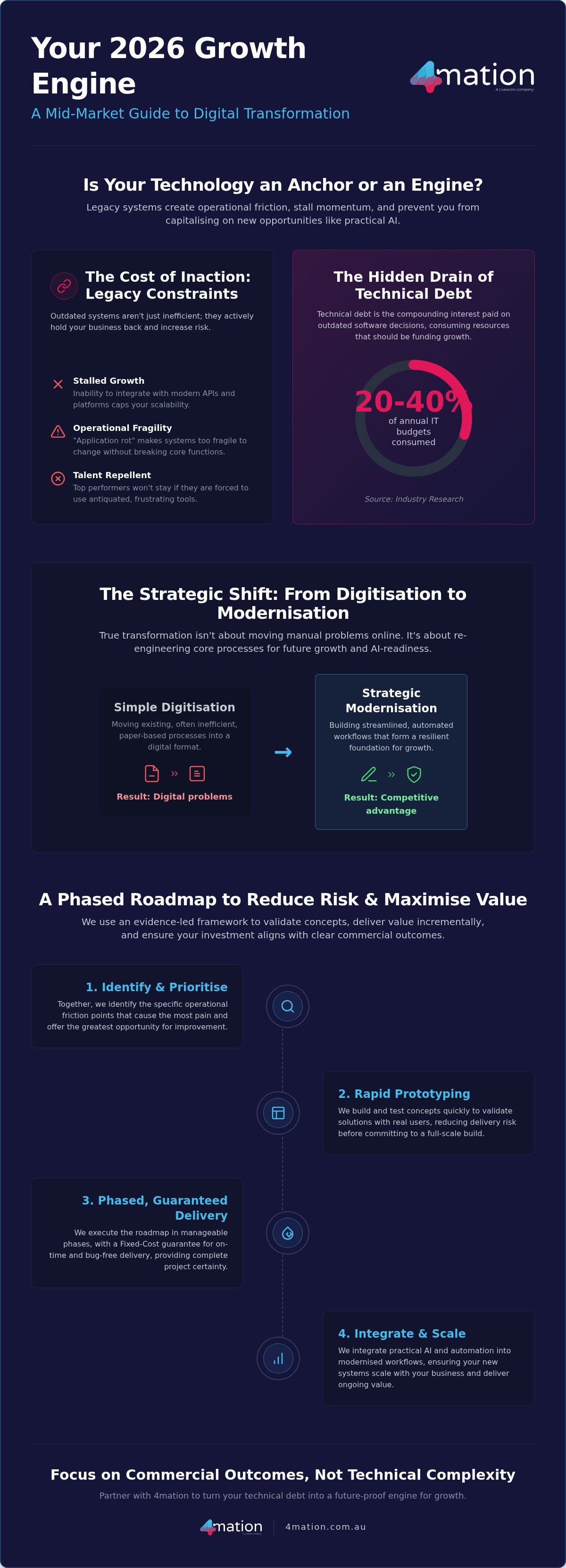
Many executives find the term “digital transformation” frustratingly vague. To understand What is Digital Transformation? in a practical, commercial context, we must view it as a prioritised plan that connects technology directly to your business outcomes. It’s vital to distinguish between simple digitisation, which often just moves manual problems into a digital format, and the strategic modernisation of core business applications. True transformation ensures your systems support future growth rather than acting as a handbrake. Digital transformation in 2026 is the bridge between legacy constraints and AI-enabled scalability.
Developing a successful digital transformation strategy for mid-market organisations requires a more disciplined lens than the one used by startups or massive enterprises. With Australian IT spending predicted by Gartner to surpass AUD 172.3 billion in 2026, the competition for efficiency is accelerating. Startups often begin with a clean slate, while enterprises can afford to absorb the costs of failed experiments. Mid-market firms sit in the “sweet spot” where every investment must be deliberate. You need a strategy that respects your operational history while aggressively pursuing new efficiencies.
The Mid-Market Advantage in 2026
Your size is a significant competitive asset. Unlike enterprise competitors slowed by deep layers of bureaucracy, you can pivot quickly when market conditions change. Success in 2026 comes from choosing high-impact projects that solve specific friction points rather than trying to “boil the ocean.” By investing in custom software development, you create unique competitive advantages that off-the-shelf products simply cannot provide. This focused approach ensures your resources are directed toward the specific workflows that drive the most commercial value for your organisation.
Beyond the Hype: Practical AI as a Strategic Pillar
The era of generative AI experiments is over. Today, the focus has shifted toward practical AI integration that delivers a clear, measurable return on investment. We work with you to identify core workflows where automation can reduce manual effort and improve the speed of decision-making. Implementing AI workplace modernisation does more than just save time. It improves employee retention and productivity by removing the repetitive tasks that lead to burnout. By focusing on ROI-led automation, you avoid the trap of chasing fleeting technology trends and instead build a resilient foundation for long-term growth.
Identifying the Operational Friction: Legacy Systems and Technical Debt
Legacy systems often feel like a safe choice, but they frequently become the primary source of operational friction. We define technical debt as the compounding interest paid on outdated software decisions. Over time, this results in application rot, where your software becomes too fragile to change without breaking core functionality. This decay directly impacts your customer experience, as slow or buggy internal processes eventually manifest as poor service or delayed deliveries.
While industry research suggests technical debt can drain between 20% and 40% of IT budgets annually, the real concern is how it prevents you from executing a digital transformation strategy for mid-market growth. The most common objection we hear is the perceived cost of modernisation. Yet, when you factor in the rising expense of maintaining legacy systems and the productivity lost to manual workarounds, the actual cost of inaction is almost always higher. Using a proven digital transformation strategy framework allows you to identify these costs and prioritise their removal.
Signs Your Organisation is Stalling
An inability to integrate with modern APIs or third-party platforms is a major red flag. If your team relies on spreadsheet silos and manual workarounds to bypass broken workflows, your scalability is capped. This also impacts recruitment. Top-tier talent won’t stay if they’re forced to use antiquated internal tools that hinder their performance. These signs indicate that your technology has transitioned from an asset into a liability.
The Consequence of Technical Debt
Rising maintenance costs for systems that no longer support growth is a primary symptom. You’re paying more just to stand still. There’s also the increased security risk; older software architectures often have compliance gaps that are difficult to patch. Perhaps the most significant loss is the opportunity cost. You can’t effectively deploy AI agents if your data is fragmented across disconnected legacy systems. If you’re unsure where your technical debt is highest, we can help you identify the most critical areas for modernisation.
Addressing these friction points isn’t just about technical cleanup; it’s about reclaiming your capacity to innovate. A well-structured digital transformation strategy for mid-market firms ensures you aren’t just fixing the past but building a platform for the future.
Strategic Framework: Aligning Technology with Commercial Outcomes
Implementing a robust digital transformation strategy for mid-market organisations requires a strict ‘Business-First’ hierarchy. We begin by identifying the critical commercial problems you face, then we uncover the specific opportunities those problems create. Only after defining the desired outcomes do we select the technology required to achieve them. This logical sequence ensures your investment is always driven by commercial necessity rather than technical novelty. We work with you to ensure every dollar spent translates into a tangible business asset.
This strategy must be evidence-led and deeply user-focused. If a new system is difficult to navigate or fails to solve a daily pain point, adoption will stall regardless of the underlying technical merit. Prioritising UX/UI design reduces internal friction and ensures your team actually embraces the new tools. When deciding between ‘Off-the-shelf’ and ‘Custom’ solutions, we help you weigh immediate convenience against long-term scalability. While generic software might solve a standard problem today, custom software provides the unique competitive advantage needed to lead your specific market tomorrow.
Choosing the Right Engagement Model
Financial certainty is paramount for mid-market leaders. Fixed-Cost projects are our gold standard for budget security. They provide a clearly defined scope, timeline, and price, which effectively removes the risk of unexpected cost overruns. For products that require continuous evolution based on real-time user feedback, an ongoing Agile development model offers the flexibility to pivot as your needs change. Alternatively, Staff Augmentation allows you to embed our specialist engineers directly into your team. This model is ideal for accelerating your existing internal roadmaps without the long-term overhead of permanent hiring.
Governance and Measurement
Measurement must be tied to commercial reality rather than technical milestones. We define success through measurable metrics such as revenue growth, significant cost reduction, or verifiable risk mitigation. As your ‘Pragmatic Visionary’ partner, we balance the desire for innovation with the absolute requirement for operational stability. We implement ‘Decision Gates’ at every phase of the project. These gates ensure that each stage of your transformation delivers verifiable value before you commit to the next investment. This disciplined approach keeps your project on track and ensures the final delivery aligns perfectly with your original commercial goals.
Executing the Roadmap: A Phased Approach to Modernisation
Successful execution of a digital transformation strategy for mid-market organisations requires more than just technical skill; it demands a disciplined, phased journey. This approach reduces delivery risk by ensuring every phase of the project provides a measurable return before you move to the next. By following a structured roadmap, we help you avoid the “big bang” failure common in large-scale technology projects.
We work with you through five critical steps to ensure long-term success:
- Discovery & Audit: We identify your core business problems and legacy constraints.
- Rapid Prototyping: We validate ideas with low-risk MVPs before committing to a full-scale build.
- Core Modernisation: We rebuild or integrate your systems to ensure they are secure and scalable.
- AI & Automation: We layer intelligent capabilities over a clean, structured data foundation.
- Continuous Improvement: We ensure your platform evolves as your business requirements change.
Phase 1: The Discovery and Solution Design
Everything begins with a thorough technical audit and an AI readiness assessment. We map your user journeys to identify where manual processes are costing you the most time and money. This phase is about more than just technology; it’s about securing stakeholder buy-in through a clear, outcome-focused solution design. By mapping these journeys early, we ensure that the eventual automation delivers the highest possible ROI for your organisation.
Phase 2: Delivery and Integration
The delivery phase focuses on system integration to break down the data silos that currently stall your growth. We utilise modern, reliable stacks such as .NET, React, and AWS to build web and mobile applications that are both secure and scalable. Managing the transition from legacy systems to cloud-native architectures requires a steady hand to maintain business continuity. We ensure your new systems work harmoniously with your existing operations while providing the flexibility to scale as you grow. If you’re ready to build your roadmap, contact our team today to discuss your specific requirements.
Ensuring Delivery Certainty: The Role of a Pragmatic Partner
A successful digital transformation strategy for mid-market organisations is ultimately judged by its execution. Even the most visionary roadmap fails if it isn’t delivered with absolute certainty. This is where the value of a “safe pair of hands” becomes clear. With 25 years of experience in the Australian market, we understand the specific commercial pressures you face. We don’t just provide code; we provide a steady, reliable partnership that ensures your technology investments deliver the stability and growth you expect.
One of the greatest risks in any technology project is the “budget creep” that often plagues less disciplined providers. We eliminate this anxiety through our Fixed-Cost guarantee. This model ensures your project is delivered on-time, on-budget, and bug-free. By providing this level of commercial certainty, we allow you to focus on your core operations while we handle the technical delivery. Our local, Australian-led team combines high-level strategic oversight with the global scale required to maintain quality and responsiveness throughout the project lifecycle.
Reducing Risk through Technology Insurance
Digital transformation isn’t a single event but a continuous process of evolution. To protect your investment, we offer what we call “Technology Insurance” through proactive monitoring and maintenance. Ongoing platform optimisation is essential to prevent new technical debt from accumulating as your business scales. Our dedicated Service Desk provides the proactive monitoring and incident response needed for business-critical systems. This ensures your software remains secure, functional, and aligned with your evolving commercial goals long after the initial launch.
The 4mation Difference
Our approach differs from typical tech providers because we are business-first. We start with your specific commercial objectives rather than a list of technical features. This mindset has led to proven success across diverse sectors, including Healthcare, Finance, and Logistics. We believe in a collaborative “together” mindset, positioning ourselves as a strategic ally rather than a mere service provider. Together, we build high-quality solutions that are functional, reliable, and designed for longevity. This commitment to transparency and integrity is why Australian mid-market leaders trust us to manage their most complex digital initiatives.
Secure Your Competitive Advantage Through Modernisation
The path to operational excellence in 2026 requires moving beyond the limitations of legacy systems. By aligning your technology with specific commercial goals, you turn technical debt into a scalable engine for growth. A successful digital transformation strategy for mid-market organisations isn’t about chasing every trend; it’s about making deliberate, evidence-led choices that reduce manual effort and improve the employee experience.
We’ve spent 25 years delivering certainty for Australian organisations, providing the steady hand needed to navigate complex modernisation projects. As an AWS Select Consulting Partner, we offer a Fixed-Cost, on-time, and bug-free guarantee that removes the financial risk often associated with custom software. We work with you to ensure your roadmap is practical, achievable, and focused on long-term value.
If you’re ready to eliminate operational friction and integrate practical AI into your workflows, we’re here to help. Book a strategy consultation with our Australian technology experts today. Together, we can build a resilient platform that supports your vision for years to come.
Frequently Asked Questions
What is the most common reason digital transformation strategies fail in mid-market companies?
Failure usually stems from a lack of clear commercial alignment or attempting to “boil the ocean” with overly complex scope. When a digital transformation strategy for mid-market firms isn’t anchored to specific business problems, it becomes a technical exercise rather than a commercial one. We prevent this by using our “Business-First” approach. This ensures every technical decision directly supports a measurable outcome, such as reducing manual processing time or increasing operational capacity.
How long does a typical digital transformation engagement take for an Australian business?
While every project is unique, a typical modernisation engagement ranges from three to twelve months. We prioritise delivering value early through a phased roadmap rather than waiting for a single, massive launch. This timeline includes a discovery phase to identify legacy constraints followed by iterative development cycles. By focusing on high-impact areas first, your organisation can begin seeing a return on investment well before the entire project is completed.
Do we need to replace all our legacy systems at once?
No, you don’t need to replace everything at once; in fact, a “big bang” approach often increases delivery risk. We recommend a phased modernisation that targets your most critical friction points first. This allows you to maintain business continuity while gradually rebuilding or integrating legacy systems into a modern architecture. This disciplined sequence ensures your team can adapt to new tools without the disruption of a total system overhaul.
How does 4mation ensure that a digital transformation project stays on budget?
We ensure budget certainty through our Fixed-Cost guarantee, which applies once the discovery and solution design phase is complete. This model removes the risk of unexpected cost overruns by defining a clear scope, timeline, and price upfront. We take full accountability for the delivery, ensuring your project is completed on-budget and bug-free. This approach provides the financial transparency that mid-market executives need to justify large-scale technology investments.
What is “Technology Insurance” and why do we need it after the project is finished?
“Technology Insurance” refers to our proactive managed services that protect your software from becoming outdated or insecure after launch. It’s essential because software requires continuous monitoring and maintenance to prevent the accumulation of new technical debt. Our Service Desk provides this ongoing support, ensuring your platform remains secure, performant, and aligned with your business goals. This proactive care extends the longevity of your asset and prevents costly emergency repairs.
How can AI be practically integrated into our existing business processes?
Practical AI integration begins with identifying repetitive, high-volume tasks that currently require manual effort. We work with you to layer intelligent automation over a clean data foundation, such as using task-specific agents to handle data entry or customer enquiries. By focusing on these functional outcomes, you can save significant time and reduce human error. This pragmatic approach ensures AI creates immediate value without the risks associated with unproven technology trends.
What is the difference between a fixed-cost project and agile development?
A fixed-cost project provides certainty in price and scope, making it ideal for well-defined modernisation tasks. In contrast, agile development offers the flexibility to evolve a product based on real-time user feedback and changing market conditions. We often combine these approaches, using a fixed-cost model for the core build and agile cycles for continuous improvement. This ensures your digital transformation strategy for mid-market growth remains both financially predictable and operationally adaptable.
How do we measure the ROI of our digital transformation strategy?
ROI is measured by tracking specific commercial metrics that were defined during the discovery phase. These typically include significant reductions in operational costs, improvements in employee productivity, or increased revenue through better customer experiences. We also consider risk mitigation as a key return, such as the removal of security vulnerabilities in legacy systems. By focusing on these tangible results, we provide clear evidence of how technology has strengthened your bottom line.
About The Author
