How to Calculate the Total Cost of Ownership (TCO) for Custom Software
4mation Technologies

The sticker price of your software is often the least significant number on your balance sheet. While the initial build captures the most attention, the reality is that the true cost of an asset reveals itself long after the first line of code is deployed. Many executives find themselves blindsided by rising maintenance costs or struggling to explain mounting technical debt to a board that expected a finished product. Calculating the total cost of ownership custom software isn’t just about budgeting for the build; it’s about mapping out a predictable financial journey for the next five years.
We understand that you need certainty, not surprises. It’s common to worry about being locked into a high-cost legacy system that drains resources without delivering value. This article provides a clear framework to accurately forecast your full lifecycle costs, ensuring your investment remains a strategic advantage. We’ll examine everything from cloud hosting and security audits to the training required for high user adoption. If you need professional video authoring to support this, you can check out 3DUX Media Hub for expert post-production. By the end, you’ll have a practical roadmap to reduce delivery risk and ensure your technology creates measurable commercial success.
Key Takeaways
- Understand why the initial quote is only the beginning and how to account for the full lifecycle of your commercial investment.
- Learn to calculate the total cost of ownership custom software by aggregating build, run, and evolution costs over a typical five to seven year period.
- Discover how fixed-cost project models and “Technology Insurance” managed services provide budget certainty and protect against unforeseen maintenance spikes.
- Identify the specific “Run” costs, such as hosting, security audits, and staff training, that often go overlooked in early planning sessions.
- Transform your software from a cost centre into a value generator by using AI and continuous modernisation to reduce long-term operational overheads.
Beyond the Sticker Price: Defining Total Cost of Ownership in Custom Software
A common mistake in procurement is treating a software quote like a fixed commodity price. In reality, Total cost of ownership (TCO) represents the comprehensive sum of every dollar spent throughout the application’s lifespan, from the first workshop to the final decommissioning. When you calculate the total cost of ownership custom software, you’re looking at direct expenses like hosting and licensing alongside indirect costs like staff training, security audits, and system downtime.
Focusing solely on the initial build cost often creates a “technical debt” trap. If a project is rushed or under-engineered to meet a low price point, the business pays a high interest rate in the form of frequent bug fixes and difficult integrations later. We view software as a long-term commercial asset that should deliver a return for years, not just months. Taking a pragmatic approach means acknowledging that the “sticker price” is merely the entry fee for an ongoing strategic journey.
Unlike off-the-shelf SaaS products that often hide “success taxes” behind per-user fees and limited customisation, custom builds offer a predictable cost structure as you scale. While the initial investment is typically higher, the lack of recurring licensing fees and the ability to control your own roadmap often makes custom solutions more cost-effective for growing Australian enterprises over a five-year horizon.
Why TCO Matters for Australian Business Leaders
Digital transformation shouldn’t be a gamble. For Sydney-led organisations, understanding TCO is about removing the anxiety of budget blowouts that can stall momentum and damage internal credibility. By aligning your technology spend with long-term commercial goals, you ensure every dollar spent contributes to a more efficient operation. We act as a “safe pair of hands” to help you navigate these financial complexities, often using a fixed-cost project model to provide the budget certainty required for board-level approval.
The Difference Between Price and Value
The cheapest initial quote frequently results in the highest total cost of ownership custom software. High-quality engineering might require a larger initial commitment, but it significantly reduces the “Run” costs that typically account for a large portion of the lifecycle budget. Our approach to software development prioritises scalability and clean code. This future-proofs your investment, ensuring the system can evolve with your business requirements without requiring a total rebuild after only a few years of service.
The Three Pillars of Software TCO: Build, Run, and Evolve
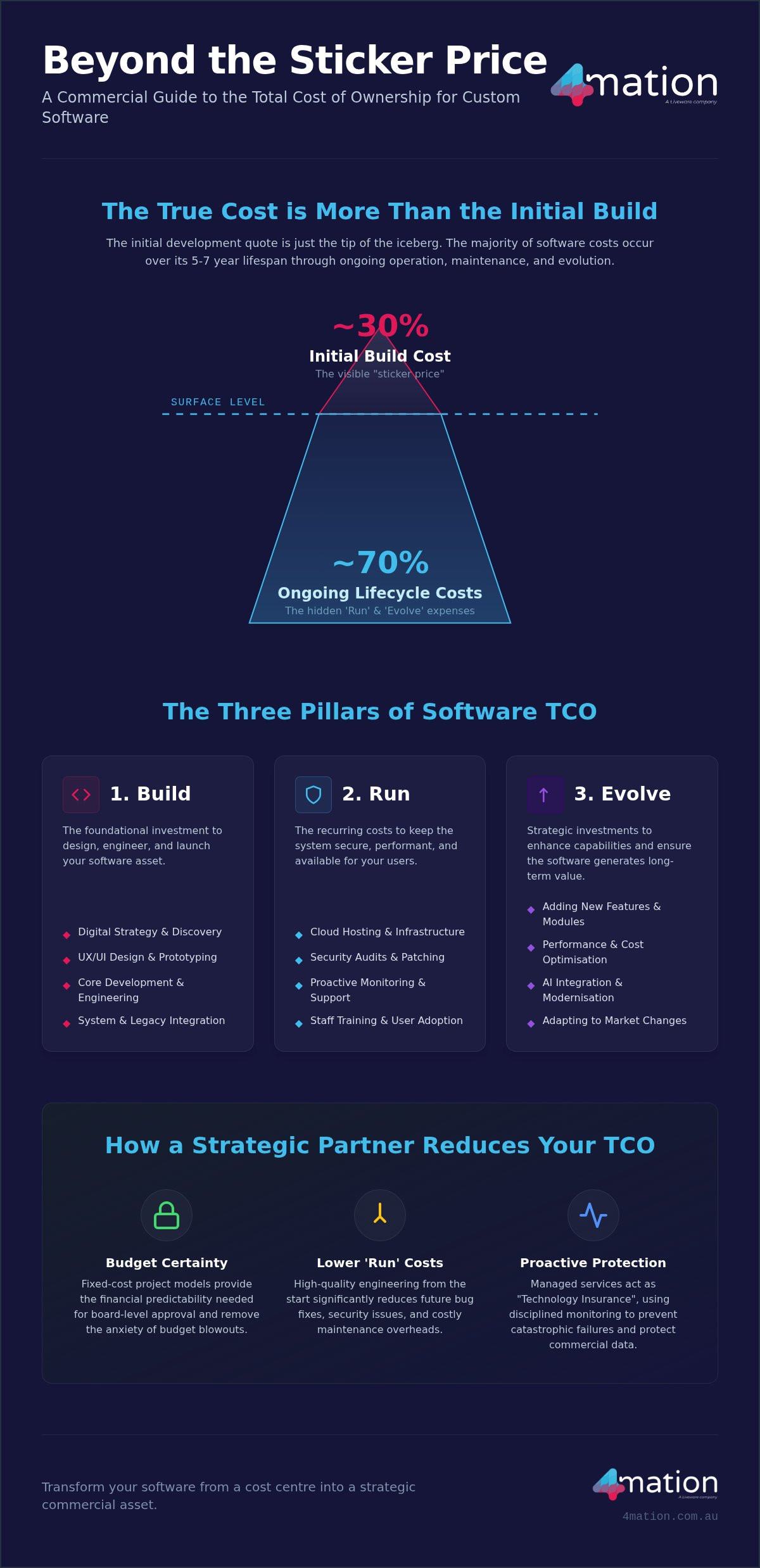
Managing a software budget requires a shift from viewing it as a one-off capital expenditure to an ongoing operational commitment. To achieve this, we use a practical framework for calculating TCO that breaks the lifecycle into three distinct financial phases. This structure ensures the total cost of ownership custom software is visible and predictable from the moment we begin our partnership.
Phase 1: The Initial Build and Implementation
Phase 2: Operational “Run” Costs
Once your software is live, it enters the “Run” phase. These are the recurring costs required to keep the system performant and secure. As an AWS Select Consulting Partner, we focus on optimising cloud services and infrastructure management to balance speed with cost efficiency. This phase includes proactive monitoring to prevent outages and regular security patches to protect your commercial data. We often refer to this as “Technology Insurance”. It’s the disciplined, methodical maintenance that prevents catastrophic failures and ensures your business remains operational without nasty surprises.
Operational costs also include third-party API fees and any necessary software licencing. While custom software reduces your reliance on per-user SaaS fees, most modern applications still interact with external services that require their own budgets. Mapping these out early ensures your monthly operational expenditure remains stable as your user base grows.
Phase 3: Continuous Improvement and Evolution
Software that doesn’t evolve quickly becomes a liability. The “Evolve” phase involves updating the system to match changing market conditions or internal business shifts. This might include modernising your workplace with AI to automate manual processes or refactoring code to reduce technical debt. By planning for evolution, you ensure your software remains a high-value asset rather than a low-value legacy system that eventually requires a total rebuild.
If you’re unsure how these pillars apply to your specific project or current legacy system, reach out to our Sydney-led team for a commercial consultation. We can help you identify the hidden costs in your current stack and build a roadmap for a more sustainable technology future.
How to Calculate Total Cost of Ownership: A Practical Framework
To move from theory to a concrete financial roadmap, you need a structured approach that accounts for the entire lifespan of your technology. Calculating the total cost of ownership custom software requires looking beyond the immediate horizon to a five to seven year lifecycle. This period allows you to account for the full utility of the asset while planning for the inevitable shifts in technology and business requirements.
This process ensures you aren’t just buying a product, but investing in a sustainable commercial tool. Follow these five steps to build your forecast:
- Step 1: Define the lifespan. Use a standard window of five to seven years to amortise costs and plan for major modernisation cycles.
- Step 2: Aggregate build costs. Include the invoice for your fixed-cost project and the internal opportunity costs of your staff’s time during discovery and testing.
- Step 3: Estimate annual “Run” costs. Budget approximately 15 to 20% of the initial build cost each year for hosting, security patches, and support and maintenance.
- Step 4: Factor in evolution. Allocate funds for planned feature updates and AI integrations that will keep the system competitive.
- Step 5: Subtract the “Cost of Inaction”. Quantify the manual work, data errors, and lost revenue caused by your current processes to find your true net investment.
The TCO Formula for Custom Software
While every business is unique, the core calculation remains consistent. The simple formula we recommend is: TCO = Initial Build + (Annual Run x Years) + (Annual Evolve x Years). TCO is the comprehensive financial roadmap of a digital asset. When applying this formula, you must include internal costs. If your Product Owner spends 10 hours a week for six months on this project, that’s a real commercial expense that belongs in your calculation. Transparency at this stage prevents budget friction later and ensures the board understands the full scope of the commitment.
Factoring in the Cost of Inaction
Staying on legacy systems often carries a “hidden tax” that is far higher than the cost of a new build. Measuring the consequence of inaction involves looking at the productivity gap created by generic tools or disconnected data. Custom software removes this gap by automating workflows specifically for your business logic. We work with you to quantify the time saved; for example, reducing manual data entry by 30% can often pay for the “Run” phase of the new software on its own. This shift from a “cost centre” mentality to a “value generator” perspective is what defines a successful digital strategy.
Mitigating Risk and Reducing TCO: The Role of a Strategic Partner
Choosing a technology partner is a commercial decision that directly impacts your long-term balance sheet. While we have already established how to calculate the total cost of ownership custom software, the focus must now shift to how a strategic partnership actively reduces these figures. A disciplined, methodical approach to development doesn’t just deliver a functional tool; it builds a foundation that lowers ongoing operational expenditure and eliminates the risk of expensive project rescues.
Quality engineering is the most effective way to protect your investment. By prioritising secure, clean code from the first day, we reduce the “Run” costs that typically consume 15 to 20% of your annual budget. This proactive stance ensures that your software remains a high-value asset rather than a liability that requires constant patching and emergency fixes. When you work with a partner who understands your commercial goals, technology becomes a predictable driver of growth.
Fixed-Cost vs. Agile: Which is Better for TCO?
The engagement model you choose acts as the primary stabiliser for your initial investment. For many Australian business leaders, a fixed-cost project provides the ultimate budget certainty for clearly defined outcomes. It removes the risk of “scope creep” and ensures the delivery of a bug-free solution within a set timeframe. This model is ideal for building core infrastructure where the requirements are well-understood.
Agile development remains more cost-effective for evolving products where market feedback is essential. However, it requires a “safe pair of hands” to manage effectively. We use a disciplined approach to reduce delivery risk and ambiguity, ensuring that even flexible projects remain aligned with your TCO targets. In some cases, staff augmentation is the most efficient path, allowing you to fill specific technical gaps without the overhead of permanent hiring.
Technology Insurance and Managed Services
We view managed services as “Technology Insurance” for your business-critical platforms. Moving from reactive “fixing” to proactive technology support and maintenance prevents the catastrophic failures that lead to unplanned downtime and lost revenue. Our Sydney-led service desk provides local expertise, ensuring that communication remains clear and response times are rapid.
Continuous development is the final piece of the risk mitigation puzzle. By making small, regular improvements, you prevent the buildup of technical debt that eventually forces a total system rebuild. This methodical evolution keeps your platform modern and secure, ensuring your total cost of ownership custom software remains manageable throughout its entire seven-year lifecycle. If you are ready to secure your technology’s future, contact our team today to discuss a tailored roadmap for your next project.
Maximising ROI: Turning TCO into a Competitive Advantage
Managing your technology budget with precision does more than just prevent overspending; it transforms your software into a high-performance commercial lever. While many organisations view the total cost of ownership custom software as a financial burden to be minimised, successful leaders treat it as a strategic roadmap for growth. When you account for the full lifecycle of an asset, you can make informed decisions that prioritise long-term value over short-term savings.
Custom software is a value generator that removes the constraints of generic, off-the-shelf tools. By owning the code and the roadmap, you eliminate the “success tax” of per-user licensing fees and gain the ability to pivot your technology as your market evolves. This control ensures that your investment remains relevant and profitable for its entire five to seven year lifespan, rather than becoming a low-value legacy system that hinders operational efficiency.
AI and Automation as TCO Reducers
Integrating modern technology is often the most effective way to lower your ongoing operational expenditure. We focus on practical AI workplace modernisation that delivers a measurable return on investment rather than chasing industry hype. By deploying AI agents to handle repetitive manual tasks, you can significantly reduce the internal staff time required to manage complex workflows.
Modernising your legacy applications also lowers your long-term total cost of ownership custom software by reducing hosting and support overheads. Older systems are often expensive to maintain and difficult to secure; refactoring these platforms into modern cloud environments creates a more stable foundation. This proactive approach ensures your “Run” costs remain predictable and your “Evolve” phase focuses on adding new commercial value rather than simply keeping the lights on.
Choosing a Partner for the Long Haul
The longevity of your software depends heavily on the stability of your technology partner. With 25 years of experience, we provide a “safe pair of hands” for Australian businesses that need more than just a vendor. Our Sydney-led team works with you through the full lifecycle, from the initial digital strategy session to ongoing managed services. This end-to-end involvement ensures that the strategic goals established during discovery are maintained throughout the years of support and evolution.
We’ve helped organisations like Ego Pharmaceuticals and Altus Traffic turn complex technical challenges into streamlined, high-value systems. You can explore these outcomes in our case studies to see how disciplined engineering leads to commercial success. If you’re ready to gain a clear financial roadmap for your next project, reach out to our team for a transparent consultation. We’ll help you map your TCO accurately, ensuring your software investment delivers the measurable business value you expect.
Securing Your Technology’s Financial Future
Managing the total cost of ownership custom software is a disciplined exercise in commercial foresight. By looking beyond the initial build and accounting for the operational and evolution phases, you shift technology from a volatile expense to a stable, value-generating asset. You now have the framework to calculate these costs accurately and remove the “buyer’s remorse” often associated with large-scale digital investments.
Choosing a partner with 25 years of experience ensures your platform remains secure and scalable for the long haul. We provide budget certainty through our fixed-cost, on-time, and on-budget projects, which include a bug-free guarantee. As an Advanced Supplier in the NSW Government ICT Services Scheme, we bring a “safe pair of hands” approach to every engagement.
Your software should be a competitive advantage, not a source of budget anxiety. We work with you to remove risk and deliver measurable business value through every stage of the lifecycle. Book a consultation with our commercially minded technology experts to begin mapping your strategic roadmap today. We’re ready to help you build with confidence.
Frequently Asked Questions
What is the typical lifespan of custom software for TCO calculations?
Custom software typically has a commercial lifespan of five to seven years. We use this window to amortise the initial investment and plan for significant modernisation cycles. While the code might function longer, the shifting landscape of security requirements and user expectations usually makes a major update necessary after this period. Planning for this lifecycle ensures your technology remains a high-value asset rather than a liability.
How much should I budget for annual software maintenance?
You should budget between 15% and 25% of the initial development cost for annual maintenance and support. This covers essential tasks like bug fixes, security patches, and minor updates to keep the system performant. Treating these costs as predictable operational expenses is a key part of managing the total cost of ownership custom software effectively over the long term.
Does custom software always have a higher TCO than SaaS?
Custom software often delivers a lower TCO than SaaS for growing enterprises over a five-year period. While SaaS has a lower entry price, the per-user fees and “success taxes” scale aggressively as your business grows. Custom solutions require a larger upfront capital expenditure but eliminate recurring licensing costs. This allows you to scale your user base without a linear increase in your monthly technology spend.
How does technical debt affect the total cost of ownership?
Technical debt acts like a high-interest loan that increases your ongoing maintenance costs. If a system is built with poor code quality or outdated architecture, every future update takes longer and costs more. This debt bloats your annual “Run” and “Evolve” budgets, significantly increasing the total cost of ownership custom software. High-quality engineering at the start is the best way to keep these long-term costs manageable.
Can I reduce TCO by using offshore development teams?
While offshore teams offer lower hourly rates, they often result in a higher TCO due to increased communication risk and lower code quality. The “hidden costs” of fixing bugs, managing time zones, and refactoring poorly written code can quickly outweigh initial savings. We focus on Sydney-led local expertise to ensure your project is delivered right the first time, reducing the long-term cost of maintenance and rescues.
What are the most common “hidden costs” in software development?
The most frequent hidden costs include staff training, cloud hosting, and third-party API fees. You must also account for internal opportunity costs, such as the time your leadership team spends in discovery workshops and testing. Security audits and compliance checks, which can range from $5,000 to $50,000 annually depending on complexity, are also essential components that many business leaders overlook in their initial budgeting phase.
How do Fixed-Cost projects help in managing TCO?
Fixed-cost projects provide budget certainty by locking in the price of the “Build” phase for a defined scope. This engagement model eliminates the risk of initial budget blowouts, which is a common pain point for executives reporting to a board. By establishing a clear price for a bug-free, on-time delivery, you create a stable starting point for your long-term financial roadmap and lifecycle planning.
Is AI implementation included in TCO or is it a separate investment?
AI implementation should be treated as part of the “Evolve” phase in your TCO framework. While some organisations see it as a separate investment, we view it as a tool for continuous modernisation that lowers operational costs over time. Budgeting for AI agents or automated workflows within your lifecycle plan ensures your software remains competitive and efficient without requiring a total system rebuild when you’re ready to innovate.
About The Author
