Custom Software Development: The Strategic Guide to Bespoke Solutions in 2026
Michael CaliHead of Marketing
Michael is passionate about showcasing what is truly possible when you partner with us. With data-driven insights, he boosts our exposure to Australian businesses that share our commitment to being at the forefront of tech innovation. His main goal is connecting our team with the market of innovators to deliver software ‘magic’!

If your business processes are being forced to fit into the rigid boxes of a standard subscription package, you’re not just losing efficiency; you’re surrendering your competitive edge. It’s a common frustration for Australian firms. Often, off-the-shelf solutions become a bottleneck that creates high technical debt and operational friction. Investing in custom software development isn’t merely about building a new tool. It’s a strategic move to reclaim full ownership of your intellectual property and create a system that actually mirrors your unique workflows.
You likely agree that technology should empower your team rather than limit them, yet the anxiety over the complexity of bespoke builds often stalls progress. This guide provides a clear roadmap for navigating bespoke solutions in 2026. You’ll discover how tailored engineering provides a scalable foundation for AI integration while ensuring your infrastructure is built for long-term stability. We’ll examine the practicalities of modernising legacy systems, managing project costs, and positioning your organisation to lead in an increasingly automated market.
Key Takeaways
- Understand why owning your digital assets through custom software development provides a superior competitive advantage over simply renting standard SaaS products.
- Learn how to apply the Build vs Buy framework to accurately assess total cost of ownership and determine the strategic fit for your organisation.
- Discover how bespoke architecture eliminates legacy technical debt while creating a robust, ready-to-integrate foundation for seamless AI scaling.
- Master the roadmap from discovery to iterative delivery, ensuring technical requirements remain perfectly aligned with your commercial objectives.
- Recognise the importance of managed support and continuous improvement in maintaining the long-term security and stability of your software investment.
Beyond Off-the-Shelf: Defining Custom Software Development for 2026
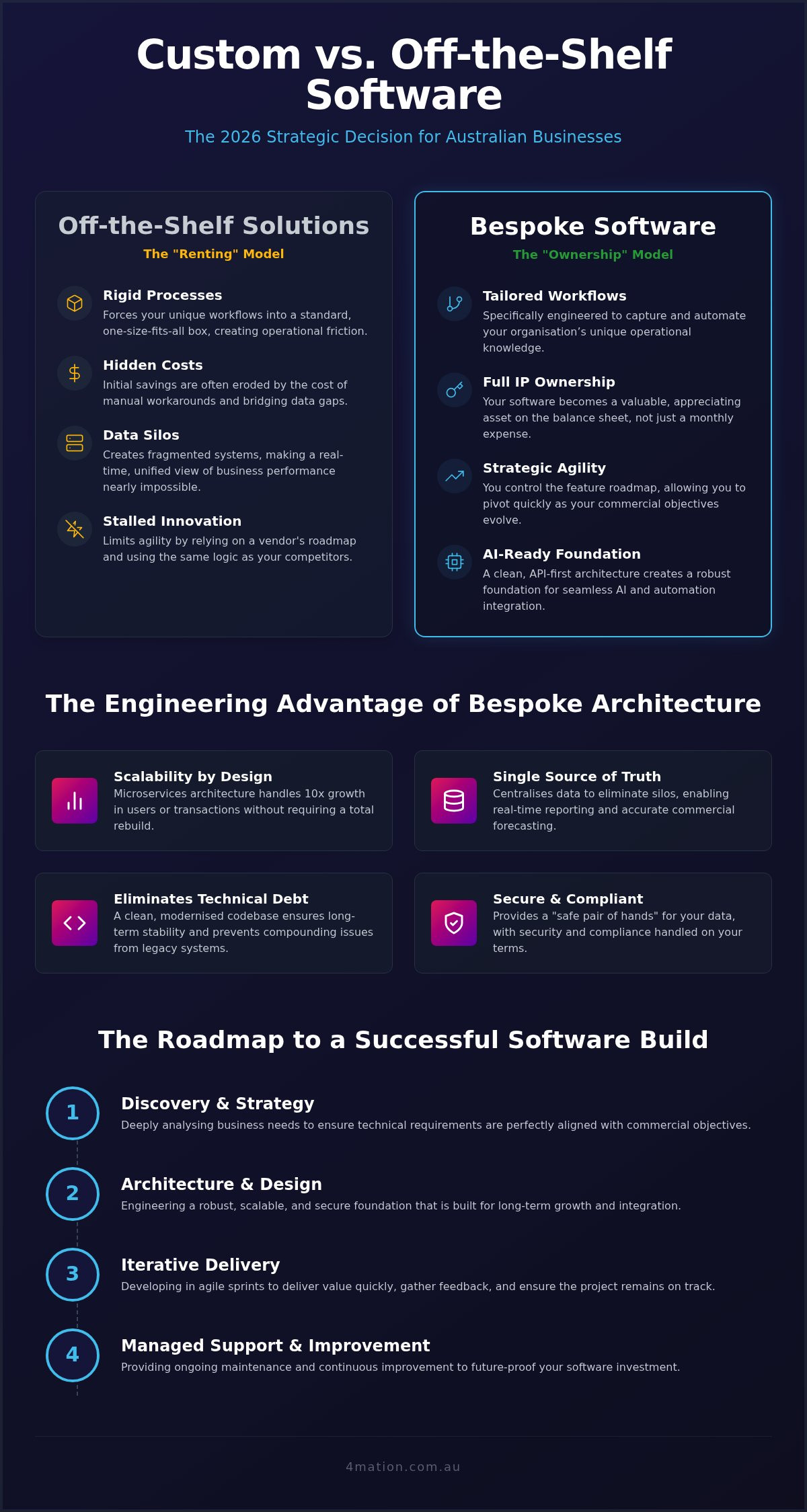
In 2026, the definition of custom software has evolved from mere “coding to order” to a strategic engineering of unique organisational workflows. While SaaS models allow you to rent functionality, custom software development ensures you own the underlying logic that drives your business. It’s the difference between leasing a standardised office space and building a purpose-fit headquarters designed for maximum output. Modern bespoke builds now prioritise an API-first architecture. This ensures that your system doesn’t just sit in a silo; it acts as a central hub that communicates effortlessly with other essential tools and data streams. Relying on a “one-size-fits-all” approach stalls innovation because it limits your agility. You’re restricted by what the vendor thinks is best for the “average” user, not what’s best for your specific growth.
The Limitations of Packaged Software
Standardised software packages often force Australian businesses to bend their processes to fit the tool. This creates operational friction. When you rely on a one-size-fits-all product, you’re using the same logic as your direct competitors, which naturally limits your ability to innovate. You’ll often find hidden costs in these “easy” solutions too. Manual data entry to bridge gaps between systems and the time spent on clunky workarounds can quickly erode any initial savings. Fragmented systems lead to data silos, making it nearly impossible to gain a clear, real-time view of your performance. Using the same tools as everyone else means your business processes are, by definition, average.
The Strategic Advantage of Bespoke Solutions
Bespoke software is a high-performance tool designed specifically to capture and automate your organisation’s unique operational knowledge. Investing in custom software development allows for full control over the feature roadmap to align with long-term business goals. You don’t have to wait for a third-party vendor to decide which updates are a priority; your business goals dictate the development schedule. You can pivot quickly when market conditions change. Perhaps most importantly, you gain direct ownership of the intellectual property. In a 2026 market where data is currency, having your software as a balance sheet asset rather than a monthly expense provides a significant long-term valuation boost. Working with specialists like Larasoft helps create a “safe pair of hands” for your data, ensuring security and compliance are handled on your terms.
Engineering Competitive Advantage: Why Bespoke Architecture Matters
Strategic growth requires an infrastructure that anticipates change rather than reacting to it. When executives evaluate The Build vs. Buy Framework, the conversation frequently shifts from upfront costs to the long-term value of architectural integrity. A well-engineered system provides a foundation where scaling and integration happen by design, not by accident. This level of precision in custom software development allows organisations to eliminate the technical debt often found in bloated legacy systems. By building a clean, modernised codebase, you ensure that every new feature adds value without compromising the stability of the entire enterprise.
Centralising your data into a “single source of truth” is another critical benefit of bespoke architecture. Off-the-shelf products often create fragmented silos that require complex middleware to talk to one another. In contrast, a custom-built system facilitates seamless integration across your entire digital ecosystem. This visibility allows for real-time reporting and more accurate commercial forecasting. It turns your software into a high-performance asset that supports your unique business logic with absolute certainty.
Scalability and Performance by Design
Growth shouldn’t be a source of technical anxiety. Many Australian firms struggle when monolithic systems fail to handle increased demand during peak national operations. Moving from these rigid structures to a microservices-based architecture provides the agility needed to scale specific functions independently. This approach ensures your digital infrastructure can handle 10x growth in user base or transaction volume without requiring a total rebuild. It’s about creating a “safe pair of hands” for your future expansion, allowing for high performance even in the most demanding Australian environments.
AI-Readiness: The New Standard for Custom Builds
Effective custom software development in 2026 must be AI-ready from day one. Many competitors treat artificial intelligence as an afterthought or a separate plugin, but true competitive advantage comes from building proprietary models directly into your architecture. This requires structuring your data today so it’s ready to leverage generative AI and machine learning tomorrow. Engaging in AI consulting services during the initial design phase allows you to move beyond generic third-party tools. You gain the ability to train models on your own intellectual property, ensuring your AI capabilities are as unique as your business itself.
The Build vs. Buy Framework: Navigating the Strategic Decision
The decision to invest in custom software development often surfaces in the boardroom as a debate over initial costs versus ongoing flexibility. To make a truly informed choice, executives must look beyond the first year and analyse the Total Cost of Ownership (TCO) over a five-year horizon. While global SaaS providers offer a low entry price, the cumulative cost of monthly subscriptions, “per-user” fees, and premium tier upgrades can eventually exceed the cost of a bespoke build. There’s also the significant risk of vendor lock-in; you’re at the mercy of their price hikes and feature deprecations. If the software function is a core competency that differentiates your business, renting it from a third party is a strategic risk.
Identifying the break-even point is essential. For many Australian organisations, the point where subscription fees outweigh custom software development costs arrives sooner than expected, particularly as teams grow. When you own the code, your costs stabilise while your value grows. It’s about moving from a position of dependency to one of digital sovereignty.
Financial and Operational Considerations
Shifting from an OpEx-heavy SaaS model to a CapEx investment in custom tools changes the nature of the software from a recurring liability to a balance sheet asset. This transition allows for a clearer calculation of ROI, particularly when you factor in the efficiency gains from automated workflows. Reducing manual data handling doesn’t just save time; it lowers the risk of human error and improves employee retention by removing clunky, frustrating processes. When a system performs exactly as needed, customer satisfaction scores typically follow. You aren’t just paying for code; you’re investing in a more streamlined, profitable operation.
When to Choose Bespoke Over Off-the-Shelf
Choosing the right path requires a cold-eyed assessment of your requirements. Bespoke solutions are generally the superior choice if your organisation meets these criteria:
- Your processes are unique and provide a measurable advantage over rivals.
- You have high security or compliance needs that standard cloud tools can’t satisfy.
- You require complex integrations between multiple legacy and modern systems.
- Your growth trajectory suggests you’ll quickly outgrow standard feature sets.
Sometimes, Australian firms find themselves in need of “Software Rescue” when an off-the-shelf tool fails to scale or breaks under the weight of manual workarounds. Consulting with an experienced digital strategist before committing capital can validate your direction and prevent costly pivots later. It’s about ensuring your technology roadmap is built on a foundation of certainty rather than hope.
From Vision to Velocity: The Roadmap for a Successful Software Build
Moving from strategic theory to practical execution requires a methodical approach that prioritises risk mitigation. A successful outcome in custom software development relies on a partnership that values transparency over guesswork. By following a structured roadmap, you ensure that every dollar invested translates into measurable business value. This process begins by bridging the gap between high-level commercial objectives and granular technical requirements, ensuring the engineering team understands the “why” behind every feature.
Adopting an Agile methodology is essential for maintaining this alignment. Iterative delivery reduces project risk by allowing you to review functional increments of the software every few weeks. This approach ensures that the final product remains relevant to your evolving business needs. It provides a level of transparency that traditional “waterfall” projects lack, giving stakeholders the certainty that the build is progressing on time and within the agreed parameters.
Discovery and Digital Strategy
The Discovery phase is the most critical stage for ensuring long-term project viability. During this period, we define the Minimum Viable Product (MVP) to accelerate your time-to-market while focusing on the most impactful features. We map detailed user journeys to ensure the software solves real-world pain points for your staff and customers. Conducting a comprehensive technical audit during discovery serves as a safeguard against scope creep; it provides a clear boundary for the project’s functional requirements and identifies potential integration hurdles early.
Development, Integration, and Deployment
The transition from design to deployment is managed through a robust DevOps pipeline. This creates a reliable deployment environment that ensures operational continuity, even when pushing complex updates. Integrating with your existing legacy systems is handled with precision to avoid any disruption to your national operations. To ensure enterprise-grade stability, we employ rigorous Quality Assurance (QA) protocols, including both automated and manual testing to confirm the system performs under high-traffic conditions.
High-quality User Experience (UX) and User Interface (UI) design are non-negotiable for driving internal adoption. If a tool is clunky or difficult to navigate, the investment is wasted. Finally, structured change management and team training ensure your organisation is ready to utilise the new system to its full potential. To see how a disciplined approach can transform your operations, explore our digital strategy and consulting services for a tailored execution plan.
Future-Proofing Your Investment: The Role of Managed Support
The launch of a new system is often viewed as the finish line, yet in the context of custom software development, it’s actually the commencement of a value-creation phase. Digital assets require continuous refinement to remain performant and secure. A “set and forget” mentality often leads to the very technical debt you sought to eliminate with a bespoke build. By committing to a cycle of continuous improvement, you ensure that your software evolves alongside shifting market demands and internal growth. Proactive maintenance keeps the codebase clean, preventing the gradual degradation that often affects legacy systems over time.
A long-term partnership also allows you to execute on the AI-ready foundation established during the initial build. As generative AI and machine learning technologies mature, having a partner who understands your proprietary logic is invaluable. They can help you identify new opportunities for automation and predictive analytics that may not have been feasible at day one. For organisations looking to move from proof-of-concept to production-ready solutions, investing in AI consulting services for Australian organisations ensures this ongoing strategic alignment turns your software from a static tool into a dynamic engine for innovation, ensuring your infrastructure remains a foundational business asset for years to come.
Managed Services and Technical Support
There is a fundamental difference between traditional “break-fix” support and proactive managed services. While break-fix models only react when a system fails, managed services focus on prevention and high availability. This is particularly vital for mission-critical web application development projects where downtime directly impacts revenue and reputation. In an evolving Australian regulatory environment, your support partner must also ensure consistent security patching and compliance with local data protection standards. This level of oversight provides the certainty needed to operate at scale without the constant anxiety of technical failure.
Choosing a Reliable Software Development Partner
Selecting the right team is about finding a “safe pair of hands” that possesses both deep technical expertise and commercial wisdom. You need a partner with a proven track record in legacy modernisation who understands the unique challenges of the Australian business context. A local firm with national reach offers the benefit of being in your time zone while providing the scale necessary to support complex, high-growth operations. Integrity and transparency are the hallmarks of a mature partnership; your developer should be more interested in your long-term success than in selling unnecessary complexity. If you’re ready to build a system that delivers a genuine competitive edge, you can organise a strategy session with 4mation to discuss your custom project.
Securing Your Digital Sovereignty in 2026
Reclaiming control over your technology is no longer a luxury; it’s a prerequisite for market leadership. As we’ve explored, custom software development offers more than just tailored features. It provides a foundation of intellectual property ownership and an architecture that’s inherently ready for AI integration. By moving beyond the rigid limitations of off-the-shelf products, you eliminate technical debt and ensure your systems scale seamlessly with your commercial ambitions.
Choosing a partner with a deep understanding of the Australian business context is the final step in this journey. With 25 years of experience, our award-winning team of engineers and strategists provides the “safe pair of hands” needed for complex legacy modernisation and AI consulting. We focus on delivering long-term stability and measurable success through disciplined, outcome-oriented engineering.
Partner with 4mation for Bespoke Software that Scales to transform your digital infrastructure into a high-performance asset. Your vision for a more efficient, automated future is well within reach.
Frequently Asked Questions
What is the average cost of custom software development in Australia?
Project costs vary significantly based on complexity and scale. Industry data from 2026 indicates that the average project costs A$132,480, with typical business applications ranging between A$50,000 and A$300,000. Complex enterprise platforms often exceed A$500,000. These figures reflect the investment required for high-quality engineering and comprehensive testing within the Australian market. For a comprehensive breakdown of what drives these figures, our guide to custom software development costs in Australia for 2026 provides a transparent framework for budgeting your project. Investing in bespoke tools ensures you aren’t paying for features your team will never use.
How long does a typical bespoke software project take to complete?
A standard project typically requires approximately 13 months from initial discovery to final deployment. Smaller, more focused applications or MVPs can often be delivered in four to six months. This timeline ensures a disciplined approach to the discovery phase, iterative development sprints, and rigorous quality assurance. Taking the necessary time for thorough testing is essential for maintaining long-term system stability and reliability.
Can custom software be integrated with our existing legacy systems?
Yes, modern custom builds are designed with an API-first architecture to facilitate seamless integration with legacy systems. This approach allows you to modernise your digital infrastructure without disrupting current operations. By creating a bridge between old and new technology, you can centralise data and improve cross-departmental visibility. This integration is a core component of digital transformation; it ensures your previous technology investments continue to provide value.
Who owns the intellectual property of the custom software once it is built?
You retain full ownership of the intellectual property (IP) and the underlying source code upon completion of the project. Unlike SaaS models where you essentially rent functionality, custom software development creates a proprietary asset for your balance sheet. This ownership allows you to modify the system as your business evolves without being restricted by third-party vendor roadmaps. It provides long-term certainty and increases the overall valuation of your organisation.
Is custom software more secure than off-the-shelf SaaS products?
Custom software provides superior security because it allows for the implementation of specific protocols tailored to your unique risk profile. Standard SaaS products are often targets for hackers; a single vulnerability can expose thousands of users. A bespoke build reduces this attack surface and enables you to integrate zero-trust architecture and AI-enhanced threat detection. This level of control ensures compliance with Australian data privacy regulations and security standards.
What happens if our business needs change during the development process?
The Agile methodology used in our development process is specifically designed to accommodate evolving business requirements. We work in iterative cycles, allowing you to review progress and provide feedback every few weeks. If market conditions shift or internal priorities change, we can adjust the project roadmap accordingly. This flexibility ensures the final product remains perfectly aligned with your commercial objectives rather than being locked into a rigid plan.
Do we need a dedicated technical team to manage the software after launch?
No, you don’t necessarily need an in-house technical team if you partner with a provider that offers managed services. A managed support model provides 24/7 reliability and proactive maintenance, handling security patches and performance optimisations on your behalf. This allows your internal staff to focus on core business operations. It offers the peace of mind that a safe pair of hands is managing your digital infrastructure.
How does custom software development support AI implementation?
Bespoke development provides the essential data infrastructure and clean codebase required for effective AI integration. Unlike off-the-shelf tools that rely on generic plugins, custom software development allows you to build proprietary AI models directly into your architecture. This ensures your AI capabilities are trained on your specific organisational knowledge. It creates a scalable foundation that can leverage machine learning and generative AI as your data volume grows. For organisations looking to replace manual workarounds with scalable digital engines, our guide to web application development for Australian organisations in 2026 explores how purpose-built platforms deliver measurable commercial outcomes.
About The Author
