How to Choose a Software Development Agency in Australia: The 2026 Enterprise Buying Guide
Jowena BorralDigital Marketing Specialist

Most enterprise software builds don’t fail during engineering; they fail during the sales pitch, long before the first line of code is written. When polished vendor presentations mask shallow technical capabilities, the inevitable result is blown budgets, missed delivery milestones, and brittle systems that compromise operations. If you’ve ever inherited unmaintainable code or watched a critical project stall in endless change requests, you already know the frustration. Knowing how to choose a software development agency in Australia requires looking past commercial promises and rigorously testing operational accountability.
This 2026 enterprise buying guide provides an objective framework to evaluate engineering depth, interrogate delivery models, and select a partner that shares your commercial focus. You’ll learn how to separate genuine technical capability from sales talk, protect your intellectual property, and select engagement models that eliminate budget surprises. We’ll walk through practical vetting criteria, risk-mitigating contract structures, and the essential benchmarks needed to ensure your next software investment delivers secure, scalable outcomes on time and within scope.
Key Takeaways
- Clarify operational bottlenecks and prioritise core functionality before engaging vendors to eliminate early scope creep and protect capital.
- Learn how to choose a software development agency in Australia by rigorously testing architectural standards, code maintainability, and delivery governance rather than trusting pitch decks.
- Compare fixed-cost and agile time-and-materials engagement models to determine which structure provides your organisation with genuine price certainty and accountability.
- Apply a structured due diligence framework to stress-test agency technical proposals, data governance protocols, and risk mitigation strategies before contract signing.
- Align with a full-lifecycle technology partner capable of balancing strategic local accountability with scalable engineering capacity to secure long-term system stability.
Defining Your Software Requirements and Commercial Objectives Before Approaching Agencies
Engineering failures rarely start in the codebase. More often, they begin with ambiguous requirements, undefined business targets, and vague scope documents that leave technical teams guessing. Before you evaluate vendors or assess how to choose a software development agency in Australia, you need internal clarity on the commercial outcome you expect this technology to deliver.
Rushing to market with rough concepts leaves your organisation exposed to runaway costs under time-and-materials contracts. By establishing your baseline requirements upfront, you retain control over delivery milestones, avoid paying for speculative research, and force prospective partners to validate their technical solutions against clear business metrics.
Identifying Core Operational Bottlenecks and User Needs
Start by auditing internal friction rather than listing desired features. Interview frontline staff and review current workflows to identify where legacy systems stall productivity, cause human error, or hinder customer retention. Quantifying these issues into commercial objectives, like reducing manual data entry by 40% or cutting customer onboarding time in half, gives prospective agencies a concrete target to solve.
You must also determine whether your challenge genuinely demands bespoke engineering. Standard business processes often run effectively on existing off-the-shelf platforms. Tailored engineering should protect your intellectual property and provide a defensible advantage. For a deeper breakdown of this strategic boundary, review our guidance on custom software development. Ensure your documentation specifies non-negotiable compliance parameters, including Australian Privacy Act obligations and internal security standards, before discovery sessions start.
Establishing Scope Boundaries and Technical Feasibility
Scope creep quickly erodes project return on investment. Categorise functionality into mandatory operational requirements versus secondary enhancements that can wait for later iterations. This discipline defines a focused initial release, keeping delivery timelines realistic and budget governance secure.
- Legacy dependencies: Map all third-party APIs, legacy databases, and architectural constraints early to avoid integration delays during sprint cycles.
- Data cleanliness: Audit existing data structures and define migration rules before development begins to minimise cutover risks.
- Governance milestones: Align delivery stages directly with internal financial quarters and executive reporting cycles to maintain commercial oversight.
Knowing how to choose a software development agency in Australia requires you to bring clean operational boundaries to the table. When you approach the market with well-defined constraints, competent agencies can provide reliable architecture roadmaps and committed pricing structures rather than speculative sales estimates.
Critical Evaluation Criteria for Australian Software Development Partners
Enterprise software vetting requires moving past polished portfolios. When determining how to choose a software development agency in Australia, your procurement framework should scrutinise architectural discipline, sovereign regulatory compliance, and proven commercial outcomes rather than sales presentations. Benchmarking prospective partners against the principles in the Commonwealth Procurement Rules helps enforce value for money and rigorous accountability across the entire delivery lifecycle.
Technical Depth, Architectural Standards, and Security Compliance
Demand clarity on technical governance before signing any agreement. Evaluate an agency’s automated testing pipelines, peer-review frameworks, and technical debt management practices. Verify cloud engineering credentials through formal accreditations, such as AWS Select Consulting Partner status, to ensure infrastructure design aligns with enterprise performance and cost controls.
Security cannot remain an afterthought. Scrutinise how the engineering team implements the ACSC Essential Eight maturity model and adheres to Australian Privacy Act obligations. If an agency can’t explain how they safeguard data residency or handle controller-processor requirements, your business bears the downstream compliance liability.
Sector Experience and Verifiable Commercial Track Record
Theoretical engineering skills don’t substitute for applied domain knowledge. Look for partners with documented case studies across specialised industry sectors facing comparable integration friction, legacy hurdles, and operational scale.
Always speak with direct client references. Ask their technology leaders about communication transparency during unexpected roadblocks and whether delivery timelines held firm. Pay close attention to project rescue capability. A firm capable of salvaging brittle codebases from previous vendor missteps demonstrates mature engineering problem-solving.
Practical Artificial Intelligence Capability Beyond Marketing Hype
Many agencies now claim artificial intelligence expertise, but few deliver practical commercial utility. Focus on measurable workflow automation, system-to-system data synthesis, and private data retrieval rather than generic conversational tools. Ask how the engineering team protects proprietary IP and prevents sensitive operational data from leaking into external models. Exploring strategic enterprise AI consulting helps separate speculative experimentation from production-ready systems.
Evaluating how to choose a software development agency in Australia ultimately hinges on finding a stable pair of hands. Independent signals, such as being prequalified as an Advanced Supplier on the NSW Government ICT Services Scheme or maintaining Great Place to Work certification, demonstrate low staff turnover and dependable institutional knowledge. If you’re reviewing prospective partners for an upcoming project, speak with our technical team to review your delivery roadmap.
Comparing Engagement Models: Fixed-Cost, Agile Time-and-Materials, and Staff Augmentation
Commercial agreements dictate where project risk actually sits. Traditional procurement often forces organisations to absorb delivery exposure under open-ended hourly agreements, paying for vendor inefficiencies rather than tangible outputs. Understanding how to choose a software development agency in Australia means matching your internal scoping clarity to the right commercial framework.
Fixed-Cost Projects: Guaranteeing Scope, Budget, and Delivery Certainty
When your functional requirements, compliance baselines, and integrations are thoroughly mapped, a fixed-cost engagement provides absolute commercial certainty. This model transfers delivery risk to the agency. A disciplined discovery phase establishes an agreed technical roadmap, allowing an experienced partner to commit to delivering on time, on budget, and bug-free. For organisations operating with strict capital expenditure approvals, this approach prevents scope creep and eliminates unexpected variation invoices.
Agile Development and Dedicated Team Augmentation
Projects involving evolving user feedback or phased product rollouts benefit from contractual adaptability. Agile time-and-materials arrangements allow sprint priorities to adjust dynamically as commercial needs shift, supported by clear sprint velocity tracking and regular burndown reviews.
Staff augmentation embeds specialised engineering talent directly into your internal teams to accelerate delivery velocity without recruitment overheads. When integrating external engineers into core environments, organisations should benchmark vendor governance against recognised cyber supply chain risk management practices to maintain complete control over code ownership and system access.
Technology Insurance and Ongoing Managed Support
Software is an operational asset that requires continuous maintenance long after deployment. Relying on transactional emergency repairs creates compounding technical debt, degrades performance, and leaves systems vulnerable to zero-day exploits. Mature technology partners treat post-launch operations as an ongoing discipline.
Structured managed technology support services deliver proactive infrastructure monitoring, regular dependency patching, and continuous system optimisation. Establishing this operational support early prevents unplanned outages, protects your initial capital investment, and keeps enterprise software aligned with business growth.
The Due Diligence Process: A Step-by-Step Agency Selection Framework
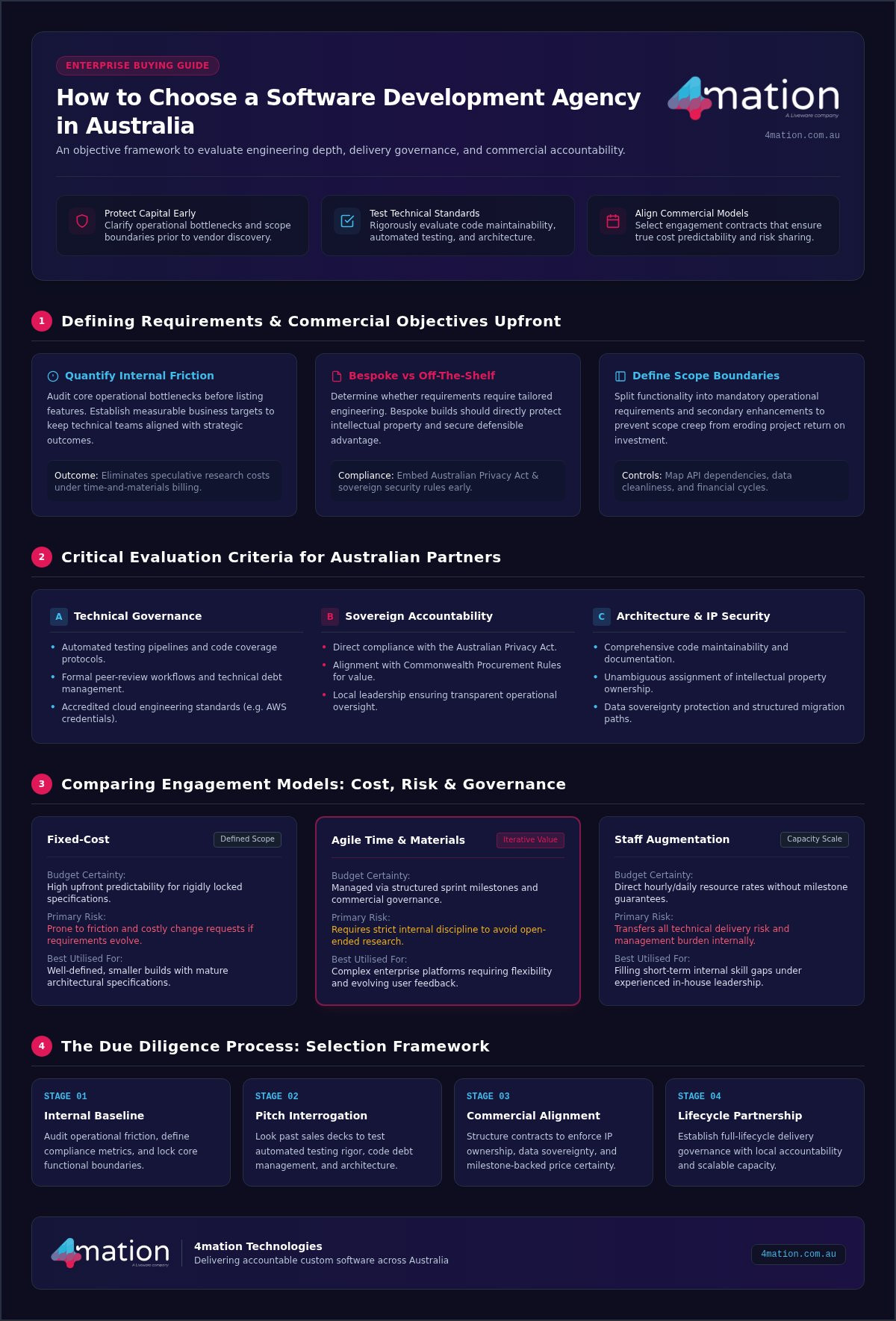
Selecting an enterprise delivery partner demands an active, forensic vetting process. Knowing how to choose a software development agency in Australia requires looking well beyond pitch decks to evaluate technical integrity, team stability, and contractual protections before capital is committed. A disciplined due diligence framework eliminates delivery surprises and protects your organisation’s long-term commercial interests.
Scrutinising Technical Proposals and Architectural Roadmaps
An experienced engineering partner won’t simply nod along with every functional request. Look for technical teams that actively challenge flawed assumptions, pinpoint architectural bottlenecks early, and propose alternative methods to lower your long-term maintenance overheads. Scrutinise their technology stack choices to ensure they avoid obscure frameworks that create technical debt. A robust discovery phase must detail clear data modelling, API integration boundaries, and security architectures before any build sprints commence.
Verifying Commercial Stability and Team Culture
High developer turnover represents one of the quietest killers of enterprise momentum. When engineers leave mid-build, institutional knowledge evaporates, code quality degrades, and delivery milestones slip. Ask prospective agencies directly about their retention metrics. Independent accreditations, like 6-time Great Place to Work certification, signal a stable team culture where senior talent stays on your account. Ensure that experienced local technical directors oversee architectural governance, maintaining consistency and direct accountability across all engineering teams.
Securing Intellectual Property Rights and Commercial Governance
Legal governance should leave no ambiguity regarding asset ownership. Your contract must state clearly that your organisation retains 100% ownership of all bespoke source code, database architectures, and digital assets from day one. Insist on continuous, direct access to code repositories and deployment pipelines rather than waiting for project handover.
To run an effective procurement process, structure your team’s evaluation across five formal gates:
- Strategic discovery: Assess whether the agency grasps your commercial drivers or simply sells pre-packaged templates.
- Architecture review: Scrutinise proposed frameworks, cloud configurations, and technical risk mitigation plans.
- Peer verification: Interview past enterprise clients who faced comparable regulatory and operational hurdles.
- IP audit: Confirm complete source code ownership, repository access rights, and strict data residency compliance.
- Operational continuity: Lock in binding service level agreements, support response times, and post-launch warranty terms.
Taking a structured approach ensures you select an engineering partner built for lasting reliability. If you are preparing to evaluate market options for an upcoming build, take the next step by consulting our technology advisors to discuss your delivery roadmap.
Partnering with 4mation: Delivering Accountable Custom Software Across Australia
Navigating how to choose a software development agency in Australia ultimately leads to a foundational question: which team can you trust to manage risk while building software that drives commercial performance? Technology investments shouldn’t feel like a gamble. For 25 years, 4mation has worked with Australian organisations nationwide, pairing commercial strategy with pragmatic engineering to eliminate operational bottlenecks and protect capital.
Twenty-Five Years of Pragmatic Australian Technology Delivery
Our approach blends local strategic leadership with scalable delivery capability. With over 40 local technology specialists guiding every engagement, your team benefits from direct access to senior solution architects who understand Australian enterprise environments and regulatory standards.
As an Advanced Supplier on the NSW Government ICT Services Scheme and an AWS Select Consulting Partner, our delivery frameworks are vetted for high-governance and complex technical requirements. We don’t chase fleeting industry trends. Instead, we deliver stable systems designed to lower operating friction and support business growth over the long run.
Full-Lifecycle Engineering from Prototyping to Long-Term Maintenance
True technical partnership extends well beyond shipping initial code. We manage the complete software lifecycle, working with you from early strategic discovery and user experience design through to technical build and operational maintenance.
Our engineering teams systematically modernise legacy platforms to unlock siloed business data, improve system responsiveness, and reduce manual intervention across workflows. Whether you need an enterprise web application or complex system integrations, our custom software development services ensure every architecture decision directly supports revenue growth, cost reduction, or customer retention.
Start Your Project with Delivery Certainty
Delivery certainty comes down to clear alignment and accountability. We offer commercial engagement models tailored to your risk appetite, including fixed-cost projects backed by a commitment to deliver on time, on budget, and bug-free.
When you’re deciding how to choose a software development agency in Australia, select a partner committed to your commercial success from day one. Take the first step toward delivery certainty by connecting with 4mation today to discuss your roadmap.
Securing Delivery Certainty for Your Next Software Investment
Enterprise technology initiatives succeed when commercial strategy dictates engineering execution. Knowing how to choose a software development agency in Australia comes down to prioritising measurable business outcomes over developer hours, enforcing architectural due diligence, and choosing an engagement structure that protects your capital. When you demand transparency around source code ownership, automated testing discipline, and post-launch maintenance, you eliminate the risks that routinely derail major digital investments.
For 25 years, 4mation has delivered pragmatic software engineering for organisations nationwide. Backed by credentials as an Advanced Supplier on the NSW Government ICT Services Scheme, an AWS Select Consulting Partner, and a 6-time Great Place to Work certified employer, we provide the stability your leadership team needs. Whether you require flexible team augmentation or our fixed-cost project guarantee to deliver on time, on budget, and bug-free, we’re ready to help you build resilient systems that scale. Speak with our Australian technology consultants today to turn your digital roadmap into a dependable operational asset.
Frequently Asked Questions
How much does it cost to build custom software with an Australian development agency?
The cost of custom software depends on architectural complexity, third-party system integrations, security compliance baselines, and whether you build an initial prototype or a full enterprise platform. Reputable agencies avoid off-the-cuff estimates. Instead, they conduct structured discovery phases to define clear scope boundaries before quoting. This process uncovers legacy data risks and user requirements early, allowing organisations to pursue fixed-cost commercial models with complete budget certainty rather than open-ended billing.
What is the difference between fixed-price and agile time-and-materials contracts?
Fixed-price contracts transfer delivery and budget risk entirely to the agency, while agile time-and-materials contracts bill for developer hours invested across flexible sprints. Fixed-cost agreements work best when project scope, technical specifications, and milestones are thoroughly mapped upfront, ensuring delivery on budget and on schedule. Agile time-and-materials engagements suit evolving products where functional requirements shift frequently based on ongoing stakeholder feedback and incremental market testing.
Who owns the intellectual property and source code developed by an external software agency?
Your organisation should retain 100% of all intellectual property, bespoke source code, and custom digital assets from the moment they’re created. When evaluating how to choose a software development agency in Australia, verify contract terms to confirm that full IP assignment occurs upon payment. Professional agencies provide continuous, unrestricted access to code repositories and technical documentation, ensuring your team avoids vendor lock-in or proprietary licensing traps.
Why should an organisation choose a local Australian agency over an offshore provider?
Local agencies provide direct strategic accountability, shared business hours, and deep familiarity with Australian regulatory frameworks like the Privacy Act and ACSC Essential Eight. Pure offshore outsourcing often introduces communication bottlenecks, architectural misalignment, and hidden management overheads that inflate total delivery costs. A mature Australian partner pairs senior local solution architecture and project governance with scalable engineering capability, ensuring your technical strategy aligns directly with commercial objectives.
How can businesses verify that an agency writes secure, high-quality, and scalable code?
Businesses should inspect an agency’s automated testing suites, continuous integration and deployment pipelines, and peer code review standards during procurement. Request evidence of cloud architectural credentials, such as AWS Select Consulting Partner status, and verify adherence to sovereign cybersecurity baselines. Exploring how to choose a software development agency in Australia also means reviewing government prequalifications, such as Advanced Supplier status on the NSW Government ICT Services Scheme, which validates technical compliance on complex builds.
What happens after custom software launches, and how is the platform maintained?
Post-launch software requires continuous platform optimisation, routine dependency patching, and active infrastructure monitoring to maintain uptime and performance. Rather than treating maintenance as an ad-hoc repair bill, organisations invest in technology insurance through structured managed services. This approach pairs dedicated service level agreements with continuous improvement sprints, ensuring your application remains secure against emerging vulnerabilities while adapting to ongoing operational needs.
Can a development agency rescue an unfinished or broken software project?
Yes, experienced software agencies regularly step in to audit, stabilise, and complete stalled or broken development projects. The rescue process starts with a technical audit to examine code quality, database architecture, and security vulnerabilities. Senior engineers then triage critical defects, refactor unmaintainable code, and establish a dependable release roadmap. This disciplined intervention recovers past technology investments and restores operational momentum without requiring an expensive, ground-up rebuild.
About The Author
