Software Risk Mitigation: Guide for Australian Businesses
4mation Technologies

With Australian IT spending projected to exceed $172.3 billion by 2026, the true cost of a failed software project isn’t just lost capital; it’s the years of competitive advantage you can never get back. We understand that for most executives, the anxiety of budget overruns and legacy system compatibility are enough to stall vital digital transformations. You’ve likely seen projects drift off course or heard tales of technical debt that cripples a business during periods of growth. Effective software development risk mitigation isn’t about being defensive; it’s about building a disciplined framework that ensures your investment delivers the commercial value you expect.
You don’t need more jargon; you need a predictable roadmap that turns uncertainty into a controlled process. This guide will show you how to identify and neutralise both technical and commercial risks before they impact your bottom line. We’ll explore how to manage modern challenges like the 2026 automated decision-making transparency rules and AI implementation, ensuring your bespoke project remains a “safe pair of hands” for your organisation. From vetting your technical architecture to securing your data, you’ll learn the exact steps to keep your project on time, on budget, and ready to scale.
Key Takeaways
- Learn why effective software development risk mitigation is a proactive business strategy that protects your capital and long-term competitive advantage.
- Align your technical roadmap with commercial goals by establishing a “Value-First” architecture during the initial discovery phase.
- Reduce project uncertainty by choosing agile governance over fixed-price models to allow for continuous feedback and strategic pivoting.
- De-risk your next build by implementing automated testing and conducting thorough audits of your existing technical debt and AI readiness.
- Secure the longevity of your software through a partnership that offers local accountability and ongoing managed support.
The Landscape of Software Development Risk in Australia
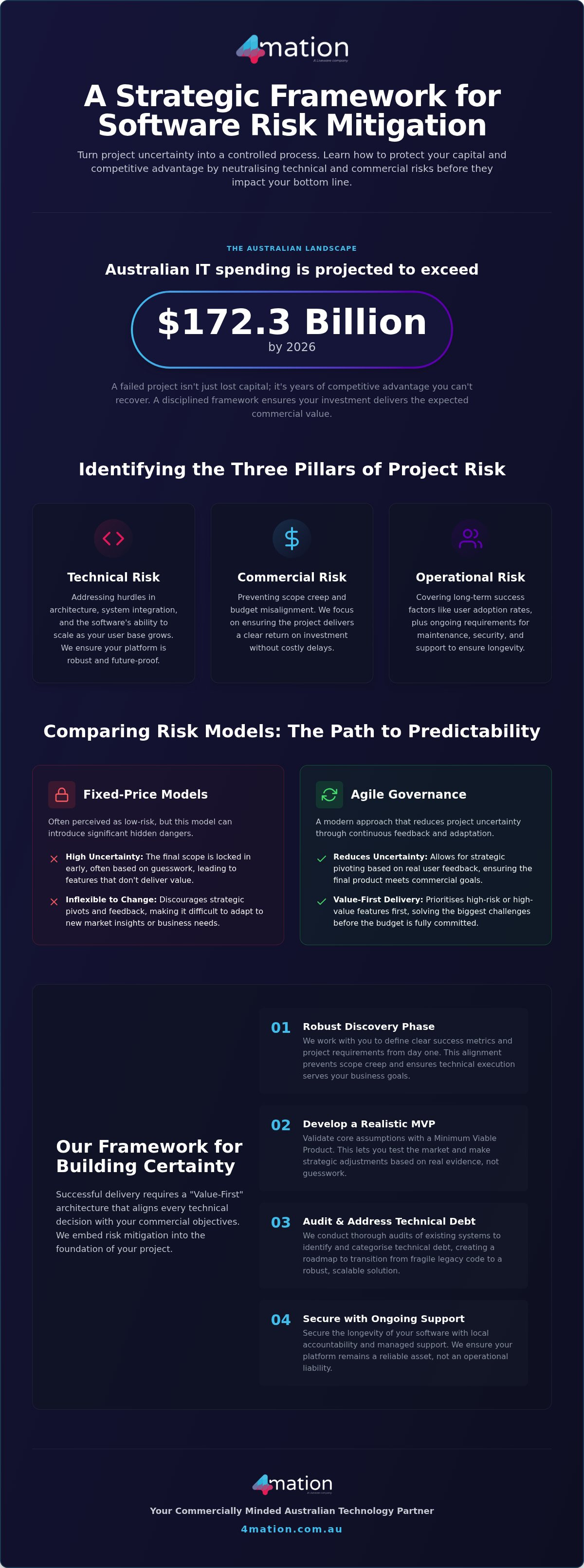
For many Australian executives, software development risk mitigation is often viewed as a defensive measure or a technical checklist. In reality, it’s a proactive business strategy designed to safeguard your capital and ensure your technology supports your commercial objectives. With IT spending in Australia set to exceed $172.3 billion by 2026, the stakes for successful delivery have never been higher. By treating risk as a governance framework, you can move from a position of uncertainty to one of calculated delivery. A project that misses its mark doesn’t just waste a budget; it erodes your competitive edge and stalls vital growth.
Project failure often has a ripple effect that extends far beyond the initial financial loss. Businesses face the consequence of missed market opportunities, damaged stakeholder trust, and operational downtime. Modernising legacy systems is a critical part of this landscape. Older infrastructures often lack the security and flexibility needed to meet new regulatory standards, such as the December 2026 automated decision-making transparency obligations. Transitioning these systems requires a steady hand to ensure data integrity and business continuity are maintained throughout the transformation.
Identifying the Three Pillars of Project Risk
To manage a project effectively, you must address three distinct areas of concern that can impact your final outcome. We work with you to categorise these risks early in the process:
- Technical risk: This involves hurdles in architecture, system integration, and the ability of the software to scale as your user base grows.
- Commercial risk: We focus on preventing scope creep and budget misalignment, ensuring the project delivers a clear return on investment without delays.
- Operational risk: This covers long-term factors like user adoption rates and the ongoing requirements for maintenance and support.
The Impact of Technical Debt on Scalability
Technical debt is a deferred cost of sub-optimal engineering. It often begins with “quick fixes” or shortcuts taken during the development phase to meet a tight deadline. While these choices might provide immediate relief, they create long-term financial burdens that hinder your ability to innovate. Unmanaged debt acts as a silent killer for business growth, making future updates more expensive and increasing the likelihood of system instability.
Identifying and categorising this debt is the first step toward recovery. We help you perform technical audits to understand where your current systems are falling short. By addressing these issues through technology support and maintenance, you can transition from fragile legacy code to robust, custom software solutions. This methodical approach ensures your platform remains a reliable asset rather than an operational liability, allowing you to scale without the need for massive, unplanned rework later.
A Strategic Framework for Software Development Risk Mitigation
Successful software delivery requires more than just skilled coding; it demands a “Value-First” architecture that aligns every technical decision with your commercial objectives. We believe that software development risk mitigation should be baked into the foundation of a project, rather than treated as an afterthought. By prioritising high-risk technical hurdles in early sprints, you ensure that the most complex challenges are solved before the bulk of your budget is committed. This methodical approach provides the certainty needed to maintain a predictable development roadmap while protecting your investment from unforeseen technical roadblocks.
The Discovery Phase: Building a Reliable Roadmap
A robust discovery phase is the cornerstone of a successful bespoke project. We work with you to define clear success metrics and project requirements from day one. This alignment ensures that your business goals and technical execution remain in sync, preventing the scope creep that often leads to budget overruns. By developing a realistic Minimum Viable Product (MVP), you can validate core assumptions with real users early. This process enables strategic adjustments based on evidence rather than guesswork, significantly reducing the risk of building features that don’t deliver measurable value to your organisation.
AI and Emerging Tech Risk Management
With 68% of Australian businesses already integrating AI according to a CSIRO report, the pressure to adopt emerging tech is high. However, rushing into implementation without a clear strategy often leads to data security vulnerabilities and integration failures. Our AI consulting services focus on addressing the “black box” problem, ensuring your custom solutions are transparent and explainable. This is particularly vital given the December 2026 transparency obligations for automated decision-making. We embed “Privacy by Design” into your systems, managing data risks while ensuring your AI models can scale alongside your business operations.
A controlled, achievable transformation starts with understanding the specific hurdles your organisation faces. If you’re unsure where to begin your modernisation journey, reach out to our Sydney-based team for a consultative discussion about your goals.
Comparing Risk Models: Fixed-Price vs. Agile Governance
Choosing the right engagement model is one of the most critical decisions in software development risk mitigation. On the surface, a fixed-price contract appears to offer the ultimate protection for your budget. It promises a specific set of features for a predetermined cost by a certain date. However, this often creates an “illusion of certainty.” In the complex world of custom software, requirements rarely stay static. When business needs shift, rigid contractual structures can transform a collaborative partnership into a series of “scope wars,” where the focus shifts from delivering value to arguing over line items.
A better approach involves balancing the need for financial predictability with the flexibility required to build high-performing technology. While we offer fixed-cost projects for well-defined scopes, we advocate for governance models that prioritise outcomes over rigid checklists. This ensures that your investment remains focused on solving business problems rather than simply ticking boxes on a stagnant requirements document.
The Pitfalls of Rigid Contractual Structures
Rigid contracts can unintentionally stifle innovation. When a team is locked into a fixed scope, there’s little room to explore better technical solutions that may emerge during the build. Even worse, it increases the risk of technical shortcuts. If a deadline is looming and the budget is tapped out, the pressure to “just make it work” can lead to the very technical debt that compromises your long-term scalability. We work with you to ensure the contract supports the project’s health, rather than becoming a barrier to quality.
Agile Governance: Managing Change without Chaos
Agile governance provides a framework for managing change through continuous feedback and disciplined execution. Rather than waiting months for a “big bang” release, we focus on regular, incremental deliveries. This approach offers several layers of protection:
- Data-driven pivots: Sprint reviews and retrospectives allow us to assess progress and adjust the roadmap based on actual user feedback.
- Reduced failure risk: Frequent releases ensure that any issues are identified and corrected early, preventing small bugs from becoming systemic failures.
- Backlog transparency: Maintaining a healthy, prioritised backlog keeps the project under control. You always know exactly what’s being built and why.
This level of transparency fosters a genuine partnership. By sharing accountability and maintaining open lines of communication, we ensure your project stays on track. It’s about being a “safe pair of hands” that can navigate the inevitable shifts in a development lifecycle without losing sight of your commercial goals.
5 Practical Steps to De-Risk Your Next Software Project
While governance models provide the strategic framework, the ultimate success of your build relies on the execution of specific, technical safeguards. Effective software development risk mitigation is achieved when you move beyond theory and implement practical measures that protect your timeline and budget. By focusing on early detection and modern engineering standards, you can ensure your project remains a valuable business asset rather than a growing liability. These five steps provide a clear path to delivery certainty.
Technical Audits and Legacy System Assessment
Modernising a legacy system without an audit is like renovating a house without checking the foundations. We work with you to evaluate the health of your existing codebase, identifying fragile components that could jeopardise the new build. This assessment reveals “single points of failure,” such as outdated integrations or undocumented logic, that pose a threat to business continuity. A “safe pair of hands” approach to legacy modernisation prioritises stability and data integrity, ensuring that critical business operations continue uninterrupted while transitioning to a modern architecture.
Modern Engineering Practices as Risk Insurance
- Code reviews: Regular peer assessments ensure security standards are met and logic remains clean across the entire team.
- Automated testing: Scripted tests catch bugs before they reach production, significantly reducing the cost of fixing errors.
- Living documentation: We treat documentation as a functional asset that evolves with the software, ensuring your internal teams aren’t left with a “black box” solution.
Establishing clear communication protocols and escalation paths is vital for maintaining project momentum. You need to know exactly who is responsible for what and how hurdles will be cleared. Prioritising system integration and data migration early in the lifecycle prevents the “big bang” integration issues that often delay launches. Finally, plan for technology support and maintenance from the initial build phase. Risk doesn’t end when the code is deployed; it shifts to operational stability and long-term maintenance.
If you’re ready to secure your next project with a disciplined, outcome-focused approach, contact our Sydney-based experts to discuss a technical audit of your current systems.
The 4mation Approach: Building Certainty into Every Build
At 4mation, we believe that effective software development risk mitigation is as much about disciplined governance as it is about high-quality code. Our Sydney-based team provides the local accountability and commercial wisdom required to navigate high-stakes digital transformations. We don’t just act as a technical vendor; we serve as a strategic ally that guides you through an end-to-end journey from initial digital strategy to long-term managed support. This holistic approach ensures that your software remains a high-performing business asset that evolves alongside your organisation.
Strategic Ally, Not Just a Service Provider
We prioritise business outcomes and measurable ROI over technical vanity. Since our founding in 2001, we’ve refined a methodical development process that allows us to manage complex system integrations with precision. Australian enterprises trust us because we speak the language of business, translating technical challenges into clear commercial opportunities. By focusing on your long-term goals, we ensure that every feature we build serves a specific purpose, reducing the risk of wasted investment and ensuring your platform is ready to scale.
- Local Expertise: Our Sydney team is always available for face-to-face collaboration, ensuring clear communication and alignment.
- Proven Track Record: With over two decades of experience, our mature processes are designed to handle the most intricate technical hurdles.
- Outcome-Focused: We measure our success by the tangible value our software delivers to your bottom line, not just by the lines of code written.
Managed Services: Securing Your Digital Future
The risk of project failure doesn’t end at the launch date; it shifts toward the threat of software obsolescence and rising technical debt. Our managed services transition your project from delivery to ongoing performance optimisation. We proactively maintain your applications to ensure they remain secure, stable, and compatible with emerging technologies. To provide the reliability your business demands, we leverage our global offices to offer 24/7 support, ensuring a “safe pair of hands” is always available to monitor your systems and resolve issues before they impact your operations.
This proactive maintenance model allows you to focus on your core business while we handle the complexities of technical upkeep and modernisation. We work with you to identify potential bottlenecks early, ensuring your digital infrastructure remains robust and competitive. If you’re ready to move forward with confidence, you can organise a strategy session with 4mation to de-risk your digital roadmap and secure the future of your bespoke software investment.
Secure Your Digital Investment with Confidence
Your bespoke software project should be a catalyst for growth, not a source of operational anxiety. By adopting a disciplined approach to software development risk mitigation, you ensure that technical decisions are always grounded in commercial reality. We’ve explored how a robust discovery phase, agile governance, and modern engineering practices create a predictable roadmap for success. These strategies don’t just prevent budget overruns; they build a foundation that allows your business to scale and adapt to future regulatory shifts.
As an award-winning Australian agency founded in 2001, 4mation has spent over 20 years acting as a “safe pair of hands” for complex enterprise digital transformations. Our team provides the expert AI consulting and managed services needed to maintain long-term stability and security. You don’t have to navigate the complexities of modernisation alone. We’re here to help you turn technical challenges into measurable business value through a transparent, collaborative partnership.
Speak with a 4mation strategist about your project today to start building your roadmap with certainty. We look forward to helping you achieve your digital goals.
Frequently Asked Questions
What are the most common risks in custom software development?
The most common risks include scope creep, budget overruns, and technical debt that limits future scalability. Without a disciplined framework, projects often drift away from their original commercial objectives. We address these by categorising risks into technical, commercial, and operational pillars. This ensures every decision made during the development lifecycle is measured against your specific business outcomes, protecting your capital from the hidden costs of project failure.
How does Agile methodology help in software development risk mitigation?
Agile methodology supports software development risk mitigation by replacing “big bang” releases with incremental, functional deliveries. This structure allows for continuous feedback loops and data-driven pivots based on real-world performance. By reviewing progress every sprint, we identify potential hurdles early. This iterative process prevents small technical issues from compounding into systemic failures, ensuring the final solution remains aligned with your evolving business needs and market conditions.
What is technical debt and why should I care about it?
Technical debt is the deferred cost of sub-optimal engineering choices made to meet short-term deadlines. You should care because unmanaged debt acts as a silent killer for business growth; it makes future updates more expensive and increases system instability. Proactively addressing this debt ensures your software remains a reliable asset. This methodical approach allows your platform to scale without the need for massive, unplanned rework that can stall your operations.
Can AI implementation increase my project risk?
Rushing into AI without a clear strategy can increase risks related to data privacy, security, and system integration. With the December 2026 transparency obligations for automated decision-making approaching, businesses must ensure their custom solutions are explainable and compliant. We mitigate these risks through expert consulting that embeds “Privacy by Design” into your architecture. This ensures your AI models deliver measurable value without creating new legal or operational vulnerabilities for your organisation. For entrepreneurs seeking to understand the fundamentals of this shift, AI Mastery provides a roadmap for integrating artificial intelligence into your business strategy.
How do I choose a reliable software development partner in Australia?
A reliable partner should offer local accountability and a mature, outcome-focused development process. Look for an agency with a proven track record in your specific industry and a “safe pair of hands” mentality toward complex integrations. It’s vital to choose a team that understands the commercial implications of technology. They should act as a strategic ally, focusing on your long-term stability and ROI rather than just technical delivery.
What is the difference between a fixed-price and a time-and-materials contract for risk?
Fixed-price contracts offer an illusion of certainty but can lead to “scope wars” when requirements shift. Conversely, time-and-materials models under agile governance provide the flexibility needed to build high-performing technology. While fixed costs work for well-defined scopes, agile models allow for continuous improvement based on user feedback. We advocate for outcome-oriented structures that balance budget predictability with the technical agility required to solve complex business problems effectively.
How does legacy system modernisation reduce operational risk?
Modernising legacy systems reduces operational risk by replacing fragile, outdated code with robust, secure architectures. Older systems often lack the flexibility needed to comply with new regulations or scale during periods of growth. By assessing and upgrading these foundations, you eliminate single points of failure and reduce maintenance costs. This transformation ensures your digital infrastructure remains a reliable support for your business operations rather than a growing technical liability.
Why is a discovery phase essential for de-risking a project?
A discovery phase is essential because it defines success metrics and project requirements before significant capital is committed. This process ensures stakeholder alignment, preventing the scope creep that often causes budget blowouts. By developing a realistic Minimum Viable Product (MVP), we validate core assumptions with real users early. This evidence-based approach allows for strategic adjustments, ensuring your project delivers a functional solution that meets your commercial goals and user expectations.
About The Author
