How to Write a Software Brief: Executive Guide
Jowena BorralDigital Marketing Specialist

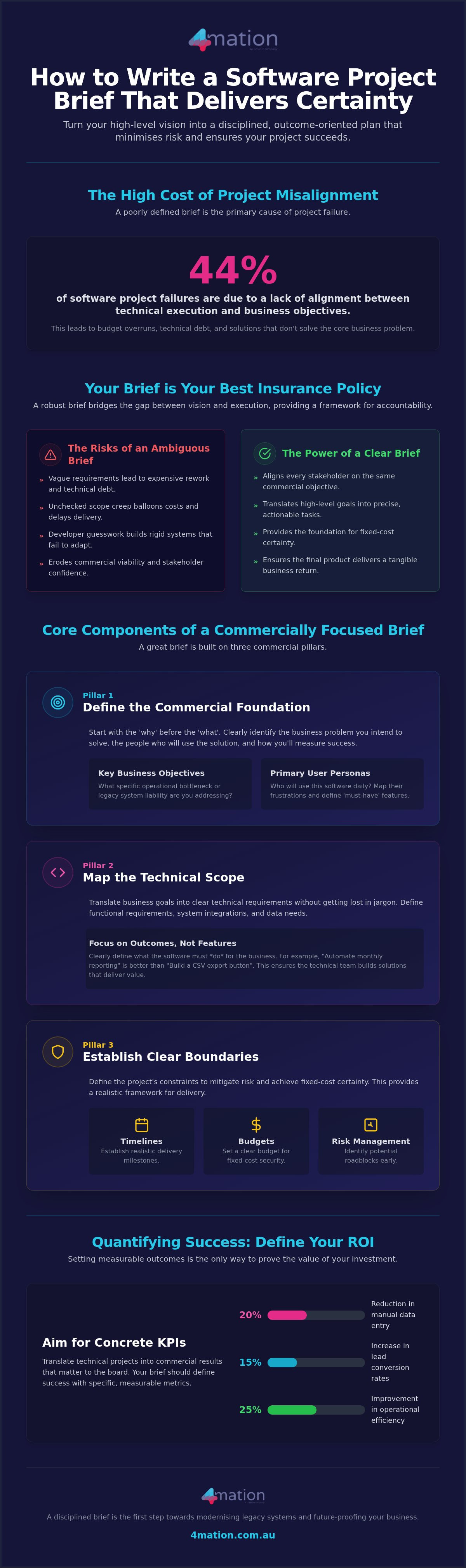
Did you know that 44% of software project failures are attributed to a lack of alignment between technical execution and business objectives? It’s a sobering reality for many Australian executives who worry that a simple miscommunication will lead to budget overruns or a solution that fails to modernise legacy systems effectively. Mastering how to write a software project brief is the single most important step you can take to bridge this gap, turning a high-level vision into a disciplined, outcome-oriented plan.
You likely believe that technology should be a foundational business asset rather than a source of financial stress. We agree that certainty is non-negotiable. This guide will show you how to craft a commercially focused brief that minimises risk, ensures budget certainty, and aligns your technical vision with measurable business outcomes. We’ll walk through the essential components of a roadmap that provides fixed-cost security and a solution that actually solves your business problems.
Key Takeaways
- Learn how a robust brief acts as an essential insurance policy to prevent technical debt and ensure long-term project certainty.
- Master how to write a software project brief that clearly defines functional requirements and system integrations without getting lost in technical jargon.
- Discover the framework for identifying key stakeholders and commercial objectives to ensure your software delivers a measurable return on investment.
- Understand how to establish realistic boundaries for budgets and timelines to achieve fixed-cost certainty and mitigate delivery risks.
- Explore how a disciplined, strategic approach can modernise legacy systems while future-proofing your business through custom software and AI consulting.
Why a Robust Software Project Brief is Your Best Insurance Policy
In the volatile world of technology, certainty is the ultimate currency. A robust brief acts as a commercial safeguard, protecting your investment from the unpredictability of development cycles. Much like a Project Charter in traditional management, a software brief formally authorises the work and defines the boundaries of success. When you understand how to write a software project brief effectively, you aren’t just listing features; you’re establishing a framework for accountability that minimises delivery risk before a single line of code is written. This alignment is essential for securing internal buy-in, as it provides the board with the confidence that the project is grounded in logic rather than technical guesswork.
The Cost of Ambiguity in Software Development
Vague requirements are the primary drivers of technical debt. When developers are forced to guess your intent, they often build rigid structures that require expensive refactoring later. Scope creep typically begins with a poorly defined brief, leading to mid-project pivots that can balloon costs and delay market entry. These pivots don’t just affect the timeline; they erode the commercial viability of the entire solution. A project brief is a strategic alignment tool that ensures every stakeholder is moving toward the same commercial objective. By clarifying expectations early, you avoid the “buyer’s remorse” that often follows large scale technology investments that fail to meet their initial promise.
Bridging the Gap Between Business Goals and Technical Execution
Executive vision often exists at a strategic level, while development happens at a granular level. The brief serves as the bridge, translating high-level goals into actionable tasks that developers can execute with precision. Defining success in commercial terms, such as increased operational efficiency or improved customer retention, ensures the technical team remains focused on what matters to the business. At 4mation, we start every engagement by deeply understanding your specific operational problem to ensure the final product delivers a tangible return. This disciplined approach allows us to offer a fixed-cost project model, providing the budget certainty and long term stability Australian businesses require to grow with confidence.
Defining the Commercial Foundation: Objectives, Users, and ROI
Every successful digital transformation starts with a clear understanding of the business problem it intends to solve. When considering how to write a software project brief, you must look beyond the technical features to the commercial impact. Are you aiming to solve a specific operational bottleneck, or is the goal to modernise a legacy system that has become a liability? A thorough “Current State” analysis identifies these pain points, ensuring the new solution doesn’t simply replicate old inefficiencies in a newer wrapper. This commercial foundation provides the context for more formal technical documents, such as Software Requirements Specifications (SRS), which will eventually guide the development team.
Identifying stakeholders is a critical part of this process. You need to distinguish between the primary users who will interact with the software daily and the secondary stakeholders, or buyers, who are invested in the commercial outcomes. Aligning these two groups ensures the project delivers value at every level of the organisation. If you’re feeling overwhelmed by the complexity of your current tech stack, our team can help you identify a clear path forward through strategic consultation.
Identifying Your Primary User Personas
Effective software design focuses on the user’s daily journey rather than just a list of buttons. Describe the frustrations your team faces with current tools. Do they spend hours on repetitive data entry? Is the current interface confusing? By mapping these frustrations, you can distinguish between “must-have” functionality that solves a problem and “nice-to-have” features that add unnecessary complexity. Linking user satisfaction directly to your digital strategy ensures high adoption rates and long term project viability.
Quantifying Success and Expected ROI
Setting measurable outcomes is the only way to prove the value of your investment to the board. Aim for concrete KPIs, such as a 20% reduction in manual data entry or a 15% increase in lead conversion rates. These figures turn a technical project into a commercial asset. Scalability is also a vital consideration. You must define where you want the software to be in five years to ensure the architecture can handle future growth. For real-world examples of how this structured approach translates into business value, explore 4mation’s case studies, where we detail our history of delivering measurable success for Australian enterprises.
Mapping the Technical Scope Without Getting Lost in Jargon
Translating a business vision into technical requirements is where many projects falter. When learning how to write a software project brief, the goal isn’t to dictate the code but to define the functional scope. You need to outline exactly what the software must do. Whether it’s processing a transaction or generating a report, clarity prevents costly assumptions. Equally important is mapping system integrations. Modern software rarely exists in a vacuum; it must communicate seamlessly with your existing CRM, ERP, or legacy databases. Identifying these touchpoints early ensures the architecture supports a unified data flow across your entire organisation.
Data security and privacy are paramount, especially under Australian regulations like the Privacy Act. Your brief should explicitly state compliance requirements to ensure the solution is “secure by design.” There is also a significant opportunity to enhance operations through AI Agents. These autonomous tools can automate complex workflows, transforming your software from a passive tool into an active business asset. By defining these technical boundaries early, you provide a clear roadmap for developers while maintaining control over the commercial outcome.
The Functional vs. Non-Functional Requirement Balance
A common mistake is focusing solely on features while neglecting performance and reliability. Functional requirements define what the system does, but non-functional requirements define how it performs under pressure. This includes load times, uptime guarantees, and scalability. To protect your investment, consider “Technology Insurance” through Managed Services early in the planning phase. This ensures your software remains stable and secure long after the initial build. Avoid the trap of over-specifying technical architecture too soon; leave room for your specialists to recommend the most efficient tools for the job.
Future-Proofing with AI and Modernisation
Determining if your project could benefit from AI Consulting is a vital step in future-proofing your brief. When briefing for AI, focus on data quality; for instance, just as analysts explore AI Stock Opportunity Discovery to find market advantages, your software can be designed to extract value from internal data. AI thrives on clean, structured data, and modernising legacy systems with AI-enabled features provides a competitive edge in the Australian market, ensuring you build a foundation for continuous improvement.
Establishing Boundaries: Timelines, Budgets, and Risk Management
Commercial certainty depends on well-defined constraints. When you understand how to write a software project brief, you create the fiscal and temporal guardrails necessary to protect your investment. A realistic timeline is not a single date but a series of disciplined phases, moving from strategy and design through to development, testing, and long term support. By identifying potential risks early, such as complex data migrations or volatile third-party API changes, you can choose an engagement model that matches your risk appetite. This proactive approach ensures that the project remains a strategic asset rather than a source of escalating costs.
Just as a software brief mitigates risk through clear definitions, complex logistics providers like D&T Freight rely on rigorous planning to manage heavy-machinery transport across Australia’s east coast, proving that operational certainty is the foundation of any successful project.
Budgeting for software requires a holistic view of the project lifecycle. Many executives fall into the trap of only accounting for the initial build, neglecting the essential stages of strategy, user experience design, and rigorous quality assurance. Bespoke software is a living asset that requires ongoing attention to remain effective in the Australian market. If you are ready to secure your project’s future with a disciplined roadmap, get in touch with our Sydney-led team to discuss your requirements.
The Reality of Software Development Timelines
Setting “ASAP” as a deadline is a recipe for technical debt and team burnout. Instead, establish meaningful milestones that allow for iterative feedback and adjustments. The speed of delivery is often dictated by internal resource availability, such as the time your stakeholders can dedicate to requirements gathering and testing. An MVP focuses on the core value proposition for early users, while a full-scale rollout delivers the complete, polished feature set required for enterprise-wide adoption. This phased approach allows you to realise value sooner while managing delivery risks effectively.
Budgeting for Long-Term Value, Not Just Initial Build
A detailed brief is the primary requirement for a fixed-cost project guarantee. This model provides the budget certainty boards require, as it shifts the risk of overruns away from your organisation. However, you must also allocate funds for continuous improvement to ensure the software evolves alongside your business. Understanding the total cost of ownership involves looking beyond the first release to the maintenance and scaling costs that will arise over the next five years. This long term perspective transforms software from a one-off expense into a durable foundation for growth.
From Brief to Build: How 4mation Delivers Fixed-Cost Certainty
While mastering how to write a software project brief is a vital first step, the true value lies in how that document is refined into a working solution. At 4mation, our “Pragmatic Visionary” approach ensures we don’t just build what is requested, but what is actually required to solve your commercial challenges. With 25 years of experience in the Australian market, we act as a strategic ally, turning your vision into a disciplined roadmap. Our Sydney-led team provides the local accountability and expertise needed to manage complex builds, while our global delivery scale ensures we remain agile and cost-effective. We’re committed to delivering projects that are fixed-cost, on-time, and bug-free, providing the peace of mind that executive stakeholders demand.
Moving from a static document to a dynamic partnership requires a shift in focus from technical specifications to commercial outcomes. We understand that technology is a foundational business asset, and our role is to ensure it delivers long term stability. As an Advanced Supplier in the NSW Government ICT Scheme, we adhere to the highest standards of delivery and integrity. By transforming your initial thoughts on how to write a software project brief into a technical reality, we help you avoid the common pitfalls of large-scale technology investments, such as buyer’s remorse and unnecessary complexity.
Our Collaborative Brief Refinement Process
We don’t simply take orders; we work alongside you to optimise the solution design. Our process often involves Rapid Prototyping to validate the assumptions in your brief early in the lifecycle. This allows us to test user journeys and functional requirements before significant resources are committed to full-scale development. If your internal team needs additional technical depth to execute the vision, we also offer Staff Augmentation. This ensures you have the right specialists in place to maintain the momentum of your project from the initial strategy through to design and final execution.
The Next Step: Your Project Strategy Session
A conversation with a specialist is often more valuable than a 50-page document. While a brief provides the foundation, a strategy session allows our solution architects to probe deeper into your operational problems and identify opportunities for modernisation. To prepare for this first meeting, gather your key stakeholders and clearly define your primary commercial objective. We’ll help you refine the technical details, ensuring the final roadmap is both ambitious and achievable. Don’t let a vague vision stall your progress. Contact our Sydney-led team to discuss your software project brief today.
Securing Your Technical Future with Commercial Clarity
A well-crafted brief is more than a technical requirement; it’s a strategic asset that safeguards your investment and ensures long-term stability. By focusing on measurable business outcomes and user journeys rather than just code, you transform technology from a source of anxiety into a foundational pillar for growth. Understanding how to write a software project brief correctly allows you to establish the boundaries needed for budget certainty and operational success.
With 25 years of Australian software excellence, 4mation provides the steady hand required to navigate complex digital transformations. As an AWS Select Consulting Partner, we offer a fixed-cost, on-time, and bug-free guarantee that eliminates the risks often associated with custom development. Our Sydney-led team is ready to help you refine your vision into a high-quality, functional reality that scales with your organisation.
Take the next step toward project certainty today. Discuss your project with 4mation’s expert strategists and turn your strategic vision into a tangible commercial advantage. We look forward to partnering with you on your next successful build.
Frequently Asked Questions
What is the difference between a project brief and a functional specification?
A software project brief focuses on the commercial “Why” and high-level “What,” whereas a functional specification details the granular technical “How.” Think of the brief as the strategic roadmap for stakeholders and the specification as the blueprint for developers. While the brief establishes the business objectives and user needs, the specification defines every button click and database interaction required to meet those goals.
How long should a software project brief be?
A software project brief should be concise enough to remain actionable, typically ranging between five and ten pages. The focus must be on clarity and strategic alignment rather than sheer volume. A 50-page document often contains unnecessary fluff that obscures the core business problem. Providing a clear summary of objectives, user personas, and success metrics is more valuable than an exhaustive list of every possible feature.
Do I need to include a specific budget in my software brief?
Including a budget range in your brief is highly recommended to ensure the proposed solution is commercially viable. It allows your development partner to recommend the most effective features and architecture within your financial constraints. Without this transparency, you risk receiving a proposal that is either technically insufficient or financially out of reach. Clear parameters help align expectations and facilitate a more productive strategy session.
Should I specify the technology stack (like .NET or React) in my brief?
You should only specify a technology stack if you have a strict requirement for legacy system integration or internal maintenance capabilities. If your organisation isn’t tied to a specific environment, it’s often better to let your specialist recommend the best tools for the job. Focusing on the desired business outcomes in your brief allows architects to select a modern stack that ensures long term scalability and performance.
How do I brief for a project that involves Artificial Intelligence?
Briefing for an AI project requires a specific focus on data quality and the desired automation outcome. Instead of specifying algorithms, describe the task you want to automate or the insight you need to gain from your data. Understanding how to write a software project brief for AI involves identifying where your current data lives and what “success” looks like in terms of operational efficiency or decision-making.
What happens if I don’t have all the technical details ready for the brief?
You don’t need all the technical details ready to start; the brief is primarily about defining the business problem. A professional agency will use your brief as a starting point to conduct deeper technical discovery. Your role is to provide the commercial context and user insights, while the solution architects will handle the complexities of system architecture and integration requirements during the refinement phase.
Can 4mation help me write my project brief from scratch?
Yes, 4mation can help you refine your ideas into a comprehensive roadmap through our strategic consulting services. We often work with executives who have a clear vision but need help articulating the technical requirements. Our team facilitates strategy sessions that bridge the gap between your commercial goals and technical execution, ensuring your how to write a software project brief journey leads to a fixed-cost, successful delivery.
How does a detailed brief help in getting a fixed-cost quote?
A detailed brief provides the clarity needed to eliminate the “unknowns” that typically lead to budget overruns. By defining the project boundaries, integrations, and user requirements early, you allow the agency to estimate the effort with high precision. This transparency is what enables a fixed-cost guarantee, as it shifts the risk of ambiguity away from the client and ensures everyone is aligned on the final delivery.
About The Author
