Common Mistakes in Software Development Projects: A Checklist for Australian Business Leaders
Jowena BorralDigital Marketing Specialist

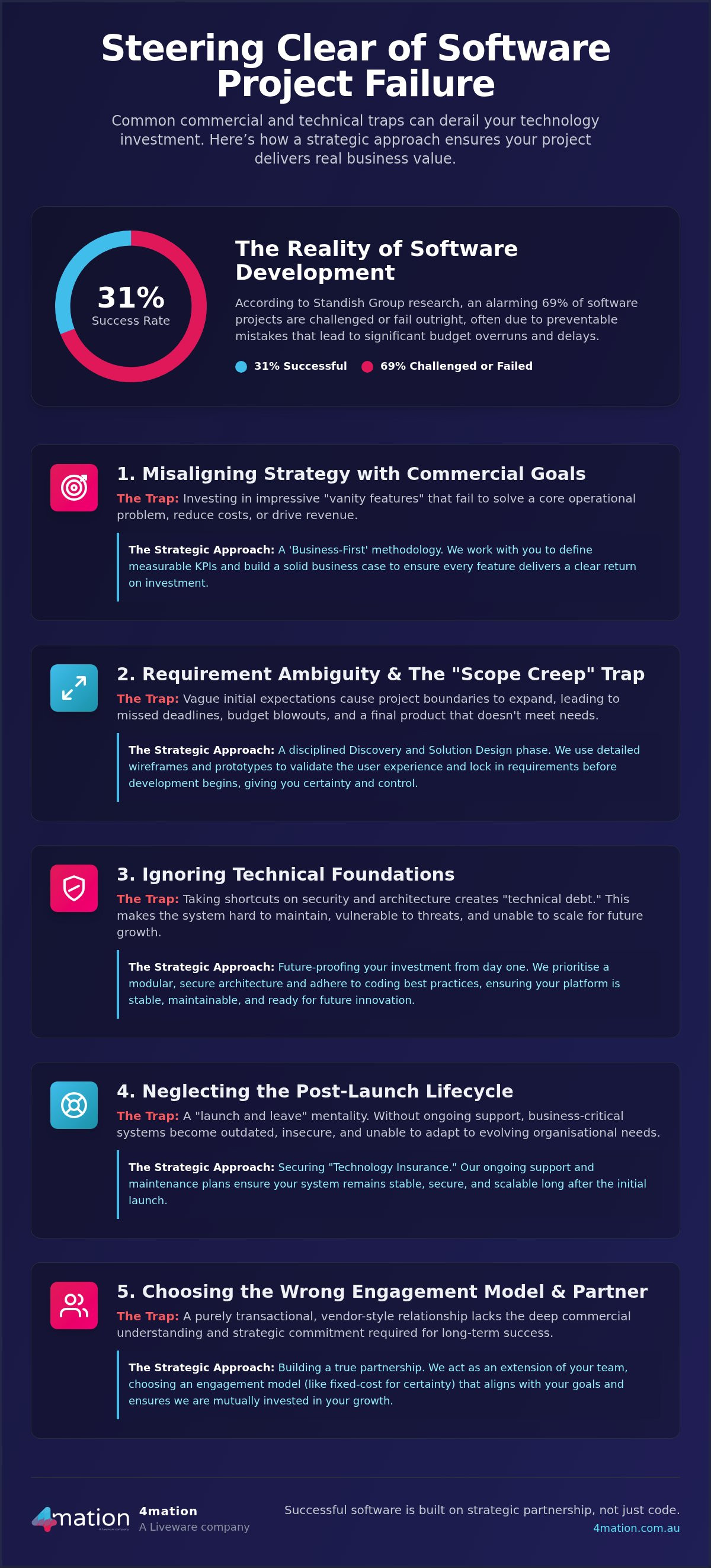
Did you know that only 31% of software projects are considered truly successful? According to the Standish Group’s research, the remaining 69% often fall victim to common mistakes in software development projects, resulting in significant delays and budget overruns. For many Australian business leaders, these figures reflect a familiar frustration: the gap between a promising digital vision and the reality of a system that doesn’t quite deliver. You’ve likely experienced the anxiety of a timeline blowing out or the disappointment of investing in features that your team simply doesn’t use.
It’s a common struggle, but these setbacks aren’t inevitable. By identifying these pitfalls early, you can move from reactive troubleshooting to strategic growth. This article provides a clear checklist to help you avoid the commercial and technical traps that drain resources and stall progress. We’ll explore how to navigate legacy system constraints, ensure transparency from your partners, and select the right engagement model to guarantee measurable business value. Together, we can transform your technology from a source of risk into a reliable foundation for your organisation’s long-term success.
Key Takeaways
- Learn how to align your software strategy with specific commercial objectives to ensure every feature delivers measurable operational value.
- Identify the common mistakes in software development projects that trigger scope creep and discover how a fixed-cost model provides budget certainty.
- Understand why treating security and technical debt as foundational priorities reduces long-term risk and prevents costly system failures.
- Discover the importance of “Technology Insurance” through ongoing support to keep your business-critical systems stable and scalable after launch.
- Evaluate different engagement models to move beyond a vendor relationship and secure a strategic partner committed to your long-term growth.
Misaligning Software Strategy with Commercial Objectives
One of the most common mistakes in software development projects isn’t found in the code; it’s found in the boardroom. Commercial misalignment happens when an organisation invests in “cool tech” that fails to solve a core operational problem. While a feature might seem impressive during a demo, it adds zero value if it doesn’t reduce costs, increase revenue, or improve efficiency. We often see businesses seduced by trends, only to realise later that the solution doesn’t actually fit their workflow or customer needs.
Vanity features are the primary culprit here. These are the “nice-to-have” additions that stakeholders request because they’ve seen them elsewhere, rather than because they serve a business goal. This unnecessary complexity drains your budget and stalls your ability to scale. Every dollar spent on a feature that doesn’t move the needle on your commercial objectives is a dollar taken away from your competitive advantage. To prevent this, every project must begin with a comprehensive Digital Strategy focused on measurable value.
A Business-First approach to software engineering ensures that every technical decision is dictated by the specific commercial outcomes and operational efficiencies you need to achieve.
The ROI Trap: Building Without a Business Case
Building custom software without a solid business case is a high-risk gamble. You need a clear “Problem-Solution” fit to justify the investment. Before our team writes a single line of code, we work with you to identify “wasted time” in your current manual processes. If a task currently takes your staff three hours to complete, the new system should aim to finish it in minutes. Without these benchmarks, you can’t measure success. You must set clear KPIs for software performance, such as reduced processing times or improved conversion rates, to ensure the project delivers a genuine return on investment.
Ignoring Scalability and Future-Proofing
The 2026 business landscape will be defined by rapid AI adoption and stricter privacy regulations. Building for “today” without considering these shifts is a recipe for expensive rework. If your software architecture isn’t modular, you’re essentially creating legacy debt from day one. You need to balance the speed of “Rapid Prototyping” with the necessity of long-term platform stability. By adhering to coding best practices, you ensure your system remains maintainable and secure as your organisation grows. This disciplined approach prevents your technology from becoming a rigid bottleneck that prevents future innovation.
Requirement Ambiguity and the “Scope Creep” Trap
Vague expectations are the primary driver of project friction in Australian organisations. When a project begins with broad strokes instead of specific outcomes, the result is almost always a misalignment between what is built and what is actually needed. This ambiguity is one of the most frequent common mistakes in software development projects, leading directly to the scope creep trap where boundaries expand while the budget and timeline remain fixed.
The consequences of poorly defined requirements go beyond simple frustration. Missed deadlines represent more than a scheduling delay; they represent lost market opportunity and wasted internal resources. Rising costs often follow as developers spend time unpicking features that don’t fit the user’s actual workflow. At 4mation, we mitigate these software development obstacles by using a disciplined Solution Design process before any development begins.
By involving UX/UI designers early, we create a visual representation of the requirements through detailed wireframes. This allows you to validate the user experience and ensure the functionality aligns with your commercial goals before we commit to the build phase. It provides a sense of control and certainty that is often missing in traditional development models.
Mistake: Skipping the Discovery and Design Phase
A jump-in-and-code mentality might feel like progress, but it is a significant commercial risk. Without a Discovery phase, you are building on assumptions rather than data. We recommend using a Rapid Prototype to test core features with real users. This validates your product-market fit early and prevents the expensive rework that occurs when expectations aren’t managed through visual designs.
Checklist: Indicators of Poorly Defined Requirements
To help you assess your current project’s health, look for these indicators of requirement ambiguity:
- Undefined user roles and permissions: It’s unclear who can access, edit, or delete specific data within the system.
- Lack of clear acceptance criteria: There’s no objective standard for what constitutes a bug-free or completed feature.
- Missing integration maps: It hasn’t been determined exactly how the new software will talk to your existing CRM, ERP, or accounting systems.
If you recognise these signs in your current project, you can speak with our team to help get your roadmap back on track.
Technical Shortcuts: Security, Debt, and AI Hype
The cheapest quote often creates the most expensive project. Choosing the lowest initial price is one of the most frequent common mistakes in software development projects, as it usually involves taking technical shortcuts that lead to “Technical Debt.” This debt is essentially a high-interest loan; you save money today but pay significantly more later in maintenance, bug fixes, and system instability. Research firm IDC predicts that by 2027, organisations failing to address this debt will face 50% higher failure rates for their AI initiatives.
Security is another area where shortcuts are commercially fatal. In Australia, the average cost of a data breach reached $2.55 million in 2025. With new rules under the Privacy Act 1988 coming into force on December 10, 2026, transparency about automated decision-making and data handling is no longer optional. You must treat security as a foundational requirement from day one, rather than an “add-on” at the end of the build. Working with local specialists ensures your project adheres to Australian data sovereignty standards and local regulatory frameworks.
The Danger of Unmaintainable Code
Your software is a business asset, and it must be built to last. A significant risk in custom development is “Key Person Dependency,” where your system relies on a single developer’s unique, undocumented coding style. If that person leaves, your project stalls. We prevent this by using standard, modern frameworks like .NET, React, or Node.js. This approach ensures your code is clean, well-documented, and ready for future integrations. It provides the long-term stability you need to scale without being held hostage by a single vendor or individual.
Implementing AI Without a Clear Workflow
While 69% of Australian small-to-medium businesses reported using AI by early 2026, many are struggling to see a genuine return on investment. The mistake is treating AI as a “magic pill” for operational inefficiency without first fixing the underlying workflow. Through AI Consulting, we help you identify specific manual tasks that are ripe for automation. Our focus is on AI Workplace Modernisation, ensuring that any implementation is secure and built within enterprise-grade ecosystems like AWS, Microsoft, or Google. This pragmatic approach delivers measurable business value rather than just a novelty chatbot.
Neglecting the Post-Launch Lifecycle and Support
Many executives mistakenly view the “Go-Live” date as the finish line. In reality, this is the moment your investment begins its true lifecycle. Neglecting the post-launch phase is among the most frequent common mistakes in software development projects, often leading to rapid system degradation and security vulnerabilities. Without a structured plan for Service Desk and Technology Support, you effectively operate without “Technology Insurance.” If a business-critical system fails during a peak period, the financial impact of downtime can be devastating. In Australia, where it takes an average of 241 days to identify and contain a data breach, having a dedicated support team isn’t just about fixing bugs; it’s about protecting your commercial reputation.
The Cost of Reactive vs. Proactive Maintenance
Fixing things only when they break is a strategy that prioritises short-term savings over long-term stability. This reactive mindset leads to emergency costs, unpredictable disruptions, and a frustrated workforce. Conversely, a proactive approach uses constant monitoring and regular updates to ensure peak performance. This is where Continuous Improvement becomes a genuine competitive advantage. It allows you to refine features based on real user feedback, keeping your platform relevant as your market evolves. By investing in ongoing optimisation, you transform your software from a static tool into a dynamic driver of business growth. Stagnation is the silent killer of ROI; if your software isn’t moving forward, it’s falling behind your competitors.
Lack of Proper Documentation and Training
Even the most sophisticated software fails if your team isn’t equipped to use it effectively. Lack of proper documentation and training creates internal “knowledge silos” that threaten your operational continuity. If the only person who understands a specific workflow leaves the company, your productivity stalls immediately. You must insist on comprehensive documentation and structured handovers to maintain full ownership of your technical assets. This transparency ensures your organisation remains agile and independent, with the ability to manage and scale the system as your goals evolve. Ensuring your staff feel confident in the new system is the final, vital step in securing the measurable business value you set out to achieve.
To secure the longevity and reliability of your digital infrastructure, you can speak with our managed services team about protecting your investment.
Choosing the Wrong Engagement Model and Partner
Selecting a development partner is one of the most significant commercial decisions you’ll make, yet many organisations treat it as a simple procurement exercise. Choosing a “vendor” who merely follows instructions rather than a “strategic partner” who challenges your assumptions is among the most frequent common mistakes in software development projects. A vendor will build exactly what you ask for, even if it’s commercially flawed; a partner will work with you to ensure every feature drives measurable business value. This distinction often determines whether a project becomes a successful asset or a costly liability.
The engagement model you choose also dictates your level of delivery risk. While many agencies push for open-ended billing, a Fixed-Cost Project provides the ultimate protection against budget blowouts. It shifts the responsibility of scope management to the partner, ensuring your project remains on-time and on-budget. Other common mistakes in software development projects include ignoring red flags during the evaluation phase, such as a lack of transparency regarding local versus offshore resources or a partner’s inability to explain technical concepts in pragmatic business language.
Fixed-Cost vs. Ongoing Agile: Which Fits Your Risk Profile?
Choosing between engagement models requires a clear understanding of your project’s maturity. We recommend a Fixed-Cost model when you need absolute certainty for a well-defined scope, as it includes a bug-free guarantee and a clear delivery roadmap. Conversely, an Ongoing Agile model or Staff Augmentation is better suited for evolving products that require rapid iteration based on user feedback. 4mation helps you decide on the best Engagement Model by assessing your specific goals, timeline, and appetite for risk, ensuring the commercial structure supports your technical success.
The Importance of Local Australian Expertise
Clear communication and timezone alignment are vital for reducing delivery friction. Working with a Sydney-led team of 40+ local specialists ensures that your strategic goals aren’t lost in translation. As part of the Liveware Group, we combine this local expertise with global delivery support to provide a scalable, reliable service. You can verify an agency’s track record by reviewing their Case Studies and looking for evidence of long-term client success. With 25 years of experience in the Australian market, we understand that technology is a foundational business asset that requires a safe pair of hands to manage and sustain over time.
Turning Technology Risks into Strategic Assets
Successful software delivery isn’t just about code; it’s about commercial alignment and disciplined execution. By moving away from vague requirements and addressing technical debt early, you protect your organisation from the most common mistakes in software development projects. A fixed-outcome approach provides the certainty you need to scale with confidence; it ensures your technology remains a foundational asset rather than a growing liability.
At 4mation, we bring 25 years of experience in delivering measurable business value to Australian organisations. As an AWS Select Consulting Partner and Great Place to Work certified agency, we prioritise a business-first methodology that guarantees results. Our Fixed-Cost model ensures your project is delivered on-time, on-budget, and remains bug-free, giving you total control over your digital investment.
Ready to transform your vision into a high-performing reality? Book a consultation with our Sydney-led team to discuss your project goals today. Together, we can build the stable and scalable solutions your business deserves.
Frequently Asked Questions
What are the most common reasons software projects fail in Australia?
Software projects in Australia primarily fail due to a lack of commercial alignment and poorly defined requirements. When a build focuses on features rather than solving an operational problem, it results in wasted budget. These common mistakes in software development projects often lead to the 69% failure or “challenged” rate reported by the Standish Group. Ensuring your technology strategy matches your business goals is the first step toward securing a successful outcome.
How does a Fixed-Cost engagement model reduce my project risk?
A Fixed-Cost model provides budget and timeline certainty by defining the project scope upfront. Unlike open-ended billing models, this approach shifts the delivery risk to your technology partner. At 4mation, our Fixed-Cost projects include an on-time, on-budget, and bug-free guarantee. This gives you total control over your investment and prevents the financial surprises that often derail custom builds. It’s the most reliable way to achieve a specific business result with minimal risk.
What is “Technology Insurance” and why does my business need it?
Technology Insurance refers to a structured managed services and support plan that protects your digital assets after launch. It ensures your business-critical systems remain stable and secure through proactive monitoring rather than reactive fixes. Without this support, a single system failure can lead to significant revenue loss and operational downtime. Investing in a dedicated service desk provides the peace of mind that your technology will continue to scale and perform as your organisation grows.
How can I avoid scope creep in my custom software build?
You can avoid scope creep by investing in a disciplined Discovery and Solution Design phase before development begins. This process uses detailed wireframes and prototypes to validate requirements with real users early. By setting clear acceptance criteria and mapping integrations upfront, you remove the ambiguity that leads to “I thought it would do X” conversations later. This structured approach keeps the project focused on the core features that deliver the highest commercial value.
Is it better to use an Australian-based development team or offshore?
Local teams offer superior communication, timezone alignment, and a deeper understanding of Australian regulatory standards. While offshore options may seem cheaper initially, they often lead to common mistakes in software development projects like delivery friction and security vulnerabilities. A Sydney-led team ensures your data handling complies with the Privacy Act 1988 and provides a “safe pair of hands” for strategic consulting. This proximity allows for a more collaborative partnership and faster response times.
How do I know if my legacy system needs modernisation or a full rebuild?
Your decision depends on whether your current architecture can support modern requirements like AI integration and scalability. If your legacy system is rigid and creates high maintenance costs, a full rebuild might be more cost-effective than continuous patching. We conduct a thorough assessment of your technical debt to determine if modernisation is viable. Often, a modular rebuild allows you to innovate faster and reduces the long-term risk of a business-critical system failure.
What role does AI play in modern software development projects?
At 4mation, we use AI as a tool for workplace modernisation and automating manual processes rather than as a standalone novelty. Our AI consulting helps identify specific areas where automation can reduce processing times and human error. Successful implementation requires a secure, enterprise-grade ecosystem like AWS or Microsoft. By focusing on practical applications that solve real business problems, AI becomes a powerful driver of operational efficiency and measurable ROI.
How can I ensure my software project delivers a clear ROI?
To ensure ROI, you must start with a business-first approach that identifies the specific commercial problem you’re solving. Set measurable KPIs before development starts, such as reducing manual processing time or increasing conversion rates. Every feature should be evaluated against its ability to move these metrics. By prioritising outcomes over technical capabilities, you ensure that your software investment delivers a tangible return and supports your long-term strategic growth.
About The Author
