Cost of Custom Software Maintenance for Australian Leaders
Jowena BorralDigital Marketing Specialist

Viewing your monthly maintenance invoice as a simple repair bill is a risky oversight that can quietly erode your digital advantage. For many Australian executives, the cost to maintain custom software feels like an unpredictable tax on innovation rather than a strategic investment. You’re likely familiar with the frustration of ‘bug fix’ line items that seem to offer little visible value, or the growing anxiety that your core systems are becoming insecure as new regulations like the 2025 Cyber Security Rules come into play.
We understand that it’s difficult to justify ongoing spend to non-technical stakeholders when the outcomes aren’t always immediately obvious. This article moves past the jargon to uncover the commercial drivers that dictate your maintenance requirements. You’ll discover a practical budgeting framework based on industry benchmarks and learn how a proactive partnership model acts as ‘technology insurance’ for your business. We’ll show you how to reduce technical debt and ensure your software remains a reliable, high-performing engine for growth.
Key Takeaways
- Understand why initial development is only the beginning of your investment and how to balance capital expenditure with ongoing operational support.
- Learn how to apply the 15-20% industry benchmark to create a predictable and transparent annual budget for your digital assets.
- Identify the commercial drivers, such as code complexity and third-party integrations, that directly impact the total cost to maintain custom software.
- Discover how a ‘Technology Insurance’ model provides proactive monitoring to prevent system obsolescence and mitigate security risks.
- Gain a clear framework to communicate the strategic value of software maintenance to non-technical stakeholders and protect against technical debt.
Beyond the Build: Understanding the Total Cost of Ownership (TCO)
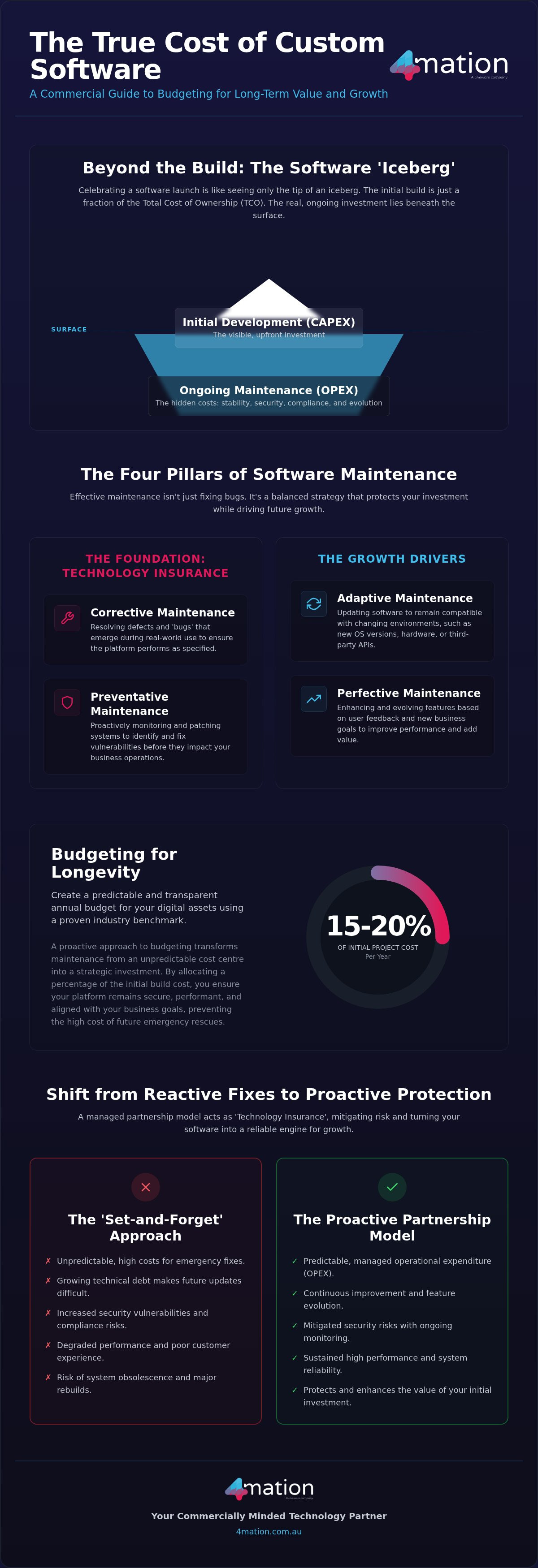
Business leaders often celebrate the launch of a new system as the finish line. In reality, it’s just the beginning of the software’s lifecycle. Think of it as the software iceberg. The initial development is the visible peak, while the substantial bulk of the total cost of ownership (TCO) remains hidden beneath the surface. Failing to account for this can lead to budget blowouts and strategic misalignment.
The initial build represents your Capital Expenditure (CAPEX). It’s the investment required to bring the vision to life. However, the long-term success of that investment depends on your Operational Expenditure (OPEX). This covers the ongoing evolution, security patches, and support that keep the system competitive. Understanding Software Maintenance is vital here; it’s not just about fixing what’s broken but ensuring the system adapts to changing business needs. Budgeting for the cost to maintain custom software shouldn’t be an afterthought. A ‘set-and-forget’ approach leads to performance lag and security vulnerabilities that can cripple your operations.
The Shift from Project to Platform
Transitioning from a project-based mindset to a platform-based one is essential for scaling. When you view your software as a living business asset, you open the door to continuous improvement. By leveraging custom software development for ongoing iterations, you can refine the user experience based on real-world feedback. This ensures your technology evolves alongside your business rather than becoming a legacy burden. It’s about building a foundation that supports long-term growth and operational certainty.
Hidden Costs of Neglecting Maintenance
Ignoring maintenance creates technical debt. This is the ‘compounding interest’ of the tech world. Every shortcut taken or update skipped makes future innovation more difficult and expensive. If you neglect your system, you eventually face the high price of emergency project rescue. This reactive approach is far more costly than steady, managed support from a partner who understands your codebase. Neglect also risks degrading your customer experience, as slow or buggy systems quickly drive users toward your competitors. Proactive care ensures your initial investment delivers measurable business value and remains a secure, high-performing asset for years to come. By managing the cost to maintain custom software through a disciplined roadmap, you protect your digital assets from the risks of obsolescence.
The Four Pillars of Software Maintenance Costs
Many executives view software maintenance as a reactive expense, similar to a plumber fixing a leak. However, a commercially minded approach treats maintenance as a multidimensional strategy to keep your digital assets relevant and high-performing. When calculating the Total Cost of Ownership, you must account for four distinct pillars that distribute your annual budget across both stability and growth. Effectively managing the cost to maintain custom software requires a disciplined balance between ‘keeping the lights on’ and ‘adding new value’. This prevents your system from becoming a legacy burden while ensuring it continues to support your revenue goals.
A typical annual maintenance budget is generally allocated across these functional areas:
- System Stability: Resolving latent defects and addressing security patches.
- Infrastructure: Managing cloud hosting and third-party API dependencies.
- Continuous Compliance: Updating systems to meet new Australian privacy and security regulations.
- Feature Evolution: Enhancing the platform based on shifting user expectations.
Corrective and Preventative: The Foundation
Corrective maintenance is the most familiar pillar, involving the resolution of latent defects or ‘bugs’ that only emerge after real-world use. While no system is perfect at launch, these fixes ensure the platform continues to meet its original specifications. Preventative maintenance, however, moves the needle from reactive to proactive. By implementing rigorous monitoring and regular system health checks, we identify and resolve potential vulnerabilities before they impact your users or operational flow. At 4mation, we treat these foundational pillars as ‘Technology Insurance’. This model prioritises the reduction of operational risk, ensuring your business remains steady even as external technical pressures increase. It’s a methodical way to protect your initial investment from the ‘compounding interest’ of technical debt.
Adaptive and Perfective: The Growth Drivers
The digital environment is constantly shifting. Adaptive maintenance ensures your software remains compatible with new operating system versions, browser updates, and emerging AI integrations. Without this adaptation, a system that worked perfectly yesterday can become obsolete tomorrow. Perfective maintenance is the process of enhancing software based on user feedback to improve performance. This pillar focuses on refining user experience (UX) and optimising features to drive better commercial outcomes. By aligning these growth drivers with your broader digital strategy, you transform your software from a static tool into a dynamic asset that scales with your ambitions. This proactive evolution ensures your platform delivers a superior experience compared to competitors who let their systems stagnate. If you’re looking to refine your current support model, our specialists can help you optimise your maintenance roadmap to ensure every dollar spent creates measurable value.
Key Drivers of Ongoing Maintenance Expenses
The cost to maintain custom software isn’t a static figure. It’s influenced by several commercial and technical variables that determine how much effort is required to keep your system operational and secure. One of the most significant factors is the original quality of the codebase. Systems built with ‘spaghetti code’ lack a clear structure, which often doubles the time required for even simple updates. This lack of modularity creates a ripple effect where a change in one area causes unexpected failures elsewhere, driving up your monthly support hours.
Managing your infrastructure is another recurring driver. Whether you use AWS or Azure, cloud costs require active management to avoid ‘bill shock’ from inefficient resource allocation. As an AWS Select Consulting Partner, we’ve seen how unoptimised environments lead to wasted expenditure that could be better spent on feature evolution. Balancing these infrastructure fees with software updates is vital for maintaining a healthy bottom line.
The Impact of System Integration
Modern platforms rarely exist in isolation. They rely on complex system integration with payment gateways, CRMs, and logistics providers. These connections require constant ‘handshake’ maintenance. When an external provider updates their API, your system must adapt to prevent ‘breaking changes’ from disrupting your business workflow. This ongoing synchronisation is a key component of the 15-20% Industry Benchmark for annual maintenance. Having a partner who understands these interdependencies reduces the risk of data silos or service outages that frustrate your customers.
Evolving Security Standards
Security is a fundamental business requirement that demands consistent investment. The Australian Cyber Security Centre (ACSC) receives a cybercrime report approximately every six minutes. This frequency highlights why proactive monitoring and regular patching are non-negotiable expenses for any Australian leader. New regulations, such as the Cyber Security Rules 2025, introduce mandatory standards that organisations must meet to stay compliant. Additionally, expanded obligations under the Privacy Act 1988 are expected across 2026 and 2027. These changes affect how you handle customer data, making regular compliance audits and security updates essential. Investing in steady, managed support ensures your platform remains a secure asset rather than a liability. This proactive approach acts as technology insurance, protecting your brand from the reputational and financial damage of a data breach.
Budgeting for Longevity: The 15-20% Industry Benchmark
Just as ensuring safety on public roads requires specialised design and planning from Acquired Awareness Traffic Management, maintaining your digital infrastructure demands a high level of technical expertise and foresight to ensure long-term compliance and security.
This requirement for ongoing specialist care is a common thread across all critical systems; for instance, McMahons Civil and Contracting PTY LTD provides the same level of rigorous oversight for complex civil, mining, and rail infrastructure projects across Australia.
Determining a predictable budget for your digital platform is essential for avoiding the ‘buyer’s remorse’ often associated with technology investments. While your initial capital expenditure gets the software live, your operational budget keeps it competitive. This benchmark isn’t arbitrary; it’s a commercially recognised standard designed to ensure long-term stability. Most Australian organisations find that the annual cost to maintain custom software settles between 15% and 20% of the original development cost. This range provides enough coverage for security patches, minor optimisations, and the ‘Technology Insurance’ required to mitigate operational risk.
Certain factors will naturally push your requirements toward the higher end of this scale. High-traffic platforms with complex 24/7 availability requirements or systems burdened by legacy technical debt often demand more intensive care. A $200,000 build typically requires a $30,000 to $40,000 annual maintenance budget to remain secure. By establishing this figure early, you move from reactive ‘firefighting’ to a disciplined roadmap of continuous improvement.
Choosing the Right Engagement Model
Success depends on selecting a partnership model that aligns with your internal capabilities. For defined tasks with a clear scope, a Fixed-Outcome model offers budget certainty and measurable delivery. If your team needs to accelerate development or manage specific technical debt, Staff Augmentation allows you to embed specialists directly into your workflow. To further strengthen your internal team, you can explore the RPL process with Right Pathway to help your experienced staff convert their practical knowledge into nationally recognised qualifications. For most leaders, however, a Managed Services approach via a dedicated Service Desk provides the most comprehensive support. This model ensures you have a ‘safe pair of hands’ available for everything from proactive monitoring to rapid incident response, allowing your internal team to focus on high-level strategy.
Professional maintenance is an investment in business continuity rather than just a line-item expense. When you calculate the true cost to maintain custom software, you must weigh it against the potential cost of system downtime or a security breach. Regular support extends the functional lifespan of your software, delaying the need for an expensive and disruptive total rebuild. It also ensures that your customer experience remains seamless, which directly impacts user retention and brand trust. By prioritising steady, managed evolution, you transform your software into a high-performing asset that grows alongside your business. To ensure your financial health keeps pace with your digital growth, Australian small businesses often rely on ASAP Solutions for expert tax and accounting guidance. If you’re ready to secure your digital future, you can contact our team for a maintenance consultation to discuss a model that fits your specific goals.
Navigating the ongoing cost to maintain custom software often feels like a defensive play, but it’s actually your strongest offensive strategy. At 4mation, we reframe this necessity as ‘Technology Insurance’. This isn’t just about a help desk that responds when something breaks. It’s a disciplined, proactive framework designed to protect your digital assets from the volatility of the tech landscape. By shifting from a reactive mindset to a strategic one, you ensure your software remains a reliable engine for growth rather than a source of operational anxiety.
With 25 years of success in the Australian market, we understand that reliability is non-negotiable for local leaders. Our Service Desk model moves you away from the exhausting cycle of reactive ‘firefighting’ and toward a steady state of platform health. We provide the steady hand needed to navigate complex challenges, prioritising incident response and proactive monitoring. This approach ensures your systems remain available and secure, allowing you to focus on high-level business strategy with total peace of mind.
The 4mation Approach to Ongoing Support
Our methodology blends foundational maintenance with continuous improvement and development. This dual focus ensures your platform isn’t just ‘functional’, but constantly evolving to meet your shifting commercial goals. We leverage deep local expertise combined with a robust delivery model to provide 24/7 reliability. This ensures your platform remains secure, stable, and scalable as your user base grows. By identifying opportunities for platform optimisation early, we help you avoid the compounding interest of technical debt and ensure every dollar spent contributes to your competitive advantage.
Next Steps for Your Organisation
Securing your digital future begins with a clear understanding of your current technical posture. We recommend conducting a comprehensive software health check to identify immediate risks and hidden technical debt that could inflate your future cost to maintain custom software. Once these baseline risks are identified, you can define your commercial objectives for the next 12 to 24 months with greater certainty. Transformation should feel controlled and achievable, backed by evidence and a clear roadmap.
Whether you’re looking to stabilise a legacy system or support a high-growth platform, we work with you to ensure your technology remains a foundational business asset. Contact 4mation today to discuss your technology support needs and discover how our partnership model can remove risk and drive measurable value for your organisation.
Secure Your Digital Advantage
Your custom software is a foundational business asset that requires a disciplined roadmap to remain competitive. By understanding the true cost to maintain custom software, you move from reactive budgeting to a strategic model that prioritises longevity and security. Embracing the 15-20% industry benchmark ensures you have the necessary resources to evolve your platform while mitigating the compounding interest of technical debt. This transition from ‘firefighting’ to proactive care is essential for protecting your initial investment.
With 25 years of experience delivering secure and scalable solutions, 4mation acts as a steady hand for Australian leaders. As an Advanced Supplier in the NSW Government ICT Services Scheme, we provide the certainty of a fixed-cost, bug-free guarantee on project outcomes. We work with you to transform maintenance from a monthly bill into a high-performing engine for business growth. Our partnership model ensures your technology remains stable, secure, and ready to scale.
Protect your digital investment with 4mation’s Technology Insurance today. We’re ready to help you remove operational risk and ensure your technology delivers measurable success for years to come.
Frequently Asked Questions
What is the average annual cost to maintain custom software?
The average annual cost to maintain custom software typically ranges between 15% and 20% of the initial development price. This benchmark ensures your platform remains secure and functional while adapting to new technical requirements. For a $200,000 build, you should budget $30,000 to $40,000 annually. This investment covers security patches, minor feature refinements, and the proactive monitoring required to prevent system obsolescence and protect your commercial advantage.
Why is maintenance for custom software so expensive compared to SaaS?
Custom software maintenance costs reflect the dedicated nature of the platform. Unlike SaaS, where support costs are shared across thousands of users, custom platforms require specific attention to a unique codebase. You aren’t just paying for generic updates; you’re investing in the evolution of a bespoke business asset. This ensures the system continues to meet your specific operational needs and integrates seamlessly with your internal workflows without the limitations of off-the-shelf products.
What happens if I stop paying for software maintenance?
Ceasing maintenance leads to immediate security vulnerabilities and gradual system degradation. Without regular updates, your software becomes susceptible to evolving threats like those reported to the ACSC every six minutes. You also risk non-compliance with new regulations like the 2025 Cyber Security Rules. Over time, the ‘compounding interest’ of technical debt makes future changes significantly more expensive, eventually requiring a total system rebuild that costs far more than steady support.
Does the 15-20% rule apply to mobile apps as well as web apps?
The 15-20% benchmark applies to both, though mobile apps often sit at the higher end of the scale. Mobile platforms require frequent updates to maintain compatibility with new iOS and Android versions, as well as a diverse range of hardware. Neglecting these updates can lead to app store delisting or broken user experiences. Whether it’s a web application or a mobile app, consistent investment is required to ensure the platform remains stable and secure.
How can I reduce my ongoing software maintenance costs?
Reducing the cost to maintain custom software starts with high-quality initial development. Well-architected code is easier and cheaper to update than ‘spaghetti code’ that lacks structure. Implementing a proactive ‘Technology Insurance’ model also prevents small issues from escalating into expensive emergency repairs. By investing in regular, managed support, you avoid the high price of project rescue and ensure your infrastructure is optimised to prevent wasted cloud expenditure on AWS or Azure.
What is included in a typical managed IT support agreement in Australia?
A typical managed support agreement in Australia includes proactive monitoring, security patching, and incident response. At 4mation, our Service Desk model goes beyond simple bug fixes to include continuous improvement and platform optimisation. This ensures your software complies with local standards like the Privacy Act 1988 while maintaining peak performance. You gain a ‘safe pair of hands’ that manages everything from cloud infrastructure to third-party API handshakes, providing total operational certainty.
How does technical debt affect my maintenance budget over time?
Technical debt acts as a tax on your future innovation. If you skip regular maintenance, small workarounds accumulate and make the codebase increasingly complex and fragile. This effectively doubles the time and cost required for future updates or new feature rollouts. By addressing these issues early through a disciplined support model, you keep your maintenance budget predictable and ensure your system remains a flexible asset rather than a rigid liability.
Can 4mation help maintain software built by another agency?
Yes, 4mation frequently takes over the support of platforms built by other agencies or internal teams. We begin with a comprehensive software health check to identify immediate risks and document the existing codebase. This methodical approach ensures a smooth transition and allows us to provide a reliable support roadmap. With 25 years of experience, we have the technical depth required to stabilise legacy systems and align them with your current commercial goals.
About The Author
