2026 Mobile App Comparison for Australian Organisations
4mation Technologies

With over 90% of Australians now owning a smartphone, the success of your mobile strategy depends less on being present and more on how your architecture aligns with your specific commercial objectives. It’s a common concern for local executives; the fear that choosing the wrong framework today will lead to expensive budget blowouts, missed deadlines, or a legacy system that refuses to talk to your modern infrastructure. You need certainty that your investment in mobile app development will solve complex business problems rather than create new ones.
We understand that the technical noise around Native, Flutter, and React Native can be overwhelming when you’re focused on operational efficiency. This guide provides a clear, commercially minded framework to help you choose the right architecture with confidence. You’ll learn how to ensure a fixed-cost, on-time delivery while building a scalable solution that integrates seamlessly with your existing business systems. Together, we will compare the leading platforms of 2026, examine the practicalities of long-term ROI, and show you how to turn technical complexity into a measurable competitive advantage for your organisation.
Key Takeaways
- Understand how to align your mobile architecture with specific commercial goals to ensure your technology investment delivers long-term scalability and ROI.
- Learn why modern mobile app development must act as a functional bridge between your legacy systems and new AI-driven automation to improve operational efficiency.
- Recognise why the initial build typically accounts for only 40% of the total cost of ownership and how to plan for sustainable maintenance.
- Discover how a structured discovery and strategy phase validates your business requirements early to ensure a fixed-cost, on-time delivery without technical surprises.
- Identify the value of partnering with an experienced Sydney-led team that provides full-lifecycle support from initial design through to ongoing managed services.
Mobile App Development in 2026: More Than Just Code
In 2026, mobile app development has moved far beyond simply establishing a digital presence. For Australian mid-market organisations, an app is no longer a standalone tool; it’s a critical engine for automating complex business processes. Many leaders find their growth is stalled by legacy systems that don’t communicate with modern software. A well-architected mobile solution acts as the necessary bridge, connecting these older databases with modern, AI-driven workflows to improve operational efficiency and data accuracy.
The consequence of “feature-first” thinking is often a solution that looks good but fails to solve the underlying commercial problem. When you focus solely on a list of technical capabilities, you risk creating a fragmented experience that adds complexity instead of removing it. This approach frequently leads to budget overruns and low user adoption. In contrast, an “outcome-first” strategy ensures that every technical decision serves a specific business goal, such as reducing manual processing times or improving customer retention rates. By starting with the desired result, you turn technology into a measurable business asset.
Solving Complex Problems with Strategic Design
A successful project begins with a robust digital strategy to identify exactly where technology can remove friction. We move beyond basic utility to create intuitive experiences that drive genuine engagement. This strategic approach reduces delivery risk by validating requirements before a single line of code is written. In 2026, a “business-first” methodology is the only way to ensure your mobile investment remains relevant as your organisation evolves. It’s about building for longevity and ensuring your software can adapt to changing market demands.
The 2026 Mobile Ecosystem
The modern mobile app development process now integrates practical AI as a standard requirement. This isn’t about chasing trends; it’s about implementing functional tools like AI agents and automated workflows that handle routine tasks without human intervention. To support these capabilities, a cloud-native architecture is vital for ensuring your app can scale as your user base grows. For enterprise-grade applications, security and stability are non-negotiable. We prioritise these foundations to protect your data and ensure your systems remain reliable under heavy operational pressure, providing the certainty you need to grow.
Native vs. Cross-Platform vs. PWA: A Commercial Comparison
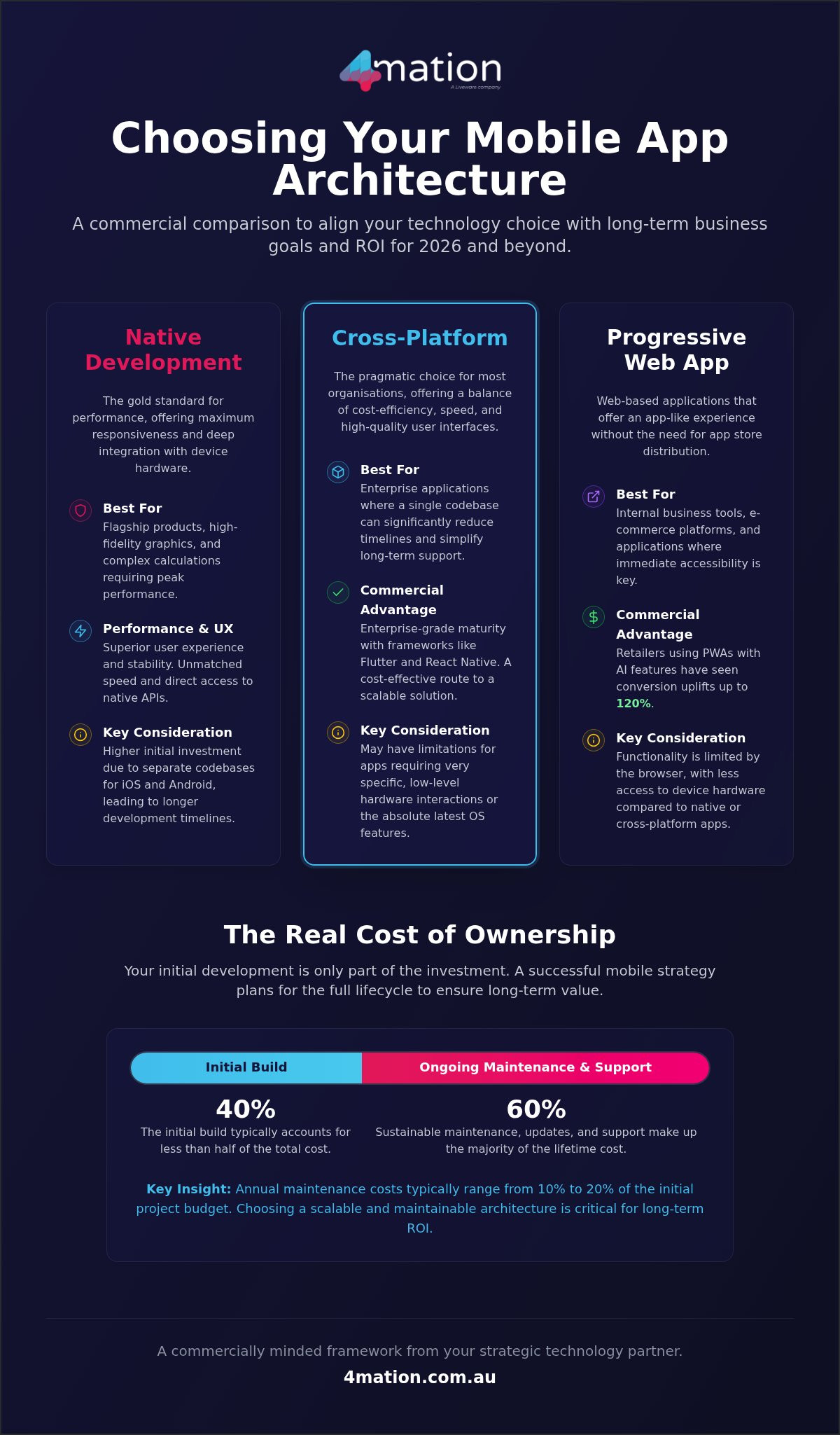
Selecting the right architecture for your mobile app development is a strategic decision that directly impacts your delivery certainty and long-term ROI. In 2026, the choice between Native, Cross-Platform, and Progressive Web Apps (PWA) should be driven by your specific commercial requirements rather than technical preference. You need a framework that balances development speed with the ongoing cost of maintenance; which typically runs between 10% and 20% of your initial budget annually.
Native development remains the gold standard for high-performance mobile app development when your project requires maximum responsiveness. If your application involves complex calculations, high-fidelity graphics, or deep integration with device hardware, Native is often the most reliable path. While the initial investment is higher because you are building separate codebases for iOS and Android, the superior user experience and stability often justify the cost for customer-facing flagship products.
Cross-platform frameworks like Flutter and React Native have reached a level of enterprise maturity that makes them the default choice for most Australian organisations. They allow you to maintain a single codebase, which significantly reduces development timelines and simplifies long-term support. This approach offers a pragmatic balance between cost-efficiency and high-quality user interfaces, ensuring your solution remains scalable as your business grows.
Progressive Web Apps (PWAs) are increasingly popular for internal business tools and retail applications that don’t require app store distribution. With the global PWA market projected to reach USD $3.32 billion in 2026, many businesses are adopting this architecture to improve accessibility. Retailers using PWAs with AI-powered features have seen conversion uplifts of up to 120% compared to standard web solutions, making them a highly effective option for e-commerce.
When to Choose Native Development
You should prioritise Native development when your solution relies on specific hardware integrations such as biometrics or advanced sensors. These features require the low-latency access that only a Native architecture can provide. While this requires a larger upfront commitment, it eliminates the risk of performance bottlenecks that can frustrate users and damage your brand reputation. It is a “safe pair of hands” approach for high-stakes enterprise applications that demand absolute reliability.
The Rise of Cross-Platform Certainty
Modern mobile development strategies often favour cross-platform frameworks to accelerate delivery without compromising on quality. Flutter and React Native provide the stability needed for complex business logic while ensuring your app feels responsive on any device. By choosing this route, you can allocate more of your budget toward user-centric features rather than redundant coding across different platforms. If you are unsure which path fits your specific goals, we can discuss your requirements to find the most cost-effective architecture for your project.
Calculating the Real Cost: Development vs. Maintenance
The initial launch of a mobile project is often viewed as the finish line, but commercially, it’s just the beginning of your investment’s lifecycle. For most successful Australian organisations, the initial build for mobile app development represents approximately 40% of the total cost of ownership (TCO) over a five-year period. The remaining 60% is allocated to maintenance, infrastructure, and the continuous improvement required to keep the solution performant. Treating your app as a “set and forget” asset is a high-risk strategy that leads to technical obsolescence and diminished ROI.
Proactive monitoring and support act as “technology insurance” for your business-critical assets. This involves more than just fixing bugs; it’s about ensuring your app remains compatible with new operating system releases like iOS 27 and Android 17. Maintaining high standards of data privacy and transparency is not just a regulatory requirement; it’s a core component of your app’s ongoing value and customer trust. Investing in a partner that prioritises these foundations ensures your technology remains a stable asset rather than a growing liability that requires a total rebuild every few years.
Understanding Technical Debt
Rushed mobile app development often leads to technical debt; a build-up of “quick fixes” that eventually stall your ability to innovate. When you bypass proper architecture for speed, you’re essentially borrowing against your future growth. This debt eventually makes it difficult to modernise legacy systems or integrate new AI-driven features. A robust service desk is essential for managing this risk, providing the disciplined support needed to keep your business-critical apps running smoothly while you focus on strategic goals.
Continuous Improvement and Development
Your app needs an ongoing development roadmap to stay relevant in a competitive market. This involves regular updates based on user feedback and evolving business needs, which drives a much higher ROI than a one-off build. To maintain this momentum, many organisations utilise staff augmentation to scale their internal teams without the overhead of permanent hiring. This collaborative approach allows you to manage cloud service costs effectively by optimising resource allocation as your traffic fluctuates. It ensures your mobile solution continues to solve complex business problems as your organisation grows, preventing the stagnation that often follows a successful launch.
The 4mation Roadmap: Minimising Risk from Discovery to Deployment
Successful mobile app development isn’t just about technical execution; it’s about disciplined risk management. We’ve seen many organisations lose significant capital by rushing into the build phase before fully validating their commercial requirements. Our roadmap is designed to eliminate this uncertainty by providing a structured, outcome-focused path from initial concept to a stable, scalable deployment. By prioritising clarity at the start, we ensure that your technology investment delivers a measurable return without the stress of unexpected technical hurdles.
Discovery and Solution Design
Every project begins with a deep dive into your business logic and user needs to define measurable outcomes. We work with you to identify exactly how a mobile solution can reduce manual administrative tasks or increase customer engagement. During this phase, we pinpoint specific opportunities for AI integration that can automate routine workflows and provide predictive insights for your team. By using rapid prototyping, we test these concepts early in the process. This allows you to see how the solution functions and make necessary adjustments before making a heavy investment in full-scale development. It’s a pragmatic way to avoid expensive pivots and ensure the final interface is practical and user-centric.
Fixed-Cost Project Delivery
For non-technical stakeholders, the “fear of the unknown” is often the biggest barrier to technology investment. We address this directly through our Fixed-Cost project model, which provides a clear guarantee that your app will be delivered on-time, on-budget, and bug-free. We don’t just build a standalone mobile tool; we ensure it integrates seamlessly with your custom cloud software to provide a unified data environment. This end-to-end approach ensures your new mobile solution strengthens your existing infrastructure rather than creating a new silo. It provides the certainty you need to move forward with confidence, knowing that the project scope is managed by an experienced Australian-led team.
By following this methodical process, we turn a complex technology project into a predictable business investment. This disciplined approach removes the anxiety often associated with large-scale software builds and replaces it with a clear, staged progression toward your goals. If you are ready to move from a concept to a high-performing digital asset that solves real business problems, contact our Sydney-led team to discuss your roadmap.
Choosing a Strategic Partner for Your Mobile Project
Selecting a partner for your mobile app development is the final and most critical step in ensuring your project delivers a measurable return. It’s about more than just finding a vendor to write code; it’s about securing a strategic ally that understands the Australian commercial landscape and can deliver a solution that integrates with your long-term goals. A full-lifecycle partner provides value from the initial strategy through to ongoing managed services, ensuring your technology remains a stable asset as your organisation scales. This end-to-end involvement prevents the communication silos that often lead to delivery risk and technical debt.
You should base your decision on evidence and documented success. Reviewing case studies allows you to see how a partner has solved similar business problems for other Australian organisations. It’s about finding a “safe pair of hands” with a history of delivering on-time and on-budget. Your choice of engagement model should also reflect your specific needs. We offer flexible options, including Fixed-Cost projects for defined scopes where certainty is paramount, or staff augmentation when you need to scale your internal team’s capacity with senior specialists.
The Benefit of Local Accountability
Having a Sydney-led team means you have direct access to senior tech specialists and strategists who are accountable for your success. We understand the local regulatory environment and the specific industry standards that Australian mid-market and enterprise buyers must meet. With 25 years of experience, we’ve developed a methodical approach that prioritises reliability and transparency. This local presence reduces communication friction and ensures that your project remains a priority throughout every stage of the development lifecycle, from the first discovery session to long-term maintenance.
Next Steps for Your Organisation
Before committing to a build, we recommend conducting an internal readiness assessment to identify your primary business constraints and desired outcomes. You might find that your modernisation needs extend beyond a mobile interface; for example, a custom CRM development project might be the necessary foundation for improving your internal data workflows. Understanding these dependencies early ensures that your technology investment is targeted where it will have the most significant impact on your operational efficiency.
We invite you to book a consultation with our strategists to discuss your specific business challenge. Together, we can evaluate your current infrastructure and determine the most effective roadmap for your organisation’s digital modernisation. Our goal is to provide the clarity and technical expertise you need to make an informed decision that drives long-term value for your business.
Securing Your Mobile Strategy for 2026 and Beyond
Navigating the complexities of mobile app development requires a partner that prioritises your commercial outcomes over technical trends. By aligning your chosen architecture with specific business goals and accounting for the long-term total cost of ownership, you can transform a digital project into a high-performing business asset. Success lies in a disciplined roadmap; one that validates requirements through discovery and prototyping before committing to a full build. This methodical approach ensures your technology remains a stable foundation for growth rather than a source of technical debt.
With 25 years of experience delivering successful software for Australian organisations, our Sydney-led team of 40+ local tech specialists is here to provide the certainty you need. We eliminate the anxiety of budget blowouts and missed deadlines with our Fixed-Cost, on-time, and bug-free guarantee. Whether you’re modernising legacy systems or building a new customer-facing platform, we work as your strategic ally to ensure every technical decision drives measurable ROI. Solve your complex business problems with a Fixed-Cost mobile app project. Contact 4mation today. We look forward to helping you achieve long-term stability and operational excellence.
Frequently Asked Questions
How much does mobile app development cost in Australia in 2026?
The cost of mobile app development depends on your specific requirements, system integrations, and desired functionality. While simpler applications require a smaller investment, complex enterprise-grade solutions with AI automation and legacy system connections involve a more significant commitment. It’s also important to plan for ongoing maintenance, which typically accounts for 10% to 20% of the initial budget annually to ensure your app remains secure and performant as technology evolves.
What is the difference between native and cross-platform app development?
The primary difference lies in how the code interacts with the device’s operating system. Native development involves building separate apps for iOS and Android to achieve maximum performance and hardware access. Cross-platform development uses a single codebase for both, which is typically more cost-effective and faster to market. Most Australian organisations now favour cross-platform frameworks because they provide a high-quality experience while significantly reducing long-term maintenance requirements and development timelines.
How long does it typically take to build a custom enterprise mobile app?
Building a custom enterprise mobile app typically takes between four and nine months depending on complexity and integration requirements. This timeline includes discovery, design, development, and rigorous testing. We use rapid prototyping early in the process to validate your business logic, which helps prevent expensive pivots later. Our structured roadmap ensures we meet your specific deadlines while maintaining the high levels of stability and security required for business-critical applications.
Can a mobile app be integrated with our existing legacy software systems?
Yes, modern mobile applications are designed to integrate seamlessly with existing legacy systems. We specialise in complex system integration, using secure APIs to connect your new mobile interface with older databases or ERPs. This approach allows you to modernise your operations and automate manual workflows without the risk of a full system replacement. It protects your previous technology investments while providing your team with the modern tools they need.
How does the 4mation Fixed-Cost guarantee work for mobile projects?
Our Fixed-Cost guarantee ensures your project is delivered on-time, on-budget, and bug-free. We achieve this through a disciplined discovery and solution design phase where we define every requirement before any development begins. This model removes the delivery risk and budget ambiguity often associated with custom software. It allows your leadership team to invest with confidence, knowing the final cost and outcome are secured by an experienced Australian-led team.
Do we need an AI strategy before starting mobile app development?
You don’t need a formal AI strategy before starting, as we identify practical AI opportunities during our initial discovery process. In 2026, mobile app development naturally incorporates AI for tasks like predictive analytics or automated support. We focus on “business-first” technology, ensuring any AI integration serves a clear purpose, such as reducing manual processing or improving data accuracy, rather than just implementing technology for the sake of a trend.
What is “technology insurance” and why does my app need it?
Technology insurance is our model for proactive monitoring, maintenance, and support for business-critical platforms. It ensures your app remains secure, performant, and compatible with new operating system updates long after the initial launch. By investing in this proactive care, you prevent the technical debt that leads to system failures or security vulnerabilities. This approach provides the long-term stability needed for platforms that support essential business functions and large user bases.
Should we build for iOS or Android first?
We generally recommend building for both iOS and Android simultaneously using cross-platform architecture. With smartphone penetration over 90% in Australia, a dual-platform launch ensures you don’t alienate a significant portion of your users or customers. However, if your specific user data shows a heavy bias toward one operating system, we can tailor the roadmap to prioritise that platform while ensuring the underlying architecture remains ready for a future multi-platform rollout.
About The Author
