Long-term Software Maintenance: A Strategic Comparison for Australian Organisations
Jowena BorralDigital Marketing Specialist

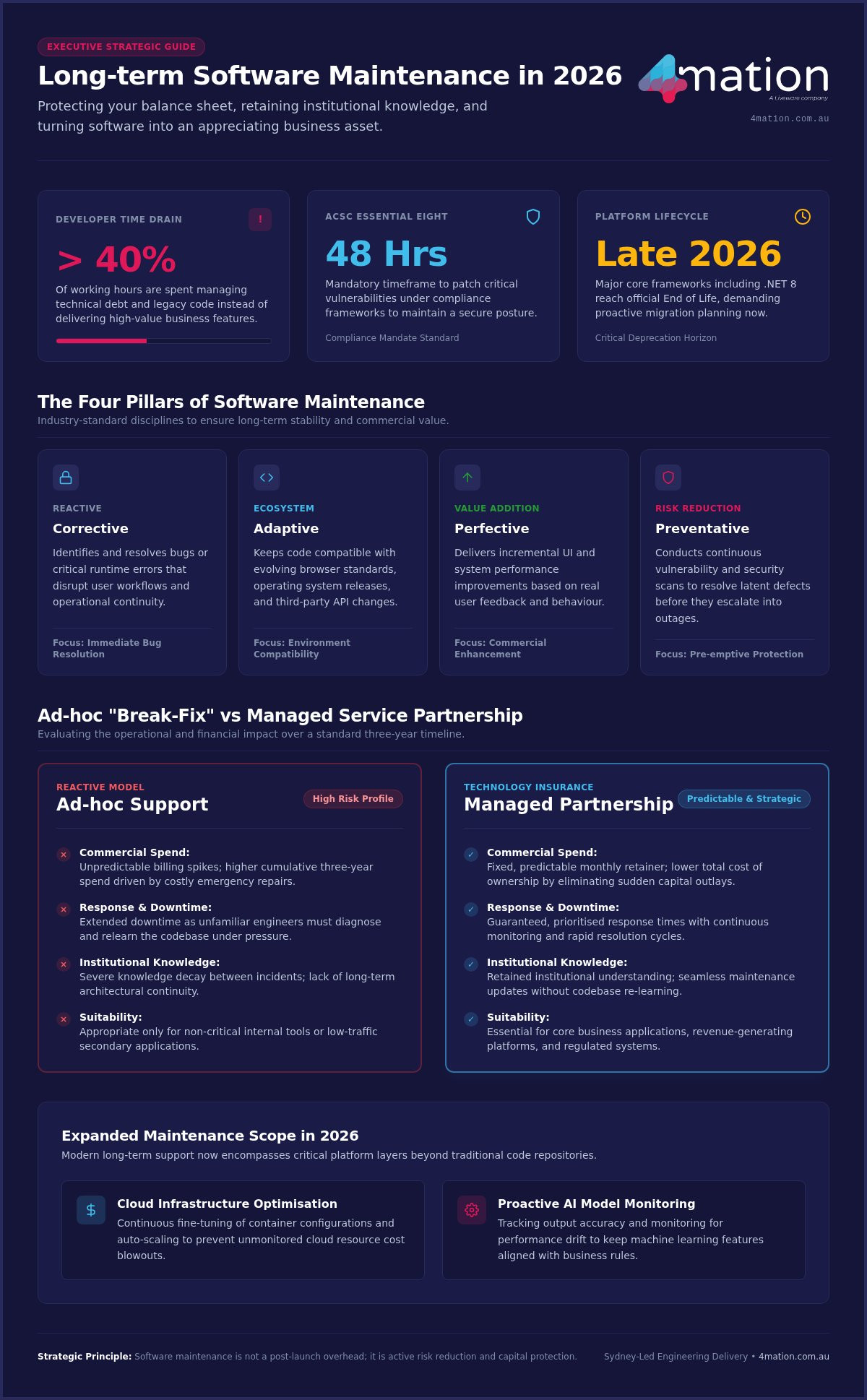
Did you know that developers often spend more than 40% of their working hours managing technical debt and legacy code rather than shipping high-value features? For many Australian executives, software can feel like a depreciating asset that becomes more expensive and fragile with every passing year. You’ve likely experienced the mounting pressure of rising operational costs, or perhaps the underlying fear that a lack of long term software maintenance could lead to a significant system outage. It’s a common challenge, but it doesn’t have to be your organisation’s status quo.
In this article, we’ll demonstrate how to protect your technology investment by moving away from reactive “break-fix” cycles. We’ll compare proactive managed services against ad-hoc support models to help you transition to a model of technology insurance that provides certainty in a volatile market. By the end, you’ll have a clear roadmap to achieve reduced operational risk, a predictable technology spend, and software that scales alongside your commercial goals.
Key Takeaways
- Understand why modern software maintenance in 2026 must include proactive AI model monitoring and cloud infrastructure optimisation to remain competitive.
- Compare the hidden risks of reactive “break-fix” support against the predictable reliability of a managed service partnership.
- Learn how investing in long term software maintenance serves as technology insurance, protecting your balance sheet from the compounding interest of technical debt.
- Identify the essential traits of a strategic technology partner, including local Sydney-led leadership and full-lifecycle development capabilities.
- Discover how a hybrid service desk model provides the stability of incident response alongside the agility of continuous, incremental software improvements.
What is Long-term Software Maintenance in 2026?
Software is often misunderstood as a static product delivered at the end of a project. In reality, it’s a living business asset that begins its most critical phase the moment it goes live. Effective long term software maintenance is the disciplined process of optimising, updating, and repairing code to ensure it remains functional and valuable over time. By 2026, the scope of this work has expanded. It’s no longer just about code; it now includes monitoring AI models for performance drift and fine-tuning cloud infrastructure to prevent cost blowouts.
Transitioning from simple bug fixing to strategic platform evolution is essential for sustainable growth. While a “break-fix” approach focuses on the past, evolution focuses on the future. Regular servicing keeps your technology healthy. Think of it like a high-performance vehicle. You don’t wait for the engine to seize before checking the oil; you maintain it to ensure it remains a reliable tool for your journey.
The Four Pillars of Software Support
To understand how to protect your technology investment, it helps to look at how industry standards categorise software maintenance types. These four pillars ensure your system remains robust and relevant:
- Corrective maintenance: This is the reactive side of support. It involves identifying and resolving bugs or system errors that interfere with the user experience.
- Adaptive maintenance: Technology doesn’t exist in a vacuum. This pillar involves updating your software to ensure it stays compatible with new browser versions, operating systems, or third-party API changes.
- Perfective maintenance: This is where you add commercial value. It involves making incremental improvements to performance and user interfaces based on how people actually use the software.
- Preventative maintenance: By scanning for latent issues and security vulnerabilities, you can stop a minor glitch from turning into a major system failure.
Why “Set and Forget” is a Risk for Australian Businesses
Choosing to ignore long term software maintenance creates a dangerous “set and forget” mentality. Security standards and browser protocols evolve almost weekly. For instance, the ACSC Essential Eight now mandates patching critical vulnerabilities within 48 hours to maintain a secure posture. An application that isn’t updated regularly quickly becomes a liability, exposing sensitive data and risking compliance breaches.
Beyond security, the financial cost of neglect is high. Small issues compound into technical debt. With major frameworks like .NET 8 reaching End of Life in late 2026, failing to plan for updates can lead to sudden, expensive emergencies. Proactive care prevents the eventual need for significant capital expenditure on legacy system modernisation services. Staying ahead of the curve is simply better business.
Ad-hoc Support vs. Managed Service Partnerships: A Comparison
The choice between ad-hoc support and a managed service partnership often dictates the long-term health of your digital assets. Ad-hoc support, commonly known as the “break-fix” model, operates on a pay-as-you-go basis. It’s inherently reactive. You only engage your technology partner when a system failure occurs or a bug is discovered. While this might appear cost-effective on a monthly balance sheet, the total cost of ownership over a three-year period frequently tells a different story. Emergency repairs are expensive. They also lead to longer periods of downtime while engineers familiarise themselves with your codebase under high-pressure conditions.
In contrast, a managed service partnership provides a proactive foundation for long term software maintenance. You pay a monthly retainer for prioritised response times and continuous oversight. This model eliminates the “knowledge loss” risk found in ad-hoc arrangements. When you rely on a dedicated team, they maintain a deep, institutional understanding of your software. This ensures that updates are seamless rather than disruptive. Over several years, the managed approach usually results in a lower spend by preventing the catastrophic failures that require massive capital outlays to fix.
When is Ad-hoc Support Appropriate?
Ad-hoc support can be a practical choice for non-critical internal tools or small-scale applications with low user traffic. These systems don’t necessarily require constant monitoring to remain commercially viable. However, the trade-off is significant. You accept a higher operational risk and the potential for “project rescue” needs if the system fails unexpectedly. We often provide software project rescue services to organisations that have outgrown their ad-hoc support and find themselves with unstable platforms that no longer serve their users.
The Strategic Advantage of Managed Services
Managed services offer more than just technical support; they provide predictable budgeting and a reduction in “emergency” spend. By investing in continuous improvement and development, your software evolves alongside your business goals. This ensures your platform doesn’t just survive but actually improves over time, delivering better user experiences and operational efficiency.
Security is another major driver for this model. Adhering to the ACSC Essential Eight framework requires rapid patching of vulnerabilities, often within 48 hours for critical exploits. A managed partner handles these updates automatically as part of their routine. This proactive approach acts as technology insurance, protecting your reputation and your data from avoidable breaches. If you are currently weighing up these two models for your own infrastructure, it may be time to discuss your requirements with an experienced consultant.
The Hidden Financial Consequence of Neglecting Software
Technical debt is the commercial interest your business pays on poor quality or outdated code. When you defer long term software maintenance, you aren’t just saving money today; you’re borrowing against your future productivity. Industry data suggests that a staggering 70% to 80% of the total cost of software ownership occurs after the initial deployment. This ongoing investment is what keeps the platform agile. Without it, the code becomes rigid and difficult to change. Technical debt is the compounding cost of deferred maintenance that eventually stalls business agility.
Neglecting your codebase also has a profound impact on your team. Developers and operational staff find it increasingly difficult to ship new features when they’re constantly fighting fires in a “clunky” legacy environment. This friction often leads to lower morale and higher staff turnover. Top talent wants to work with modern, well-maintained stacks. They don’t want to spend their days patching together fragile systems that should have been updated years ago. When feature delivery slows down, your competitors gain the opportunity to move ahead.
Quantifying the Cost of Downtime
Calculating the cost of an outage is a sobering exercise for any executive. You must account for lost revenue per hour, idle staff wages, and the resources required for emergency recovery. For mission-critical systems in healthcare or financial services, the damage extends far beyond the immediate financial hit. Trust is the primary currency in these sectors. A system failure can cause irreparable reputational harm that takes years to rebuild. Proactive monitoring acts as an early warning system, allowing specialists to catch and resolve failures before your users even notice a glitch.
Security and Compliance Obligations
Australia’s data privacy standards are becoming more stringent. Regular patching is no longer optional. It’s a core requirement for meeting local compliance standards. A robust approach to maintenance ensures your custom software remains a secure asset rather than a ticking security liability. Many cyber-insurance providers now demand proof of ongoing maintenance and patching cycles as a prerequisite for coverage. By prioritising these updates, you protect your organisation from the devastating costs of a data breach and ensure you meet your legal and insurance obligations.
Evaluating a Software Maintenance Partner in Australia
Choosing a partner for long term software maintenance requires more than just a technical checklist. It demands an alignment of values and a deep understanding of the Australian commercial environment. Australian-led leadership ensures your strategy is synchronised with local business hours and regulatory requirements. This national presence eliminates the friction often associated with offshore-only models, where time zone differences and cultural nuances can delay critical decisions and responses.
Transparency is a non-negotiable trait of a mature technology partner. You should expect clear, regular reporting on maintenance activities and overall system health. This data allows you to see exactly where your investment is going and how it’s reducing operational risk. At 4mation, we combine this local expertise with the global delivery scale of the Liveware Group. This hybrid model offers the best of both worlds: high-level strategic oversight from Australian experts and the cost-efficiency of global resources.
A “safe pair of hands” can manage the entire software journey. You need a partner with full-lifecycle capability, moving seamlessly from AI consulting and initial development to ongoing support. This continuity prevents the “knowledge silos” that occur when you hand off a project from one vendor to another. It ensures that the people maintaining your code understand the original vision and the commercial goals behind it.
The Importance of Service Level Agreements (SLAs)
An SLA is the bedrock of accountability. When evaluating a partner, look for specific targets regarding response times, resolution windows, and uptime guarantees. “Best effort” support is rarely sufficient for business-critical platforms where every minute of downtime has a direct financial impact. We structure our SLAs to provide the certainty you need to manage your technology insurance effectively. This ensures that when issues arise, they’re handled with the priority your business deserves.
Cultural and Commercial Alignment
Does the partner truly understand your sector? A specialist with experience in Transport & Logistics or other complex industries will suggest improvements, not just fix bugs. They’ll look for ways to optimise your workflows and enhance the user experience based on real-world data. With 25 years of history, 4mation offers the stability and commercial wisdom of a long-term strategic ally. If you’re ready to secure your platform’s future, contact our Australian-led team today.
4Mation’s Service Desk: Technology Insurance for Your Business
The 4mation Service Desk acts as the operational hub for the strategic concepts explored in this guide. It functions as a hybrid model, combining the protective nature of technology insurance with the forward-moving energy of continuous development. This approach ensures that long term software maintenance becomes a driver of value rather than a drain on resources. By integrating incident response with strategic oversight, we help Australian organisations maintain a competitive edge in a market that demands constant uptime.
A key differentiator in our delivery is the Fixed-Cost guarantee for specific maintenance outcomes. This provides the commercial certainty required for effective balance sheet protection. Our support plans are also designed to accommodate AI workplace modernisation. This ensures your platform isn’t just kept alive; it’s actively upgraded with the latest automated efficiencies to keep your operations lean and productive.
Proactive Monitoring and Maintenance
System health requires constant vigilance rather than periodic checks. We utilise automated tools to monitor your software’s performance 24/7, identifying latent bottlenecks before they impact your users. This proactive stance is what defines “Technology Insurance” in practice. It provides the peace of mind that comes from knowing your business-critical systems are being overseen by national experts who understand the importance of uptime and operational resilience. This constant oversight allows your internal team to focus on growth while we secure the foundation.
Continuous Improvement: Evolving Your Platform
We believe that long term software maintenance should involve more than just fixing errors. Our Service Desk model allows you to allocate a portion of your support budget toward incremental feature enhancements. This prevents your software from stagnating and eventually requiring a total rebuild. Instead, your platform evolves alongside your business, modernising incrementally to serve your users better. This disciplined evolution keeps your technology relevant and your users engaged. To explore how we can tailor a plan for your specific needs, contact 4mation today.
Securing Your Organisation’s Digital Future
Strategic long term software maintenance is no longer a discretionary expense; it’s a foundational requirement for any commercially minded organisation. By transitioning from reactive “break-fix” cycles to a proactive Technology Insurance model, you protect your balance sheet from the compounding interest of technical debt. This approach ensures your software remains a secure, scalable asset that drives efficiency rather than a legacy system that stalls growth.
With 25 years of experience delivering certainty for Australian organisations, 4mation offers the national expertise and commercial wisdom of a steady partner. As an Advanced Supplier in the NSW Government ICT Services Scheme and a 6x Great Place to Work certified team, we provide the accountability and specialised skill sets required to manage complex technology environments. We work with you to ensure your digital tools continue to deliver measurable results and a competitive advantage.
Ready to move beyond emergency repairs and start building a more predictable technology roadmap? Secure your software investment with 4mation’s Technology Insurance today. We look forward to helping you turn your software into a high-performing engine for your business success.
Frequently Asked Questions
What is the difference between software support and software maintenance?
Software support is typically reactive, focusing on resolving immediate user issues and technical bugs as they occur. In contrast, long term software maintenance is a proactive strategy that involves continuous optimisation, security patching, and incremental updates. While support keeps your system running today, maintenance ensures the platform evolves to meet future business requirements and remains compatible with shifting technology standards. This distinction is critical for protecting the total value of your digital assets over time.
How much should we budget for long-term software maintenance annually?
While specific costs depend on the complexity of your platform, a common industry benchmark is to allocate approximately 15% to 20% of the initial development cost for annual maintenance. This investment covers essential security updates, performance tuning, and small feature enhancements. 4mation provides commercial certainty through our Service Desk model, allowing you to establish a predictable technology spend that prevents the sudden, massive capital outlays often required to fix neglected legacy systems.
Can 4mation maintain software that was built by another company?
Yes, we frequently take over and optimise codebases developed by other vendors. This process typically begins with a comprehensive technical audit to understand the current state of the code and identify any immediate risks. Our Sydney-led team has 25 years of experience in project rescue and platform modernisation, ensuring a smooth transition. We work to stabilise your existing software while aligning it with your current commercial goals and long term performance requirements.
What happens if we choose not to have a formal maintenance plan?
Choosing to operate without a formal plan results in the rapid accumulation of technical debt and increased exposure to security threats. Over time, your software becomes harder to update and more prone to failure, which often leads to significant operational downtime. Without a disciplined approach to long term software maintenance, you eventually face a “technology cliff” where the only viable option is an expensive and risky total system rebuild rather than a manageable evolution.
How does 4mation handle emergency security patches?
We prioritise security through proactive monitoring and rapid incident response. When a critical vulnerability is identified, our team works to deploy patches in alignment with the ACSC Essential Eight framework, which often mandates updates within 48 hours for high-risk exploits. This disciplined approach ensures your software remains a secure asset. We manage the entire patching lifecycle, from testing in a staging environment to final deployment, reducing the risk of a data breach for your organisation.
Do we need a maintenance plan if our software is hosted in the cloud?
Cloud hosting manages the underlying infrastructure, such as servers and networking, but it doesn’t cover the application code itself. You still need a maintenance plan to manage software libraries, third-party API integrations, and security patches within the application. While the cloud provides a stable environment, your custom software requires regular attention to ensure it remains performant, secure, and compatible with the latest browser versions and mobile operating system updates.
What is “Technology Insurance” and how does it work?
Technology Insurance is our Service Desk model designed to reduce operational risk for business-critical platforms. It combines proactive monitoring, regular maintenance, and guaranteed incident response times to ensure your software stays healthy. This model provides the peace of mind that comes from knowing a dedicated team of specialists is watching your system 24/7. It’s a strategic investment that protects your balance sheet by preventing small technical issues from escalating into major commercial failures.
Can you provide staff augmentation for our internal maintenance team?
Yes, we offer staff augmentation services to provide specialist engineers or entire teams that embed directly with your internal technology function. This is an ideal solution when you need to scale your maintenance capacity quickly or require specific expertise in languages like .NET, React, or Node.js. Our engineers work alongside your staff, following your internal processes while bringing the commercial wisdom and technical depth that 4mation has developed over two decades in business.
About The Author
