Risks of Deploying a Vibe Coded App for Your Business
Jowena BorralDigital Marketing Specialist

What if an app that works in a demo exposes customer data or interrupts an important business process after launch? The risks of deploying a vibe coded app go beyond visible bugs. Without a clear assessment of how it handles information, access and real operating conditions, a smooth-looking interface can conceal weaknesses in security, reliability and maintainability.
AI-assisted development can help turn an idea into a working prototype quickly. But a successful demo does not show that the app is safe to deploy, ready to scale or straightforward to support. If ownership and accountability are unclear, even a small defect can take longer to investigate and resolve.
This article explains the main risks in business terms, including their potential effects on data, customers and operations. You will learn what to assess before deployment, how to decide whether to pause, remediate or proceed, and how to establish clear ownership for future support and changes. The aim is not to assume the app needs a rebuild, but to make a measured decision based on its exposure and your business priorities.
Key Takeaways
- AI-assisted development is a way to build software, not proof that an app is unsafe. Assess its design, testing and operating context.
- The risks of deploying a vibe coded app depend on who will use it, what information it handles and what happens if it fails.
- Compare a prototype, a controlled pilot and broad operational deployment before deciding how widely to release the app.
- Map the app’s purpose, users, data, integrations and ownership to identify which risks need attention first.
- Targeted improvements, integration changes or ongoing support may address identified gaps without automatically requiring a rebuild.
Why deploying a vibe-coded app changes the risk equation
Vibe coding uses natural-language prompts to guide AI tools in generating and refining software code. It can help a team explore an idea or build a working prototype quickly. But the method alone does not show whether the resulting app is secure, reliable or suitable for business use. Those qualities depend on how the app was designed, tested and prepared for the conditions it will face.
The risk equation changes as an app moves from experimentation to live use. A prototype might be tested by a small team using sample information. A deployed app could handle customer details, connect to other systems or support a daily workflow. Deployment risk is the possibility that the app’s behaviour, failure or weaknesses could affect its users, data or important business processes. The more your organisation depends on it, the more important it is to understand those possible impacts.
Speed can also create future work if early decisions make software difficult to change or maintain. This can contribute to technical debt, where expedient choices create additional effort later. That does not mean an AI-generated app needs to be replaced. It means you should understand what you are taking on before expanding its use.
When does a prototype become a business-critical application?
The shift happens when real people and real business activity depend on the app. A tool used to test an internal idea has a different exposure from one staff use to process orders or customers use to submit information. If an outage could delay work, create manual rework or interrupt service, the app has become part of your operating environment, even if it began as an experiment.
At that point, ownership, monitoring and support become business requirements. Someone needs to be accountable for changes, know when the app fails and coordinate a response. Without that clarity, a defect can linger while staff develop workarounds or customers experience disruption. Define who owns the app, who can approve changes and what users should do if it becomes unavailable.
Why working features do not prove production readiness
A demo shows what happens along a particular path. It may not show whether access is appropriately limited, information is handled safely or the app behaves reliably when a service it depends on is unavailable. These less visible controls matter because they determine who can do what and how the business responds when things do not go to plan.
Limited testing can miss unusual inputs, different user roles and failure conditions. Before deployment, assess the app against its intended use and the consequences of failure. For example, test whether a staff member can access only the records needed for their role, and what happens when a connected service does not respond. This gives you a practical basis to proceed, add controls or narrow the release, without assuming every AI-assisted app contains defects or needs a rebuild.
The main risks of deploying a vibe-coded app to real users
The practical risks depend on what the app can access and what your business relies on it to do. A weakness in permissions could let a user see information they should not. An error in a workflow might send incomplete data to another system, delay staff or leave a customer unsure whether their request went through. These are possibilities to investigate, not inevitable results of using AI to develop software.
Security and data risks leaders should understand
Check who can sign in, what each user can view or change, and how the app handles information as it moves between screens, databases and connected services. If access controls are too broad, staff or customers might reach data outside their role. Credentials or other secrets stored in exposed code could also give unauthorised users a route into connected accounts or systems.
Third-party services and software components need attention too. An app may rely on external tools to process information or send notifications, and each connection can affect how data is handled and where a failure may occur. Guidance on software supply chain security explains why organisations should consider the components and services their software depends on.
For business leaders, the key question is what a security weakness could mean for confidentiality and trust. Review the app’s access, data flows and dependencies in the context of the information it handles. Do not assume that a working feature has also been checked for these issues.
Reliability, integration and maintenance risks
An app can behave correctly under ordinary conditions but fail when it receives an unexpected input or an external service is unavailable. If it supports an operational task, a failed connection could leave records out of sync, interrupt a handover or force staff to repeat work. Poor performance can also make routine tasks slower for users.
Look at how the app connects to other systems. If a change in one part affects another, a routine update may have wider consequences and become harder to test and manage. Unclear code structure or missing documentation can compound the problem. The person responsible for support may need more time to understand what a function does and where a change could cause an issue.
To assess the risks of deploying a vibe coded app, trace each concern to its likely effect on customers, staff, data or a business process. This helps you focus review and remediation on the exposure that matters most. For an overview of how an app’s risks relate to your operations, read more about discussing your software with our team.
How to weigh vibe-coded app risks against the value of deploying
The right deployment decision depends on what the app does, who relies on it and what could happen if it fails. A tool that saves a team time on a low-impact task may justify a different level of exposure from an app that supports customer transactions or an important operational workflow. Compare the value of moving forward with the consequences of a problem, then consider whether you can limit the impact while gathering more evidence.
The risks of deploying a vibe coded app should be assessed in context. Use its purpose and operating environment to decide whether to keep it as a prototype, run a controlled pilot or prepare it for broader use.
| Deployment stage | Business value | Users and data | Impact if it fails | Fallback |
|---|---|---|---|---|
| Prototype | Test an idea and learn quickly | Small internal group; controlled or sample data | Limited if no core task depends on it | Return to the existing process |
| Controlled pilot | Test real workflows and gather feedback | Restricted group; use only the data needed for the test | Contained if access and scope stay limited | Pause the pilot and continue the existing workflow |
| Broad operational deployment | Support customers, staff or ongoing operations | Wider user group; potentially more sensitive or business-critical data | Could disrupt service, work or customer experience | Defined recovery steps and an accountable support owner |
Which deployment stage fits your app and business exposure?
A prototype is useful for learning, provided it does not quietly become part of daily operations. A restricted pilot can test the app with real users and workflows while keeping access and reliance manageable. Broad deployment calls for clear ownership and safeguards suited to the app’s role, including a way to respond if it stops working as expected.
Choose the stage by considering the app’s users, the information it handles and the consequences of an error or outage. If you cannot describe a workable fallback, or do not know who will respond to a failure, keep the release limited while you address those gaps.
When should a business pause, limit access or proceed?
Pause if serious concerns about data handling, access or reliability remain unresolved, especially where failure could affect customers or an essential process. Limit access when the app has potential value but you still need evidence. Keep the pilot narrow, avoid unnecessary data and retain a workable alternative.
Proceed when you understand the remaining risks, know who is accountable for the app and have agreed how your team will respond to an issue. An assessment does not automatically mean a full rebuild. It may show that targeted changes, clearer ownership or a controlled release are enough to support the business outcome.
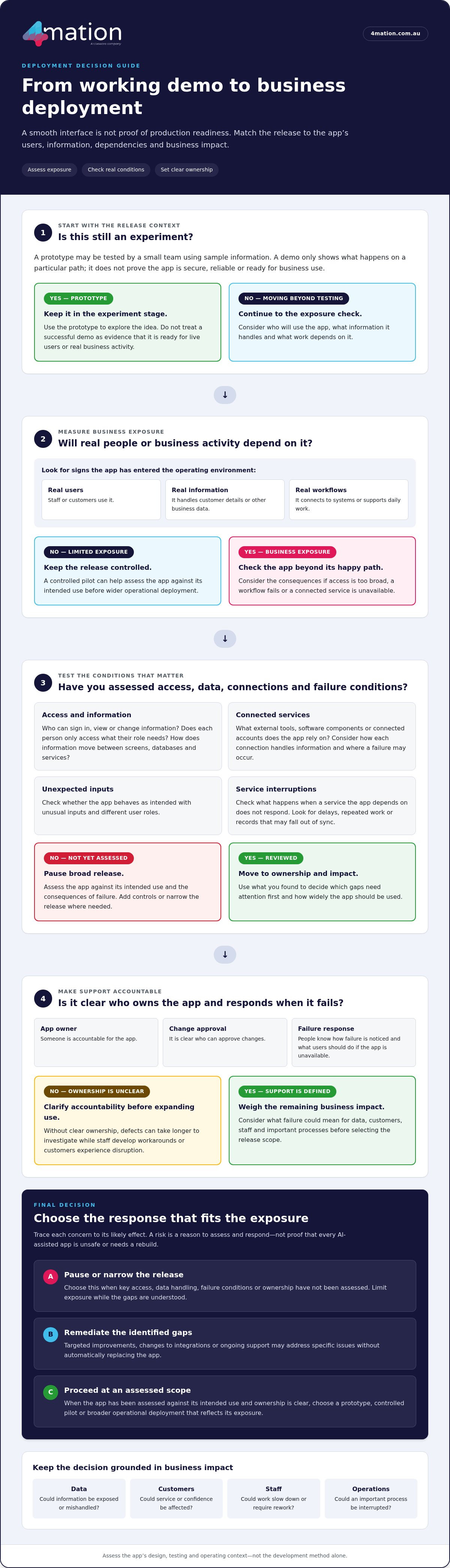
A practical assessment plan before deploying a vibe-coded app
A proportionate review helps you make a release decision based on the app’s purpose, not assumptions about how it was built. The risks of deploying a vibe coded app become easier to prioritise when you connect each technical finding to its potential effect on customers, data or business operations.
What to include in a proportionate app review
Work through the app in a clear sequence. Record what you find, why it matters and who will follow it up.
- Map the purpose and users. Identify the business task the app supports, who will use it and what each user should be able to do. Separate essential tasks from features that are useful but not necessary for the first release.
- Trace data and access. Note what information the app collects, stores or shares. Review user permissions, data flows and how credentials or other secrets are protected. Check whether the app requests or retains information it does not need for its purpose.
- List integrations and dependencies. Identify connected systems and external components, then consider what happens if they change, become unavailable or return unexpected information. Confirm which business process depends on each connection.
- Test realistic scenarios. Check common workflows across relevant user roles, as well as errors, unusual inputs and failure conditions. Testing should show whether users can complete essential tasks and what happens when they cannot.
- Clarify failure impacts and ownership. Consider the effects of an outage or incorrect result. Record who owns the app, responds to issues and approves future changes. Identify the alternative process staff should use while a fault is being resolved.
For implementation detail, see Making Your Vibe-Coded App Production-Ready. Use the review findings to decide what needs to change before release and what can be addressed during a controlled pilot.
How to turn findings into a controlled release decision
Rank each finding by how likely it is to occur, the business consequence if it does and the controls already in place. A minor display issue with a simple workaround may be suitable for later improvement. Unclear access to sensitive information or a failure that could interrupt an important workflow may need to be resolved before users depend on the app.
For higher-impact findings, name an owner and define what an acceptable resolution looks like. That might mean confirming that access is restricted to the right roles, testing a key integration when it fails or documenting how staff will continue the process if the app is unavailable. Keep unresolved risks and release decisions visible, rather than relying on informal assurances.
If the review supports a pilot, release in phases, limit access to the agreed group and monitor whether the app performs as expected. Set a clear point to review feedback and decide whether to expand, hold or adjust the release. 4mation can help you assess an app against your business needs through an app assessment discussion.
How 4mation helps manage vibe-coded app deployment risk
Deciding what to do with an existing app starts with understanding the business outcome it needs to support. 4mation works with you to consider the app’s users, data, integrations and operational role before recommending technical work. That keeps the response proportionate: the right next step might be a targeted fix, improved integration, phased release or further development, rather than an automatic rebuild.
Our capabilities include AI consulting, custom software development and system integration. With 25 years of client success and AWS Select Consulting Partner status, we bring experience in connecting technology decisions with practical business goals.
From risk findings to fit-for-purpose improvements
Assessment findings help shape a response around the app’s actual exposure. If a gap is limited to a specific workflow, targeted remediation may be appropriate. If an integration creates reliability concerns, improving how systems exchange information may help. Where the app needs broader changes, redevelopment or a phased release can provide a more considered path forward. The recommendation should reflect who uses the app, what information it handles and how important it is to daily operations.
If you are weighing the role of AI in a wider business decision, our AI consulting guidance can help you consider where it fits and what outcomes to pursue.
Plan for ownership after deployment
Release is the start of an ongoing responsibility. Your team needs clear technical ownership, a way to identify and respond to issues, and a plan for maintenance as business needs change. Monitoring helps surface problems; support helps coordinate a response; and continuous improvement keeps the app aligned with evolving workflows. Without assigned responsibility, defects and change requests can stall, even if the initial release meets its goals.
Technology support and maintenance can provide a structured approach to caring for an application beyond launch. The right arrangement depends on the app’s role, the skills available in your team and the continuity your operations need. Make ownership explicit so people know who can investigate a fault, approve a change and keep the app fit for purpose.
If you are considering the risks of deploying a vibe coded app, talk with us about its business role, the findings that matter most and sensible next steps. Discuss your app and deployment plans with 4mation.
Make your next deployment decision with confidence
The risks of deploying a vibe coded app depend on how it will be used, what information it handles and how much your business relies on it. A focused assessment can help you choose a sensible path, whether that means a limited pilot, targeted improvements or broader deployment. It can also clarify who owns the app and how your team will support it after launch.
You do not have to assume that an app needs a complete rebuild. Start by understanding its business role, identifying the issues that matter most and matching the next steps to your organisation’s needs.
4mation brings 25 years of client success, 40+ local tech specialists and AWS Select Consulting Partner status to software and AI projects. We work with you to connect technical decisions with business priorities and a practical plan for ongoing ownership.
Discuss your app and its deployment risks with 4mation. With a clear view of the risks and options, you can make a considered decision and move forward with confidence.
Frequently Asked Questions
What are the biggest risks of deploying a vibe-coded app?
The main risks are security gaps, unreliable behaviour, integration failures and unclear ownership. For example, overly broad permissions could expose information to the wrong users, while a failed connection might interrupt a customer or staff workflow. The likelihood and impact depend on what the app does, which data it handles and how much your business relies on it. Assess each concern in that context rather than assuming AI-assisted development makes an app unsafe.
Is a vibe-coded app safe to use with customer or business data?
It may be suitable, but assess how it protects and handles data before relying on it. Review who can access information, how users sign in, where data flows and whether credentials or secrets are protected. Also consider the app’s external services and software components. Use only the data needed for testing, and avoid introducing sensitive information until you understand the app’s safeguards and any remaining risks.
Can a vibe-coded app be used in production without a full rebuild?
Yes. A full rebuild is not automatically necessary. A review may find that the app needs targeted fixes, stronger access controls, improved error handling or changes to a particular integration. You can then test those changes against realistic workflows and decide whether a controlled release is appropriate. The decision should reflect the app’s business purpose, users, data and failure impact, not simply the fact that AI generated some of its code.
What happens if a vibe-coded app fails after launch?
A failure can interrupt work, delay a customer request, create inconsistent information or require staff to fall back to a manual process. The actual effect depends on the app’s role and whether a practical alternative exists. Before launch, identify who responds to faults, how users report problems and what process they should follow if the app is unavailable. These arrangements help your team contain disruption and make informed decisions about restoring service.
How can a business assess the security of AI-generated code?
Assess the app as a whole, not just the code’s origin. Review authentication, user permissions, data flows, stored credentials, external services and software dependencies. Test whether users can access only the functions and information intended for their role. Include realistic workflows and failure scenarios, then record findings by business impact, likelihood and existing controls. A qualified technical review can help identify weaknesses and clarify which findings need attention before release.
Does vibe-coded software need ongoing maintenance and support?
Yes. Like other business software, it needs an owner who can manage defects, updates, integrations and changing user needs. Without clear responsibility, small issues can remain unresolved or future changes can create unexpected problems. Plan who monitors the app, investigates incidents, approves changes and maintains documentation. The level of support should match how important the app is to your operations and how much continuity your users need.
When should a business pause deployment of a vibe-coded app?
Pause if serious concerns about data access, information handling or reliability remain unresolved, particularly if a failure could affect customers or an important business process. You can also limit access while gathering evidence, fixing known issues or testing with a controlled group. Before proceeding, make sure decision-makers understand the remaining risks, an accountable owner is in place and users have a clear fallback if the app does not work as expected.
About The Author
