Finish Your Vibe Coded App: From Prototype to Production
Jowena BorralDigital Marketing Specialist

A convincing demo can still fail when a customer or staff member needs to complete a real task. If you’re trying to finish vibe coded app development, it can be difficult to tell what stands between a polished prototype and a dependable product.
The prototype is a useful starting point, but important workflows, data handling, access controls and support arrangements may still need attention. The answer isn’t automatically to start again. First, identify what users need the app to do and where the current version falls short.
This guide explains how to define “finished” for your app, prioritise remaining work by user impact and business risk, and assess which parts of the AI-generated code are worth keeping. It also covers testing, ownership and ongoing support, so you can plan a practical path from prototype to an app your organisation can operate with confidence.
Key Takeaways
- Define “finished” by agreeing on the user, business and operational needs the app must meet.
- Review the app’s screens, workflows, integrations and limitations before deciding what to change.
- When you finish vibe coded app development, prioritise essential user journeys and business value over visual polish alone.
- Use clear scope, regular review points, testing and handover to keep delivery controlled and stakeholders aligned.
- Choose internal, specialist or end-to-end support based on the gaps, your team’s skills and the app’s ongoing needs.
What does it mean to finish a vibe-coded app?
A working demonstration proves that an idea can take shape. It doesn’t necessarily prove that people can complete important tasks consistently or that your organisation can support the app in day-to-day operations.
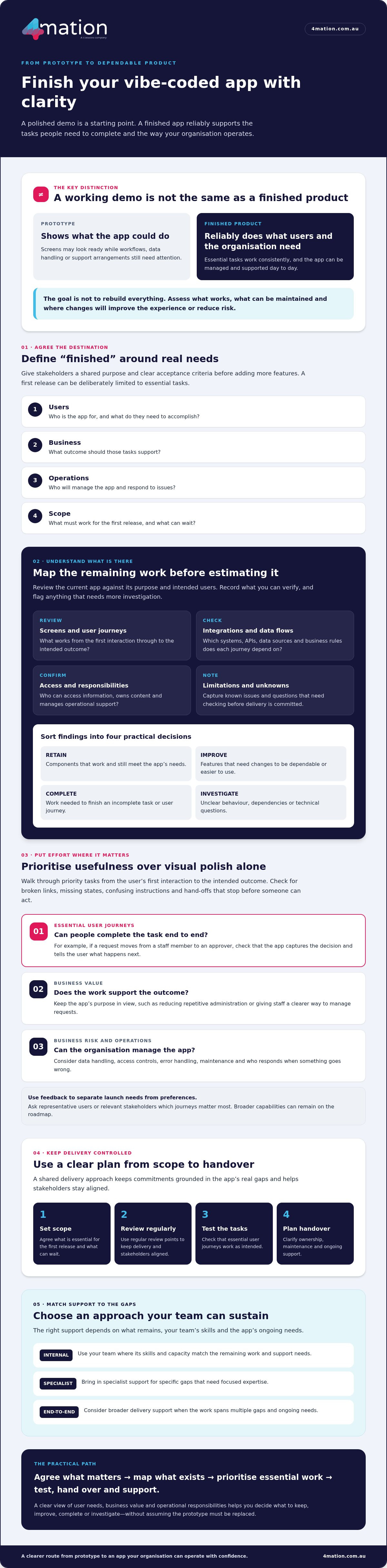
A prototype shows what an app could do. A finished product reliably does what its users and organisation need it to do.
Finishing means agreeing on the app’s purpose, then making sure its essential user journeys and business outcomes are supported. That may involve completing workflows, resolving technical issues, confirming how the app will be maintained or deciding who owns support. It doesn’t automatically mean replacing every AI-generated component. Assess what works, what can be maintained and where changes will reduce risk or improve the experience.
Why a convincing prototype can still feel unfinished
Polished screens can hide gaps in the journey behind them. A form may look ready to use but fail to validate an entry, confirm a successful submission or explain what happens next. The screen is visible, but the complete service behind it may not be.
Real use also raises less visible questions: Does information reach the right place? How does the app handle errors? Who responds when something goes wrong? Quick implementation choices can create technical debt, where shortcuts make future changes or maintenance harder. That doesn’t mean the prototype is wasted. It means you should assess its components before deciding what to retain, improve or replace.
Agree what finished means for your organisation
Start with the people who will use the app and the tasks they need to complete. Connect those tasks to the business outcome the app is meant to support, such as reducing repetitive administration or giving staff a clearer way to manage requests. Without a shared purpose, teams can spend time adding features that don’t solve the main problem.
A first release can be deliberately limited. It needs to support an agreed set of essential tasks, while broader capabilities remain on the roadmap. Before development continues, stakeholders should agree on acceptance criteria: what users must be able to do, what a successful outcome looks like and what operational arrangements need to be in place.
- Users: Who is the app for, and what do they need to accomplish?
- Business: What outcome should those tasks support?
- Operations: Who will manage the app and respond to issues?
- Scope: What must work for the first release, and what can wait?
This gives your team a practical basis to finish vibe coded app work: focus on agreed needs, not the assumption that every screen or feature must be production-ready at once.
Map the remaining work before you finish a vibe-coded app
Before committing to new features or estimating delivery, establish what the app already does and what your organisation needs. A time-boxed discovery review gives you a clearer basis for decisions without letting assessment become an open-ended project.
Review the scope before estimating the work, so commitments reflect the app’s real gaps rather than assumptions.
Confirm the app’s purpose, intended users and business goals. Then document its current state: working screens, key user journeys, integrations, data flows and known limitations. Record what you can verify and flag anything that needs further investigation. The aim is a shared view of what exists, not an automatic decision to rebuild.
Sort findings into four practical categories:
- Retain: Components that work and still meet the app’s needs.
- Improve: Existing features that need changes to be dependable or easier to use.
- Complete: Work needed to finish an incomplete task or user journey.
- Investigate: Unclear behaviour, dependencies or technical questions to check before committing.
Review the prototype against real user journeys
Walk through each priority task from the user’s first interaction to the intended outcome. Note broken links, missing states, confusing instructions and hand-offs that stop before someone can act. For example, if a request must move from a staff member to an approver, check whether the app captures the decision and tells the user what happens next.
Ask representative users or relevant stakeholders to validate which journeys matter most. Their feedback can distinguish a genuine launch requirement from a preference that can wait. This gives product and delivery teams a grounded basis for prioritising work.
Check dependencies and decisions that affect scope
List the systems, APIs, data sources and business rules each priority journey depends on. Confirm which connections exist and which still need investigation. Record decisions about who can access information, who owns content and who manages operational responsibilities. These questions affect both the scope and effort required to complete the app.
Structured software project management helps teams turn findings into agreed work, clear responsibilities and review points. For a broader discussion of custom software development, you can also explore custom software development. If you’d like to discuss how to assess your prototype and define its scope, talk with our team.
Prioritise the work that makes a vibe-coded app useful
Once you’ve mapped the gaps, decide what to address first by weighing user value, business importance, dependencies and effort. A visual refinement may make a prototype look more polished, but completing a workflow or connecting it reliably to a business system may deliver more practical value.
AI-generated code also needs review before it can support real use. IBM describes the engineering efforts for production that can sit beyond generating code. Focus your plan on the work needed for the app’s agreed purpose. Don’t assume every component needs replacement or treat this stage as a full security audit.
Prioritise complete user journeys over extra features
Identify the smallest coherent set of journeys that delivers the app’s intended outcome. If a user can create a request but nobody can review or resolve it, completing that end-to-end process may matter more than adding another screen.
Product and operational stakeholders should confirm priorities together. They can balance user needs with business outcomes, dependencies and effort. This keeps decisions grounded in the app’s purpose rather than whoever has the strongest preference for a particular feature.
Priority
Essential launch workflows: Complete the journeys needed to deliver the app’s primary purpose, including the necessary hand-offs and outcomes.
Valuable improvements: Address usability issues or integrations that improve important tasks but aren’t required for the initial release.
Later enhancements: Defer additional features or visual refinements that add value but don’t block essential use.
Decide what to retain, improve or replace
Assess each existing component against its purpose, maintainability and fit with agreed requirements. Consider whether users can understand it, whether it supports the required data flow and whether your team can operate or update it. AI-generated code isn’t automatically good enough to keep, but it isn’t a reason to start again either. Base the decision on its value and the work required to rely on it.
For example, an existing screen may be worth retaining while its incomplete connection to a data source needs improvement. If that dependency isn’t available or its ownership is unclear, investigate it before committing to related features. Keep the review proportionate by focusing on decisions that affect priority journeys, not every possible technical concern.
If the app needs to work on mobile devices, the platform and delivery approach can also shape scope. Explore mobile app development when comparing options for your users and use case.
To finish vibe coded app work with clear priorities, agree what must be completed now, what can wait and who will own the decisions. If you’d like to discuss how those choices apply to your prototype, talk with our team.
Finish a vibe-coded app with a controlled delivery plan
A defined delivery plan turns prioritised gaps into work your team can review and accept. Agree what’s in scope, resolve decisions that could block progress, complete the priority work, test relevant journeys and plan the handover. Clear ownership and acceptance criteria help everyone understand what “done” means as the app moves towards release.
Keep stakeholders aligned with short, regular review points. Use each one to show progress, raise issues and confirm decisions, rather than relying on assumptions or promising a delivery date before the work is understood. If priorities or dependencies change, assess the effect on scope together before adjusting the plan.
Build and validate in manageable increments
Break the agreed work into outcomes stakeholders can review, such as completing a user task or connecting a required system. Set acceptance criteria for each outcome so the team can check whether it meets the agreed need. For example, criteria might specify what information a user submits, what confirmation they receive and what happens next.
Test complete journeys, not just individual screens. Include relevant edge cases, such as missing information or an unsuccessful hand-off, and check connected systems where they form part of the task. Use review feedback to resolve issues before marking a milestone complete. This gives stakeholders a chance to confirm progress and surface gaps while there’s still time to address them.
Plan handover and ongoing improvement
Release is not the end of ownership. Before handover, clarify who controls the codebase and required access, where documentation is kept and who makes operational decisions. Agree how users can report issues and how your organisation will choose future improvements. These arrangements help keep the app understandable and supportable after delivery.
User needs and business processes may change. A defined approach to support and continuous improvement helps you respond deliberately, rather than letting small issues accumulate or adding features without clear priorities. 4mation’s continuous improvement and development service may suit organisations that need ongoing product work as requirements evolve.
To finish vibe coded app delivery with confidence, make scope, decisions, acceptance and ownership visible throughout the work. If you’re ready to discuss your app’s remaining work and a practical way forward, start a project conversation.
Get the right support to finish your vibe-coded app
The right support depends on what the review uncovered. If your team has the skills and time to address the gaps, internal delivery may be enough. If the work hinges on a specific technical challenge, targeted specialist support can fill that gap. If the app needs coordinated work across product decisions, development and ongoing support, an end-to-end partner may be a better fit.
Before recommending an approach, a development partner should understand your business goals, intended users, existing work and constraints. That includes identifying which prototype components are useful, what your team can manage and what needs to change for the app to serve its purpose. The aim is to match support to the work, not assume a complete rebuild.
Choose an engagement model around the work
Consider the scope, your internal capacity and what the app will need after its first release. A fixed-cost project may suit work with clearly agreed scope and acceptance criteria. Ongoing development can suit a product that needs regular, prioritised improvements. Staff augmentation can add specialist capability to an existing team, while service desk support can help with ongoing operational needs.
These are different ways to organise delivery, not interchangeable promises. 4mation describes its Fixed-Cost projects as fixed cost, on time, on budget and bug-free. Confirm how the guarantee applies to the proposed work, what the engagement includes, how decisions will be made and who owns the outcome.
Assess a development partner’s fit
Look for a partner who will assess your existing app before recommending what to build next. Ask how they’ll understand your users and business goals, distinguish essential work from later improvements and explain technical decisions in terms of user or operational outcomes. You should be able to see how the proposed work connects to the result your organisation needs.
4mation states it has 25 years of client success and 40+ local technology specialists. Its capabilities include custom software development and ongoing technology support, which can be considered in line with the app’s remaining work. The approach should still start with your context, not a predetermined solution.
To finish vibe coded app work, you don’t need every technical answer before seeking support. A clear account of the app’s purpose, what already works and where users get stuck is a useful starting point. If you’re weighing up the next steps, talk with 4mation about your app.
Take the next step from prototype to dependable app
A promising prototype gives you a foundation, but the path to a dependable app starts with clarity. Define what users need to accomplish, assess which parts of the existing app are worth keeping and focus delivery on the workflows that support your business goals. Clear scope, review points and ownership help turn remaining work into manageable decisions.
You don’t need to solve every future requirement before moving forward. A practical plan can identify what matters for the first release and leave room to improve as you learn from real use. That’s a considered way to finish vibe coded app development without assuming a complete rebuild is necessary.
4mation brings 25 years of client success and 40+ local technology specialists, alongside its position as an AWS Select Consulting Partner and six-time Great Place to Work certified organisation. We can work with you to understand your app, users and goals before discussing a suitable way forward.
Talk with 4mation about finishing your app and explore the next steps with an experienced technology partner. Your prototype can be the start of an app your organisation can confidently use and support.
Frequently Asked Questions
Can a developer finish my vibe-coded app without rebuilding it?
Yes, a developer may be able to build on the existing app. First, they’ll need to assess which components work, whether they can be maintained and how well they fit your requirements. Some parts may be retained, while others need improvement or replacement. The right approach depends on the app’s current state and your goals. An assessment helps avoid assuming either that all AI-generated work is usable or that a complete rebuild is necessary.
How do I know what still needs to be done on my AI-built app?
Review the app against the tasks its intended users need to complete. Walk through each priority journey from start to finish, noting missing steps, unclear instructions, broken hand-offs and incomplete outcomes. Then check the integrations, data flows and operational decisions those journeys rely on. To finish vibe coded app work with focus, sort findings into what to retain, improve, complete or investigate before committing to more features or delivery estimates.
Is AI-generated code safe to use in a business app?
AI-generated code isn’t automatically safe or unsafe. Treat it as code that needs appropriate review before business use. The level of assessment depends on what the app does and the information and systems it handles. A developer can review how the code behaves, test important user journeys and check relevant access controls, dependencies and data handling. This helps your organisation make an informed decision about what to retain, change or investigate further.
How long does it take to finish a vibe-coded app?
There’s no reliable timeframe without understanding the app’s current state and the work it needs. A small, clearly defined gap differs from incomplete workflows, uncertain integrations or unresolved business decisions. A discovery review can identify dependencies, priorities and acceptance criteria, creating a more grounded basis for planning. Ask your delivery team to explain what could affect the schedule and how they’ll review progress, rather than relying on an estimate based only on the prototype.
Should I add more features before finishing my app?
Usually, first confirm that users can complete the essential tasks the app is meant to support. An additional feature may be useful, but it won’t compensate for a core workflow that stops before the intended outcome. Compare proposed features by user value, business importance, dependencies and effort. Agree with product and operational stakeholders which capabilities belong in the first release and which can wait until you have more insight from use.
What should I look for in a partner to finish a vibe-coded app?
Look for a partner who assesses your existing work before recommending a solution, asks about your users and business goals, and explains how proposed technical work supports them. They should be clear about scope, decisions, acceptance criteria and ongoing ownership. Also consider whether their support can match your needs, from targeted development work to ongoing app improvement. 4mation states 25 years of client success and 40+ local technology specialists.
About The Author
