Bespoke Web Applications: How to Plan, Build and Sustain One
Jowena BorralDigital Marketing Specialist

What if the answer to slower workflows isn’t another off-the-shelf tool, but a better fit for the way your business works? When manual processes and disconnected systems make everyday tasks harder to manage, bespoke web applications can bring workflows together around a specific operational need.
A tailored application isn’t automatically the right investment. It needs to solve a meaningful problem, work well for the people who use it and justify the effort involved in building and supporting it. Clear decisions about scope, integrations and priorities can help you reduce delivery risk and focus on outcomes that matter.
This guide explains how to assess whether a bespoke web application is right for your organisation, what to plan before development and how to sustain value after launch. We’ll cover how to define the problem, shape a usable solution, connect it with your existing systems and plan ongoing support. At 4mation, we start with your business goals, users and operational challenges, then work with you across strategy, design, development and support to deliver a practical solution.
Key Takeaways
- Assess whether a tailored application addresses a clear business problem, rather than adding technology without a defined purpose.
- Learn how to turn business goals, user needs and existing workflows into a practical development plan.
- See how bespoke web applications can bring processes and information together to support day-to-day work.
- Understand how clear responsibilities, regular decisions and suitable engagement models help manage delivery and ongoing change.
- Explore how a connected approach to strategy, design, development, integration and support can help sustain value after launch.
What are bespoke web applications, and what business problems can they solve?
Staff re-entering the same information, teams checking different versions of a record, or customers struggling to complete a digital task can all point to a workflow problem. The issue may be a gap between how your organisation works and what its current systems support. Bespoke web applications can address that gap by bringing the right tasks and information into a service shaped around the people who use it.
A bespoke web application is browser-accessible software designed around specific users, workflows and business needs to achieve a defined operational or customer outcome. Rather than asking people to adapt to a generic process, it can support the steps they need to complete, the information they need to access and the decisions they need to make. The business purpose should be clear, such as reducing duplicate data entry or helping customers submit complete requests.
A tailored solution isn’t automatically the best choice. If existing software supports your process effectively, extending or improving how you use it may be more appropriate. The case for custom development is stronger when a recurring business problem remains unresolved and a defined outcome can justify the effort of building and maintaining an application.
How is a web application different from a standard website?
A website primarily presents information: it might explain services, publish updates or help visitors find contact details. An application lets users do something. They may submit a request, track its progress, update a record, manage a booking or work through an internal process. A web application runs through a browser, but its defining feature is the interaction it enables, not simply where it appears.
The distinction isn’t always absolute. A digital service can combine public pages with secure, task-based features. For example, an organisation might publish guidance on its website and provide an online area where users submit information or check the status of a request. The right design depends on what each audience needs to accomplish. For organisations that simply require an effective online presence rather than complex custom functionality, working with Go Mylo Web Design offers a practical solution to get established online.
Which business problems can a bespoke application address?
Look for repeated friction in a process, then connect it to an outcome you can assess:
- Repetitive processing: Staff copy details between forms or systems. A workflow that captures information once and moves it to the next step can reduce manual handling.
- Disconnected data: Teams rely on separate records to answer basic questions. A shared view of relevant information can make it easier to see what has happened and what needs attention.
- An awkward customer journey: Customers repeat information or can’t easily complete a task online. A clearer sequence of steps can make the service easier to use and reduce avoidable follow-up.
These examples are starting points, not a reason to build by default. First establish where the process breaks down, who it affects and what improvement would count as success. If the problem is limited or an existing system can address it, a new application may add unnecessary complexity. If a genuine gap remains, defining the outcome gives your team a sound basis for planning the solution.
How do you turn a business need into a clear application plan?
A strong plan turns a broad concern into a shared, testable goal. Before discussing screens or technical choices, you and your development partner need to understand what isn’t working, who it affects and what a better result would look like. That discovery process keeps decisions grounded in your business priorities, rather than assumptions about what an application should do.
Map the current workflow with the people who use it. Follow a task from start to finish, noting hand-offs, repeated data entry, delays and information gaps. A process may look simple on paper but work differently in practice. These details help shape requirements that reflect real user needs. For further context on the delivery discipline involved, see our guide to software development.
What should you clarify before development begins?
Identify each user group and the tasks they need to complete. Then distinguish essential launch needs from improvements that can wait. Agreeing on priorities early helps prevent extra features from expanding the scope without a clear business reason. For bespoke web applications, a focused first release can address the core problem while leaving room to refine the solution as your needs evolve.
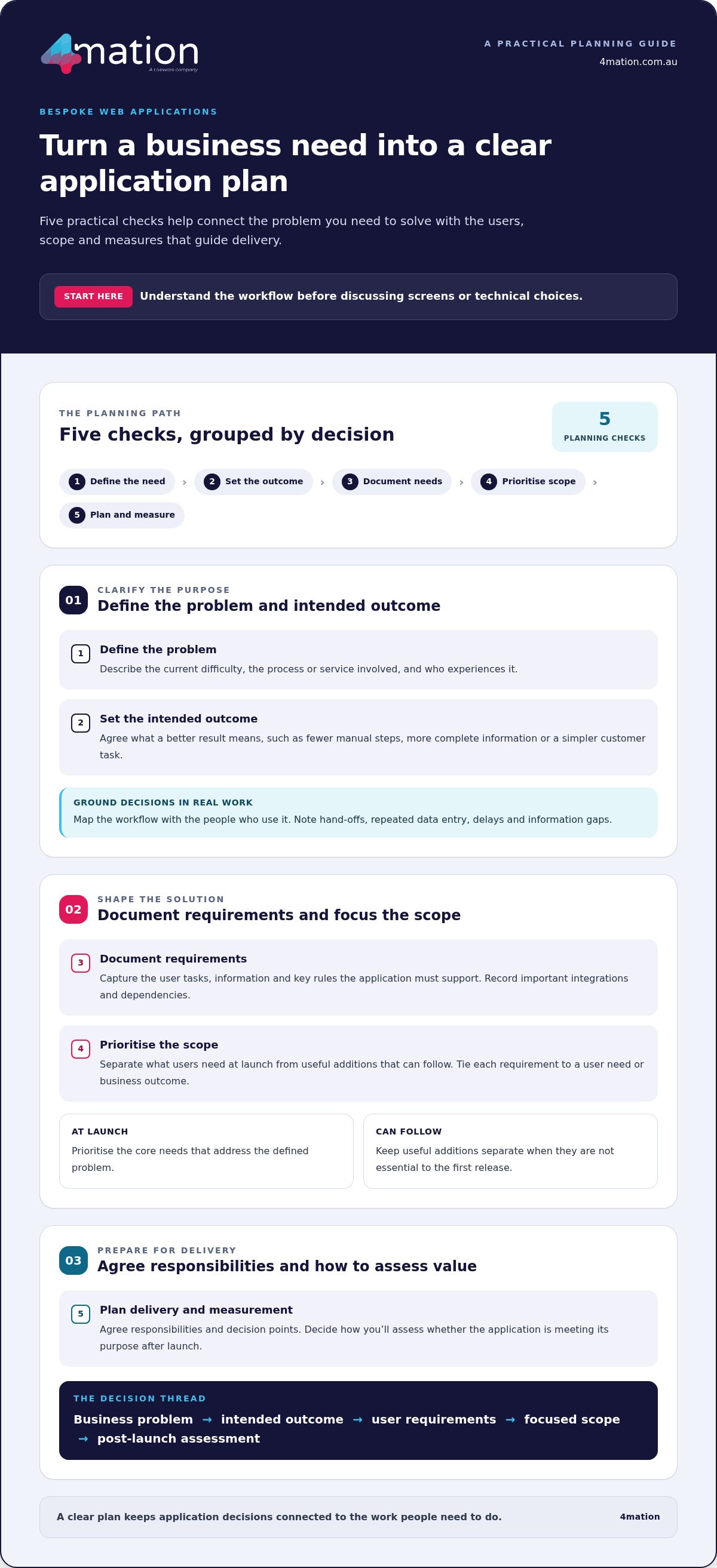
A practical planning path is:
- Define the problem: Describe the current difficulty and who experiences it. Be specific about the process or service that needs improvement.
- Set the intended outcome: Decide what a better result means, such as fewer manual steps, more complete information or a simpler customer task.
- Document requirements: Capture the user tasks, information and key rules the application must support. Record important integrations and dependencies.
- Prioritise the scope: Separate what users need at launch from useful additions that can follow. Tie each requirement to a user need or business outcome.
- Plan delivery and measurement: Agree on responsibilities, decision points and how you’ll assess whether the application is meeting its purpose after launch.
How can a prototype reduce uncertainty?
A prototype gives stakeholders and users something concrete to review before a complete build begins. It can show how a task might flow across screens, where information appears and what decisions users need to make. This makes it easier to spot unclear steps or missing requirements while changes are still focused on the proposed experience.
Use feedback to improve the journey, not to chase visual novelty. Ask users whether they can understand what to do, find the information they need and complete the task with confidence. Record decisions and update the requirements so the delivery team has a shared reference point.
Clear priorities don’t remove every delivery decision, but they make trade-offs easier to assess. If you’re shaping a project, talk with our team about your goals and users to help clarify the problem and plan a suitable next step.
What makes a bespoke web application useful in day-to-day operations?
An application earns its place when it helps people complete real work with less friction. That means shaping the workflow around common tasks, presenting only the information a user needs and connecting systems where a hand-off currently creates extra effort. The value isn’t measured by the number of features. It’s measured by whether the application makes work clearer, more consistent or easier to complete.
How should user experience support the work people need to do?
Start with the tasks users perform most often. Map each step, then look for unnecessary screens, repeated questions or unclear next actions. A well-considered interface gives users clear navigation, useful prompts and feedback when they submit or update information. This helps people understand what’s happened and what to do next, rather than relying on extra training or workarounds.
Different roles may need different views or permissions. For example, a customer might submit a request, while an operations team member reviews it and updates its status. Designing for each role keeps the experience relevant without exposing every user to functions they don’t need.
How can integration and scalability support business operations?
Where appropriate, APIs and other system integrations let applications exchange information with existing business systems. A connection might pass a submitted request to a team’s work queue or display relevant account details without staff re-entering them. The right integrations depend on how information is managed and where it needs to go. Plan them around a specific operational benefit, not simply because a connection is technically possible.
Scalability is the capacity to adapt as users, workflows and business requirements change. That may mean refining a process, supporting another user role or connecting an additional system. Planning for change doesn’t require building every possible feature at launch. It means making considered design decisions so the application can evolve without losing sight of its purpose.
The table below shows how a business need can guide useful application capabilities and a practical outcome:
| Business need | Useful application capability | Intended operational outcome |
|---|---|---|
| Staff need to review incoming requests | A shared queue with status updates | Clearer ownership and progress |
| Users submit incomplete information | Guided forms with relevant prompts | Fewer gaps to resolve later |
| Teams re-enter the same details | Relevant integration with an existing system | Less duplicate handling |
| Different roles perform different tasks | Role-based views and permissions | A more focused experience for each user |
Use these examples as prompts, then test each proposed capability against a user task and an intended outcome. Our guide to custom software development covers broader considerations for selecting and shaping a solution. For bespoke web applications, a clear connection between workflow, usability and business purpose is a stronger measure of value than feature volume or a particular technology stack.
How can you manage bespoke web application delivery and ongoing change?
A clear delivery approach makes progress easier to track and decisions easier to manage. Agree who can approve scope changes, who provides user and business feedback, and how the team will assess progress. Regular check-ins help surface risks early, resolve questions and keep priorities tied to the outcomes the application needs to achieve.
Choose an engagement model that matches how defined the work is and what support your team needs. Each option provides a different way to manage delivery or strengthen your capacity:
Which engagement model suits your project needs?
- Fixed-Cost: Suits a project with a clearly defined scope and outcome. 4mation’s Fixed-Cost projects are fixed cost, on time, on budget and bug-free. This model gives you a defined delivery commitment when the requirements and decisions are sufficiently clear. Learn about our Fixed-Cost project approach.
- Ongoing Agile Development: Suits work that needs regular reprioritisation or improvement over time. You and the team review progress, decide what matters next and develop the application in increments, keeping effort focused on current business needs.
- Staff Augmentation: Adds specialist capability to your existing team. Your organisation retains its delivery structure while additional expertise supports the work already underway.
- Service Desk: Provides a support channel for application users or operational issues. It differs from staff augmentation, which adds capacity to a delivery team rather than focusing on ongoing user support.
Whichever model you choose, set clear responsibilities for approving changes and communicating their effect on priorities. A new feature may improve a user journey, but it can also affect delivery scope or introduce dependencies. A shared decision process helps your team weigh the expected benefit against the work involved.
Why plan for support after launch?
Launch is the start of operational use, not the end of the application lifecycle. Monitoring helps identify issues that may affect availability or performance, while maintenance helps keep the application functioning as its environment changes. A clear support arrangement also gives users a known path for raising problems and helps your organisation manage the application as part of day-to-day operations. Explore our technology support and maintenance for ongoing care.
Plan for improvement, too. User feedback, changed business processes and new priorities may show that parts of the application need adjustment. Agree how you’ll review those needs and decide what to address next, so change remains purposeful rather than becoming a stream of uncoordinated requests.
If you’re weighing up delivery or support options, discuss your application goals with 4mation. Together, we can consider the work ahead, the outcomes you’re aiming for and an engagement model that fits your needs.
How does 4mation approach bespoke web application development?
Good development starts with the work your organisation needs to improve, not a preferred technology or a long list of features. 4mation works with you to understand your business goals, users and operational challenges, then shapes a solution around the intended outcome. This business-first approach helps keep decisions practical, from early planning through to ongoing support.
The lifecycle connects strategy and design with prototyping, development, system integration and support. Each stage builds on the decisions made before it: user and business needs inform the design, prototypes help test the proposed experience, and development turns agreed requirements into a working application. Integration can connect it with relevant systems, while support helps maintain and improve it after launch.
What evidence shows the value of a business-first approach?
Two examples illustrate the kinds of problems a tailored application can address. Load & Go has a web and mobile suite that replaced manual workflows. This shows how a digital solution can take the place of manual processes, without assuming outcomes beyond that description.
The NATA accreditation portal has more than 5,000 active users. That figure provides a concrete reference for the scale of a live application. Together, these examples show different contexts for application development: supporting workflow change and serving a substantial active user base. You can explore more 4mation case studies to see examples of its work.
Trust also depends on delivery experience and relevant credentials. 4mation is an AWS Select Consulting Partner and an Advanced Supplier in the NSW Government ICT Services Scheme. These credentials can inform confidence in the partner, but the project still needs to be judged by how clearly it addresses your business needs and supports your users.
What happens when you discuss an application opportunity with 4mation?
The discussion centres on the problem you want to solve, the people affected and the result you want to achieve. You can describe existing workflows, constraints and the systems involved. Together, we can consider whether a tailored application is appropriate and how strategy, design and delivery can work as connected stages. The aim is to establish a considered path forward, not to prescribe unnecessary complexity.
That conversation can also identify what needs to be decided before development, where a prototype could help clarify the experience and what support may be needed after launch. These choices help you understand the work as a complete lifecycle, rather than treating development as an isolated build.
If you’re considering bespoke web applications for a specific business need, talk with 4mation about your application. Start with the challenge, your users and the outcome you want to make possible.
Make your next application decision with purpose
The next step doesn’t have to be a commitment to build. Start by identifying one operational challenge worth solving and what a better result would look like for your users and business. That gives you a practical basis to assess whether bespoke web applications could help, what needs to be understood first and how you’ll recognise value over time.
A well-planned application is shaped by real work, not assumptions. Keep the business outcome at the centre as you consider the user experience, delivery approach and support needed after launch. With the right priorities, you can move from an unclear problem to an achievable plan without adding complexity for its own sake.
If you’re ready to explore an opportunity, share your application challenge with 4mation. We’ll work with you to understand the need and consider a sensible path forward. Every useful application begins with a clear problem and a willingness to improve how work gets done.
Frequently Asked Questions
Can a bespoke web application work on mobile devices?
Yes. A web application can be designed to work in a mobile browser, with layouts and controls suited to smaller screens and touch input. The right approach depends on how people will use it. A field worker entering updates on-site may need a different mobile experience from an office user reviewing detailed records. Test common tasks on the devices your users rely on, rather than assuming a desktop layout will translate well.
Does bespoke software always need to be built entirely from scratch?
No. A tailored application can use established frameworks, components and services, or connect with systems your organisation already uses. The aim is to meet the business need without rebuilding capabilities that already work. For example, an application might provide a specific workflow while relying on an existing platform for another function. Loyalty software, for instance, can be integrated via API to manage customer rewards and points without needing to build an incentive engine from scratch. Your development team can assess what to reuse, integrate or build based on requirements, constraints and long-term support needs.
How long does it take to develop a bespoke web application?
There isn’t one timeline that applies to every project. Delivery depends on factors such as the number and complexity of user workflows, integrations, decision-making and how much testing the application needs. A focused application with a clear scope may involve different work from a platform serving several user groups. Ask for a delivery plan that explains key stages, dependencies and decisions, so you can understand what may affect progress.
How much does a bespoke web application cost?
The cost depends on the agreed scope, the application’s complexity, integrations and the work required to test and support it. A useful estimate needs to relate those factors to your requirements, rather than rely on a generic price range. Clarify what the proposed scope includes, how changes are handled and which ongoing costs sit outside development. This gives you a more considered basis for comparing the investment with the business value you expect.
Who owns a bespoke web application after it launches?
Ownership should be set out in your project agreement. Clarify who owns the application’s custom code, designs and documentation, and identify any third-party components that have separate licence terms. Also agree how your organisation will access source code, hosting accounts and essential project records. These details help you understand what you can maintain, change or transfer after launch. Review the terms with your legal or procurement advisers if you need advice on your rights.
Can a bespoke web application use AI features?
Yes, if an AI feature supports a clear business task. An application might help staff classify incoming enquiries or find relevant information, but the value depends on whether it improves the workflow and provides results users can assess. Define what the feature should do, what information it can use and when a person needs to review its output. Consider privacy, security and ongoing evaluation as part of planning, not as add-ons after development.
What should happen after a bespoke web application goes live?
After launch, check that users can complete key tasks and that the application behaves as expected in its live environment. Give users a clear way to report issues, review feedback and track problems that affect their work. Your organisation should also assign responsibility for access, maintenance and decisions about future changes. A planned review can help identify where the application needs adjustment as workflows, systems or user needs change.
About The Author
