AI implementation guide for Australian organisations
Jowena BorralDigital Marketing Specialist

What if your organisation’s strongest AI opportunity isn’t a new product, but a workflow that takes too long or creates avoidable rework? AI implementation for business is most valuable when it addresses a defined operational problem, fits the way your people work and supports an outcome you can measure.
It’s reasonable to question where to start. A promising pilot can lose momentum if it can’t connect with existing systems, staff don’t adopt it or the effort outweighs the expected value. Rather than adopting AI for its own sake, assess the process, information and people involved before deciding whether AI is the right fit.
This guide explains how to identify a focused use case, assess its potential and move from discovery and prototype to integration and ongoing support. You’ll also learn how to prepare users for change and set measures that show whether AI is improving productivity, accuracy or customer experience. The goal is a practical path from business need to lasting value, with decisions grounded in your organisation’s priorities.
Key Takeaways
- Start with a specific workflow challenge and the business outcome you want, then assess whether AI is a suitable fit.
- AI implementation for business depends on more than the model. Consider data, users, existing systems and accountability together.
- Compare potential use cases by business value, workflow fit, data readiness and delivery effort before choosing where to begin.
- Use clear decision points to progress from discovery and prototyping to integration, user adoption and ongoing measurement.
- Work with a partner that understands your goals and users to shape an AI capability around practical, measurable outcomes.
AI implementation for business starts with the problem, not the tool
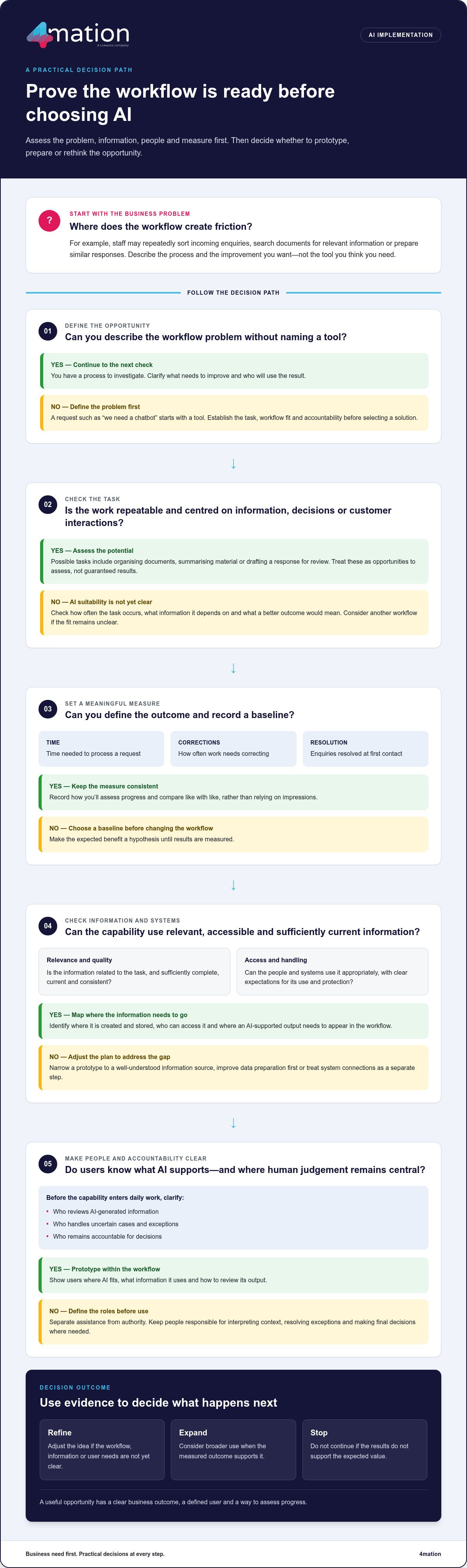
A new AI tool can look promising, but choosing it before defining the problem makes it difficult to judge whether it belongs in your organisation. Start with a workflow that creates friction: staff might repeatedly sort incoming enquiries, search documents for relevant information or prepare similar responses. Then clarify what needs to improve and who will use the result.
AI implementation applies an AI capability to a defined business need so people can use it and the organisation can assess its value. It’s more than purchasing software. The capability needs a place in the workflow, a clear purpose and people who understand when to rely on its output. For background on the technology itself, see What is Artificial Intelligence?
Compare the problem with the proposed solution. “Our team spends time categorising incoming requests” describes a process to investigate. “We need a chatbot” jumps to a tool before establishing whether a chatbot suits the task, how it would fit existing work or who would be accountable for its output. Starting with the business need keeps these questions visible and helps you avoid a pilot without a clear owner or measure of success.
Which business problems are suitable for AI?
Look for repeatable work involving information, decisions or customer interactions. AI might help organise documents, summarise material or draft a response for review. Treat these as possibilities to assess, not guaranteed results. Ask how often the task occurs, what information it depends on and what a better outcome would mean for staff, customers or the organisation. The AI consulting approach starts with your goals and operational challenges before a solution is recommended.
Separate assistance from authority. AI may help a staff member gather relevant information or prepare an initial draft, while a person interprets context, resolves exceptions or makes the final decision. Be especially clear about this distinction when an outcome affects a customer, employee or business commitment. Define which steps AI could support and where human judgement remains central.
What should an implementation aim to improve?
Choose a baseline before changing the workflow. Depending on the problem, this could be the time needed to process a request, how often work needs correcting or the proportion of enquiries resolved at the first point of contact. Decide how you’ll record the measure and compare results, so you’re assessing like with like rather than relying on impressions.
Map who does the work today and how their responsibilities might change. A useful opportunity has a clear business outcome, a defined user and a way to assess progress. Treat the expected benefit as a hypothesis until you measure it. This gives decision-makers a sound basis for deciding whether to refine the idea, expand it or stop.
How AI implementation connects data, people and business systems
An AI capability only helps if it works with the information and processes your organisation relies on. A response assistant, for example, may need access to current policy documents and a way to fit into the application staff use to manage enquiries. If it sits outside the workflow, people may have to copy information between systems or maintain a separate process, limiting its practical value.
AI implementation connects a model to relevant data, systems and people, with clear accountability for how its output is used. The technology is only one part of a working capability. Workflow design determines where it operates, data informs what it can draw on, system connections make it usable, and people and accountability shape how outputs are reviewed and acted on. This broader view is central to Developing an AI Strategy for Business, where technology choices need to support business priorities.
What role do data and existing systems play?
Trace information through the target workflow before settling on a design. Identify where it is created and stored, who can access it and where it needs to appear. This can show whether an AI capability must connect with an existing application, draw on approved documents or pass its output to another process step.
Assess the data in practical terms:
- Relevance: Does it relate to the task the capability needs to support?
- Access: Can the people and systems involved use it appropriately?
- Quality: Is it sufficiently complete, current and consistent for the intended purpose?
- Handling: Are expectations clear for how the information is used and protected?
Gaps don’t automatically rule out an opportunity, but they can change the plan. You might narrow the prototype to a well-understood information source, improve data preparation first or treat system connections as a separate step. Mapping these dependencies early keeps the proposed solution grounded in how work happens.
How do people and process shape adoption?
Involve the staff who handle the workflow, including those who know where exceptions arise. Their experience can help distinguish routine tasks from situations that need context, escalation or a different response. Set out who reviews AI-generated information, who handles uncertain cases and who remains accountable for decisions. Make these roles clear before the capability becomes part of daily work.
People also need a practical explanation of what changes. Show where the AI fits, what information it uses, how to review its output and what to do when it doesn’t suit the situation. This gives users a clear role instead of asking them to trust a tool without context. If you’re mapping a workflow across people and systems, talk with 4mation about your implementation needs.
How to assess AI use cases, value and implementation trade-offs
Not every promising idea deserves the same level of investment. Compare candidate use cases by the importance of the problem, the likely business benefit and the work required to fit AI into the process. This helps you weigh opportunity against practical constraints without assuming a return before you have evidence.
For each idea, consider four factors: the consequence of the current problem, how well AI fits the workflow, whether relevant data is accessible and suitable, and the effort needed to connect systems and support users. A pressing issue that depends on scattered information or major process changes may need a narrower first step. In supply chain operations, for example, evaluating suitability through a targeted exoskeleton for logistics trial lets teams assess worker adoption and physical workflow fit before scaling up. A small, bounded use case can help you gather evidence for the next decision.
| Focused use case | Broad ambition |
|---|---|
| Targets a defined workflow, such as sorting a particular type of enquiry. | Aims to “automate customer service” across different interactions and teams. |
| Names the users, information sources and existing process it must fit. | Leaves system connections, data needs and ownership unclear. |
| Sets a measure and a review point to guide the next decision. | Assumes value will emerge after adopting a tool. |
How can you prioritise AI opportunities?
Compare opportunities using a written assessment rather than a speculative return-on-investment forecast. Describe the problem’s operational or customer impact, the expected benefit, workflow fit, data access, system connections and the people needed to deliver the change. Record what you know and what remains uncertain. Prioritise a bounded workflow where a prototype can answer an important question and help you decide whether to proceed, adjust or pause.
Consider risk as part of the design. Ask what could happen if an output is incomplete or incorrect, who would notice and what recovery step is available. For routine support tasks, AI may prepare or organise information for a person to check. Where an action has greater consequences or needs contextual judgement, keep meaningful human review and accountability in the process.
What should you test before scaling an AI use case?
Test the capability in the workflow it is intended to support, including common exceptions and incomplete inputs. Assess whether outputs are useful, how much review they require, whether users understand their role and who owns the process day to day. Agree in advance what evidence would support continuing, changing or stopping the work. This keeps AI implementation for business grounded in observed workflow performance, not confidence in a demonstration alone.
Use the findings to make a measured decision. If outputs need frequent correction, refine the task or the information available. If users can’t fit the capability into their work, revisit the process and guidance. Scale only when the evidence supports it and your organisation can manage the workflow, oversight and ongoing ownership.
A practical AI implementation roadmap from discovery to measurement
A staged roadmap gives decision-makers clear points to proceed, adjust or pause. Each stage should produce evidence for the next, so AI implementation for business moves forward because the use case is ready, not simply because a prototype exists.
- Define the workflow. Map the steps, users and exceptions in the process you want to improve. Proceed when the team agrees on the workflow boundary, the problem and the outcome to pursue.
- Assess the fit. Check whether AI suits the task, whether relevant information is available and what system connections or human reviews may be needed. Proceed when the main dependencies and constraints are understood.
- Prototype the idea. Test the central assumptions with a limited use case. Gather examples of useful and unsuitable outputs, and note where users need to intervene. A prototype provides evidence for a decision. It is not automatically ready for production.
- Integrate the capability. Refine the design around the findings, including how it connects to existing applications and workflow steps. Proceed when the intended process, technical requirements and operational ownership are agreed.
- Prepare people to use it. Explain what changes, how staff review or act on outputs, and where exceptions go. Proceed when users have practical guidance and responsibilities are clear.
- Measure and review. Compare performance with the baseline selected during discovery, then review feedback and exceptions. Use the evidence to decide whether to improve, expand or stop the capability.
How should a business move from prototype to implementation?
Use prototype findings to narrow or refine the scope. Confirm which parts of the workflow the capability will support, what information it needs and how staff will use its output. Then plan the system connections and user experience around that agreed need. Depending on the solution, AI application development can deliver a capability shaped for your organisation’s workflow. Set operational ownership and the measurement approach before deployment, so support and evaluation are part of the plan from the outset.
How do you measure and improve an AI capability?
Return to the baseline established during discovery and collect comparable information once the capability is in use. A useful implementation measure tracks the business problem the AI was chosen to address. If the aim is to reduce processing delays, measure the relevant processing time. If the aim is to improve accuracy, review corrections against the earlier process. Claim improvement only when the evidence supports it.
Pair those measures with user feedback. Ask where the capability saves effort, where it creates friction and which exceptions need better handling. Use the findings to make specific changes, then reassess whether the workflow and outcome remain aligned. If you have a defined opportunity to explore, discuss your AI implementation with 4mation.
How 4mation helps Australian organisations implement practical AI
Turning an AI idea into a useful part of daily work takes more than selecting technology. 4mation works with organisations to understand their business goals, users and operational challenges, then shapes an approach around the workflow and outcome they want to improve. The focus is practical delivery, guided by your organisation’s needs rather than a one-size-fits-all tool.
With 25 years of experience, 40+ staff and certified AWS partner status, 4mation brings business and technology expertise to AI projects. Our work can span AI Consulting, AI Prototype, AI Integration and AI Application Development, depending on the problem, what needs testing and how the capability should fit into existing systems.
What does a business-first AI engagement look like?
We begin by exploring the workflow, the people involved and the outcome your organisation wants to improve. That discovery helps establish whether AI is a suitable fit and what information, systems and decisions the solution needs to support. From there, we can shape a focused prototype to test an idea and identify what should change before implementation.
A prototype tests assumptions. It doesn’t mean the resulting capability is ready for everyday use. Findings can inform the scope, user experience and integration requirements for the next stage. If you’re considering where to start or how to shape an opportunity, our AI consulting service provides a way to explore the business need and possible approach.
Our work includes distinct examples of applying AI to a real need. Ego Pharmaceuticals engaged 4mation as an AI consultant for smarter skincare choices. Separately, NATA’s AI proof of concept focused on enquiry handling and member onboarding. These examples reflect different needs, not a single solution for every organisation.
How can implementation continue beyond launch?
Once a direction is established, integration can connect the capability with relevant business applications and processes. AI Application Development can support a solution designed around the agreed need. The appropriate next step depends on what discovery and prototype work show. Planning for operational ownership, user feedback and ongoing development helps keep the solution aligned with the workflow as needs evolve.
You can explore more examples of 4mation’s work in our AI implementation case studies. They show how different business challenges can shape an AI project, rather than provide a template to copy. Across each engagement, we connect the technology to a defined business purpose and a way to assess its value.
If your organisation has a specific workflow or challenge in mind, talk with 4mation about a practical AI implementation opportunity. Together, we can explore the need, the people and systems involved, and a sensible path from initial idea to a capability your organisation can assess and support.
Turn your next AI idea into a considered decision
The next step doesn’t need to be a large-scale commitment. Choose one workflow your organisation would like to improve, then consider what a useful change would look like for the people who use it. A clear starting point gives you a practical basis to decide whether AI is appropriate and what evidence you’ll need before taking the idea further.
A measured approach to AI implementation for business helps you move from a broad ambition to a specific opportunity your organisation can assess. You can make progress without treating every idea as a project or assuming a promising demonstration is ready for everyday use.
Bring your business challenge, the workflow involved and the outcome you hope to achieve. Discuss an AI implementation opportunity with our team and explore a practical next step for your organisation. A well-defined problem is a strong place to begin.
Frequently Asked Questions
Can you manage an existing AWS or Azure environment?
Yes.
Can you support cloud infrastructure you did not design?
Absolutely.
About The Author
