2026 App Support & Maintenance Guide for AU Organisations
4mation Technologies

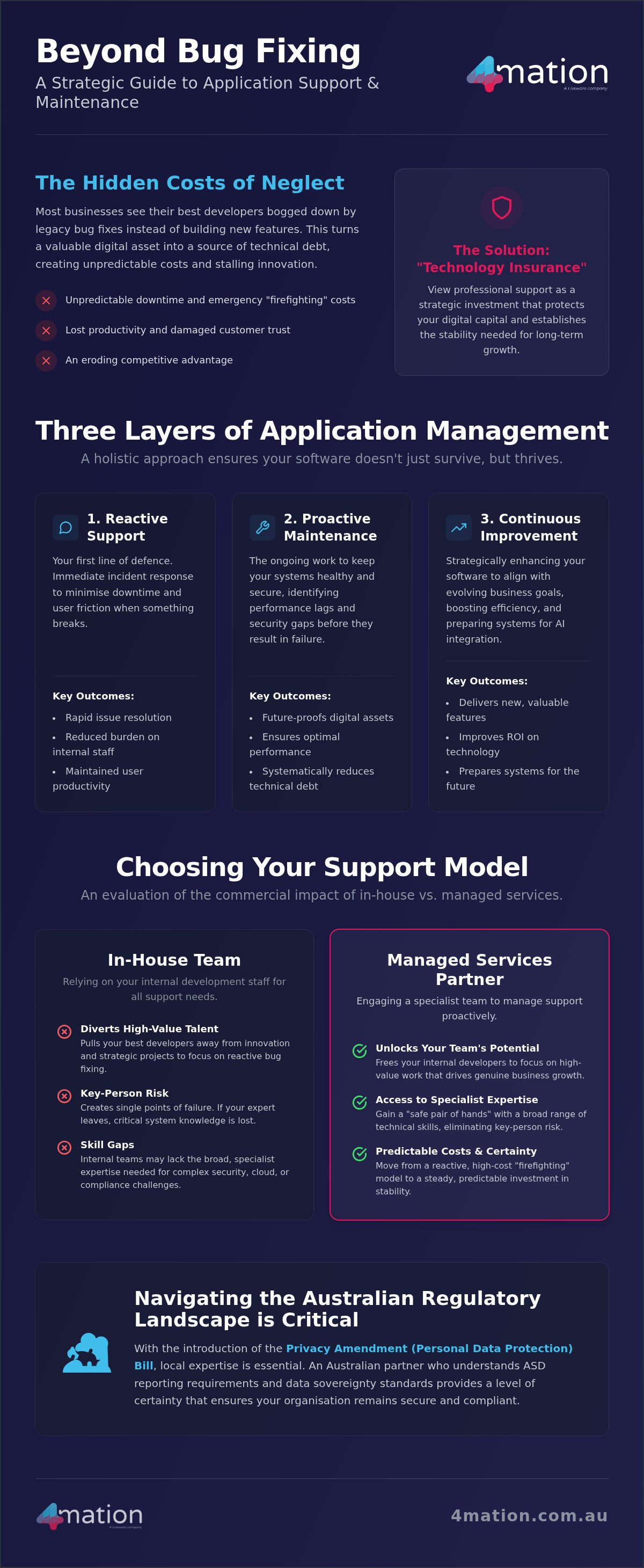
What if your application support wasn’t just a cost centre, but a form of “technology insurance” that actually accelerated your internal AI roadmap? Most Australian leaders feel the frustration of unpredictable downtime or seeing their best developers bogged down by legacy bug fixes instead of building new features. It’s a common bottleneck that turns a once-valuable digital asset into a source of technical debt. Investing in professional application support and maintenance services is no longer just about keeping the lights on; it’s about establishing the strategic stability needed for long-term growth.
This guide shows you how to protect your digital assets, eliminate the high costs of reactive “firefighting,” and ensure your custom software remains a genuine competitive advantage through proactive managed support. You’ll learn how to navigate the 2026 regulatory environment, including the recent Privacy Amendment (Personal Data Protection) Bill, while freeing your team to focus on innovation. We’ll provide a clear framework to reduce technical debt, improve operational efficiency, and prepare your systems for the next wave of AI integration without the usual delivery risks.
Key Takeaways
- Treat your software maintenance as “technology insurance” to protect your digital capital and prevent the unpredictable costs of reactive emergency repairs.
- Discover how proactive application support and maintenance services reduce technical debt, freeing your developers to focus on building new features rather than fixing old ones.
- Assess the commercial benefits of managed services over in-house models to eliminate key-person risk and access a broader range of specialist technical expertise.
- Align your digital assets with the 2026 Australian privacy law changes to maintain security and ensure your organisation meets new compliance standards.
- Identify the criteria for a strategic technology partner who aligns with your business goals to ensure your software continues to deliver a measurable return on investment.
Beyond Bug Fixing: The Commercial Case for Managed Application Support
For most Australian organisations, custom software is no longer a peripheral tool; it’s a core business asset that represents significant digital capital. When you treat Software maintenance as an afterthought, you aren’t just risking a few hours of downtime. You’re allowing your competitive advantage to erode. Professional application support and maintenance services should be viewed as “technology insurance.” This proactive approach ensures your systems remain stable, secure, and ready to scale, rather than becoming a source of mounting operational risk. For many Australian businesses, partnering with a reliable managed IT partner like CX IT Services ensures the underlying infrastructure remains robust enough to support these critical applications.
The cost of reactive “firefighting” is almost always higher than the investment in a steady, managed support model. When a system fails unexpectedly, the business absorbs the costs of lost productivity, damaged customer trust, and emergency developer rates. By contrast, a proactive partner identifies performance lags and security gaps before they result in failure. This “safe pair of hands” approach doesn’t just protect your current operations; it protects your people. When your internal developers aren’t distracted by constant maintenance tickets, they can focus on high-value innovation that actually moves the needle for your business.
Identifying the True Cost of Technical Debt
Technical debt is the “interest” businesses pay on rushed development decisions. While a quick fix might solve an immediate problem, it often leaves behind messy code that makes future updates more difficult and expensive. Over time, these minor issues accumulate into systemic risks that stall growth. This becomes particularly evident when you try to integrate modern AI solutions. If your underlying codebase is fragile or poorly maintained, it acts as a bottleneck, making it impossible to adopt the automated efficiencies your competitors are likely already using. We work with you to systematically reduce this debt, ensuring your software remains a flexible foundation for future growth.
The Australian Context: Compliance and Security in 2026
In 2026, the Australian regulatory landscape has become significantly more complex. With the introduction of the Privacy Amendment (Personal Data Protection) Bill 2026, the requirements for data handling and security have reached a new peak. Local expertise is essential for navigating these changes. A partner who understands the Australian Signals Directorate (ASD) reporting requirements and local data sovereignty standards provides a level of certainty that offshore-only providers cannot match. Our role as an Advanced Supplier in the NSW Government ICT Services Scheme means we maintain the high standards required for enterprise and government contracts. Failing to keep pace with these standards doesn’t just risk a fine; it risks your ability to win and retain business. You can learn more about these strategic trade-offs in our guide on The Risks of Not Modernising Legacy Systems.
Support vs. Maintenance vs. Continuous Improvement: What’s the Difference?
Many business leaders use these terms interchangeably, but they represent three distinct layers of value for your digital assets. To achieve the best long-term ROI from your application support and maintenance services, you must understand how each function contributes to your system’s stability and growth. A holistic approach that combines all three ensures your software doesn’t just survive the year, but thrives as your business evolves.
Reactive Support: Minimising Downtime and Friction
Reactive support is your first line of defence. It’s about immediate incident response when something breaks or a user encounters a hurdle. For business-critical platforms, even ten minutes of downtime can translate into lost revenue and significant internal frustration. Our Service Desk model focuses on rapid resolution, ensuring your team stays productive and your customers enjoy a seamless experience. By managing user enquiries professionally, we reduce the administrative burden on your internal operations, allowing your leadership to stay focused on strategy rather than troubleshooting.
Proactive Maintenance: Future-Proofing Your Investment
While support fixes the present, maintenance secures the future. This involves regular security patching and framework updates to prevent “version rot,” where software becomes obsolete and vulnerable over time. Proactive maintenance also includes database optimisation and cloud resource management to keep your operational costs predictable and lean. Crucially, a well-maintained codebase is the prerequisite for AI integration. You can’t layer intelligent automation or advanced data processing over a foundation that hasn’t been patched or optimised in years. We work with you to ensure your architecture is always ready for the next technological shift.
Continuous Development: Evolving with the Market
Continuous development is where your software becomes a genuine competitive advantage. Instead of waiting five years for a total system rebuild, we use an Agile approach to implement small, high-impact features based on real user feedback. This steady evolution ensures your platform remains relevant and valuable without the risk and expense of a massive overhaul. It turns your software into a living tool that adapts to changing market demands in real-time. If you’re unsure whether your current model covers all three of these critical bases, we can help you audit your support requirements to ensure your digital strategy remains robust for 2026 and beyond.
Evaluating Support Models: In-house, Staff Augmentation, or Managed Services?
Choosing the right delivery model for your application support and maintenance services is a strategic decision that directly impacts your operational risk and bottom line. While many Australian organisations initially favour a “DIY” approach, they often encounter the high costs of recruitment and the inherent dangers of key-person risk. If your institutional knowledge sits with just one or two internal developers, a single resignation can stall your entire product roadmap. Shifting away from this “single point of failure” allows you to focus on growth rather than just maintaining the status quo.
Managed services and staff augmentation offer two distinct paths to achieving stability. Managed services involve outsourcing the entire responsibility for system health to a partner, providing you with fixed-cost certainty and a “safe pair of hands” for your digital assets. Conversely, staff augmentation allows you to embed specialist engineers into your existing team to boost capacity for specific projects. Deciding between these models depends on whether you need to transfer the risk of system uptime or simply require more hands on deck to execute your vision.
When to Choose Managed Support Services
This model is ideal for stable, business-critical applications that require high reliability. One of the primary benefits is the immediate access to a broad range of specialists, including UX designers, DevOps engineers, and security experts, for a fraction of the cost of hiring each role individually. It provides a comprehensive solution for organisations that want to guarantee system performance without managing the day-to-day technical minutiae. For applications that have been neglected or are currently unstable, we provide a Fixed-Cost Project guarantee to stabilise the platform before transitioning it into a long-term managed support model.
The Role of Staff Augmentation in Scaling Teams
If you already have an established internal team but lack specific technical gaps, such as .NET or React expertise, Staff Augmentation services offer a flexible way to scale. This approach allows you to increase your development velocity without the long-term commitment of increasing permanent headcount. It’s a practical solution for meeting tight deadlines or launching new features quickly. At 4mation, we combine Australian-led management with global scale, ensuring you have local accountability and clear communication while benefiting from a larger talent pool to meet your specific goals.
What to Look for in an Australian Application Support Partner
Selecting a provider for application support and maintenance services is a decision that impacts your organisational stability for years. It’s not enough to find a team that can clear a ticket queue. You need a partner that understands your underlying business goals and the specific pressures of the Australian market. A Sydney-led team provides more than just convenient time zones; it offers cultural alignment and a deep understanding of local compliance requirements. This local expertise ensures that your technology strategy remains aligned with your commercial objectives.
Transparency is the foundation of a successful partnership. You should demand KPI-based reporting that links technical work to actual business outcomes. If your provider can’t show you how their work is reducing operational risk or improving user experience, they’re likely just performing maintenance for maintenance’s sake. We focus on clear, actionable data that gives you a sense of control over your technology investment, rather than hiding behind dense technical jargon.
Defining Meaningful SLAs and KPIs
Traditional metrics like “uptime” are the bare minimum. In 2026, truly valuable reporting moves beyond simple availability to focus on “time to resolve” and internal user satisfaction. Our approach to Technology Support and Maintenance focuses on these high-impact metrics to ensure your platform remains a genuine asset. We use proactive monitoring alerts to identify and resolve potential issues before your users even notice a performance dip. This reduces friction and keeps your team focused on their primary tasks.
The ‘Partner’ vs. ‘Vendor’ Distinction
A vendor follows instructions; a partner challenges your roadmap. You need a consultant who will suggest better ways to work and identify opportunities for cost optimisation in your cloud environment. This consultative approach prevents you from over-investing in unnecessary complexity and ensures your software evolves with the market. You can evaluate a partner’s track record by reviewing case studies in similar Australian industries like healthcare or logistics. These results provide concrete proof of how a “safe pair of hands” can deliver long-term stability and measurable success. If you’re ready to shift from reactive firefighting to a strategic support model, we invite you to contact our Sydney-led team to discuss your goals.
The 4mation Approach: Delivering Certainty through the Service Desk
We bring 25 years of experience to every partnership, prioritising commercial outcomes over technical vanity. Our “Service Desk” model provides a strategic framework for application support and maintenance services that delivers both technology insurance and a pathway for continuous development. We understand that for an Australian organisation to remain competitive, its software must do more than just function. It must evolve. By combining our Sydney-led strategic expertise with a global delivery network, we offer the 24/7 capability required for modern, business-critical platforms while maintaining local accountability and clear communication.
This hybrid approach ensures you have a “safe pair of hands” managing your systems at all times. We don’t just wait for things to break; we actively monitor for performance bottlenecks and security gaps. This disciplined methodology allows us to provide a sense of security and accountability that typical tech providers often lack. We position ourselves as a strategic ally, valuing long-term stability and measurable success over fleeting trends, ensuring your technology remains a foundational business asset.
Practical AI and Modernisation
We focus on ROI-led technology investments rather than chasing hype-filled trends. A key part of our approach involves preparing your architecture for the next stage of automation. This includes ensuring your maintained systems are ready to integrate AI Agents that can handle complex, multi-step tasks autonomously. We help you transition from the burden of legacy support to AI Workplace Modernisation, where technology actively reduces manual processing and improves operational accuracy. Together, we work to turn your software from a potential bottleneck into a high-performing engine for growth.
Ready to Protect Your Digital Assets?
Moving from high-risk legacy systems to a secure, optimised, and growing platform requires a disciplined approach. You’ve seen how proactive maintenance reduces technical debt and how the right support model can free your internal team for innovation. The final step is choosing a partner who values long-term stability and measurable success as much as you do. We provide the certainty and technical depth needed to make large-scale technology investments feel less risky. If you’re ready to secure your digital capital and ensure your software remains a competitive advantage, the path forward starts with a strategic review. We’ll help you identify your current gaps and build a roadmap for a more resilient future. Contact our Sydney team today to discuss your application support needs.
Securing Your Digital Future with Strategic Support
Transitioning from reactive firefighting to a proactive “technology insurance” model is the most effective way to protect your digital capital. By prioritising long-term stability and continuous improvement, you ensure your custom software remains a flexible foundation for growth rather than a source of mounting technical debt. Professional application support and maintenance services provide the certainty needed to navigate the complex regulatory environment while preparing your architecture for the next wave of AI-led automation.
As an Advanced Supplier in the NSW Government ICT Services Scheme and an AWS Select Consulting Partner, we bring 25 years of experience to every partnership. Our status as a 6x Great Place to Work Certified organisation reflects the depth of talent dedicated to your success. Together, we can turn your software into a high-performing engine for innovation. Contact 4mation today to discuss your application support and maintenance needs and ensure your technology investment is working as hard as you are.
Frequently Asked Questions
What is the difference between application support and maintenance?
Application support is a reactive service focused on immediate incident response and end-user assistance to resolve downtime or errors. Maintenance is a proactive discipline involving security patching, framework updates, and performance tuning to prevent future failures. Together, they form a comprehensive strategy for application support and maintenance services. This dual focus ensures your software remains functional today while securing its stability and performance for the long term.
How much do managed software support services cost in Australia?
The investment for managed support varies based on your application’s complexity and required response times. Australian industry benchmarks often suggest budgeting between 15% and 25% of the initial development cost for annual maintenance. While ad-hoc emergency repairs can cost between $250 and $400 per hour after business hours, a managed partner provides a more predictable and cost-effective monthly fee. This model allows for better budget control while reducing operational risk.
Do I need a local Australian partner for application support?
A local partner is essential for navigating Australian data sovereignty laws and the 2026 Privacy Amendment Bill. While global delivery networks offer scale, Australian-led management ensures cultural alignment and clear communication during your business hours. Local experts understand the specific requirements of the NSW Government ICT Services Scheme and other domestic standards. This proximity reduces delivery risk and ensures your technology strategy remains aligned with the Australian commercial environment.
What is ‘Technology Insurance’ in the context of software?
Technology insurance is a proactive support model designed to reduce operational risk for business-critical platforms. It moves beyond simple bug fixing to include constant monitoring, incident response, and regular security updates. This approach protects your digital capital by preventing small technical issues from escalating into systemic failures. By investing in this “insurance,” you avoid the high costs of unpredictable downtime and ensure your custom software remains a reliable asset.
How does managed support help with reducing technical debt?
Managed support reduces technical debt by systematically addressing legacy code and minor bugs before they accumulate into a bottleneck. Instead of just patching symptoms, a strategic partner identifies the root causes of performance lag. This disciplined approach prevents your software from stalling future growth. By clearing this debt, we ensure your platform remains flexible, making it easier and more cost-effective to implement new features or integrate advanced automated workflows later.
Can 4mation support applications built by other developers?
Yes, we frequently take over the support of applications originally built by other developers or internal teams. Our process begins with a thorough audit to understand the existing codebase and identify any immediate security or stability risks. For platforms that require initial stabilisation, we often use a fixed-cost project model. This ensures the application is brought up to a professional standard before transitioning it into our ongoing managed support framework.
What are the typical SLAs for enterprise application support?
Enterprise SLAs typically focus on response and resolution targets based on the severity of the issue. For business-critical platforms, you should expect “time to respond” and “time to resolve” metrics that align with your operational needs. Beyond simple uptime, modern SLAs also track user satisfaction and proactive monitoring alerts. These benchmarks provide a clear framework for accountability, ensuring your partner delivers a measurable outcome that protects your customer experience and internal productivity.
How does ongoing maintenance prepare my business for AI integration?
Ongoing maintenance ensures your codebase is clean, optimised, and ready for advanced automation. You can’t effectively deploy AI agents or intelligent workflows on top of fragile, unpatched legacy systems. Regular framework updates and database optimisations create the stable foundation required for these modern technologies. By keeping your software maintained, you’re building the architectural readiness needed to adopt intelligent tools that can automate complex business processes and improve operational accuracy.
About The Author
