The Risks of Not Modernising Legacy Systems: A 2026 Strategic Guide
4mation Technologies

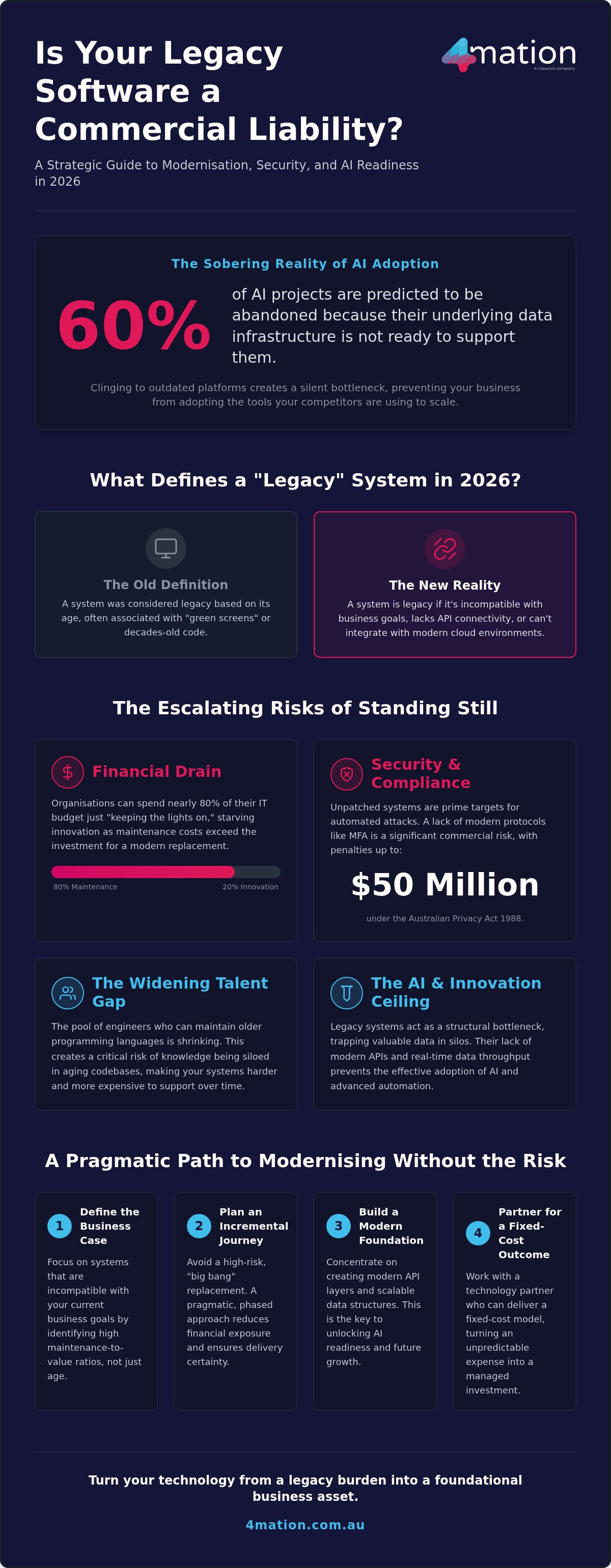
Through 2026, 60% of AI projects are predicted to be abandoned because the underlying data infrastructure isn’t ready to support them. It’s a sobering statistic that highlights a growing reality for Australian businesses. While your legacy software might still function, it’s likely becoming a silent bottleneck that prevents you from adopting the very tools your competitors are using to scale. We understand that the decision to overhaul a system you’ve relied on for years feels daunting. It’s often easier to justify another year of maintenance than to commit to a major change. However, the risks of not modernising legacy systems have shifted from being a technical nuisance to a significant commercial liability.
Clinging to outdated platforms creates escalating financial and security risks that can no longer be ignored. This guide provides a strategic roadmap to help you navigate a path toward secure, scalable modernisation. Together, we’ll explore the true cost of inaction, the widening talent gap for developers who know old languages, and how to build a foundation that delivers measurable operational efficiency and AI readiness. By the end, you’ll have the clarity needed to turn your technology from a legacy burden into a foundational business asset.
Key Takeaways
- Identify the specific markers that define software as “legacy” in 2026, shifting the focus from the age of the system to its functional incompatibility with your business goals.
- Understand the escalating commercial risks of not modernising legacy systems, including your exposure to sophisticated cyber threats and significant penalties under current Australian privacy regulations.
- Mitigate the talent gap by addressing the shrinking pool of engineers who can maintain older programming languages and the risk of critical knowledge being siloed within aging codebases.
- Prepare your organisation for AI success by establishing the modern data foundations and API layers required to support advanced automation and real-time data throughput.
- Learn how to navigate the modernisation journey using a pragmatic, incremental approach that ensures delivery certainty and reduces financial risk through a fixed-cost model.
What Defines a Legacy System in 2026?
In the past, we often associated legacy software with green screens or systems decades old. Today, the definition has shifted significantly. A platform is considered legacy when it no longer supports your current business objectives or meets the security standards required to protect your data. You might be surprised to learn that a system built only five years ago can already be a legacy asset if it’s incompatible with modern cloud environments or lacks the connectivity your organisation now requires. To understand the broader context, you can explore the foundational definition of What is a Legacy System? which highlights how these systems continue to be used despite being superseded by newer technology.
We often look for two main indicators of a legacy environment. First is a high maintenance-to-value ratio, where you’re spending more on keeping the software running than you’re gaining from its features. Second is a lack of API connectivity. If your software can’t talk to other tools in your ecosystem, it’s holding you back. Ultimately, a legacy system acts as a structural bottleneck that restricts operational agility and prevents the effective adoption of AI technologies.
The Escalating Cost of Technical Debt
Quick fixes and workarounds accumulate over years, creating what we call technical debt. While these shortcuts solve immediate problems, they result in a brittle foundation that makes even simple updates risky. Research into US federal agencies indicates that organisations can spend nearly 80% of their IT budget just “keeping the lights on” for existing systems. You reach a critical tipping point when the cost of maintaining these aging platforms exceeds the investment required for a modern replacement. At this stage, the risks of not modernising legacy systems become a direct threat to your bottom line and your ability to compete.
The Myth of “If It Isn’t Broken, Don’t Fix It”
Vulnerability in Unpatched Infrastructure
Legacy systems often operate as “black boxes” because they lack the comprehensive logging and monitoring capabilities required for modern threat detection. Without these features, a breach can go unnoticed for months. Monolithic architectures are also harder to secure than modern microservices because a single vulnerability can grant an attacker access to the entire environment. High-profile cases involving vulnerabilities in government legacy systems demonstrate how even well-resourced organisations struggle to defend outdated infrastructure. If your current build cannot support modern protocols like Multi-Factor Authentication (MFA), you’re essentially leaving your front door unlocked.
Meeting Australian Regulatory Standards
The Australian regulatory landscape has tightened significantly to protect consumer data. Under the Privacy Act 1988, serious or repeated breaches can now result in penalties of up to $50 million. Many legacy systems weren’t built with the Australian Privacy Principles (APPs) in mind, particularly regarding data portability and the “right to be forgotten.” For organisations in critical sectors, the Security of Critical Infrastructure (SOCI) Act mandates reporting serious incidents within 12 hours. If your software can’t provide the necessary audit trails to meet these deadlines, you face both legal and financial repercussions.
Viewing modernisation as a form of technology insurance allows you to protect your brand reputation while ensuring continuous compliance. A single data leak on a legacy platform can cause irreparable damage to customer trust that takes years to rebuild. If you’re concerned about your current exposure, it’s worth taking a moment to discuss a security audit of your existing platforms to identify where your greatest vulnerabilities lie.
The Talent Gap: Why Legacy Code Stalls Your Workforce
Software is a human-powered asset. As older programming languages fade from university curriculums, the pool of specialist engineers capable of maintaining them shrinks every year. This scarcity drives up the cost of “emergency” support because you’re forced to compete for a dwindling number of contractors who know your specific outdated stack. The risks of not modernizing legacy systems extend beyond the code itself. They manifest as a significant operational bottleneck when you can’t find the hands needed to keep the wheels turning.
We often see organisations fall into the “Knowledge Silo” trap. This occurs when a single long-term employee holds the keys to a critical business platform. If that individual leaves or retires, they take decades of undocumented logic with them. This creates a profound financial, security, and legal liability for your business. Without a clear path to modernisation, you’re essentially tethered to a single point of failure that could halt your operations overnight.
Attracting the Next Generation of Engineers
Top-tier Australian tech talent wants to work with contemporary stacks like React, Node.js, and AWS. They aren’t interested in learning obsolete languages that offer little career progression. If your environment is purely legacy, you’ll struggle with both recruitment and retention. Modernising your infrastructure improves internal culture and employee engagement by allowing your team to focus on innovation rather than manual bug-fixing. During this transition, we work with you using staff augmentation to provide the necessary skills while your internal teams upskill on newer technologies.
Reducing Operational Dependency
Moving away from “hero-based” support is essential for your long-term stability. By modernising, you can transition to standardised, documented managed services that any modern development team can support. This allows for better automation of routine technical tasks, which frees your people for higher-value work. Our approach to continuous improvement ensures that system knowledge is shared across a team rather than locked in one person’s head. This shift reduces your delivery risk and ensures your technology remains a reliable foundation for your growth.
The Innovation Ceiling: Legacy Systems vs. AI Readiness
Most legacy architectures were designed for a world of batch processing and siloed data, not the real-time requirements of modern artificial intelligence. These systems often lack the data throughput needed to power AI agents, creating a structural “innovation ceiling” that limits your growth. Integrating Generative AI into your operations becomes a prohibitively expensive or impossible task when your core software lacks robust API layers. Without these connections, your data remains trapped in a format that modern models simply cannot consume. One of the most significant risks of not modernizing legacy systems is that you’re effectively locking yourself out of the most powerful efficiency gains available today.
While your team might still be performing manual data entry or complex cross-referencing, your competitors using modern stacks are already automating these workflows. They’re moving faster, making fewer errors, and freeing their staff for higher-value tasks. AI readiness is the primary driver for AI workplace modernisation in 2026. If your foundation isn’t ready, any attempt to layer AI on top will likely stall before it delivers value.
Unlocking Data for Practical AI
Machine learning models are only as effective as the data they’re trained on. Legacy systems frequently house unstructured or “dirty” data that requires extensive cleaning and transformation before it’s useful for automation. Research indicates that 72% of senior leaders feel their organisation lacks the unified, accessible data required to run an AI initiative in production. We work with you through AI consulting to identify the highest ROI modernisation paths, ensuring your data is structured to support AI-driven insights rather than manual reporting.
Competitive Advantage in the Australian Market
In the Australian market, the gap between leaders and laggards is widening. Industry peers are increasingly adopting AI agents to handle operational scheduling, customer service, and predictive maintenance. These organisations aren’t just following a trend; they’re building a scalable advantage that reduces their cost per transaction. A “waiting and seeing” approach is a high-risk strategy for legacy-heavy businesses. Every day you delay modernisation, the risks of not modernizing legacy systems grow as the technical and data gap between you and your competitors becomes harder to close. Contact us today to assess your system’s AI readiness and build a practical roadmap for the future.
A Pragmatic Approach to Modernising Without the Risk
Modernisation shouldn’t be a leap of faith. Many executives hesitate to act because they’ve seen “Big Bang” rebuilds fail to deliver on their promises or spiral out of budget. Instead, we advocate for an incremental, value-led approach. By breaking the project into manageable phases, you can maintain business continuity while steadily improving performance. We start by conducting a thorough system audit to prioritise updates based on business impact rather than technical age alone. This ensures that you address the most critical risks of not modernizing legacy systems, such as security vulnerabilities or integration failures, before they become unmanageable.
Positioning 4mation as your strategic ally means you’re choosing a partner that values long-term stability over fleeting trends. We focus on identifying the specific areas where your current software limits growth. Our goal is to deliver secure, scalable software that provides measurable value to your organisation. By focusing on outcomes first, we help you turn your technology from a brittle liability into a foundational business asset that supports your long-term vision.
Fixed-Cost, On-Time, Bug-Free Delivery
Our engagement model is designed to remove the ambiguity and commercial anxiety that often plagues software development. We offer a Fixed-Cost project model to provide delivery certainty. This means your project is delivered on-time, on-budget, and bug-free. By adopting a “business-first” technology approach, we ensure that every technical decision is tied directly to an operational goal. This methodical process reduces the “buyer’s remorse” often associated with large-scale digital transformation. You gain a steady, reliable hand that understands the complexities of the Australian market and prioritises your commercial success.
Your Roadmap to Modernisation
A successful journey toward a modernised environment follows a structured, logical progression that mirrors a well-organised project roadmap. We work with you through three clear stages:
- Step 1: Strategic discovery and assessment. We conduct a deep dive into your current tech stack to identify hidden dependencies and security gaps.
- Step 2: Identifying “low-hanging fruit”. We find immediate opportunities for ROI, such as automating manual workflows that currently drain your team’s time.
- Step 3: Long-term planning. Together, we build a comprehensive plan for full application modernisation and AI integration.
This approach ensures you aren’t just replacing old code with new code. You’re building a resilient infrastructure that eliminates the risks of not modernizing legacy systems and prepares your business for the next decade of innovation.
Secure Your Organisation’s Future with Strategic Modernisation
The commercial landscape in 2026 demands more than just functional software; it requires platforms that are secure, scalable, and ready for AI integration. We’ve explored how the risks of not modernizing legacy systems manifest as escalating maintenance costs, critical security vulnerabilities, and a widening innovation gap. Maintaining the status quo isn’t just a technical decision; it’s a strategic risk that can hinder your ability to compete and scale across the national market.
Modernisation doesn’t have to be a source of anxiety. With 25 years of experience in custom software development, our team of 40+ local tech specialists understands how to navigate these complexities. We provide a steady hand through our fixed-cost, on-time, bug-free guarantee, ensuring your investment delivers measurable business value without the risk of budget blowouts or delivery ambiguity.
Taking the first step toward a more resilient infrastructure starts with a clear plan. We’re here to work with you to identify the most impactful path forward for your organisation. Book a modernisation strategy session with the 4mation team to turn your aging technology into a foundational asset. We look forward to helping you build a more efficient future.
Frequently Asked Questions
What are the most common signs that my legacy system is becoming a risk?
Signs include a high maintenance-to-value ratio, lack of API connectivity, and an inability to support modern security protocols like Multi-Factor Authentication. If you struggle to find developers who know your software’s language, your organisation is exposed to the risks of not modernizing legacy systems. We also look for “knowledge silos” where only one person understands the system logic. These indicators suggest your technology has become a bottleneck rather than a foundational business asset.
How much does legacy system modernisation typically cost for an Australian business?
Modernisation costs depend entirely on the complexity of your current tech stack and your specific operational goals. We don’t provide generic estimates because every legacy environment is unique; instead, we focus on providing a fixed-cost guarantee after a strategic discovery phase. This approach removes financial ambiguity and ensures your project remains on-budget. We work with you to prioritise the highest ROI paths to ensure your technology investment creates measurable value for your business.
Can we modernise our system without taking the entire platform offline?
You can certainly modernise your systems without significant downtime by using an incremental, value-led approach. We often employ strategies like the “Strangler Fig” pattern, where we build new functionality around the edges of the old system. This allows us to migrate features piece by piece while the core platform remains active. This method reduces delivery risk and ensures your daily operations continue smoothly while we build a more secure and scalable foundation.
What is the difference between rehosting, replatforming, and refactoring?
These terms describe the depth of the modernisation process. Rehosting is a “lift and shift” to a cloud environment with minimal changes to the code. Replatforming involves making minor adjustments to take advantage of cloud-native features without changing the core architecture. Refactoring is a more comprehensive rewrite of the code to improve its structure and scalability. We help you choose the right path based on your long-term goals for AI readiness and operational efficiency.
How does 4mation guarantee a fixed-cost outcome for complex modernisation projects?
We guarantee certainty through our Fixed-Cost / Fixed-Outcome engagement model. This starts with a deep-dive discovery phase where our local tech specialists define the project scope, user requirements, and technical dependencies. Because we take the time to understand the complexities upfront, we can commit to an on-time, on-budget, and bug-free delivery. This disciplined process aims to alleviate the anxiety often associated with large-scale technology investments and ensures a reliable result for your organisation.
Is it possible to integrate AI into a legacy system without a full rebuild?
Integrating AI into a legacy environment is often achievable without a total rebuild by using API layers or system integrations. We identify specific manual workflows that can be automated through practical AI implementation. This might involve creating a modern interface that communicates with your old database to provide AI-driven insights. This approach allows you to bypass the innovation ceiling of your legacy software and start seeing measurable ROI from automation much sooner.
How do we handle data migration from an old database to a modern cloud solution?
We manage data migration through a methodical process of strategic discovery, cleaning, and validation. Moving data from an old database to a modern cloud solution requires careful mapping to ensure no information is lost or corrupted. We focus on creating unified, accessible data structures that are essential for future AI initiatives. Our goal is to ensure your migrated data is a reliable asset that supports accurate business reporting and high-speed automation.
What role does technical debt play in slowing down our digital transformation?
Technical debt acts as a silent drain on your resources by forcing you to spend more on “keeping the lights on” than on new features. It creates a brittle foundation where even small updates become risky and time-consuming. This structural bottleneck slows down your digital transformation because your team is constantly fixing old bugs rather than building new value. Modernising allows you to pay down this debt and reclaim your operational agility. If you’re unsure of the true health of your current investment, commissioning a third party software project audit can replace uncertainty with objective clarity and ensure your technology is building long-term value rather than future liabilities.
About The Author
