7 Critical Signs You Need a Custom Software Solution to Scale Your Business
Michael CaliHead of Marketing
Michael is passionate about showcasing what is truly possible when you partner with us. With data-driven insights, he boosts our exposure to Australian businesses that share our commitment to being at the forefront of tech innovation. His main goal is connecting our team with the market of innovators to deliver software ‘magic’!

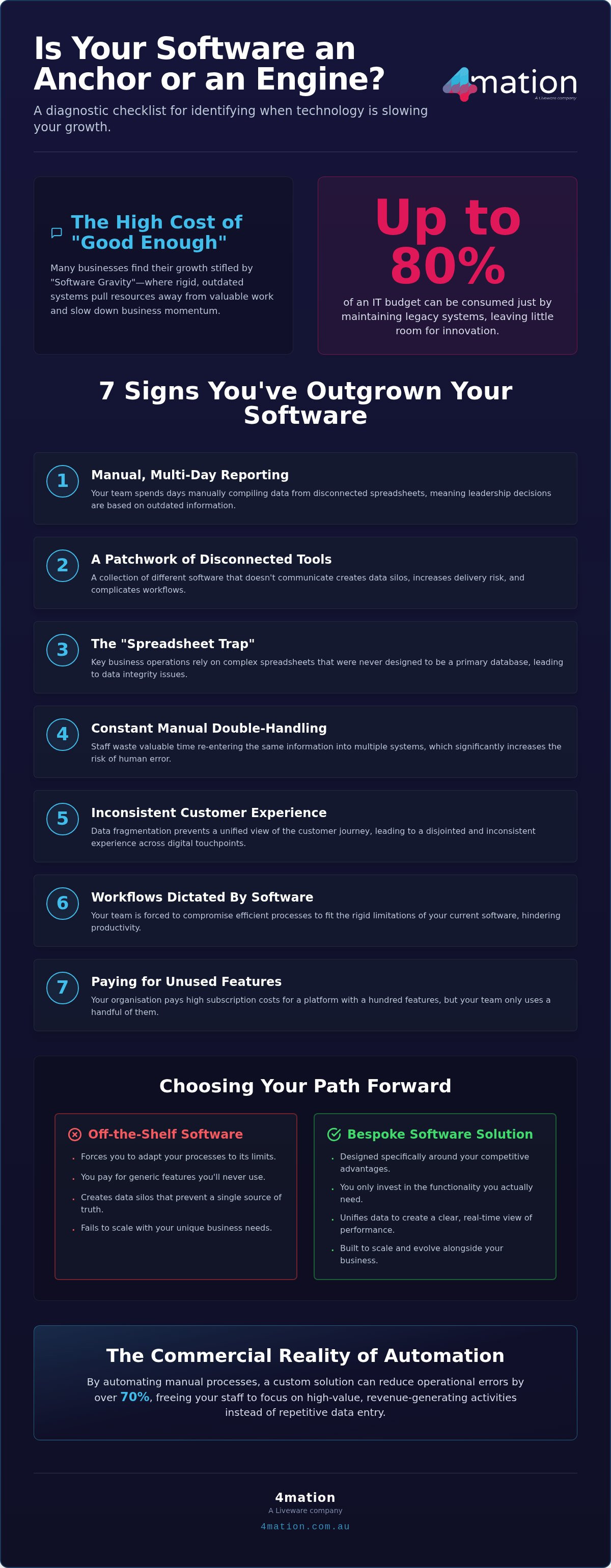
Did you know that many organisations currently spend between 60% and 80% of their IT budgets just to maintain legacy systems that no longer serve their commercial goals? It is a staggering figure that highlights how easily outdated technology can become a financial anchor rather than a growth engine. If your team is constantly battling manual data entry between disconnected tools or struggling to get a clear picture of your performance, you are likely seeing the first signs you need a custom software solution to reclaim your operational efficiency.
We understand the frustration of paying high subscription costs for generic platforms that only meet half your requirements while leaving you with features you never use. Technology should adapt to your specific business processes, not the other way around. When your software dictates your workflow, it becomes a liability that introduces unnecessary risk and human error into your daily operations.
This article identifies the critical operational bottlenecks and technical limitations signalling that off-the-shelf software is no longer supporting your commercial goals. We will explore seven key indicators that it is time to transition to a scalable platform that grows with you, ensuring your technology remains a foundational asset rather than a hurdle to your long-term success.
Key Takeaways
- Learn to identify the “Software Gravity” effect, where rigid systems begin to slow your business velocity and pull resources away from high-value tasks.
- Use our diagnostic checklist to spot the seven critical signs you need a custom software solution to eliminate manual workarounds and fragmented data.
- Understand the commercial reality of maintaining legacy systems, which can consume up to 80% of IT budgets while increasing the risk of operational failure.
- Compare bespoke development against off-the-shelf and low-code alternatives to determine the most cost-effective path for your specific commercial goals.
- Discover how a fixed-cost, outcome-oriented model provides the financial certainty and accountability needed to ensure your technology investment delivers measurable results.
When “Good Enough” Stops Working: The Cost of Commercial Friction
Growth brings complexity that standard software isn’t designed to handle. There is a specific moment in every company’s lifecycle where “good enough” technology becomes a primary source of commercial friction. We call this “Software Gravity.” It occurs when your rigid systems begin to pull down your business velocity, making it harder to pivot or respond to market changes. Recognising the signs you need a custom software solution is critical before this friction turns into a full-blown operational crisis.
Many Australian organisations delay modernisation until a system failure or a lost contract forces their hand. This reactive approach increases delivery risk and often leads to higher costs in the long run. Shifting your perspective to view technology as a capital investment rather than just an operational expense allows you to build a platform that scales alongside your ambitions. To manage this transition with certainty, commercially minded leaders often prefer a fixed-cost project model that ensures the technology investment delivers a measurable business outcome.
The Limitations of Off-the-Shelf SaaS
Standard SaaS platforms are built for the average user, which usually means they fail to support the unique ways your business creates value. The tipping point arrives when your team spends more time working for the software than the software spends working for them. You might find yourself paying for a suite of 100 features while your team only utilises five. These rigid structures force you to compromise your processes to fit the software limits. Custom software is designed specifically around your competitive advantages, ensuring your technology supports your growth rather than restricting it.
Understanding Technical Debt in Your Organisation
Technical debt is a term often used by developers, but it has significant commercial consequences. It is essentially the interest paid on yesterday’s quick fixes. For non-technical executives, it manifests as a slow, invisible drain on productivity. Every hour your staff spends cleaning data or moving information between disconnected systems is an hour not spent on revenue-generating activities. Identifying these signs you need a custom software solution early helps you avoid the mounting costs of legacy maintenance that can consume up to 80% of an IT budget. By addressing these bottlenecks now, you remove the friction that prevents your business from reaching its next stage of growth.
A Diagnostic Checklist: 7 Signs You Need a Custom Software Solution
Identifying the specific signs you need a custom software solution is the first step toward reclaiming your team’s time and ensuring your technology supports your commercial goals. When your staff spends more time managing data than using it for strategic decisions, your current system has likely reached its limit. This inefficiency often manifests as a multi-day manual reporting process involving several disconnected spreadsheets, leaving your leadership team with outdated information for critical decision-making. To address these operational hurdles, you may wish to learn more about Marketing System Solutions and how they help Australian companies streamline their internal processes.
A “patchwork” of tools that refuse to talk to each other creates significant delivery risk. This fragmentation often results in an inconsistent customer experience across different digital touchpoints, as data silos prevent a unified view of the client journey. If your current setup feels like it is working against you rather than for you, it is time to evaluate whether to invest in custom software to unify your operations.
Operational Red Flags and Inefficiencies
The “Spreadsheet Trap” is perhaps the most visible indicator of technical debt. When Excel becomes your primary database, you’ve moved beyond its intended purpose. This leads to manual double-handling of data across sales, finance, and operations, which significantly increases the risk of human error. Research indicates that implementing business process automation can reduce these operational errors by more than 70%, freeing your team to focus on higher-value tasks. If your systems are actively failing or require constant “rescue” from manual workarounds, you can speak with our consultants to identify a more stable path forward.
Customer and Competitive Disadvantage
Poor software directly impacts your bottom line through slow response times and decreased customer retention. If you find yourself unable to launch new services or products because your system “can’t handle it,” you’re handing a competitive advantage to more agile rivals. Many forward-thinking Australian organisations are already using AI and digital innovation to streamline their workflows. Falling behind in these areas makes it increasingly difficult to attract and retain both customers and top-tier talent.
Security, Compliance, and Scaling Risks
Using outdated legacy systems that no longer receive security updates is a significant liability. Generic global tools often struggle to meet specific Australian data privacy standards, leaving you vulnerable to compliance breaches. As you grow, this technical limitation creates “operational chaos” because the software cannot scale horizontally to meet increased demand. A tailored solution, such as those developed by AP4 Digital, ensures your technology is a foundational asset that provides certainty, security, and the ability to grow without constant technical friction.
The Commercial Reality: The Hidden Cost of Doing Nothing
The decision to stick with a legacy system often feels like the safer financial choice, but the hidden costs tell a different story. When you ignore the signs you need a custom software solution, you are essentially accepting a permanent tax on your productivity. Organisations globally spend between 60% and 80% of their IT budgets just maintaining legacy systems, leaving little room for the innovation required to stay competitive. This “Risk of Failure” is not just about technical crashes; it is the commercial risk of being unable to adapt as your market evolves.
Transitioning to bespoke software allows you to implement AI workplace modernisation that targets high-volume, repetitive tasks. Unlike off-the-shelf tools that offer generic automation, custom platforms enable “Practical AI” tailored to your specific workflows. This creates a clear path to long-term ROI, where the initial capital investment is often offset by significant reductions in combined hardware and staffing costs over time. Navigating the Build versus buy decision requires a clear-eyed look at these long-term commercial outcomes rather than just the immediate price tag.
Staff Morale and Talent Retention
Frustrating, slow software is a primary driver of employee burnout and the rise of “shadow IT,” where teams use unauthorised tools just to get their jobs done. In the current Australian market, providing modern, intuitive tools is a critical factor in attracting and retaining top-tier talent. There is a direct, measurable correlation between the quality of a company’s internal software and the level of employee engagement and output. Just as modular platforms like Maker & Coder engage students with specialised STEM hardware and software, purpose-built business systems empower employees to solve complex problems with confidence. If your team feels hindered by their tools, they won’t just work slower; they’ll eventually look for an employer who values their time and provides the right technology to succeed.
Data-Driven Decision Making
Flying blind with delayed or inaccurate reporting is a significant commercial hazard that leads to missed opportunities. A custom dashboard provides the executive team with a single source of truth, removing the need to reconcile conflicting spreadsheets from different departments. This real-time access to data allows for faster, more confident commercial pivots, ensuring you can capitalise on market shifts before your competitors do. When you have certainty in your data, you reduce the risk of making expensive strategic errors based on outdated or fragmented information.
Strategy vs. Hype: Choosing Your Path Forward
When business leaders evaluate the signs you need a custom software solution, the first objection is almost always financial. It’s tempting to think that buying another SaaS subscription is the cheaper path. While the upfront cost of a generic subscription is lower, this approach often leads to “SaaS sprawl,” where you pay for a dozen disconnected tools that require manual workarounds to function as a cohesive system. Over time, the cost of these subscriptions and the lost productivity they cause can far exceed the investment in a tailored platform.
Choosing the right path requires a clear distinction between commodity functions and core competitive advantages. Digital transformation is rarely a “big bang” event that happens overnight. It’s a phased journey that prioritises high-impact areas first. By focusing on the parts of your business that truly drive revenue, you can build a scalable asset that delivers a measurable return. For many Australian organisations, this means moving away from the “patchwork” model toward a more disciplined, outcome-oriented technology strategy.
The “Buy vs. Build” Decision Framework
The most effective strategy is to buy what is common and build what is unique. You should buy software for commodity functions like email, basic accounting, or payroll. These processes are the same for almost every business and don’t provide a competitive edge. However, you should build software for your core value proposition and unique operational workflows. This logic extends to physical assets too; for instance, companies often find they can read more about sourcing high-quality used industrial equipment to optimise their capital expenditure. Identifying these unique drivers is one of the clearest signs you need a custom software solution to protect your market position.
Modernising Legacy Applications with AI
Modernisation doesn’t always require you to “rip and replace” every existing system. In many cases, strategic integration is the more pragmatic choice. You can use AI agents to bridge the gaps between your legacy tools and new, automated workflows. This approach allows you to future-proof your software assets without the delivery risk of a total system overhaul. Our team at 4mation provides AI consulting to help you identify where these smart integrations can remove bottlenecks and create immediate commercial value. If you’re unsure which path is right for your current infrastructure, you can book a strategic consultation with our local specialists to map out a clear roadmap.
Reducing Risk: The 4mation Approach to Certainty
Identifying the signs you need a custom software solution is only the first step toward operational excellence. The secondary challenge for most Australian executives is managing the delivery risk associated with large-scale technology investments. At 4mation, we address this through a “Safe Pair of Hands” mentality, backed by 25 years of experience in delivering complex projects for local organisations. We understand that commercial certainty is just as important as technical functionality, which is why we prioritise accountability at every stage of the development lifecycle.
Our model is built on providing a disciplined, outcome-oriented approach that avoids the frantic energy of typical tech startups. We work with you as a strategic ally, ensuring that every line of code serves a specific business goal. Whether you are looking to automate workflows or build a completely new platform, our team of 40+ local specialists provides the methodical expertise required to move from an initial vision to a sustained, high-performing reality. If your internal team is already at capacity, our staff augmentation services can provide the extra talent needed to accelerate your roadmap without the overhead of permanent hiring.
Delivery Certainty in a Complex Landscape
Budget blowouts are the primary source of “buyer’s remorse” in software development. To eliminate this anxiety, we offer Fixed-Cost Projects that guarantee on-time and on-budget delivery. This model shifts the risk from your balance sheet to our expertise, providing the financial predictability you need to secure board approval and meet your commercial targets. Being a Sydney-led agency means our communication is always aligned with your business hours and local market nuances, ensuring that the final product reflects your unique operational requirements rather than a generic global template.
Beyond the Build: Continuous Improvement
Successful software is a living asset that requires proactive monitoring to remain effective. We view ongoing support as “Technology Insurance” for your critical platforms. Through our Service Desk, we provide Managed Services that reduce operational risk and ensure your systems remain secure and compliant. This isn’t just about fixing bugs; it’s about continuous improvement. We regularly review your platform’s performance to identify new opportunities for automation or modernisation, ensuring your technology continues to remove friction as your business grows. This long-term commitment to reliability is what distinguishes a true technology partner from a simple software vendor.
Secure Your Commercial Future with Purpose-Built Technology
When generic tools force your team into manual workarounds, they stop being assets and start being liabilities. Recognising the signs you need a custom software solution early allows you to transition from reactive maintenance to strategic growth. By choosing to build where you have a unique competitive advantage, you protect your market position and remove the technical friction that holds back your business velocity. This shift ensures your technology supports your long-term commercial goals rather than dictating your daily workflows.
As an AWS Select Consulting Partner with 25 years of experience delivering successful software projects, 4mation provides the technical certainty your organisation requires. Our fixed-cost guarantee ensures your project remains on budget, providing a safe pair of hands for your digital transformation journey. We focus on delivering measurable outcomes that reduce risk and drive efficiency across your entire operation. You don’t have to navigate these complex technical decisions alone.
Book a consultation with our Sydney-led strategy team to discuss your custom solution and discover how a tailored platform can accelerate your growth. We look forward to helping you build a more reliable, scalable future.
Frequently Asked Questions
How do I know if custom software is worth the investment for my business?
Custom software is worth the investment when the cost of manual workarounds and lost opportunities exceeds the capital expenditure of the build. We work with you to calculate the return on investment by analysing potential time savings and revenue growth. If your current tools are one of the clear signs you need a custom software solution, the long-term efficiency gains usually outweigh the upfront costs.
What is the typical timeframe for a bespoke software project in Australia?
Project timeframes vary depending on complexity, but most core bespoke solutions take between three to nine months to deliver. We often recommend a phased approach, starting with a Minimum Viable Product (MVP) to get you into the market faster. This methodical progression ensures we deliver immediate commercial value while building a robust foundation for your future requirements and long-term scalability.
Can custom software integrate with my existing off-the-shelf tools?
Yes, custom software is designed specifically to integrate with your existing off-the-shelf tools through secure APIs. This removes the “patchwork” problem by creating a unified data flow between your sales, finance, and operations platforms. By connecting your disconnected tools, we eliminate manual data entry and ensure your executive team has a reliable, single source of truth for decision-making.
What happens if my business requirements change during the development process?
We manage changing requirements through a collaborative and transparent discovery process that defines the project scope early. If your commercial goals shift during development, we work with you to assess the impact on the timeline and budget. Our disciplined project management ensures that any adjustments are controlled and documented, maintaining the delivery certainty that our fixed-cost model provides for your organisation.
How does 4mation ensure the security and scalability of custom builds?
We ensure security and scalability by utilising industry-standard frameworks and our status as an AWS Select Consulting Partner. Our local tech specialists conduct rigorous testing and follow best practices for data encryption and privacy compliance. This approach ensures your platform can scale horizontally as your user base grows, providing a reliable technology foundation that eliminates the operational chaos of underperforming systems.
Is it possible to modernise a legacy system without a total rebuild?
You can often modernise legacy systems through strategic integration rather than a total rebuild. We use technologies like AI agents or custom middleware to bridge gaps in your existing workflows. This pragmatic approach allows you to address the signs you need a custom software solution incrementally, reducing delivery risk while still achieving significant improvements in your operational efficiency. If you are looking for further examples of this approach, you can check out Founders Workshop, who specialise in modernising legacy applications and building MVPs.
What is the difference between a fixed-cost project and agile development?
A fixed-cost project provides budget certainty by defining the outcome and price upfront, while agile development allows for continuous flexibility. At 4mation, we blend these approaches by using a fixed-cost model for the core project delivery to eliminate budget blowouts. This gives you the financial security of a predictable investment while still benefiting from a collaborative and iterative development process.
Do I own the intellectual property (IP) of the software 4mation builds for me?
You own the intellectual property (IP) of the software we build specifically for your business once the project is completed and paid for. We believe that your technology should be a foundational asset that adds value to your company’s balance sheet. Providing full IP ownership ensures you have total control over your software’s future, allowing you to innovate and scale without being locked into a vendor’s proprietary platform.
About The Author
