25 Critical Questions to Ask a Software Developer Before Hiring in 2026
Jowena BorralDigital Marketing Specialist

The biggest risk to your software budget isn’t poor syntax; it’s hiring an engineer who builds precisely what you ask for without understanding your commercial goals. When developers focus purely on features rather than operational outcomes, minor misalignments quickly spiral into blown deadlines and compounding technical debt. Knowing the right questions to ask a software developer before hiring is the difference between securing a disciplined partner and inheriting an expensive digital headache.
You already know how difficult it can be to evaluate technical capability without a deep background in systems architecture. It’s frustrating to watch delivery milestones slip while juggling concerns around data security, privacy compliance, and ambiguous intellectual property ownership.
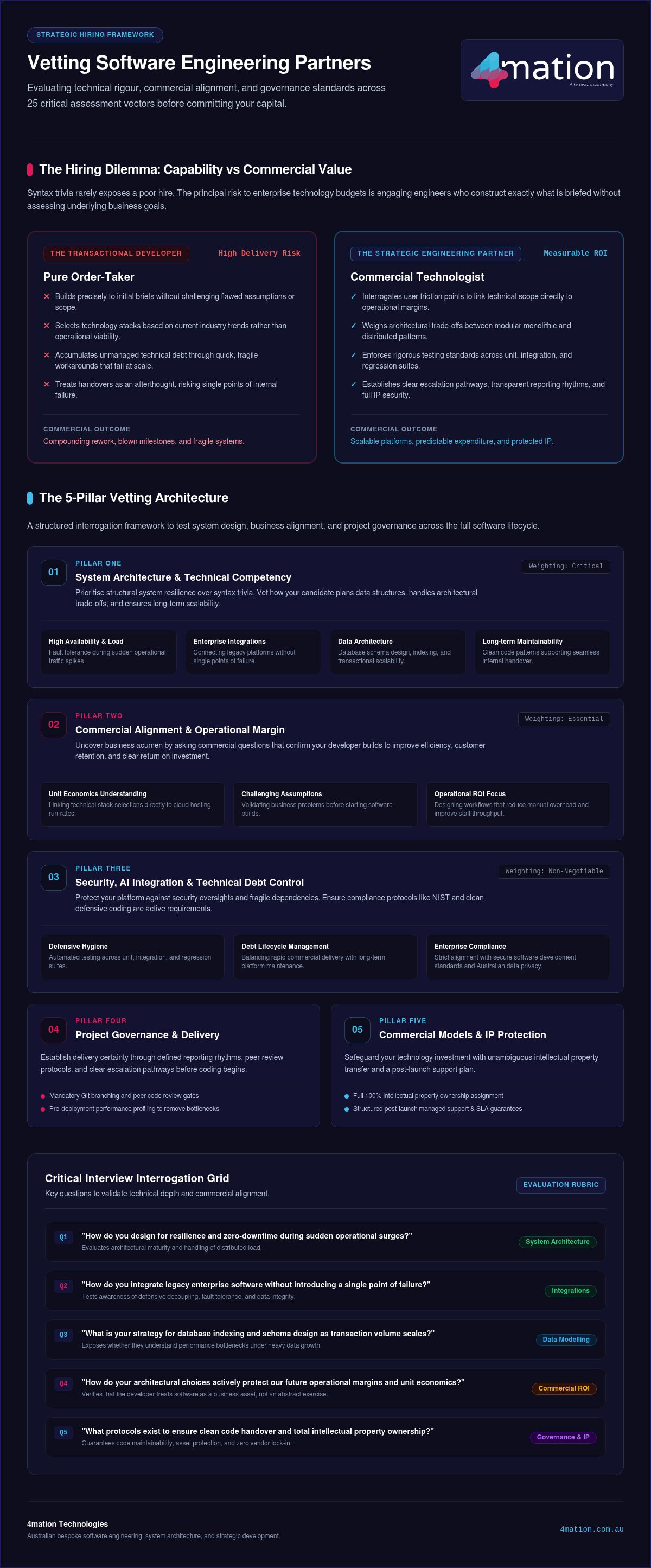
This guide gives you a structured vetting framework to assess both technical competence and business acumen with total confidence. Across the following 25 critical questions, you’ll discover how to interrogate architecture, commercial accountability, and project governance to ensure your software is reliable, scalable, and built to last.
Key Takeaways
- Prioritise system design over programming trivia by vetting how an engineer plans data structures, handles architectural trade-offs, and ensures long-term scalability.
- Uncover business acumen by asking targeted commercial questions that confirm your developer builds to improve operational margins, user experience, and measurable ROI.
- Use our structured vetting framework featuring 25 critical questions to ask a software developer before hiring to protect against unmaintainable technical debt and security oversights.
- Ensure project delivery certainty by establishing transparent reporting rhythms, clear escalation pathways, and rigorous governance standards before writing a single line of code.
- Protect your technology investment by choosing an appropriate commercial model, securing full intellectual property ownership, and planning post-launch managed support.
Architectural and Technical Competency: Questions to Test Core Engineering Capabilities
Syntax trivia rarely exposes a poor hire. Quizzing an engineer on specific language functions or algorithm memorisation tells you very little about their ability to build robust, business-critical platforms. With tech talent increasingly utilising platforms like QuickApply to streamline the application process, hiring teams face higher candidate volumes, making deep structural vetting essential. High-performing Australian organisations look beyond syntax to assess system architecture, operational resilience, and disciplined engineering practices. When planning your screening strategy, the most effective questions to ask a software developer before hiring focus on structural design decisions that influence long-term stability and platform total cost of ownership.
Reliable engineering begins with evaluating how a specialist structures software to handle business growth. Rather than rushing into microservices, an experienced practitioner weighs the real operational trade-offs between modular monolithic systems and distributed services. Inquire how they enforce strict quality controls across enterprise environments such as .NET, React, and Node.js. A competent partner ensures software foundations remain maintainable rather than accumulating quick, fragile workarounds that fail under pressure.
Evaluating System Architecture and Design Patterns
Digging into system design demonstrates whether an engineer builds for resilience or simply patches together functional prototypes. When screening candidates or assessing an outsourced partner for bespoke software development, explore these core architectural questions:
- High availability and load: “How do you design an application architecture to ensure high availability, fault tolerance, and resilience during sudden traffic surges?”
- Integrations: “What is your strategy for integrating third-party APIs and mission-critical legacy platforms without introducing single points of failure?”
- Data architecture: “How do you approach database schema design, indexing, and data modelling to prevent performance degradation as transaction volumes multiply?”
- Long-term maintainability: “In what ways do your architectural patterns support clean handover and ongoing development for our internal engineering teams?”
Assessing Code Quality, Version Control, and Testing Standards
High-quality engineering requires disciplined hygiene across the entire deployment lifecycle. The most vital questions to ask a software developer before hiring explore automated validation and defensive programming. Candidates must articulate a clear balance between rapid delivery and managing technical debt to safeguard platform longevity.
Ask developers to outline their automated testing coverage across unit, integration, and end-to-end regression suites. Check how their Git branching strategies and mandatory peer review protocols prevent flawed code from entering production pipelines. Finally, require them to explain how they profile code performance to eliminate operational bottlenecks, memory leaks, and sluggish database queries well before initial deployment.
Commercial Alignment: Questions to Evaluate Business Acumen and ROI Focus
Writing elegant code means very little if an application fails to advance your commercial objectives. Order-takers build precisely what is written on an initial specification sheet without questioning whether the requested functionality actually solves the underlying business problem. Strategic engineering partners do the opposite. They challenge assumptions, evaluate customer friction points, and link technical requirements directly to operational margins. Knowing the right commercial questions to ask a software developer before hiring helps you separate transactional coders from true business partners.
Every architectural commitment carries long-term operational costs. An engineer with genuine commercial acumen seeks to understand your unit economics, delivery schedules, and compliance targets before choosing a development stack. They understand how adhering to structured security protocols like the NIST Secure Software Development Framework protects enterprise value and preserves customer trust throughout delivery.
Connecting Technical Solutions to Business Outcomes
Commercial maturity shows up in how an engineer justifies technical decisions. To evaluate how prospective developers connect technology to commercial returns, explore these practical scenarios:
- Backlog prioritisation: “How do you evaluate and prioritise backlog features to ensure the engineering team delivers the fastest return on investment?”
- Cost reduction: “Can you describe a past project where simplifying the technical scope saved significant capital expenditure or operational costs?”
- Executive communication: “How do you explain technical constraints and infrastructure trade-offs to non-technical executive stakeholders?”
- Customer experience: “How do your frontend design choices directly reduce user friction, drop-off rates, and operational support overheads?”
Handling Changing Business Requirements and Scope Creep
Digital initiatives rarely follow a rigid linear path. Shifting market dynamics, customer feedback, and internal operational realities inevitably require feature adaptations mid-build. The critical question is whether a developer responds with defensive pushback or structured commercial governance.
Ask candidates how they negotiate conflicting stakeholder demands when timelines tighten. How do they balance urgent feature adjustments against core project deliverables without blowing out the budget? You need engineers who quantify the downstream impact of scope additions clearly, detailing the exact effect on sprint velocity, system stability, and delivery dates. If you want to ensure your development strategy remains closely tied to measurable business value, you can speak with our engineering consultants about structuring commercially aligned delivery roadmaps.
Security, AI Integration, and Technical Debt: Questions for Future-Proofing Software
A functional platform can still represent an existential corporate liability if it exposes customer records or traps your organisation in rigid architectures. Building modern applications requires rigorous adherence to statutory data obligations, responsible intelligence workflows, and disciplined lifecycle management. Integrating security and governance checks into your questions to ask a software developer before hiring ensures you don’t inherit vulnerable codebases or unmaintainable operational burdens.
Modernising outdated systems carries substantial commercial weight. Inquire how prospective partners evaluate the risks of not modernising legacy systems when mapping out refactoring initiatives versus clean builds. Reliable engineers look beyond quick interface overhauls; they systematically eliminate architectural fragility while ensuring your business complies with Australian privacy standards and enterprise operational benchmarks outlined in the Bureau of Labor Statistics occupational guide.
Application Security and Compliance Standards
Defensive coding must be embedded from the initial commit. Interrogate developers on how they protect sensitive workflows by asking these core compliance questions:
- Defensive controls: “How do you enforce secure coding practices against OWASP Top 10 vulnerabilities like injection and broken access controls during active development sprints?”
- Data protection: “What encryption ciphers and key management procedures do you use for customer data both in transit and at rest?”
- Local regulatory alignment: “How do your architectural designs support Australian Privacy Principles, role-based permissions, and automated data retention limits?”
- Vulnerability patching: “What is your defined incident response protocol for isolating and remediating critical zero-day vulnerabilities in production environments?”
Vetting Practical AI Implementations and Governance
Artificial intelligence introduces immense operational leverage alongside substantial regulatory and architectural risk. The essential questions to ask a software developer before hiring for modern projects must uncover whether they grasp governance alongside raw machine learning capabilities:
- Commercial viability: “How do you determine whether an AI workflow delivers genuine operational efficiency rather than unnecessary technical complexity?”
- Enterprise data privacy: “What engineering boundaries do you configure to prevent sensitive company or customer data from leaking into public training sets?”
- Output verification: “How do you test and monitor model outputs for accuracy, hallucination risks, and systematic drift over extended operational lifecycles?”
Managing and Mitigating Technical Debt
Uncontrolled technical debt quietly erodes maintenance budgets. Software developers must balance immediate launch urgency against future architectural viability. Ask candidates how they audit, track, and remediate legacy code bottlenecks before they destabilise downstream features. Require them to demonstrate how their system documentation and pipeline automations allow new internal engineers to onboard smoothly without prolonged downtime or expensive project restarts.
Project Governance and Communication: Questions to Ensure Delivery Certainty
Most software initiatives fail due to poor governance rather than flawed coding. Without transparent reporting and clear operational rhythms, communication gaps quickly widen into delivery delays and compounding budget overruns. For business leaders, evaluating management maturity is just as vital as testing technical architecture. Knowing the right governance questions to ask a software developer before hiring ensures your engineering team remains accountable, predictable, and aligned with agreed milestones throughout the build.
Experienced agencies structure their work around multidisciplinary teams that unite product owners, solution architects, and senior engineers under unified leadership. Engaging a partner for software development services should give your organisation structured oversight rather than an administrative burden. Disciplined Agile practices replace vague progress updates with demonstrable software increments and measurable velocity.
Agile Ceremonies, Sprint Cadences, and Velocity
A rigorous delivery methodology provides total operational visibility. Screen a developer’s delivery framework using these direct questions:
- Ceremony structure: “How does your team run sprint planning, daily stand-ups, and retrospectives to maintain consistent delivery cadence?”
- Executive progress reporting: “How do you track and present sprint velocity, burndown charts, and completed user stories to commercial stakeholders?”
- Proactive issue management: “What exact mechanisms do you use to flag technical blockers before they compromise scheduled delivery milestones?”
- Tooling and tracking: “Which project management platforms do you configure to give our internal team real-time visibility over active work tickets?”
Stakeholder Collaboration and Escalation Procedures
Delivery certainty depends on frictionless communication channels. When challenges surface during complex builds, ambiguity around operational ownership slows down remediation and magnifies commercial risk.
Evaluate collaboration structures by confirming who holds commercial and technical accountability on a day-to-day basis. Will you communicate through a dedicated delivery lead, or will you need to coordinate disparate contractors directly? Inquire how early scope variances and technical bottlenecks are escalated to senior executives before they impact the critical path. Confirm their willingness to integrate directly with your internal operations and IT teams rather than working in isolation. If you want a dependable delivery framework backed by local leadership, contact our team today to review your project roadmap.
Engagement Models and Ongoing Support: Questions to Protect Your Investment
A flawless technical build still fails commercially if the commercial contract leaves your organisation exposed. Loose time-and-materials arrangements frequently lead to scope creep, while ambiguous licensing terms can leave you without full ownership of your own software. Selecting the right commercial structure protects capital allocation and ensures intellectual property remains an unencumbered corporate asset. Adding commercial terms to your questions to ask a software developer before hiring helps eliminate contract ambiguity before work begins.
Every technology initiative requires an engagement model matched to its delivery risk. Whether your organisation needs specialized engineering muscle through staff augmentation or end-to-end commercial certainty via a scoped fixed-cost project, clarity around legal ownership and operational support ensures the platform remains an asset rather than a liability.
Clarifying Engagement Models: Fixed-Cost versus Staff Augmentation
The right partnership model hinges on project definition and internal capability. Assess how prospective partners handle delivery risk across different engagements:
- Delivery guarantees: “Do you offer fixed-cost agreements with guaranteed delivery milestones, fixed pricing, and bug-free warranties to eliminate budget creep?”
- Team integration: “How does your staff augmentation model integrate senior developers into our internal engineering processes and technical stand-ups?”
- Resource agility: “What contractual notice periods govern our ability to scale developer headcount up or down as commercial priorities pivot?”
Intellectual Property, Code Ownership, and Vendor Lock-in
Unclear intellectual property clauses can jeopardise future capital raises and prevent platform migrations. Ask these vital questions to ask a software developer before hiring to protect company assets:
- IP assignment: “Does our organisation retain 100% unencumbered ownership of all custom source code, design assets, and architecture documentation upon payment?”
- Proprietary dependencies: “Does your solution rely on proprietary agency frameworks or underlying tooling that prevents other teams from managing the codebase?”
- Handover transparency: “How do you manage the transition of code repositories, cloud infrastructure, and deployment keys if we choose to bring maintenance in-house?”
Post-Launch Maintenance, SLAs, and Technology Insurance
Modern software requires ongoing operational care. Treating deployment as the finish line leads to performance degradation, unpatched vulnerabilities, and operational downtime. Inquire about formal service level agreements for critical bug remediation, uptime guarantees, and ongoing infrastructure health. Ensure they provide continuous technology support and maintenance to monitor application dependencies and prevent systemic technical debt. When you are ready to explore an experienced delivery partner, you can contact our team to discuss a tailored approach for your organisation.
Building Technology with Commercial Confidence
Hiring an engineering partner shouldn’t feel like a leap of faith. The right questions to ask a software developer before hiring reveal whether a team builds for genuine business outcomes or simply writes code in isolation. Interrogating system architecture, data security standards, and contractual ownership ensures your digital investment creates durable operational value from the very first sprint.
Delivery certainty comes from working with proven specialists who understand local regulatory standards and commercial accountability. With 25 years of proven delivery success across Australian organisations and a team of 40+ local specialists, 4mation provides the technical depth and strategic guidance your platform demands. Through our fixed-cost project guarantee, we ensure your bespoke software is delivered on time, on budget, and bug-free.
When you’re ready to de-risk your technology roadmap and build scalable software that supports long-term growth, speak with our Australian technology specialists about your project.
Frequently Asked Questions
What are the most important technical questions to ask a software developer before hiring?
Focus on architectural design, data integrity, and automated testing rather than language syntax. Ask how they design systems for high availability, how they model database schemas under heavy transaction loads, and how they implement continuous testing pipelines. Exploring these structural areas will immediately reveal whether an engineer builds scalable software foundations or relies on fragile workarounds that create unmanageable technical debt down the track.
How do I evaluate a software developer’s problem-solving skills if I am not technical?
Ask them to explain a complex technical obstacle they overcame in plain business terms. Have them describe how their solution protected the client’s timeline, reduced operational costs, or improved the end-user experience. A skilled developer communicates trade-offs clearly without hiding behind deep jargon. If they can’t connect their technical decisions to measurable commercial outcomes, they will struggle to align with your broader organisational goals.
What is the difference between hiring a freelancer and engaging a software development partner?
Freelancers offer targeted coding capacity for isolated tasks, but they introduce single-point-of-failure risks and lack broader strategic oversight. An established software development partner provides an integrated team of solution architects, project managers, and quality assurance specialists. Partners bring multidisciplinary governance, proven delivery frameworks, and long-term accountability, ensuring your software remains maintainable, secure, and supported well beyond the initial deployment. Alternatively, if your organisation is looking to recruit permanent, highly specialised talent across complex engineering or data roles, check out QNT Partners for dedicated recruitment and advisory services.
How can I ensure our business retains full ownership of custom software code?
Ensure your contract contains an explicit intellectual property assignment clause stating that all custom source code, design assets, and architecture documentation transfer to your business upon payment. Confirm the developer uses standard open-source libraries rather than proprietary platforms that enforce vendor lock-in. Clarify this during your initial questions to ask a software developer before hiring so you secure full administrative access to repositories and cloud environments.
What questions should I ask a developer about artificial intelligence integration?
Ask how they protect enterprise data privacy and prevent sensitive information from entering public training models. Inquire about their methods for monitoring AI outputs to mitigate hallucination risks and ensure data accuracy over time. Critical questions to ask a software developer before hiring also evaluate commercial intent; verify whether their proposed AI architecture solves an actual operational bottleneck or simply adds unnecessary technical complexity to your platform.
Can a software development partner guarantee fixed costs and delivery timelines?
Yes, experienced development partners offer fixed-cost engagement models backed by structured delivery guarantees. By conducting thorough upfront solution design and scoping sprints, partners can commit to delivering your bespoke software on time, on budget, and bug-free. This approach eliminates the unpredictable billing cycles typical of loose time-and-materials arrangements, transferring delivery and technical risk away from your organisation and onto the engineering partner.
What ongoing maintenance and support should I expect after software deployment?
Post-launch support should operate like technology insurance for your digital asset. Expect proactive infrastructure monitoring, regular security patching, and dependency updates alongside clear service level agreements for critical bug remediation. A mature partner also offers continuous improvement development, helping your internal teams optimise performance, evolve user features, and adapt your system as your business scales and regulatory compliance mandates shift.
About The Author
