System Integration: 2026 Strategic Guide for Australia
4mation Technologies

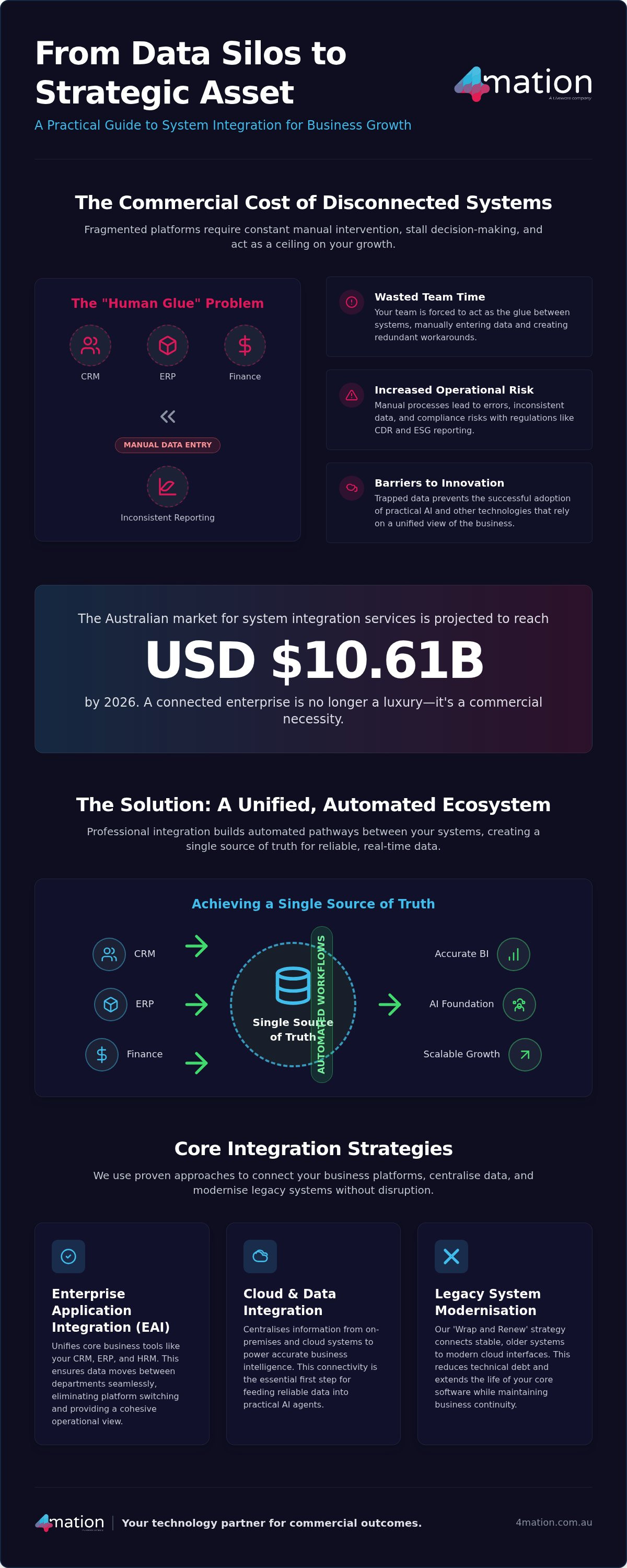
With the Australian market for system integration services projected to reach USD $10.61 billion in 2026, the connected enterprise has moved from a technical luxury to a commercial necessity. You’ve likely felt the daily friction of manual data entry between platforms or the frustration of inconsistent reporting that stalls critical decision-making. These legacy bottlenecks do more than just waste your team’s time; they act as a ceiling on your growth and a barrier to adopting practical AI. We understand that managing these complexities requires a steady hand and a clear focus on commercial outcomes rather than just technical features.
This guide shows you how to unify your technology ecosystem to eliminate data silos, automate manual processes, and build a foundation for scalable growth. We’ll explore how to create a single source of truth across your organisation while reducing operational risk through professional managed support. You’ll also learn how to prepare for 2026 regulatory shifts, such as the Consumer Data Right expansion, by ensuring your systems are secure and interoperable. By the end of this article, you’ll have a pragmatic roadmap to transform your technology from a source of frustration into a reliable business asset.
Key Takeaways
- Understand how fragmented data silos stall growth and why professional system integration services are the essential foundation for a scalable, connected enterprise.
- Learn to eliminate manual data entry and redundant workarounds by automating workflows across your CRM, ERP, and internal business platforms.
- Discover how centralising your information provides a single source of truth for accurate reporting and the successful adoption of practical AI.
- Identify how to manage data security and system compatibility risks when modernising legacy systems to ensure long-term stability.
- Gain insights into selecting a reliable technology partner with the local expertise and disciplined delivery models required for complex integration projects.
Understanding System Integration Services in the Modern Enterprise
System integration is the strategic process of linking disparate computing systems and software applications, either physically or functionally, to act as a coordinated whole. While the technical definition of What is System Integration? involves complex architecture, the business reality is simpler: it’s about making sure your tools talk to each other. For many Australian organisations, the current reality is a collection of isolated platforms that require constant manual intervention to share data. Professional system integration services bridge these gaps, turning a fragmented collection of software into a unified ecosystem that supports your specific operational goals.
In 2026, the “Data Silo” problem has become a critical bottleneck for growth. With the expansion of the Consumer Data Right (CDR) and new mandatory ESG reporting requirements, Australian firms can’t afford to have financial, sustainability, and customer data trapped in separate systems. Fragmented data leads to inconsistent reporting, which stalls decision-making and increases the risk of regulatory non-compliance. A business-first approach to connectivity focuses on solving these commercial pains before selecting the technology. We move beyond simple “plug-and-play” connectors, which often fail under enterprise-level stress, to build bespoke system integration services that respect your unique workflows and legacy constraints.
The Role of Integration in Digital Transformation
Integration serves as the structural backbone for any successful digital transformation strategy. It marks the shift from slow, manual data handling to automated, real-time synchronisation. When your systems are properly aligned, your team stops acting as the “human glue” between software platforms. This transition is essential for scaling; without it, every new customer or transaction adds a linear increase in administrative burden. Custom software and integration work together to ensure your technology scales at the same pace as your ambitions.
Key Components of an Integrated Ecosystem
A resilient integrated environment relies on three core pillars. First, APIs (Application Programming Interfaces) act as the primary building blocks, allowing different software to exchange information securely. Second, the architecture must prioritise data integrity to create a “single source of truth.” This ensures that when a customer updates their address in your CRM, the change reflects instantly in your billing and logistics systems. Finally, in complex enterprise environments, middleware acts as a translator, managing communication between modern cloud applications and older legacy systems that might not natively speak the same language.
The Core Types of System Integration Services
Professional system integration services address specific operational gaps by connecting your internal business platforms. Enterprise Application Integration (EAI) unifies tools like your CRM, ERP, and HRM, ensuring that data moves between departments without manual intervention. This creates a cohesive environment where your team can access real-time information without the friction of platform switching.
Data integration focuses on centralising this information for accurate business intelligence. By creating a single source of truth, you enable your organisation to leverage real-time data for forecasting and growth. This connectivity is also the essential first step for cloud integration, which bridges the gap between your on-premises systems and modern environments. It’s particularly vital for those looking to feed data into practical AI agents, as these tools require reliable data to deliver measurable value.
Legacy System Modernisation and Integration
You don’t always need to replace your existing software to achieve modern results. We often utilise a ‘Wrap and Renew’ strategy for modernising legacy applications. This approach connects your older, stable systems to modern cloud interfaces, reducing technical debt while maintaining business continuity. If you’re managing complex legacy software, we can help you identify a secure integration path forward.
B2B and Third-Party Connectivity
Your technology ecosystem extends beyond your internal walls to include supply chain partners and government portals. B2B connectivity uses secure Electronic Data Interchange (EDI) standards to automate procurement and logistics data. This reduces errors and accelerates transaction speeds across your entire vendor network. When evaluating these external connections, following established government frameworks for Selecting a System Integration Partner ensures your system integration services projects meet the highest standards of security and reliability.
Realising Business Value Through Strategic Connectivity
Strategic connectivity is about more than just data flow; it’s about measurable commercial performance. When you invest in professional system integration services, you aren’t just buying software links. You’re building a foundation for operational excellence. By moving away from a siloed approach, your organisation can eliminate the hidden costs of manual data entry and redundant workarounds that drain staff productivity. This shift allows your team to focus on high-value tasks rather than administrative troubleshooting.
The technical definition of system integration describes the process of linking computing systems to act as a coordinated whole. In a business context, this coordination manifests as a unified view of the customer. When your sales, billing, and support platforms share a single source of truth, your team provides a seamless experience at every touchpoint. This level of visibility also enables more accurate forecasting. Real-time data allows you to make decisions based on what’s happening now, rather than relying on outdated reports from last month. A flexible architecture ensures that as you grow, your technology supports you instead of holding you back.
Integration as a Catalyst for Practical AI
High-quality data is the essential fuel for any modern automation project. This makes robust integration a non-negotiable prerequisite for successful AI consulting. We work with you to ensure your data pipelines are clean and reliable before implementing AI-enabled triggers. This approach moves your organisation beyond the hype, focusing on measurable ROI through workflows that actually work. Whether it’s automated inventory alerts or intelligent customer routing, the value comes from the connectivity behind the intelligence. Together, we can build systems that don’t just store data but actively use it to drive efficiency.
Reducing Operational Risk and Technical Debt
Poorly executed connections often lead to “spaghetti code,” creating fragile systems that break whenever a single component is updated. Professional system integration services prevent this by using structured, scalable architectures that grow with your organisation. This reduces long-term technical debt and ensures business continuity. To maintain this stability, we recommend ongoing technology support and maintenance. Proactive monitoring of your critical links ensures that as your ecosystem evolves, your connections remain secure and performant. This methodical approach gives you the confidence to innovate without risking the stability of your core operations.
Overcoming the Practical Challenges of Complex Integrations
Executing complex system integration services involves navigating more than just technical hurdles. Data security and privacy are paramount, particularly as sensitive information moves between disparate cloud and on-premises platforms. You need to manage these risks without sacrificing the speed of your operations. Compatibility issues also frequently emerge when different systems use conflicting data formats or outdated communication protocols. Our team focuses on resolving these mismatches through pragmatic design, avoiding the common pitfall of over-engineering a solution that becomes too rigid to manage.
Cultural adoption is another significant factor. Transitioning your team from manual data entry to automated workflows requires active change management. If your staff don’t understand or trust the new integrated processes, the technical success won’t translate into commercial value. We work with you to ensure that new systems are intuitive and that your team is prepared for the shift, turning potential resistance into operational momentum.
Mitigating Integration Risks
The best way to reduce delivery risk is through a disciplined discovery and solution design phase. By identifying potential roadblocks early, we ensure the project remains on track. To provide you with total financial certainty, we offer a Fixed-Cost project model. This engagement style ensures we’re accountable for the outcome, not just the hours worked. Comprehensive testing and QA phases further protect your business, as we rigorously validate every data link before it reaches your production environment.
Managing Technical Debt and Scalability
Maintaining a healthy technology ecosystem through professional system integration services requires a balance between custom-built APIs and off-the-shelf platforms. While pre-built connectors can be useful for standard tasks, bespoke development is often required to handle unique business logic without creating technical debt. We prioritise a modular architecture that allows you to swap or upgrade individual components as your needs change. This approach is reinforced by a strategy of continuous improvement, ensuring your integrations remain performant and secure over the long term. If you’re ready to address your legacy bottlenecks, contact our team for a strategic consultation.
Selecting a System Integration Partner in Australia
Choosing a technology partner requires a balance between deep technical knowledge and a thorough understanding of the Australian business environment. When you evaluate system integration services, you aren’t just looking for a vendor; you’re selecting a strategic ally to manage your organisation’s most critical infrastructure. With a 25-year history of client success, we’ve seen how reliability and local accountability consistently outperform the fleeting energy of trend-chasing providers. We operate with a “safe pair of hands” mentality, prioritising long-term stability and measurable success over unnecessary complexity. For a broader view of how to evaluate partners for large-scale modernisation, our guide to choosing an enterprise digital transformation agency outlines the essential criteria for delivery certainty and commercial accountability.
Our credentials reflect this commitment to professional excellence and rigorous governance. As an Advanced Supplier in the NSW Government ICT Services Scheme and an AWS Select Consulting Partner, we maintain the high standards of security and reliability that Australian organisations require. This local, Australian-led expertise ensures that you have direct access to your project team, providing a level of transparency and accountability that offshore models often lack. We understand the specific operational challenges faced by Australian mid-market firms, from local regulatory shifts to the complexities of regional supply chains.
The 4mation Approach to Integration
We start every project by focusing on your commercial goals rather than just technical requirements. Whether you’re looking to reduce manual processing or build a foundation for AI, our approach is modelled around the outcomes you care about. To ensure total delivery certainty, we offer a Fixed-Cost, on-time, and bug-free guarantee. This engagement model removes the financial ambiguity often associated with complex technology investments. Our relationship doesn’t end at deployment; we provide ongoing managed support to ensure your technology continues to evolve alongside your business.
Flexible Engagement Models for Integration Projects
Every organisation has different requirements for their modernisation journey. For projects with a specific, defined scope, our Fixed-Outcome model provides the highest level of certainty. If you already have an internal team but need specialised expertise to accelerate your system integration services project, we offer staff augmentation to embed our specialists directly into your workflow. This flexibility allows you to scale your capabilities without the overhead of permanent hiring. By partnering with us for the long term through our Service Desk and proactive monitoring, you ensure that your integrated ecosystem remains a foundational business asset rather than a source of technical debt.
Build a Resilient Foundation for Your Organisation’s Future
Transforming your technology from a collection of isolated silos into a unified ecosystem is a critical step for any commercially minded leader. By investing in professional system integration services, you eliminate the daily friction of manual workarounds and create the high-quality data foundation required for practical AI. This strategic connectivity doesn’t just improve your operational efficiency; it also ensures your organisation is prepared for the regulatory and market shifts of 2026. We work with you to turn these technical complexities into clear, achievable business advantages.
With 25 years of success delivering software projects for Australian organisations, 4mation offers the stability and expertise you need for complex modernisation. As an Advanced Supplier in the NSW Government ICT Services Scheme, we provide a Fixed-Cost, on-time, and bug-free guarantee to give you total delivery certainty. This methodical approach reduces your risk and ensures your technology investment delivers a measurable outcome. Together, we can build a scalable architecture that supports your long-term goals and keeps your business moving forward.
Contact our team to discuss your integration project and discover how we can help you achieve a seamless, automated workflow.
Frequently Asked Questions
What exactly are system integration services?
System integration services involve linking your disparate computing systems and software applications so they function as a unified ecosystem. Instead of having data trapped in isolated silos, professional integration ensures that information flows seamlessly between platforms like your CRM and ERP. This coordinated approach eliminates the need for manual data entry and reduces the risk of human error. It transforms your technology from a collection of tools into a strategic business asset.
How much do system integration services cost in Australia?
The investment for system integration services depends on the complexity of your existing technology stack and the volume of data being synchronised. Factors such as the number of platforms, the age of legacy systems, and specific security requirements all influence the final cost. We address budget ambiguity through our Fixed-Cost engagement model. This provides you with total financial certainty and delivery accountability before the project begins, ensuring your modernisation goals stay on track.
How long does a typical system integration project take?
Project timelines vary significantly based on the scope of the connectivity required and the readiness of your data. A straightforward integration between two modern cloud platforms may take several weeks, while a complex enterprise-wide modernisation involving legacy software can span several months. Every project begins with a disciplined discovery and solution design phase. This methodical approach ensures we identify potential roadblocks early, allowing us to deliver your integrated solution within a guaranteed timeframe.
What is the difference between an API and system integration?
An API is a technical tool used to exchange data, while system integration is the broader strategic process of connecting your business applications. You can think of an API as the messenger that carries information between two points. Integration is the overarching architecture that ensures those messages result in a meaningful business outcome. While APIs are essential building blocks, a successful integration requires a business-first strategy to ensure all systems work together reliably.
Will system integration improve my business security?
Professional integration significantly enhances your security posture by replacing manual, high-risk data handling with secure, automated pipelines. Instead of staff emailing spreadsheets or using insecure file transfers, data moves through encrypted channels with strict access controls. As an AWS Select Consulting Partner, we implement industry-standard protocols to protect your sensitive information. This reduces the risk of data breaches and ensures your organisation remains compliant with evolving Australian privacy standards and reporting requirements.
Can you integrate legacy software with modern cloud applications?
You can absolutely connect older legacy software with modern cloud environments using a pragmatic “Wrap and Renew” approach. This strategy allows you to keep your core business logic intact while adding modern connectivity and interfaces. It’s a cost-effective way to extend the life of your valuable assets without the risk of a total system replacement. We specialise in bridging these gaps to ensure your legacy data is accessible to your modern cloud applications.
How does system integration support AI implementation?
You don’t need a permanent internal team if you partner with a provider that offers managed support and flexible engagement models. We provide a Service Desk that acts as technology insurance, offering proactive monitoring and maintenance for your integrated systems. If you require deeper technical expertise for a specific project, our staff augmentation model allows you to embed specialist engineers directly into your workflow. This approach gives you access to expert skills without the overhead of permanent hiring.
About The Author
