Digital Transformation Roadmap Services: From Business Priorities to Practical Delivery
Jowena BorralDigital Marketing Specialist

More technology initiatives don’t automatically create more progress. When budgets and attention are stretched, legacy systems and disconnected processes make it harder to decide what to tackle first. Executives need more than a list of technologies; they need a clear business case for change. That’s where digital transformation roadmap services can help.
A practical roadmap connects business priorities to sequenced, measurable initiatives. It helps you compare opportunities by expected value, understand dependencies and risks, and plan delivery in achievable stages. The goal isn’t to transform everything at once. It’s to focus investment on improvements that matter to your organisation and give teams a clear path from strategy to implementation.
In this article, we explain what roadmap services deliver and how they help you decide what to do first. We also look at how 4mation works with you to understand your goals, users and operational challenges, then shape a plan that can move into delivery and ongoing improvement.
Key Takeaways
- Use digital transformation roadmap services to connect business goals with prioritised technology and process improvements.
- Follow a clear sequence from discovery and assessment through prioritisation, delivery planning and review.
- Make your roadmap a living decision-making tool, with measurable outcomes, owners, dependencies and review points.
- Stage investment around dependencies, team capacity and organisational readiness to make change achievable.
- Connect strategy with design, development, integration and support so priorities can progress into practical delivery.
What digital transformation roadmap services help your organisation achieve
When core systems don’t connect, staff may re-enter information, work around outdated processes or wait for decisions that should be straightforward. These issues affect productivity, customer experience and the ability to grow. Digital transformation roadmap services help connect business goals with prioritised technology and process changes.
A digital transformation roadmap makes the choices, outcomes and sequence of business change explicit, so your organisation can decide what to do, why it matters and what needs to happen first. It’s more than a technology wish list. Each initiative should have a clear purpose, an accountable owner, known dependencies and a way to assess progress.
What does a digital transformation roadmap include?
The work starts with discovery: understanding your goals, users, existing systems, workflows and constraints. This helps distinguish symptoms from underlying problems. For example, repeated manual data entry may point to a process or integration issue, rather than a need to add another standalone tool.
From there, the roadmap sets out possible initiatives and the decisions needed to progress them. It may include:
- Priorities linked to business and user needs
- Dependencies between systems, processes and teams
- Delivery stages, risks and organisational constraints
- Measures of success tied to intended outcomes
The scope should reflect your organisation, not a standard template. A business preparing to scale may prioritise process capacity, while another may focus on improving customer interactions or reducing operational risk.
Why start with business outcomes rather than technology?
Starting with a preferred technology can narrow the options too early. First define what needs to improve, such as processing work more efficiently, making services easier to use or reducing reliance on manual steps. Then consider how your users work and what your existing systems can support.
This outcome-first approach helps you compare initiatives by business value, feasibility and dependencies. It gives executives a clearer basis for discussing investment and trade-offs, while giving delivery teams a shared understanding of what success means.
Digital transformation involves more than adopting new tools; it can also mean changing processes and how an organisation creates value. A digital transformation strategy guide can help frame that broader direction, while a roadmap translates priorities into practical decisions about what to deliver and in what order.
How digital transformation roadmap services move from discovery to delivery
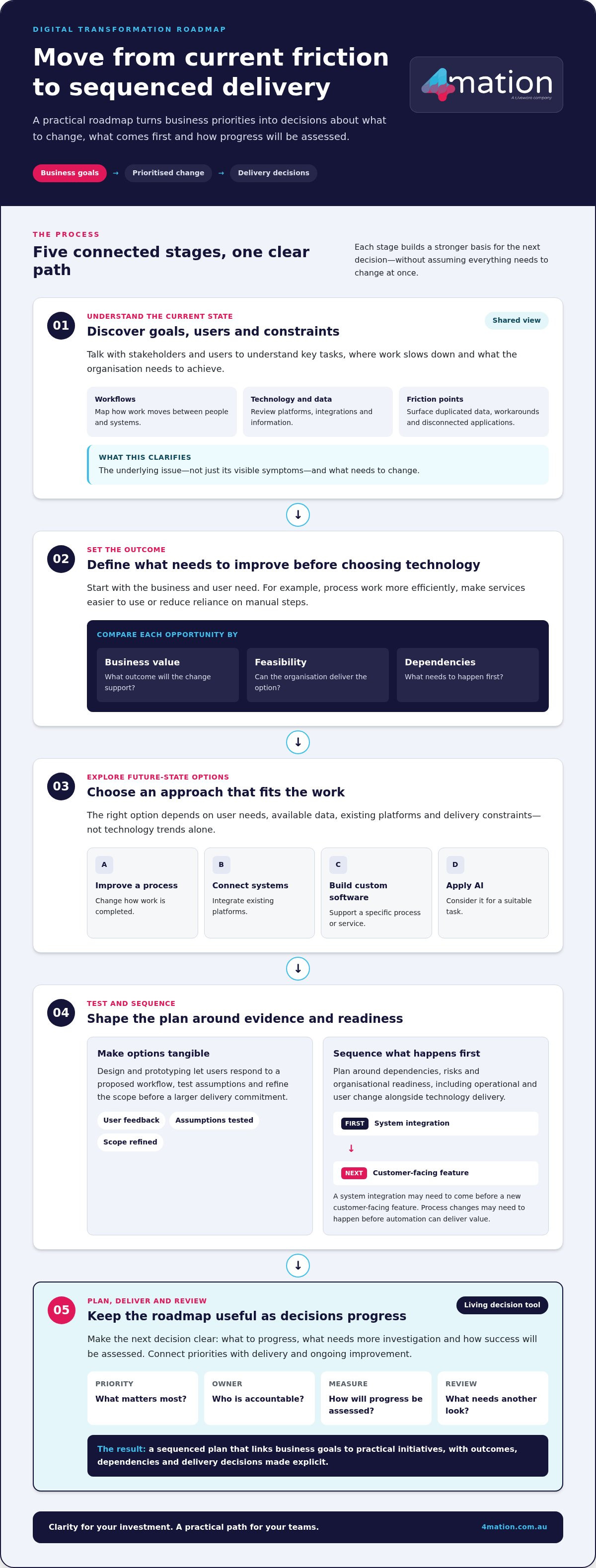
A useful roadmap develops through a series of decisions, not a technology checklist. Digital transformation roadmap services take your organisation from understanding current challenges to selecting practical initiatives, planning delivery and reviewing progress. Each stage gives decision-makers clearer evidence for what should happen next.
Discovery and current-state assessment
Discovery reduces ambiguity by surfacing your goals, constraints and dependencies early. Through conversations with stakeholders and users, we learn how people complete key tasks, where processes slow down and what your organisation needs to achieve.
We then assess the workflows and technology that support them, including existing platforms, integrations and data. Duplicated information, manual workarounds and disconnected applications can signal friction, but they don’t always reveal the root cause. Mapping how work moves between people and systems helps separate the underlying issue from its visible symptoms. The result is a shared view of what needs to change and what to consider before selecting a solution.
From future-state options to a sequenced plan
Once the current state is understood, define the outcomes you want and consider options that could achieve them. These may include improving a process, connecting existing systems, building custom software or applying AI to a suitable task. The right choice depends on user needs, available data, existing platforms and delivery constraints, not technology trends alone.
Design and prototyping can make an option tangible before a larger delivery commitment. For example, a prototype lets users respond to a proposed workflow and highlight assumptions that need testing. Their feedback helps refine the scope and reduces the risk of investing in an approach that doesn’t fit how work happens.
The plan then sequences initiatives around dependencies, risks and readiness. A system integration may need to come before a new customer-facing feature. Process changes may need to happen before automation can deliver value. MIT Sloan Management Review’s discussion of the nine elements of digital transformation also highlights that transformation spans multiple parts of an organisation. A practical plan should account for operational and user change alongside technology delivery.
The roadmap should make the next decision clear: what to progress, what needs more investigation and how success will be assessed. Where bespoke tools are needed to support a process or service, custom software development services can turn a prioritised initiative into a working solution. If you’re considering how to move from priorities to delivery, talk with our team about your transformation goals.
Is a digital transformation roadmap just another strategy document?
It can be, if it ends as a polished document that no one uses to make decisions. A roadmap adds value when it guides investment, assigns accountability and shapes delivery. A static project list may capture ideas, but it won’t show how they connect, which should come first or what success looks like.
A delivery-ready roadmap is a living plan. Priorities can change as new evidence emerges, capacity shifts or business needs develop. Regular reviews help leaders adjust the sequence without losing sight of the outcomes they’re working towards. Digital transformation roadmap services should give your organisation a practical way to make those decisions. Planning alone doesn’t guarantee results.
| Strategy document | Delivery-ready roadmap |
|---|---|
| Lists broad ambitions or proposed projects | Connects each initiative to a defined business outcome |
| Leaves accountability unclear | Identifies decision owners and initiative leads |
| Shows little about sequence or constraints | Makes dependencies, milestones and delivery capacity visible |
| Can become outdated after approval | Includes review points to revisit priorities and measures |
How to prioritise initiatives without chasing every new technology
Prioritisation means making trade-offs explicit. Assess each initiative against its expected business value, user impact, feasibility, dependencies and available delivery capacity. Separate essential foundations, such as resolving a key data or process constraint, from improvements that can follow once those foundations are in place.
Consider AI where it addresses a defined business problem, but don’t make it a roadmap item by default. Apply the same test to any technology: what outcome does it support, what needs to be true for it to work, and is it more valuable than competing priorities?
How to make ownership and progress visible
For each initiative, clarify who makes decisions, who leads the work and which measure will indicate progress. Set review points so executives can assess milestones, dependencies and emerging constraints. If a critical integration slips or team capacity changes, visible dependencies help leaders understand the impact and decide whether to re-sequence work, reduce scope or defer another initiative.
A digital transformation roadmap guide can offer useful context for Australian mid-market organisations, but the plan still needs to reflect your goals and delivery realities. The point isn’t to lock every decision in place. It’s to give your team a shared, accountable basis for deciding what to do next and adapting as circumstances change.
How to turn a transformation roadmap into an achievable investment plan
A roadmap becomes an investment plan when it accounts for what your organisation can realistically deliver. Sequencing initiatives around dependencies, team capacity and readiness helps you make progress without committing to more change than the business can absorb.
Build a roadmap around capacity, dependencies and risk
Before scheduling work, map the people, systems, data and integrations each initiative relies on. A new digital service, for example, may depend on changes to existing data flows or processes. If those foundations aren’t ready, address them first.
Group related work into stages, with a clear decision point at the end of each. This gives leaders the opportunity to assess what they’ve learned, manage emerging risks and confirm whether the next stage still fits business priorities. It also makes progress easier to understand than treating a complex transformation as one large commitment.
Governance should provide useful oversight, not unnecessary reporting. Agree who can make decisions, what information they need and when to review progress. A concise view of milestones, dependencies, risks and decisions helps executives make informed trade-offs without adding layers of process.
Choose measures that show business value
Set a baseline before delivery so you can compare the future state with how the organisation works now. Choose measures that connect directly to the intended outcome. Depending on the initiative, these could include staff effort spent processing work, customer feedback about a service or the visibility teams have over operational activity.
Targets should reflect your starting point, available evidence and business goals. A measure is most useful when teams know how it will be assessed and can act on what it shows. Avoid tracking activity alone, such as counting features delivered, if the real aim is to improve a process or customer experience.
At 4mation, we work with you to connect priorities with practical delivery, taking account of your organisation’s goals, users and operational realities. For initiatives with a defined scope, our Fixed-Cost projects are fixed cost, on time, on budget and bug-free. A sound investment plan makes the stages, decision points and measures clear, while leaving room to respond as evidence and business needs evolve.
Discuss your transformation priorities with our team and consider how to move them into achievable stages.
How 4mation connects digital transformation roadmaps with delivery
A roadmap creates value when it helps your organisation move from priorities to practical change. 4mation starts by understanding your business goals, users and operational challenges before recommending technology. That keeps decisions grounded in the work your people need to do and the outcomes your organisation wants to achieve.
A practical partner across strategy, software and support
4mation connects digital transformation roadmap services with capabilities across the delivery lifecycle. Strategy and design clarify needs and shape an approach. Development and system integration turn priorities into working solutions that fit your existing systems. Practical AI can address defined operational needs, while ongoing support helps maintain and improve technology after implementation.
The right engagement model depends on the work and how your organisation needs to deliver it. Fixed-Cost projects suit defined scopes. Ongoing Agile Development supports iterative progress as priorities are refined. Staff Augmentation can add skills to your team, while a Service Desk provides technology support. These are distinct ways to structure delivery, rather than a single approach applied to every roadmap.
4mation brings 25 years of client success and a team of 40+ local technology specialists. The company is also an AWS Select Consulting Partner and an Advanced Supplier in the NSW Government ICT Services Scheme. You can explore ongoing technology support and maintenance as part of planning for the lifecycle beyond launch, and review 4mation case studies for examples of work addressing business and operational needs.
Start with the business problem you need to solve
You don’t need to arrive with a finished technology brief. Start with the goals you’re working towards, the constraints affecting progress and the workflows that create the most friction for your teams or customers. We’ll first understand your organisation and the problem to solve, then consider which options and delivery model best fit your priorities.
This approach connects planning to implementation without assuming every initiative needs the same solution. The roadmap guides decisions, while the delivery approach reflects your scope, capacity and evolving needs. To talk through your goals and current constraints, talk through your roadmap with 4mation.
Turn your priorities into practical progress
A useful transformation roadmap does more than capture ideas. It links business outcomes to prioritised initiatives, makes dependencies and ownership visible, and gives leaders a basis for measuring progress. With digital transformation roadmap services, your organisation can move from competing technology requests to a considered sequence of achievable change.
4mation works with you to understand your goals, users and operational challenges before shaping a path from strategy and design through development, integration and ongoing support. Our experience includes 25 years of client success and a team of 40+ local technology specialists. 4mation is also an AWS Select Consulting Partner and an Advanced Supplier in the NSW Government ICT Services Scheme.
Your roadmap should fit your organisation, not a standard formula. Start with the outcomes you need, the constraints you face and the workflows you want to improve. Together, we can explore practical next steps and a delivery approach that suits your priorities.
Talk through your digital transformation priorities and take the next step towards focused, measurable change.
Frequently Asked Questions
What are digital transformation roadmap services?
Digital transformation roadmap services help you connect business goals with prioritised technology and process changes. The work typically begins by understanding your organisation’s goals, users, workflows and existing systems, then identifies opportunities and constraints. The result is a practical plan showing which initiatives to consider, how they relate to business outcomes and what dependencies or decisions may affect delivery. It supports informed choices rather than prescribing technology for its own sake.
What should a digital transformation roadmap include?
A digital transformation roadmap should reflect your organisation’s priorities and practical constraints. It may set out desired outcomes, current challenges, prioritised initiatives, owners, dependencies, delivery stages, risks and measures of success. It should also show how initiatives relate to existing systems, processes and user needs. A useful roadmap makes it easier to see what needs attention first, what can follow later and how progress will be reviewed as circumstances change.
How long does it take to create a digital transformation roadmap?
There isn’t one timeframe that suits every roadmap. The effort depends on factors such as the number of business areas involved, the complexity of existing systems, access to stakeholders and the level of assessment required. A focused review may need less discovery than a roadmap spanning multiple workflows and platforms. The aim is to gather enough information to clarify priorities and dependencies, without adding unnecessary analysis.
How do you prioritise digital transformation initiatives?
Prioritise initiatives by comparing their expected business value, user impact, feasibility, dependencies and the capacity available to deliver them. Start with the outcomes that matter, such as improving a customer interaction or reducing manual effort, then assess what must be in place to achieve them. Separate essential foundations from improvements that can follow. This helps leaders make informed trade-offs and avoid committing to more initiatives than teams can realistically progress.
Can a digital transformation roadmap work with existing systems?
Yes. A roadmap can build on existing systems by assessing how platforms, data and integrations support current workflows and where they create friction. Some priorities may involve improving processes or connecting applications rather than replacing technology. In other cases, custom software or modernisation may be worth considering. The right direction depends on business needs, technical constraints and user experience, so the roadmap should assess the current environment before recommending changes.
How should AI fit into a digital transformation roadmap?
AI should be considered when it can address a defined business problem, not added simply because it’s a current technology trend. First identify the workflow or user need, then assess whether suitable data, systems and oversight are available. A contained prototype can help test assumptions before broader implementation. Comparing AI with process improvement, integration or custom software also helps ensure the selected approach fits the outcome you want to achieve.
How can a roadmap reduce digital transformation delivery risk?
A roadmap can help reduce delivery risk by surfacing dependencies, constraints and assumptions before teams commit to major work. It can clarify ownership, sequence initiatives around readiness and define measures that show whether expected business outcomes are emerging. Regular reviews let decision-makers respond to new evidence, capacity changes or shifting priorities. This improves visibility and supports better decisions, but a roadmap cannot remove every uncertainty or guarantee a particular delivery result.
About The Author
