Digital Strategy Consulting for Australian Organisations: Turn Priorities into Progress
Jowena BorralDigital Marketing Specialist

A technology roadmap can look ambitious on paper and still fail to move the business forward. The difference is whether each initiative supports a clear priority, addresses a real user need and has an outcome you can assess. Digital strategy consulting helps Australian organisations turn competing opportunities into a practical path for progress. If you’re considering digital strategy consulting, start by asking how each proposed initiative will support your organisation’s goals.
When existing systems, operational demands and disconnected initiatives all shape what’s possible, deciding what to tackle first can be difficult. The answer isn’t to adopt more technology for its own sake. It’s to agree on the problems that matter, then make informed decisions about where investment can deliver the greatest value.
In this article, you’ll learn how to connect business goals with user needs, assess technology opportunities against real-world constraints and build a sequenced roadmap with clear outcomes and decision points. At 4mation, we work with you from strategy into solution design, delivery and ongoing improvement, so recommendations can progress beyond a plan and support business outcomes.
Key Takeaways
- Connect digital initiatives to business goals and user needs so investment addresses real operational challenges.
- Build a practical roadmap by involving leadership, operational teams and users in discovery and prioritisation.
- Compare process improvement, system integration, custom software and AI against business value, feasibility and dependencies before choosing an approach.
- Turn competing priorities into a sequenced plan with clear decision points and measurable outcomes.
- Prepare to move from strategy into design, prototyping, development, integration and ongoing support.
Why digital strategy consulting matters when priorities compete
Disconnected systems, repeated manual tasks and frustrating service hand-offs can drain time and make it harder to respond to customers. Leaders may also face competing proposals for new technology without a shared way to decide what deserves attention first. The risk isn’t simply choosing the wrong tool. It’s investing in initiatives that don’t address the organisation’s most important needs.
Digital strategy consulting connects business goals to prioritised initiatives, showing how each proposed change is intended to improve an outcome. It starts with your objectives and considers the processes, people and technology involved in achieving them. A digital strategy provides a framework for making those choices. Consulting makes that framework practical by grounding priorities in business context and user needs, rather than treating technology as the starting point.
That’s different from a technology shopping list, which can name platforms or tools without explaining the problem they solve. It’s also distinct from a digital marketing plan, which focuses on promotional and marketing activity—an area often delivered by outsourced specialists such as Marketing Angels. The purpose is to help decision-makers choose where digital change can create business value and how initiatives can fit together.
What does digital strategy consulting help an organisation decide?
It helps leaders identify which business problems and user needs should come first, then consider the most suitable response. A slow process might call for process redesign, while duplicated data entry could point to a need for system integration. Custom software may suit a requirement existing systems don’t address. AI may be worth exploring where it can improve a defined workflow. For example, AI consulting can help assess how AI could support a practical business objective.
Each option should connect to an intended outcome, such as reducing rework, improving access to information or making a service easier to use. This gives leaders a sounder basis for comparing initiatives than novelty or vendor claims alone.
When does a digital strategy become useful?
A strategy can help when teams repeat work across different systems, struggle to share reliable data or find that existing tools constrain service. It’s also useful when departments have separate priorities and no agreed view of how proposed projects support wider business goals. Consulting can help establish shared direction before your organisation commits to a solution.
Not every organisation needs a major transformation programme. Sometimes the most valuable next step is a focused improvement to one process or a clearer decision about an existing initiative. The right scope depends on the problem, its impact and your organisation’s capacity to act.
How a digital strategy moves from discovery to a practical roadmap
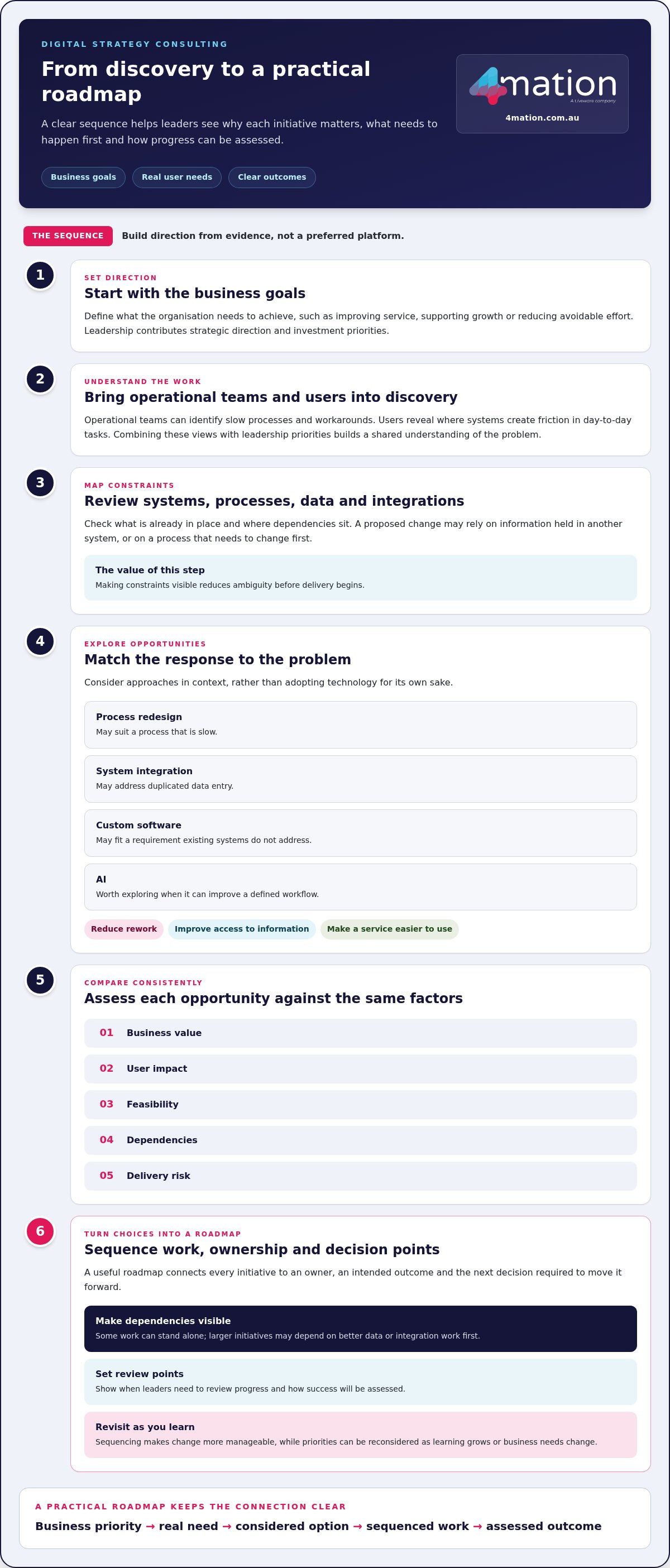
A useful roadmap starts with evidence, not a preferred platform. The process moves from understanding organisational goals to mapping current constraints, identifying opportunities, comparing options and planning a sequence of work. Each step helps leaders see why an initiative matters, what needs to happen first and how to assess progress.
Start with business goals, users and operational realities
Discovery should establish what your organisation needs to achieve, whether that means improving service, supporting growth or reducing avoidable effort. Leadership brings strategic direction and investment priorities. Operational teams can explain where processes slow down or rely on workarounds. Users show where systems create friction in their day-to-day tasks.
Reviewing current systems, processes, data and integration constraints adds essential context. A proposed change may depend on information held in another system, or on a process that needs to change first. Bringing these perspectives together creates a shared definition of the problem and reduces ambiguity before delivery begins.
Prioritise initiatives into a sequenced roadmap
Once opportunities are clear, compare them against consistent criteria: business value, user impact, feasibility, dependencies and delivery risk. A small process improvement may be achievable on its own, while a larger initiative could depend on better data or integration work first. A framework for a digital business model can help leaders consider how digital choices support the organisation’s wider model, rather than treating technology as an isolated investment.
A useful roadmap connects every initiative to an owner, an intended outcome and the next decision required to move it forward. It should make dependencies visible, identify when leaders need to review progress and show how success will be assessed. Sequencing makes change more manageable, but it doesn’t mean every date or assumption will remain fixed. Teams can revisit priorities as they learn more or business needs change.
AI may be one option where it addresses a defined need and can be assessed against practical constraints. For example, AI consulting can help explore relevant use cases and connect them to intended business outcomes, rather than adopting AI without a clear purpose.
If you’re ready to discuss how strategy could support your organisation’s goals, talk with our team.
How to compare digital strategy options without chasing technology trends
A sound recommendation starts with the problem, not a preferred technology. Compare each opportunity against the same factors so decision-makers can see whether a proposal is valuable, workable and connected to a real need. This keeps discussions focused on business outcomes rather than the appeal of a particular tool.
Use a simple assessment like this:
| Factor | Question to ask |
|---|---|
| Business problem | What specific issue or opportunity does this address? |
| User impact | Whose work or experience will change, and how? |
| Expected outcome | What improvement should the organisation be able to observe? |
| Feasibility | Do the systems, data, skills and capacity support this approach? |
| Dependencies | What needs to happen first, and what could affect delivery? |
This framework separates two questions that are often blurred: how important is the problem, and is this particular response suitable? A high-impact issue doesn’t automatically justify a complex technology investment. Make assumptions explicit, identify what needs further investigation and agree on decision points before committing to a direction. This is more useful than presenting uncertain estimates as guarantees.
Assess value, feasibility and delivery risk together
Consider operational change alongside technical fit. An option may depend on reliable data, connections between existing systems, changes to staff workflows or the capability to support it over time. These factors don’t automatically rule out an initiative, but they affect its effort, sequence and risk. A balanced assessment makes those trade-offs visible and supports decisions grounded in your organisation’s circumstances.
Decide where AI, integration or custom software fits
Different problems call for different responses. Improving a process may remove unnecessary steps without adding technology. Integration can reduce double handling and make information easier to share across disconnected systems. Existing platforms or off-the-shelf tools may suit a well-understood need, while custom software can address requirements those options don’t meet. AI is worth exploring when a defined problem and practical value justify it, not simply because it’s available. AI consulting can help assess its fit with your business goals.
These choices sit within a broader digital transformation, but they don’t all need to happen at once. A focused improvement can be the right next move if it addresses a clear constraint. A transparent comparison process keeps recommendations tied to business needs, delivery realities and intended outcomes, rather than technology trends.
How to prepare your organisation for digital strategy consulting
You don’t need a formal audit or a complete inventory of every system before strategy work can begin. A few practical preparations can make discovery more focused: agree on the business challenge, identify who needs to contribute and gather useful information that already exists.
Align stakeholders around the problem to solve
Choose an executive sponsor who can connect the work to organisational priorities, then involve the operational and technology stakeholders closest to the challenge. Include teams affected by potential changes so the discussion reflects how work happens in practice, not just how a process is meant to work.
Ask people to bring concrete examples. A delayed hand-off, repeated data entry or a system that makes routine service difficult is more useful to explore than a general statement that “the technology needs updating”. Agree on which decisions the strategy should inform, such as what to prioritise, what to defer or where more investigation is needed.
Set outcomes and establish a useful baseline
Describe the result in business terms. You might want to reduce manual effort, make information easier to access or improve the customer experience. Gather relevant material, such as existing plans, known pain points, a high-level view of systems and processes, and any available measures of current performance.
This information doesn’t need to be complete. A baseline records what you can observe before a change, giving your organisation a reference point for later evaluation. It helps teams assess progress against the agreed outcome without implying that a particular result is guaranteed.
Choose an engagement approach that fits the work
The right way to work together depends on the scope and how much flexibility the initiative needs. A fixed-cost project suits work with a clearly defined scope. Ongoing agile development supports priorities that may evolve as the team learns and delivers. Staff augmentation adds specialist skills or capacity to an existing team. These engagement models can align the way we work with your delivery needs.
Preparation is about bringing the right context and people to the conversation, not arriving with all the answers. We work with you to clarify the challenge and determine a practical next step. Discuss your digital strategy goals with our team.
How 4mation connects digital strategy with delivery and ongoing support
A strategy creates value when it helps your organisation make sound decisions and carry them through to delivery. 4mation takes a business-first approach, connecting organisational goals and user needs to practical technology priorities. The aim is not to recommend technology for its own sake, but to shape a considered path from the problem you need to solve to a solution your teams can use and improve.
Keep strategy connected to implementation
After clarifying the challenge and priorities, solution design can turn recommendations into a practical direction. Prototypes let stakeholders explore an idea and test key assumptions before making larger delivery decisions. This helps clarify what users need, what the solution must do and where the proposed approach may need adjustment.
From there, the response should match the problem. Custom software can support a business requirement that existing systems don’t meet. Integration can help information move between systems and reduce manual handling. AI may suit a defined task where it can contribute practical value. 4mation can carry recommendations into design, prototyping, development and integration, keeping the original business objective in view as delivery progresses.
Published client examples can help illustrate the range of work involved. Explore 4mation’s case studies for project context, and assess each example against its published details rather than assuming another organisation’s outcomes will apply to yours.
Build for improvement beyond the initial roadmap
Delivery isn’t the end of the strategy. Business needs, user feedback and operating conditions can change, so business-critical solutions need appropriate support and opportunities for ongoing improvement. Planning for continuity helps teams maintain a solution and make sensible refinements as new needs emerge.
4mation’s approach spans discovery, strategy, design, delivery and ongoing technology support. With 25 years of client success and 40+ local tech specialists, we focus on connecting a clear plan with the people and delivery work needed to put it into practice.
If you’re weighing up digital strategy consulting sydney, focus on whether recommendations can progress into delivery and remain connected to your business goals over time. Discuss your organisation’s goals with 4mation to explore a practical way forward.
Turn your digital priorities into progress
Digital strategy creates value when it helps you focus investment on business priorities, sequence practical initiatives and define how progress will be assessed. A shared view of user needs, operational constraints and intended outcomes gives leaders a clearer basis for deciding what to do next, without treating every technology trend as a priority.
For organisations considering digital strategy consulting sydney, 4mation brings 25 years of client success and 40+ local tech specialists, alongside experience as an Advanced Supplier in the NSW Government ICT Services Scheme and an AWS Select Consulting Partner. We work with you to connect strategy with design, delivery and ongoing improvement, so recommendations can become achievable next steps for your organisation.
Ready to turn your priorities into a practical plan? Discuss your digital strategy with 4mation. With clear goals and the right decisions in view, meaningful progress is within reach.
Frequently Asked Questions
What does digital strategy consulting include?
Digital strategy consulting connects business objectives to practical technology priorities. It typically includes understanding your goals, user needs and current systems, identifying opportunities, comparing possible responses and setting out a prioritised roadmap. The work should clarify why each initiative matters, what outcome it aims to support and what decisions or dependencies could affect progress. Depending on your needs, recommendations may lead into design, prototyping, development, integration or ongoing support.
How do you create a digital strategy for a business?
Start by agreeing on the business outcomes you want to achieve, then gather perspectives from leaders, operational teams and users. Map the processes, systems and constraints that shape the problem. Next, identify possible improvements and compare them by value, feasibility, dependencies and delivery risk. A useful strategy turns those findings into a sequenced roadmap with clear owners, intended outcomes and decision points, rather than a list of technologies to adopt.
How long does digital strategy consulting take?
The time required depends on the scope, complexity of the business challenge, availability of stakeholders and the information needed to make decisions. A focused piece of work may involve a narrower set of questions than a strategy covering several teams, systems and competing priorities. Establishing the scope and decision points helps you understand what needs to happen and plan around your organisation’s capacity.
How much does digital strategy consulting cost?
The cost depends on what the strategy needs to cover, the complexity of your organisation’s needs and the level of discovery and planning involved. A focused strategic question differs from work that must account for multiple teams, processes and system dependencies. The engagement approach also affects how the work is structured. Clarifying the intended outcomes and scope helps establish a suitable approach without assuming every organisation needs the same level of work.
Can digital strategy consulting help modernise legacy systems?
Yes. Consulting can help assess how existing systems support business goals, where they create constraints and what changes could improve operations or service. Modernisation may involve improving a process, connecting systems, extending an existing platform or developing custom software. The right option depends on user needs, technical constraints and intended outcomes. A strategy helps make those trade-offs visible before your organisation commits to a delivery path.
How do you measure whether a digital strategy is working?
Measure progress against outcomes agreed before delivery, such as reducing manual effort, improving access to information or making a service easier to use. Record an initial baseline using relevant measures your organisation already has, then review progress at agreed decision points. The measures should reflect the original business problem, not simply whether a technology was delivered. This gives leaders a practical basis for learning and adjusting priorities as work progresses.
Is digital strategy consulting only for large organisations?
No. Organisations of different sizes can use digital strategy consulting when they need to clarify priorities, address a specific operational problem or make better-informed technology decisions. The scope should match the challenge and the organisation’s capacity to act. Some businesses may need a focused improvement rather than a major transformation programme. The goal is to create useful direction and practical next steps, not unnecessary complexity.
What is the difference between digital strategy and digital transformation?
Digital strategy sets direction: it connects business goals and user needs to priorities, intended outcomes and a plan for action. Digital transformation is the broader process of changing how an organisation operates or delivers value through digital capabilities. Strategy can guide that work, but transformation may involve changes to processes, systems, services and ways of working. Not every digital strategy requires a large-scale transformation effort.
For organisations considering digital strategy consulting sydney, the focus should remain on business needs, practical priorities and measurable outcomes, not technology for its own sake.
About The Author
