Digital strategy for enterprises: A practical guide for 2026
Jowena BorralDigital Marketing Specialist

What if your next technology investment solved a business priority rather than adding another project to an already crowded roadmap? Enterprise leaders know digital initiatives need funding, but without shared criteria, it can be difficult to decide what should come first. A digital strategy for enterprises connects business goals with technology choices and delivery, giving each investment a clear purpose and a way to measure progress.
The challenge is making that connection practical. When business priorities, technology decisions and delivery plans don’t align, teams can work hard without giving leaders clear evidence of value. A considered approach creates shared direction, helps you weigh initiatives by value, feasibility, risk and dependencies, and assigns accountability for delivery.
In this guide, you’ll learn how to turn enterprise goals into prioritised digital initiatives and measurable outcomes. We’ll cover how to assess opportunities, sequence work, connect strategy to delivery and check whether change is creating value. The aim is a clear, achievable plan that helps business and technology leaders make informed decisions together.
Key Takeaways
- Connect business priorities, user needs, technology choices and delivery in one shared direction.
- Assess goals, processes, data, platforms and delivery capability to identify pain points and dependencies.
- Prioritise digital strategy for enterprises by weighing value, feasibility, risk, dependencies and time to evidence against your organisation’s priorities.
- Turn agreed outcomes into a roadmap with clear owners, decision rights, measures and regular reviews.
- Choose a strategy partner that understands your business and can support accountable delivery and ongoing improvement.
What an enterprise digital strategy should achieve
Technology activity can expand without improving a shared business outcome. One team may replace a system, another may automate a process, and a third may launch a new digital channel, yet leaders may still struggle to see how the work supports organisational priorities.
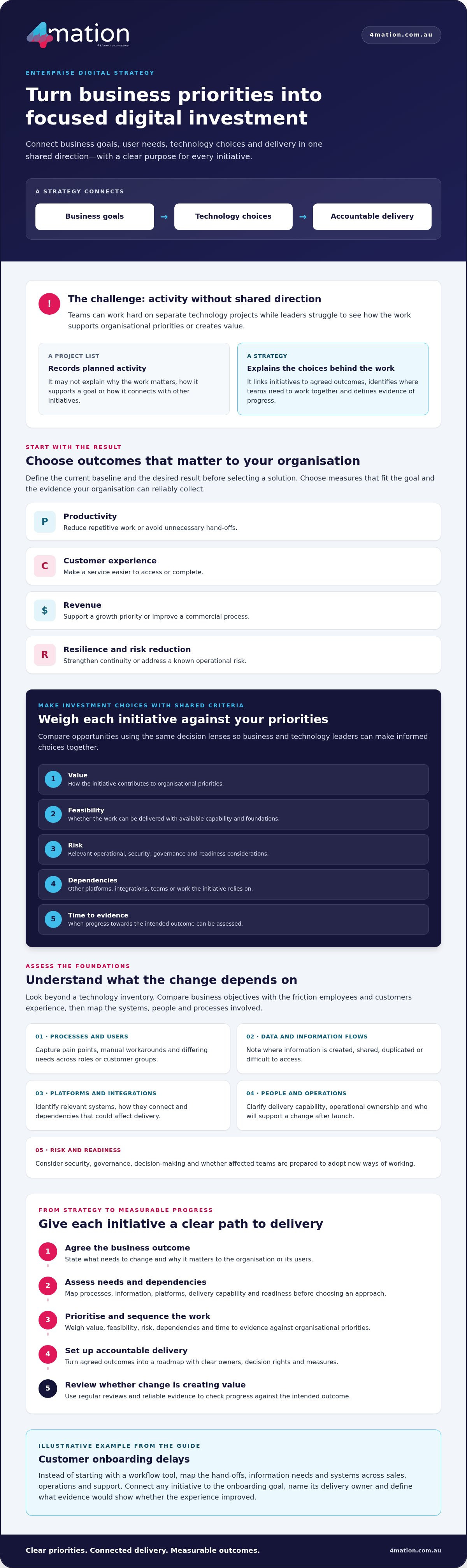
An enterprise digital strategy is a set of choices that connects business priorities and user needs with technology decisions and accountable delivery. It gives leaders a basis for deciding what to change, why it matters and how to assess progress. A digital strategy can cover a broad range of choices. The enterprise focus is on coordinating them across functions, platforms and decision-makers.
That makes a digital strategy for enterprises more than a project list, technology purchasing plan or IT-only roadmap. It should show how initiatives contribute to agreed business goals, where teams need to work together and what evidence will indicate progress. The result is clearer investment decisions and a stronger link between delivery and operational or customer outcomes.
How enterprise strategy differs from a list of technology projects
A project list records planned activity. A strategy explains the priority behind that activity, the outcome it is intended to support and how it relates to other work. That distinction matters across an enterprise, where a change to one platform or process can affect several functions and customer interactions.
Hypothetical example: An organisation wants to reduce delays in customer onboarding. Rather than simply buying a new workflow tool, leaders could map the hand-offs, information needs and systems involved across sales, operations and support. The strategy would connect any chosen initiative to the onboarding goal, name who owns delivery and define what evidence would show whether the experience had improved.
Which business outcomes should guide digital decisions?
Start with the business result, not a preferred technology. Depending on your organisation’s priorities, digital initiatives might support:
- Productivity: reduce repetitive work or avoid unnecessary hand-offs.
- Customer experience: make a service easier to access or complete.
- Revenue: support a growth priority or improve a commercial process.
- Resilience and risk reduction: strengthen continuity or address a known operational risk.
Before selecting a solution, define the current baseline and the desired result. For example, record how a process performs today, where delays or rework occur, and what change would count as meaningful. Choose measures that suit the goal and the evidence your organisation can reliably collect. Not every benefit will be easy to measure, but the intended outcome should be clear enough to guide decisions and review progress.
How to assess enterprise priorities, users and technology foundations
A useful assessment tests whether the organisation’s stated priorities match the work people need to do and the systems that support it. For digital strategy for enterprises, look beyond a technology inventory to understand how business goals, user needs, processes and delivery capability connect.
Start with business needs, because a preferred tool can’t define the outcome your organisation needs to achieve. Broader transformation context can also help leaders position digital initiatives within wider organisational change.
What should an enterprise digital assessment examine?
Compare strategic objectives with the friction employees and customers experience today. If a goal is to make a service easier to use, for example, trace the steps people take, where delays occur and what information teams need at each hand-off. Don’t assume a system is the cause before you’ve mapped the process.
Build a practical picture of the foundations each potential initiative may rely on:
- Processes and users: capture pain points, manual workarounds and differing needs across roles or customer groups.
- Data and information flows: note where information is created, shared, duplicated or difficult to access.
- Platforms and integrations: identify relevant systems, how they connect and dependencies that could affect delivery.
- People and operations: clarify delivery capability, operational ownership and who will support a change after launch.
- Risk and readiness: consider security, governance, decision-making and whether affected teams are prepared to adopt new ways of working.
Separate confirmed findings from open questions. If system ownership is unclear or information quality hasn’t been checked, record it as something to validate, not as an established cause. This keeps recommendations grounded and shows leaders where further investigation is needed.
How do you involve business, technology and users?
Bring together the people who set direction, run operations, maintain technology and experience the processes being assessed. Executive perspectives clarify priorities; operational and technology teams reveal constraints; affected users show how work happens in practice. Interviews and process walkthroughs can surface differences that a high-level workshop or system diagram might miss.
Before roadmap planning, agree who makes decisions, who provides input and who owns each intended outcome measure. This prevents unresolved questions from being passed into delivery, where they can create delays or competing expectations. It also gives teams a shared basis for resolving trade-offs.
A focused discovery can make the next decisions clearer without pretending every unknown is already solved. If you’re weighing up how to assess your organisation’s priorities and foundations, you can discuss your digital strategy with a technology partner.
How to prioritise enterprise digital initiatives and investments
A strong digital strategy for enterprises helps leaders make deliberate trade-offs, rather than simply approving the loudest request or the newest technology. Compare initiatives against shared criteria, then sequence them according to your organisation’s goals, constraints and available evidence.
Use a consistent set of questions to make options easier to discuss. The answers matter more than a universal score.
| Criterion | Questions to consider | What it helps reveal |
|---|---|---|
| Business value | Which priority does this support, and what evidence suggests the opportunity is real? | Whether the initiative addresses a defined need or a perceived one. |
| Feasibility | Can your teams deliver and operate it with available capability and capacity? | Practical constraints and skills that may need to be addressed. |
| Risk | What could affect customers, operations, information or delivery? | Risks to assess, manage or reduce before committing. |
| Dependencies | Which systems, data, decisions or other initiatives must be in place first? | Foundational work that could enable or delay other change. |
| Time to evidence | How soon could you gather credible evidence of progress? | Whether a smaller test or staged investment could inform the next decision. |
Weight these criteria against organisational priorities. If resilience is the immediate focus, risk and dependencies may carry more weight. If improving a customer journey is central, user impact and time to evidence may matter more. Treat scores as prompts for discussion, not an objective ranking. Where evidence is limited, identify what you need to learn before approving a larger commitment.
Sequence foundations and visible improvements
Foundational initiatives, such as improving data flows or resolving integration constraints, may not be visible to customers, but other changes can depend on them. User-facing initiatives can make the benefit clearer, but may stall if essential foundations are missing. Map those relationships, then decide whether to complete enabling work first, run a contained test or deliver related changes in stages.
To prevent the strategy becoming shelfware, give every priority a named owner, a decision to resolve and a concrete next action. Record what evidence will trigger a continue, change or stop decision. That turns the roadmap into a working management tool.
How should enterprises choose between build, buy and integration?
Compare each approach against business processes, integration needs, flexibility and ongoing ownership. Don’t assume custom development or off-the-shelf software is automatically the right fit. Validate the preferred option against requirements, existing systems, delivery capability and the work needed to operate it over time. If custom-built software is under consideration, the custom software development strategic guide offers further context.
How to turn enterprise digital strategy into governed delivery
A strategy creates value when teams can act on it, make decisions and adjust based on evidence. For digital strategy for enterprises, governance provides the working structure: it clarifies who can approve changes, how teams manage dependencies and risks, and when leaders should review progress.
Clear ownership and regular review turn strategic priorities into accountable delivery. Use a practical sequence to move from intent to action:
- Agree on outcomes and owners. Confirm the business result each priority supports, who is accountable for it and who makes key decisions.
- Build the roadmap. Sequence initiatives, show dependencies and set decision points. Mark confirmed commitments separately from ideas that need discovery or prototyping.
- Deliver in increments. Break work into manageable stages that can test assumptions, surface constraints and demonstrate progress before the next commitment.
- Measure against a baseline. Confirm how the outcome performs today, then agree suitable measures and targets. Choose a small number of indicators that leaders and delivery teams can use.
- Review and adapt. Revisit priorities when evidence, business needs or operating conditions change. Decide whether to continue, adjust or pause each initiative.
Governance shouldn’t add approval steps without purpose. It should make decision rights visible, give teams a route to escalate risks and resolve dependencies, and coordinate work across business and technology functions. Leaders can set direction and resolve trade-offs, while accountable owners manage day-to-day progress within agreed boundaries.
What belongs in an enterprise digital roadmap?
A useful roadmap shows the initiatives, their sequence, dependencies, accountable owners and the decisions needed to move forward. It also distinguishes commitments from hypotheses. For example, a proposed process change might need prototyping before the organisation can confirm its requirements or likely benefits. An increment can test that assumption and give decision-makers evidence for the next step.
If AI is a prioritised use case, the AI consulting guide for Australian organisations offers additional context for considering it as part of the roadmap.
How should leaders measure progress and adapt the strategy?
Pair delivery indicators, such as completion of a planned stage, with business measures tied to the intended outcome. Finishing a project shows activity; it doesn’t, on its own, show that operations or customer experience improved. Use operational data and user feedback to understand what changed, where friction remains and whether the original assumptions still hold.
Set review points that fit the initiative and revisit them when material evidence or priorities change. To put accountable delivery behind your strategy, talk with our team about your goals.
How a digital strategy partner can support enterprise outcomes
Your internal teams may be well placed to lead digital strategy when they have executive sponsorship, time to coordinate across functions and the capability to connect business goals with technology delivery. External facilitation or delivery support may help when priorities compete, important expertise is missing or teams need an independent perspective to reach clear decisions.
A partner should help your organisation make informed choices, not prescribe a standard solution. Look for evidence that they understand your business, make assumptions and risks visible, clarify decisions and ownership, and can support delivery and ongoing improvement. For digital strategy for enterprises, the right support depends on your needs and should complement the strengths of your internal team.
What should you expect from a strategy and delivery partner?
Discovery should begin with organisational goals, user needs and operational problems. Recommendations should connect to practical next steps, which may include design, prototyping, development, integration and support. Ask how the partner will document assumptions, assess risks, track intended outcomes and show which decisions your leaders need to make.
4mation takes a business-first approach across strategy, design, prototyping, development, integration and ongoing support. This full-lifecycle capability can help maintain continuity from planning into delivery, though it won’t be necessary for every organisation or initiative.
As one example of enterprise-scale use, Altus Traffic’s core business application supports 2.5 million service hours annually and more than 1,600 staff. This describes the application’s scale and use; it shouldn’t be read as proof of a particular strategy or business outcome. You can explore other published case studies to assess the documented context of different projects.
Which engagement model fits the work ahead?
Choose an engagement model based on how clearly you can define the work, the capability your team already has and the support you’ll need over time:
- Fixed Cost: suited to work with a clearly defined scope. 4mation describes Fixed-Cost projects as fixed cost, on time, on budget and bug-free.
- Ongoing Agile Development: supports work that develops through ongoing prioritisation and delivery.
- Staff Augmentation: adds capability to your existing team while your organisation retains its delivery context and direction.
- Service Desk: provides a channel for technology support and maintenance needs.
These options aren’t interchangeable. Match the approach to your requirements, decision-making capacity and plans for ongoing ownership. If you’re considering how to progress your priorities, discuss your enterprise digital strategy with 4mation and explore what support may fit your organisation.
Turn your digital priorities into measurable progress
A digital strategy for enterprises works when it connects business goals to initiatives your teams can deliver and leaders can assess. Start with a clear view of organisational priorities, user needs and technology dependencies. Then compare investment options against value, feasibility and risk, and give each priority an owner, a next step and measures grounded in a confirmed baseline.
The strategy should remain useful beyond approval. A practical roadmap, clear decision rights and regular reviews help your organisation respond to evidence, manage dependencies and keep delivery aligned with the outcomes that matter. 4mation works with Australian organisations across strategy, design, prototyping, development, integration and ongoing support, with the approach shaped around your needs.
Discuss your organisation’s digital strategy with 4mation to explore how your priorities could translate into accountable delivery. With shared direction and a clear way to measure progress, your next technology decisions can feel more considered and achievable.
Frequently Asked Questions
What is an enterprise digital strategy?
An enterprise digital strategy connects business priorities and user needs with technology choices and accountable delivery across an organisation. It helps leaders decide which changes matter, how teams and systems need to work together, and what evidence will show progress. Unlike a catalogue of projects, it explains why initiatives are worth pursuing and how they contribute to business outcomes such as productivity, customer experience, resilience or growth.
How is digital strategy different from IT strategy?
Digital strategy focuses on how technology-enabled change supports business goals, users and operations across the organisation. IT strategy typically focuses more directly on technology foundations, platforms, architecture, security and the capabilities needed to run them. The two should inform each other: business priorities shape technology decisions, while technology constraints and opportunities help leaders make realistic plans. In practice, enterprise digital strategy involves business and technology decision-makers.
How do you create a digital strategy for an enterprise?
Start by agreeing on business priorities and the outcomes leaders want to achieve. Assess user needs, processes, data, platforms, dependencies, risks and delivery capability to understand the current position. Involve executives, operational teams, technology specialists and affected users so discovery reflects how work happens. Then compare initiatives, sequence them into a roadmap, assign owners and define measures. Record uncertainties that need validation before committing to larger investments.
How should an enterprise prioritise digital initiatives?
Compare initiatives using criteria such as expected business value, delivery feasibility, risk, dependencies and how soon you can gather evidence. Weight each criterion according to your organisation’s priorities rather than relying on a universal score. Consider whether foundational work must happen first, and identify what you need to learn before committing. For every selected initiative, name an accountable owner, the next decision and a practical action to keep the strategy moving.
How do you measure the success of a digital strategy?
Measure success against the business outcomes each initiative is intended to support. First confirm a baseline, then select a small number of suitable indicators, such as process effort, service performance or customer feedback, based on the available evidence. Pair these outcome measures with delivery indicators, but don’t treat completed work as proof of business value. Review results regularly and use operational data and user feedback to decide whether to continue or adjust.
Can an enterprise develop a digital strategy without replacing its existing systems?
Yes. A digital strategy doesn’t require replacing every existing system. Assessment can identify which platforms still support business needs, where integrations or process changes may help, and which constraints require further investigation. Leaders can prioritise improvements around existing technology, test options in stages and consider replacement only where the evidence supports it. The right path depends on organisational goals, system dependencies, risk and the cost of maintaining current capabilities.
When should an enterprise engage a digital strategy partner?
Consider external support when priorities compete, teams need help coordinating across business and technology, or internal capacity or specialist delivery capability is limited. A suitable partner should begin with your goals, users and operational challenges, then explain how recommendations connect to delivery and measurable outcomes. 4mation provides Digital Strategy & Consulting alongside design, development, integration and ongoing technology support. Your internal team can remain closely involved in decisions and ownership.
About The Author
