Enterprise AI strategy consulting timelines and roadmaps
Jowena BorralDigital Marketing Specialist

A focused enterprise AI strategy sprint can produce a ranked roadmap in 3-4 weeks; a comprehensive strategy engagement typically takes 8-16 weeks. Enterprise AI strategy consulting helps you set priorities around business value, readiness and delivery, so the roadmap reflects what your organisation can put into practice, not just what the technology can do.
It’s reasonable to want a clear timeline before committing to an AI initiative. The duration depends on your goals, data, systems, governance needs and the teams involved. This guide explains what enterprise AI strategy consulting covers, how a readiness assessment identifies practical opportunities, and how a roadmap turns priorities into staged action. You’ll also learn what shapes the timeline, how strategy differs from implementation, and what to consider before taking the next step towards enterprise AI transformation.
Key Takeaways
- Bring business, technology, data, security, legal or risk teams, and workflow users into strategy discussions to surface practical needs and risks.
- Separate the strategy from implementation: a roadmap sets priorities, while transformation also depends on adoption, training and clear ownership of value.
- Use a readiness assessment to identify data, systems, people and process constraints before committing to use cases.
- Rank opportunities by business impact, feasibility and alignment with organisational goals, then turn the strongest candidates into staged delivery plans.
- Plan timelines and budgets around the scope of the work, integration needs, governance requirements and the level of change across the organisation.
What services are covered under AI strategy consulting?
AI strategy consulting connects business goals with practical decisions about AI. It can cover opportunity discovery, data and technology readiness, use-case prioritisation, implementation planning and governance. For example, a retailer could assess whether AI may improve demand forecasting, then map the data, systems, staff roles and risks involved before approving a pilot. This turns a broad ambition into a programme with accountable owners and measurable outcomes.
When selecting an AI strategy consultant, compare their approach with your business objectives, proposed scope and timeline, and the measures they will use to assess success. Ask for evidence of AI systems running in production for at least six months. Discuss how they will work with your business, technology, data, security, legal and risk teams, as well as the people who use the relevant workflows.
Governance should clarify decisions and responsibilities throughout the AI lifecycle. A practical framework identifies who approves use cases, owns the data, reviews outputs and responds to unexpected results. It should also explain how teams document decisions and monitor performance after release. For a customer-support tool, for instance, governance could specify when a person must review an answer and how staff report errors.
Organisations can use the NIST AI Risk Management Framework and the EU AI Act as frameworks for mapping governance controls. ISO/IEC 42001, an international standard for an AI management system, was published in December 2023 and is voluntary. These references can help structure policies, roles, assessment and monitoring. They do not replace decisions about how controls fit your organisation, its systems, and the way each AI use case affects people.
Regulated businesses should connect AI risk reviews with existing compliance and risk processes. GDPR, for example, is relevant to data protection compliance for AI. A useful advisory process maps the information an AI system handles, who can access it, how outputs influence decisions and where human oversight is needed. Teams can then assign actions, record control evidence and review changes before expanding a use case or connecting another platform.
Ethics and risk management also need practical tests, not just principles. For each proposed use case, identify affected users, possible errors, and the consequences of an incorrect output. Then agree on safeguards, escalation paths, and monitoring responsibilities before deployment. An AI consulting framework can help translate these governance questions into decisions that support responsible implementation and business priorities.
Enterprise AI transformation versus implementation
Implementation delivers an AI capability. Transformation changes how teams use it across the business. This distinction helps define the problem, delivery scope and measures of value.
Transformation and Implementation Approaches
A single implementation might automate document classification for one team. Enterprise transformation considers how that workflow connects with neighbouring operations, staff responsibilities, customer outcomes and decision-making. The difference is scope: one system can solve a defined task, while transformation reshapes processes across functions.
Assess whether the use case can be delivered as a contained release or requires broader organisational change. Transformation planning includes stakeholder alignment, employee training and workflow redesign as well as technology. Define who owns the outcome after go-live, which teams need to change their work and how performance will be measured. These decisions help distinguish a useful pilot from a wider programme.
Industrialisation, Integration and Deployment
A working model is only one part of production delivery. Industrialisation establishes a repeatable pipeline for preparing data, testing changes, releasing updates and monitoring results. Without these steps, a successful proof of concept may remain isolated and become difficult to maintain as business needs change.
Integration planning should map how an AI capability connects with existing platforms, data flows and user workflows. For example, an AI tool that classifies service requests must fit the systems staff already use to review and resolve them. Deployment plans should define testing, human review, ownership and escalation. These details help teams move from demonstration to reliable operations.
Roadmaps and Proof of Concept
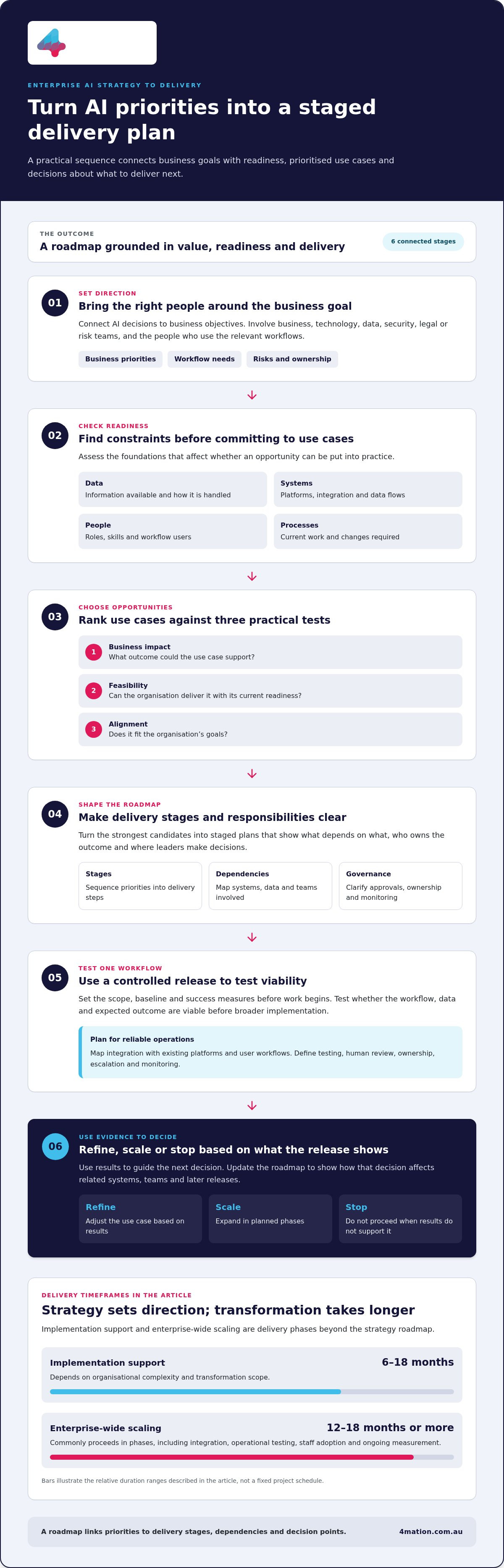
A strategy roadmap links business priorities to delivery stages, dependencies and decision points. A proof of concept can help test whether a priority use case is viable before broader implementation. It can test whether the workflow, data and expected outcome are viable before the organisation commits to broader implementation.
After strategy, move to one controlled workflow release rather than another strategy phase. Set its scope, baseline and success measures before work begins. Use the results to decide whether to refine, scale or stop the use case. The roadmap should show how that decision affects related systems, teams and later releases, rather than treating the pilot as an isolated experiment.
Implementation support typically extends 6-18 months, depending on organisational complexity and transformation scope. Enterprise-wide scaling commonly takes twelve to eighteen months or more and proceeds in phases. These timelines reflect the work beyond building a model, including integration, operational testing, staff adoption and ongoing measurement. A clear roadmap makes dependencies visible and gives leaders decision points throughout delivery.
Compare proposed plans by asking what each release changes, which teams own the result, and what evidence supports expansion. A practical plan connects each use case to a business problem and names the conditions for deployment. If you’re aligning a strategy with a first production release, discuss your AI delivery priorities with the team.
How to apply AI strategy consulting for enhancing business operations?
Start with an operational problem and define what a better result looks like. Then connect the desired outcome to practical work, owners and decision points.
Engagement Timelines and Deliverables
Agree on the engagement scope and deliverables before work begins. Useful outputs include a ranked set of opportunities, delivery dependencies, named owners and measures for reviewing progress. For example, a project aiming to reduce service hand-offs should identify where those hand-offs occur and who can confirm whether the process has improved.
Set decision points so leaders can review findings and adjust priorities. This keeps the work connected to business needs as teams uncover constraints, rather than locking them into an initial plan regardless of what discovery reveals.
Strategy Sprint and Project Timing
Plan timing around access to decision-makers, workflow owners, data and technical teams. Delays in these inputs can affect when teams can assess an opportunity or prepare it for delivery. A clear sequence of workshops, reviews and approvals helps participants make decisions and prevents critical work from stalling between stages.
For an operational project, map dependencies such as data preparation, system integration, user testing and staff training. Decide which activities can run in parallel and which depend on earlier decisions. This gives leaders a more useful view of delivery progress than a single target date.
Costs, Benefits and Return on Investment
The price depends on the case and is provided after a quote request. Scope, integration needs, data condition, infrastructure and delivery requirements shape the work involved. These factors also affect the resources needed to operate the solution once it is in use.
Estimate value against a clear operational baseline. For a document-processing workflow, compare staff effort, processing time, volume and error rates before deployment with the results afterwards. Include the ongoing cost of running the system and supporting its users. This gives decision-makers a fuller view of ROI than comparing development effort with a projected benefit alone.
Use review points to decide whether to refine the workflow, expand its use or redirect effort. If staff feedback reveals an unaddressed exception, adjust the process before increasing its reach. If performance supports the business case, plan the next release around its dependencies and accountable owners.
To discuss how your priorities could translate into operational outcomes, contact the team about your AI strategy.
Enterprise AI readiness and use-case assessment
A readiness assessment shows what your organisation can support and which gaps may slow delivery. It connects business priorities with the data, systems, workflows and workforce needed to act.
Readiness Diagnostics and Assessment
A readiness assessment can help teams understand their current capabilities and identify areas that need attention. It reviews data quality and access, existing technology, operational processes, governance, skills and executive sponsorship. The findings should show where teams can proceed and which constraints they need to address first.
Score each readiness dimension from one to five, and treat scores of two or below as constraints. For example, a low data-readiness score may indicate inconsistent records or unclear data ownership. Identifying the issue early helps leaders plan improvements before selecting AI tools or committing to implementation.
Gartner predicted that through 2026, organisations would abandon 60% of AI projects unsupported by AI-ready data. An assessment can reveal whether the data needed for a proposed workflow is accessible, reliable and suitable for its intended use. This helps distinguish a viable opportunity from one that needs foundational work first.
Use-Case Assessment and Strategic Planning
Use-case assessment turns readiness findings into prioritised decisions. First, list operational problems where AI could support a defined outcome, such as reducing manual document handling or helping staff find relevant information. Then assess each opportunity against business goals, feasibility and available resources.
Score potential business value from one to five and implementation effort from one to five. Compare the results alongside readiness constraints, rather than selecting a use case on potential value alone. A high-value workflow may need to wait if its data or systems require substantial preparation.
Select the top 3 AI use cases based on potential impact, feasibility, alignment with business goals and resource availability. Record the expected outcome, dependencies and accountable owner for each. This gives leaders a strategic basis for sequencing work and deciding which opportunity deserves an initial controlled release.
Workforce Readiness and Adoption
Technology readiness does not establish whether employees can use AI effectively in daily work. Only 23% of workforces are rated AI-ready. Assess the roles involved, the tasks affected and the support staff need to adopt changed workflows.
People and process issues account for around 70% of challenges organisations face when implementing AI initiatives, compared with around 20% attributed to technology problems. Use workflow mapping and staff interviews to identify where responsibilities, handovers or review practices may change. These findings can shape training and implementation planning.
For a customer-service workflow, map how staff review AI-generated suggestions, correct errors and escalate unusual cases. Assign an owner to monitor adoption and gather feedback from the team using the system. This makes workforce readiness part of the plan, rather than an assumption made after deployment.
Finally, connect assessment findings to strategic planning. If a workflow scores well for value but poorly for readiness, address its constraints before rollout. If employees need clearer guidance, include training and process changes alongside technology work. This sequence helps leaders direct effort towards practical adoption and business outcomes.
AI strategy and roadmap development
A useful AI roadmap turns business ambition into sequenced decisions, delivery work and measures of success. Start by defining the outcomes leadership wants, such as faster service, lower processing effort or better access to information. Then connect each target to the capability, data and process changes needed to deliver it. A proposed backlog can include a 90-day plan and a 6-month plan, giving executives near-term actions and a view of what follows.
Sequence work across short-term, medium-term and long-term horizons. The short term covers the next 3-6 months, where teams can address a practical priority and build delivery experience. Medium-term work can extend successful capabilities into connected workflows. Longer-term initiatives may depend on broader data, infrastructure or organisational change. Record dependencies between initiatives so leaders can see what must happen first and avoid committing resources to work that is not ready.
Strategy needs executive sponsorship and a clear business link. AI Pacesetters capturing real returns: 99% have a well-defined AI strategy, compared with 58% of organisations overall. Companies with a bold, enterprise-wide strategy championed by top leadership are 3× more likely to succeed with AI initiatives. These comparisons reinforce a practical point: leaders need to set direction, fund priorities and own the outcomes, rather than delegate AI as a technology-only program.
Communication matters too. Organisations whose leaders publicly communicate an AI vision are 1.5× more likely to achieve desired outcomes. Translate that vision into specific choices: which business objectives matter, what capabilities need investment, and how employees will prepare for change. For example, a service organisation targeting faster response times could link its AI plan to workflow redesign, data quality improvements and staff training, then measure progress against its existing service baseline.
Successful AI transformations start with clear business objectives, investment in data infrastructure, employee training and executive sponsorship. Build these foundations into the roadmap rather than treating them as separate workstreams. Give each initiative an accountable owner, a target outcome, delivery dependencies and a review point. This makes the roadmap a decision tool: leaders can continue, adjust or pause work as evidence emerges, while keeping investment connected to business value.
Review the roadmap as operating conditions change. Shifts in business priorities, data access or team capability may affect which initiative should come next. Keep target outcomes stable, but revisit sequencing and assumptions at planned decision points. This helps organisations move beyond a static strategy document towards a working plan that guides investment and delivery over time.
If you’re ready to turn AI priorities into a practical roadmap, discuss your strategy and delivery goals.
4Mation: Custom Software Development
4mation helps organisations move from AI priorities to software built around their operational needs. Its AI Consulting & Implementation and Custom Software Development can support you when existing platforms don’t fit a priority workflow, or when integrating AI requires changes to your systems.
We work with you to understand the business outcome, users and technical context before shaping an approach. Depending on your roadmap, that may include an AI capability within a web application or mobile app, tailored to your organisation’s requirements. Discuss the workflow you want to improve and the outcome you need to measure to identify the right next step.
Contact 4mation to discuss your AI roadmap.
Turn your AI priorities into practical progress
Choose a business outcome worth pursuing and give someone clear responsibility for it. Define what progress looks like, what evidence you’ll use to assess it and how the work can fit your existing operations. This keeps AI investment connected to a real organisational need, rather than letting the technology set the agenda.
Enterprise AI strategy consulting can help you shape that direction into work your teams can deliver. 4mation brings together AI Consulting & Implementation and Custom Software Development, with Mobile App Development available when a roadmap includes mobile experiences. The focus is on understanding your goals and users, then aligning the technical approach with the outcome you want to achieve.
You don’t need to settle every decision before starting a conversation. Bring the business problem, current constraints and questions you’re weighing. Together, we can identify a sensible next step and build from there.
Contact 4mation to discuss your AI strategy and take the next step with clarity.
Frequently Asked Questions
How long should AI strategy take?
The duration depends on how quickly your organisation can make decisions and provide access to relevant people and information. A focused business challenge with an engaged sponsor is simpler to address than a strategy spanning multiple divisions, systems and approval groups. Clarify whether the work ends with strategic direction or includes preparation for delivery. That distinction helps set realistic expectations for involvement and deliverables.
What Is AI Consulting?
AI consulting helps leaders make informed decisions about applying artificial intelligence to business challenges. It brings an independent view of the problem, possible approaches and the organisational changes involved. For example, a company considering an AI assistant might use consulting to determine how employees would use it, where human judgement remains essential, and how the solution fits existing technology and business processes.
Who should be involved?
Include the executive who can sponsor the work, the business leader accountable for the outcome and people who understand the affected operation. Technology, data, security and risk representatives can contribute specialist perspectives. For a proposed staff-facing assistant, involve employees who would use it and the managers responsible for their work. Their input can surface practical requirements, terminology and exceptions that senior stakeholders may miss.
Why Do Most Enterprise AI Projects Fail?
Projects often falter when teams build a technically functional system without changing the work around it. Employees may not trust its outputs, managers may lack time to support adoption, or the system may not fit existing processes. For example, an AI tool that drafts responses adds little value if staff still have to re-enter information manually. Strong delivery connects the system to real work and assigns clear operational ownership.
Why is establishing an AI Center of Excellence (COE) crucial for AI strategy consulting?
An AI Centre of Excellence can help an organisation coordinate expertise and share lessons across teams. It can provide a forum for resolving common questions, developing reusable practices and building internal knowledge. Its remit should fit the organisation: a central group might advise business teams, while operational leaders remain responsible for results. Clear authority and executive backing help the centre contribute to decisions without becoming an extra approval hurdle.
What does enterprise AI strategy consulting include?
Enterprise AI strategy consulting helps leaders connect organisational ambition with decisions about investment, operating practices and technology. The scope may include executive workshops, an assessment of existing AI activity, options for building or integrating capabilities, and advice on how teams will work with AI. Define the engagement’s boundaries and expected outputs early, so stakeholders understand which decisions it will support and what remains for delivery teams.
How much does AI strategy consulting cost in Australia?
The price depends on the case and is provided after a quote request. Scope, organisational complexity, stakeholder involvement, existing systems and the depth of analysis all affect the work required. An engagement focused on executive decision-making differs from one that also explores technical architecture or delivery planning. Before requesting a proposal, define the business question you need answered and the decisions you expect the work to inform.
What are the steps to develop an enterprise AI strategy?
Start by securing executive sponsorship and agreeing on the business ambition. Document current AI activity, identify who owns related decisions and set principles for investment and acceptable use. Decide how the organisation will build, buy or partner for capabilities. Define how leaders will review progress and communicate priorities to employees. Enterprise AI strategy consulting can help structure these choices around your organisation’s operating model and goals.
About The Author
