Is Your Vibe Coded App Production-Ready? Expert Assessment
Jowena BorralDigital Marketing Specialist

What if the app that impressed everyone in a demo isn’t ready for real customers or business-critical data? If you’re asking, “is my vibe coded app production ready?”, a smooth demo is a promising start, but it doesn’t prove the app can operate reliably day to day.
It’s reasonable to feel uncertain. AI-assisted development can turn an idea into a working prototype quickly, but real use brings different demands: secure data handling, dependable performance, clear ownership and ongoing support. Gaps may only become visible when users rely on the app or your team needs to change it.
This assessment will help you make a defensible decision: launch, release to a limited group or pause to address priority risks. We’ll look at the evidence that matters, including how the app supports user needs, handles business-critical data and fits into ongoing operations. You’ll also see how to move forward proportionately, whether that means targeted improvements, further assessment or a broader development plan. Useful prototype work can often provide a foundation for what comes next.
Key Takeaways
- To decide “is my vibe coded app production ready?”, look for evidence that it can meet user needs and support its intended business purpose.
- Assess security, reliability, user experience, maintainability and operational ownership. Note what has been reviewed and what remains uncertain.
- Choose between a controlled trial, limited release or broader production use based on user impact, data sensitivity, dependencies and the quality of available evidence.
- Use a proportionate assessment to define intended use, map dependencies, rank gaps and agree on the next step. A rebuild isn’t the default.
- 4mation can help turn assessment findings into a practical plan through software development, AI consulting, project rescue and ongoing technology support.
Is your vibe-coded app production-ready, or only demo-ready?
Can your users rely on the app beyond a controlled demonstration? That’s the business question behind “is my vibe coded app production ready?” A successful demo shows that a feature can work under specific conditions. It doesn’t show that the whole app can support real workflows, protect business data and keep operating when something goes wrong.
Production readiness means there’s credible evidence that an app can serve its intended users and business purpose reliably. The standard depends on what the app does and the consequences of failure. A tool that helps staff organise low-risk internal tasks has different operational demands from an app that handles sensitive information or supports a critical customer process.
A working prototype proves that an idea can run; a production-ready application shows that people can depend on it in the conditions your business expects.
AI-assisted coding is a development approach, not a quality rating. It doesn’t automatically make an app unsafe, and it doesn’t prove the app is ready to release. Base the decision on the app’s behaviour, the quality of its implementation and the evidence available to support ongoing use. The Software release life cycle is a useful reminder that a working build is one stage in a broader process of development and release.
What does production-ready mean for a business app?
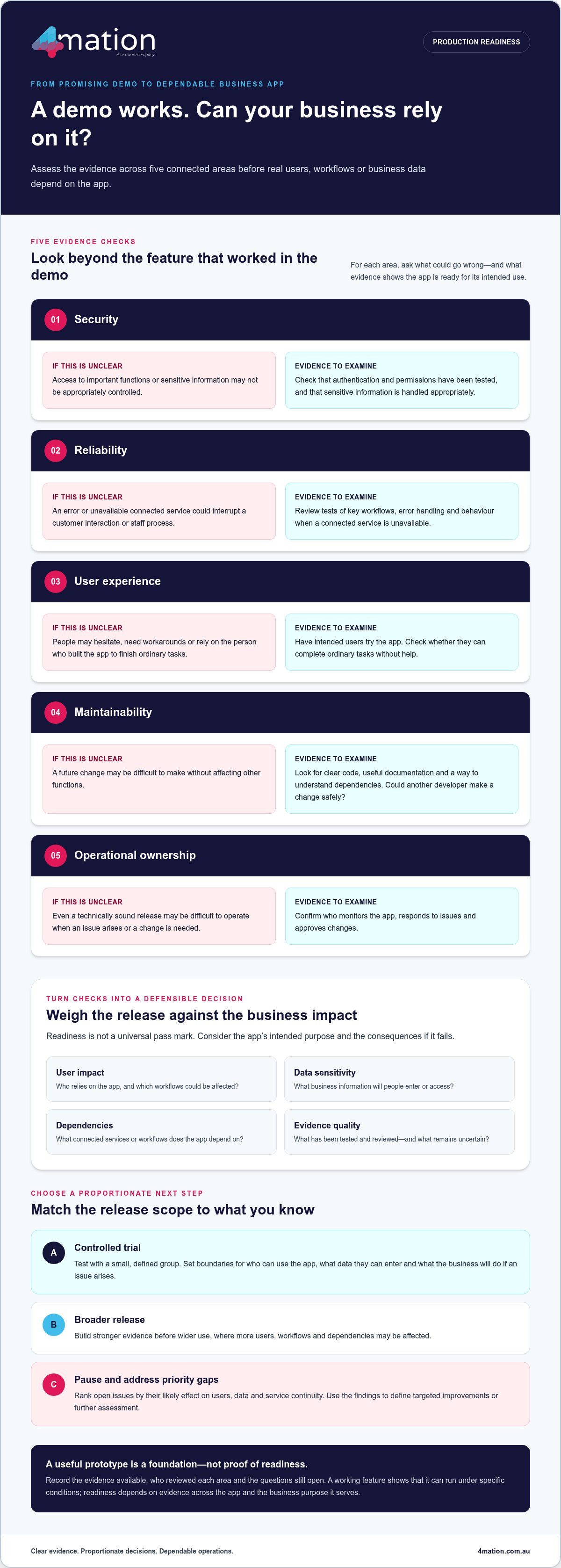
Start with the app’s intended users and the tasks they need to complete. Consider the real workflow, the business data involved and expectations for availability, ownership and support. Readiness isn’t a universal pass mark. It’s a judgement about whether the app suits its defined purpose and whether the business can manage the consequences if it fails.
A controlled trial can be a sensible way to test an app with a small, defined group before relying on it more broadly. Set clear boundaries: who can use the app, what data they can enter and what the business will do if an issue arises. A broader release calls for stronger evidence because more users, workflows and dependencies may be affected.
Why a successful demo is not enough evidence
A demo often follows a prepared path. The person presenting it may use familiar inputs, avoid unusual conditions and focus on one feature that works well. Everyday use is less predictable: users may enter incomplete information, take an unexpected route or need to recover from an error. A polished demonstration can’t show how the app handles these situations across the full workflow.
Nor does one working feature prove that the entire product is dependable. A form may save information correctly while another step fails to pass it on, or while access controls and recovery processes remain untested. The prototype still has value: it can validate an idea, clarify user needs and provide a foundation for further work. A release decision needs evidence beyond the demonstration, including:
- Whether the main user journeys work from start to finish.
- How the app handles errors and unexpected inputs.
- Who owns the app and can respond to operational issues.
- What has been tested, reviewed and left uncertain.
These checks turn a promising demo into a decision you can explain. They also help show whether the next step is a controlled trial, targeted improvements or a broader readiness assessment.
Which production-readiness evidence should you examine first?
A useful assessment connects technical checks to business impact. A weakness matters because it could expose information, interrupt a workflow, confuse customers or leave staff unable to support the app. To answer “is my vibe coded app production ready?”, examine five connected areas, then record who reviewed each one and what remains uncertain.
Readiness comes from evidence across connected areas, not from one passing test. A successful security check, for example, can’t show whether users can complete their work or whether someone can restore service after a failure. Review the app in the context of the work it needs to support.
- Security: Look for evidence that authentication and permissions have been tested and that sensitive information is handled appropriately. Who reviewed access to important functions? What still needs examination given the data involved?
- Reliability: Review tests of key workflows, error handling and behaviour when a connected service is unavailable. Would a failure interrupt customer service or a staff process? Has that scenario been tested?
- User experience: Check whether people can complete ordinary tasks without relying on the person who built the app. Have intended users tried it? Where do they hesitate or need workarounds?
- Maintainability: Look for clear code, useful documentation and a way to understand dependencies. Can another developer make a change without risking unrelated functions?
- Operational ownership: Confirm who monitors the app, responds to issues and approves changes. Without clear ownership, even a technically sound release may be difficult to operate.
For each area, capture the evidence available, the person who reviewed it and the open questions. This makes gaps visible without treating every concern as equally urgent. Rank them by their likely effect on users, data and service continuity. A missing check for a low-impact internal feature may call for a different response from uncertainty about access to sensitive information.
Can the app protect data and control access?
Check how users sign in, how permissions limit what they can see or change, and how these controls have been tested. Confirm that passwords, API keys and other secrets aren’t embedded in application code, where they could be exposed during review or reuse. The depth of a security review should reflect the sensitivity of the data and the business impact of misuse. If you need an independent perspective, discuss the app’s security evidence with 4mation to clarify a suitable next assessment step.
Can the app remain dependable and supportable?
Testing should cover more than the expected route through the app. Examine what happens when users submit incomplete information or a connected service stops responding. Check whether test scenarios cover key user journeys and how the team records and resolves failures. Then consider whether the codebase is understandable enough to change, and name who will monitor, support and improve the app after release. These responsibilities turn test findings into a practical operating plan.
How should you interpret the results: launch, trial or hold?
A readiness assessment should lead to a clear next step, not a misleading pass mark. If you’re asking “is my vibe coded app production ready?”, weigh the quality of the evidence against the app’s users, data, dependencies and role in your business. A gap in a low-impact feature may be manageable; the same uncertainty around a critical workflow could change the release decision.
Use this comparison as a guide, not a scoring system. The right option depends on what you know, what remains uncertain and what would happen if the app failed.
| Release option | When it may fit | What to put in place |
|---|---|---|
| Controlled trial | Core behaviour is understood, but you need to learn from use in a contained setting. | Define users, scope, success measures and how you’ll respond to issues. Set clear boundaries for data and workflows. |
| Limited release | Evidence supports a defined use, while some lower-impact gaps remain. | Restrict access and functionality to the agreed scope. Assign an owner and review feedback and issues before expanding. |
| Broader production use | Evidence covers the important user journeys, data handling and operational responsibilities for the intended use. | Make sure support, monitoring and change ownership are clear, with a plan for responding to failures. |
When is a controlled trial a reasonable next step?
A trial can help you learn without treating a prototype as ready for unrestricted use. Select a defined group of users and a specific workflow, then agree what success looks like, such as whether users can complete the task as intended. Set boundaries around sensitive data and avoid including business-critical processes unless the evidence supports that use. Decide in advance who will review feedback, respond to issues and determine whether to proceed.
During the trial, record what users actually do, where they encounter problems and how the app behaves under normal conditions. Use those observations to update the evidence and decide whether a limited release is appropriate. A trial is useful when its scope is controlled and its findings inform a decision, not when it simply postpones one.
When should you pause wider release?
Pause if a known issue could materially affect users, expose data or interrupt an essential operation. Treat unknowns seriously too. Missing access controls, unclear ownership or untested behaviour when a critical connected service fails leave important questions unanswered. A checklist can organise findings, but it can’t replace judgement about the app’s purpose and consequences.
For each unresolved issue, document known facts separately from assumptions. Record the potential impact, who is accountable for addressing it and what evidence would support the next decision. Then set a review point. This gives decision-makers a defensible basis to hold, trial or expand the release, and keeps the next action proportionate to the risk.
How can you assess readiness without turning it into a rebuild?
A readiness review should answer a practical question: what needs to change before this app can serve its intended purpose? It doesn’t need to become a broad review of every technical choice. Focus on the app’s users, data, integrations and importance to your business. This helps you identify targeted remediation or support needs without assuming the prototype must be replaced.
Use a clear sequence to keep the assessment proportionate:
- Define intended use. Record who will use the app, which workflows it supports and what would happen if it became unavailable or produced an incorrect result.
- Map dependencies. Identify the data the app uses, the services it connects to and the people or processes that rely on it. A failure in an optional integration may have a different impact from a failure that stops a core workflow.
- Gather evidence. Review relevant code, architecture, testing, access controls and deployment arrangements. Focus on the parts that support the intended use rather than inspecting everything equally.
- Rank the gaps. For each finding, record the available evidence, potential impact, priority and accountable owner. Separate confirmed issues from questions that still need investigation.
- Agree the next action. Decide whether to address a release blocker, improve a specific area, provide ongoing technical support or plan a broader project. Set a review point so the decision can be revisited as evidence changes.
What should a focused readiness review cover?
Trace the main user journeys from beginning to end, then compare them with business requirements and data flows. Note where information enters, where it goes and which external services the app depends on. Review relevant code and architecture alongside test results, access controls and how changes are deployed. A useful finding is specific: it explains what was examined, what the evidence shows, how the issue could affect the business and who owns the next step.
How do you turn findings into a proportionate plan?
Group work into three practical horizons: release blockers that need attention before the intended use, near-term improvements that reduce operational friction, and longer-term enhancements that support future needs. Preserve features and workflows that already work and can be understood and maintained. A targeted code improvement may be enough; project rescue or ongoing technical support may suit different needs. A rebuild is one possible response, not the default.
Where findings call for focused engineering work, 4mation’s custom software development can help address specific gaps while retaining useful prototype work. If you want to turn your assessment findings into a practical next-step plan, talk with 4mation about your app.
How can 4mation help you make a confident readiness decision?
Deciding whether to release an app is a business decision as much as a technical one. 4mation works with you to understand the outcomes you need, who will use the app, how it fits into daily operations and what evidence the prototype already provides. That context helps separate risks that need attention from improvements that can wait, so you can choose a proportionate next step.
Our recommendations are guided by what the app must do and what the evidence shows, not by assumptions about how it was built. AI-assisted code may be worth retaining, improving or extending. Depending on your needs, we can support you with software development, AI consulting, project rescue or ongoing technology support. The aim is to help you make an informed decision and maintain continuity where useful, not to prescribe a rebuild by default.
4mation’s NATA AI proof of concept demonstrates our experience with AI proof-of-concept work. It doesn’t establish whether your app is ready for production. Your decision needs to rest on your app’s purpose, users, operating conditions and readiness evidence.
What does a practical assessment partnership look like?
We begin by listening to the people responsible for the app and the people expected to use it. Together, we clarify the intended business outcome, important workflows and operational expectations, then compare those needs with the available technical evidence. Where questions remain, we identify what needs further review and explain how each finding could affect users or operations. This creates a practical basis for deciding whether to proceed, limit the release or address specific gaps first.
4mation has 25 years of client success. We bring that experience to the assessment while keeping the recommendation specific to your situation. The question isn’t simply whether AI generated the code; it’s whether the app can support the way your organisation plans to use it.
What should you bring to the first conversation?
You don’t need a perfect technical pack. A few practical details can help make a focused discussion more useful:
- The working app or prototype, and the main user journeys you want it to support.
- The intended launch context, including who will use it and what business outcomes matter.
- Any existing technical documentation, test results or notes about how the app was developed.
- Known issues, connected systems and questions about data, ownership or ongoing operation.
With this information, we can help clarify the assessment scope and identify a sensible next step, whether that’s targeted development, further review or support for ongoing operation. If you’re ready to discuss your app and its readiness priorities, talk with 4mation about your app.
Turn your prototype into a well-judged next step
The question “is my vibe coded app production ready” doesn’t need to end in a blanket yes or no. It can lead to a practical decision about what to do next, based on the app’s role in your business and the evidence you have. A focused review can help you protect useful work, address priority gaps and move towards release at a pace that suits your users and operations.
With the right technical and business context, you can make a decision that’s clear to stakeholders and grounded in your organisation’s needs. 4mation is an AWS Select Consulting Partner, bringing practical technology experience to conversations about your app’s next stage.
Discuss your app’s production readiness with 4mation and identify a sensible path forward. Your prototype can be the starting point for a dependable business asset.
Frequently Asked Questions
Is a vibe-coded app production-ready if it works in a demo?
No. A demo confirms that a particular scenario works, not that the full app is dependable, secure or supportable. For example, it may not show what happens when a user submits incomplete information or loses access mid-task. Readiness depends on intended use, data sensitivity and business impact. Before a wider release, examine evidence for security, testing, failure handling and ownership, including how the team would respond to a problem.
Can I launch a vibe-coded app with real customer data?
Possibly, but only if the app’s data handling, access controls, security review and operational safeguards suit the information involved. A prototype working with sample data isn’t enough. Map what customer information the app collects, where it is stored or sent, and which people or systems can access it. Then assess whether the controls are appropriate for the possible consequences of exposure, misuse or incorrect processing.
How do I know if my AI-generated app is secure?
Security confidence comes from reviewing the actual app and testing relevant risks, not from knowing that AI helped create it. Examine how information moves through the app, how users authenticate, what permissions they receive and how secrets such as access credentials are handled. A tool or checklist can support the review, but neither guarantees security. Match the depth of assessment to the sensitivity of the information and the likely effect of a failure.
What happens if my vibe-coded app is not production-ready?
It doesn’t automatically mean you need to discard the app. The findings may point to a targeted fix, more testing, a contained trial or broader engineering work. For example, a workflow could be useful while a particular integration still needs attention. Prioritise each gap by its effect on users, data and operations, assign someone to address it, and decide what evidence is needed next. Base the release decision on risk, not launch pressure or effort already spent.
Can a vibe-coded app scale as more people use it?
It depends on how the app handles its expected workload, integrations and data, and how its architecture supports growth. A demo with a few users won’t establish how the app behaves when more people use it at once or rely on it during busy periods. Define realistic usage expectations, then review relevant performance and reliability evidence against them. Increase access in stages where appropriate, and reassess before making the app central to important workflows.
Do I need to rebuild my vibe-coded app before putting it into production?
No, a rebuild isn’t the default answer. A review can show which parts already meet your needs and which require changes, testing or refactoring. For instance, the main user flow may be worth keeping even if its supporting code needs improvement. The proportionate approach depends on the codebase, business requirements, identified risks and support needs. Focus on reaching the intended outcome appropriately, rather than treating the app’s AI-assisted origins as a reason to start again.
Who should assess whether a vibe-coded app is ready for business use?
A suitable review combines software engineering expertise with a clear understanding of your business purpose. The people involved should be able to examine how the app supports users, workflows and connected systems, then explain the implications of technical findings in business terms. Involving operational stakeholders helps surface practical needs, such as who handles a failed process or user issue. This shared view supports a release or remediation decision that reflects both technical evidence and business priorities.
About The Author
