Fintech Application Development Services for Cost and Support Planning
Jowena BorralDigital Marketing Specialist

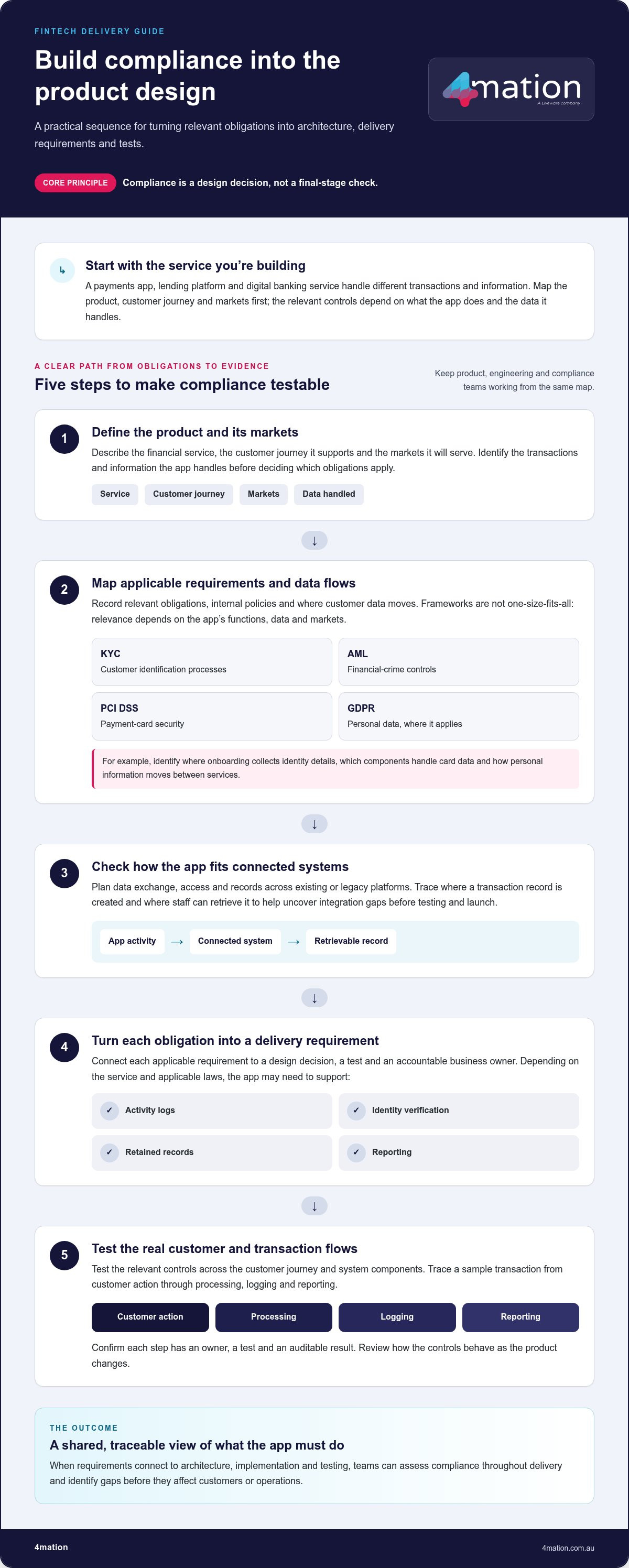
Compliance is a design decision, not a final-stage check. Fintech application development services should build testing for relevant KYC, AML, PCI DSS and GDPR requirements into the project, based on the product and the markets it serves.
It’s also reasonable to want clarity on security, delivery effort and the ongoing work required after launch. A well-planned fintech app connects those decisions to the service you’re building, so compliance and security needs shape the architecture, development steps and support model from the outset.
This guide explains how to plan for Australian fintech requirements, protect sensitive data and assess the factors that influence development timelines and costs. It also covers ongoing support, how to choose a development partner and how a structured project can take your business from an initial idea to a dependable financial product.
Key Takeaways
- Map the financial service, markets and data it handles before translating relevant compliance needs into development and testing requirements.
- Plan account protection around secure sign-in, encryption and transaction monitoring to help safeguard customers and financial data.
- Estimate delivery effort by defining the app’s features, integrations, compliance needs and support requirements early.
- Use a staged development process to test the product, gather feedback and manage delivery risks before launch.
- Choose custom software, mobile or web app development support that fits your business goals and the financial product you’re building.
How do you approach compliance and regulations in FinTech software development?
Compliance starts with defining the financial service, customer journey and markets the app will support. Key risks include applying unsuitable controls, exposing sensitive data and designing recordkeeping that does not meet the service’s regulatory needs.
Australian Regulatory Requirements
Start with a compliance map for the specific product, rather than treating every fintech app alike. A payments app, lending platform and digital banking service handle different transactions and information, so their control needs can vary. Record applicable obligations, internal policies and customer-data flows before finalising the architecture.
The Australian Securities and Investments Commission (ASIC) notes that fintech systems may need to fit existing or legacy systems. This affects how teams plan data exchange, access and records across connected platforms. For example, map which system creates a transaction record and where staff can retrieve it. This helps identify integration gaps before testing and launch.
A development company should turn the map into traceable requirements. Link each requirement to a design decision, a test and an accountable business owner. Depending on the service and applicable laws, a financial application may need activity logs, identity verification, retained records or reporting. Documenting these needs early helps teams assess compliance throughout delivery.
KYC, AML, PCI DSS and GDPR
Testing should address the KYC, AML, PCI DSS and GDPR requirements that apply to the product. KYC and AML processes relate to customer identification and financial-crime controls; PCI DSS concerns payment-card security, while GDPR relates to personal data. Relevance depends on the app’s functions, data and markets, so map each requirement to the customer journey and system components.
For example, identify where onboarding collects identity details, which components handle card data and how users’ personal information moves between services. Then test the relevant controls, including access permissions, validation steps and data handling. This gives product, engineering and compliance teams a shared view of what the app must do.
GDPR may apply where a service handles personal data within its scope. Naming a framework does not prove compliance. Instead, record why it applies, what the app must support and how tests demonstrate those behaviours. This makes compliance decisions easier to review as the product changes.
Financial-Sector Expertise and Standards
Domain expertise helps translate regulatory language into workable product requirements. A team familiar with payment flows can identify where transaction records, identity checks and reporting fit into the architecture. Ask a development company to explain how it connects those requirements to design, implementation and testing, rather than relying on a generic security checklist.
Standards and frameworks can offer useful reference points when assessing information security, privacy and payment controls. These names don’t mean every framework applies to every Australian fintech product. Use them as reference points for assessing information security, privacy and payment controls, then establish which are relevant to the service and its operating context.
Make the review practical: trace a sample transaction from customer action through processing, logging and reporting. Confirm that each step has an owner, a test and an auditable result. This connects financial-sector requirements to the system’s real behaviour and helps teams identify compliance gaps before they affect customers or operations.
What security measures are required for FinTech apps?
Security controls should reflect what the app does and the information it handles. A digital wallet, mobile banking app and lending platform each need protection designed around their customer journeys, transactions and connected services.
Start with account access. Multifactor authentication and biometric verification can help protect accounts from unauthorised access. For example, a banking app can combine a password with a second verification step or offer biometric sign-in. Design clear recovery steps too, so legitimate customers can regain access without weakening account protection.
Protect financial data in transit and at rest with encryption. This helps safeguard sensitive information as it moves between a mobile app, platform services and connected systems, and while it is stored. Map customer and transaction data flows, then apply encryption at each relevant point.
Transaction monitoring can help teams identify unusual activity. AI algorithms can monitor transaction behaviour for anomalies and provide real-time updates about potentially fraudulent transactions. Define what the system monitors, how it flags an exception and how staff or customers receive an alert. Clear handling steps help teams respond consistently.
Security priorities also vary by financial use case. A payments app must protect payment flows and transaction data. A digital banking platform may bring account access and transfers into one mobile experience. A lending app handles application information and decisions. Personal finance tools can help users view financial information across accounts, making careful access controls and data handling important.
API integrations connect apps with banks, payment gateways and data providers, allowing platforms to exchange financial information and conduct transactions. Treat each connection as part of the security boundary. Map what information each integration sends and receives, limit access to what it needs and test how errors or interruptions affect transaction flows.
Build security checks into development and release. Test sign-in, account recovery, data movement, transaction flows and integrations across supported devices. Include scenarios such as a rejected payment or interrupted bank connection, then verify that the app handles the issue without exposing sensitive details or confusing the user.
Review these decisions against your product’s customer journey and operating needs. If you’re planning a banking, payments or lending app, discuss your app security requirements as part of defining its scope.
App development timelines, costs and ongoing support
Delivery time and total investment depend on the product’s scope, integrations, compliance needs and support plan. Include testing, deployment and post-launch maintenance in the project lifecycle, rather than treating launch as the finish line.
Development Timelines and Costs
An entry-level fintech application can take 12-16 weeks to develop. A focused fintech app typically takes 3-6 months from discovery to launch, while complex solutions involving trading, AI or blockchain can take 6-8 months. Complex platforms with deep compliance requirements may take 8-18 months. These ranges describe different scopes, so compare the features and delivery stages behind each estimate.
Plan costs around the scope. Key factors include the number of user journeys, integrations, security controls, testing requirements and connections to existing systems. A payments product may also need dispute resolution and customer service processes alongside its technology. FinTech Australia and the Small Business Association of Australia identify compliance infrastructure, dispute resolution, customer service, and maintaining and developing technology platforms as potential costs for fintech payment providers.
Ask an app development company to break its estimate into discovery, design, development, testing and deployment. That makes assumptions visible. For example, adding a bank integration or complex reporting requirement can affect both delivery effort and testing. Price depends on the case and is given after a quote request, with scope, integrations, compliance needs and support requirements shaping the estimate.
Post-Launch Maintenance and Support
Before launch, test complete customer journeys, not just individual screens. Check account creation, payments, error handling and connected services in realistic scenarios. Resolve defects, confirm deployment steps and prepare operational teams to handle common customer issues. A controlled release plan also helps the business monitor whether the app performs as intended.
After launch, support should cover the work needed to keep the product dependable and useful. This can include investigating reported faults, maintaining integrations, addressing security issues and planning improvements as business needs change. Define how issues are prioritised, who owns each action and how changes are tested before release.
Set a post-launch review cycle around product performance and user feedback. For example, analyse where customers abandon an application or encounter a failed transaction, then prioritise fixes by business impact. Keep records of changes and test results so teams understand what changed and why. This turns maintenance into planned product management rather than disconnected fixes.
Budget for support across the product lifecycle, alongside development and deployment. A clear operating plan helps decision-makers understand responsibilities, manage ongoing work and keep the app aligned with customer and business needs after launch.
FinTech app development process
A clear process connects business goals to a tested product, with decisions made in sequence. For fintech solutions, discovery, design, software development, quality assurance and release each provide inputs for the next stage.
Discovery and Design
Begin by defining the customer problem, business outcome and core transactions. For example, a lending app may let customers submit applications and track progress, while a payments product focuses on initiating and viewing transactions. Mapping these journeys helps teams agree what the first release must do.
Next, document user roles, information flows, integrations and operational needs. Identify the existing systems the app must connect to and what data those connections exchange. These decisions shape the architecture and make project scope more concrete.
Design turns agreed journeys into screen layouts and interactions. Review a prototype with business stakeholders and representative users before development begins. For example, a customer testing a transfer flow may reveal unclear wording or missing steps while changes are still easier to make.
Before moving forward, confirm the planned features, dependencies and acceptance criteria. A shared backlog gives product, design and engineering teams a practical reference. It also helps prioritise essential functions if the scope needs to change during delivery.
Development and Quality Assurance
Developers build the application in manageable increments, connecting each feature to an agreed user journey. A banking dashboard, for instance, needs to present account information clearly and handle unavailable data appropriately. Reviewable pieces let the team inspect progress and resolve questions early.
Quality assurance should run alongside development, not just at the end. Test individual functions, then check how they work together across the application. For a payment journey, verify that the customer can enter details, review the transaction and receive a clear result.
Include relevant integration and error scenarios in each test cycle. A bank connection may return incomplete information, or a payment gateway may not respond as expected. Testing these paths helps confirm that the app communicates the issue and handles the next step consistently.
Track defects against agreed acceptance criteria, then retest fixes before adding more changes. This creates a visible record of what passed and what still needs attention. Regular demonstrations also let stakeholders compare working software with the original scope.
Testing and Release
Before release, test complete journeys in an environment that reflects the planned production setup. Check supported devices, key integrations and customer-facing messages. For example, confirm that a failed transaction does not appear as successful in the user’s account history.
Prepare a release plan that names decision-makers, deployment steps and post-launch checks. Confirm that relevant teams know how to identify issues and communicate their impact. A staged rollout can help teams observe application behaviour before expanding access.
After deployment, review operational feedback and reported issues against the release criteria. Record defects, assign owners and prioritise fixes based on their effect on customers and business operations. This makes launch a controlled transition from delivery to ongoing product management.
Close the initial delivery cycle by reviewing results against the original goals. Compare shipped features with the approved backlog, note remaining work and agree on next priorities. This record keeps future improvements connected to customer needs and business outcomes.
Fintech application development services
Australian companies develop digital banking platforms, payment processing applications, lending software, investment platforms and AI-powered financial tools. The right scope depends on your product, customers, financial workflows and existing technology, not simply the app category.
That distinction matters for enterprise projects. A lender may need a customer portal connected to application processing, while a payments business may need transaction functionality that fits its existing operations. Start by defining the business outcome, user groups and processes the product must support. Then identify what needs to be built, integrated or improved.
Typical fintech project areas include:
- Digital banking: customer-facing platforms for account and banking services.
- Payments: applications that support payment processing and financial transactions.
- Lending: software that supports lending workflows and customer interactions.
- Investment: platforms that help users access investment-related services.
- Financial tools: AI-powered applications designed for specific financial tasks.
These categories overlap, but each has different operational needs. For example, a lending product may combine a customer-facing application with internal staff tools. A financial services platform may also need to share information with existing business systems. The Australian Securities and Investments Commission (ASIC) notes that fintech systems may need to fit existing or legacy systems, making integration planning important.
When assessing a proposed solution, look beyond the feature list. Ask how the design supports your customer journey, how information moves between systems and how staff will manage day-to-day work. A useful project scope describes the users, core tasks, integrations and business outcomes. It should also clarify which capabilities are essential for the initial release and which can follow later.
Technology choices should serve those requirements. A mobile app may suit customers who need convenient access on their phones, while a web application may better support staff workflows or complex administration. Some products need both. Choose based on user needs and operational context, rather than adding platforms without a clear business purpose.
For Australian organisations, the practical takeaway is to treat fintech development as product and systems planning, not just app construction. Define the financial service, map its workflows, then scope the software and integrations around them. This gives decision-makers a stronger basis for comparing approaches and setting priorities.
If you’re planning a financial product, discuss your fintech project requirements and the systems it needs to support.
4Mation: Custom Software Development
4mation works with Australian businesses to shape financial software around their products, users and operational needs. If your banking, payments or lending platform needs custom workflows or connections to existing systems, Custom Software Development can help bring those requirements into one tailored solution.
We also develop customer-facing mobile apps and web applications, aligning the experience with how your customers and teams use the service. For projects involving AI, our AI Consulting & Implementation can help assess where it fits your business needs. Start with a clear discussion of your goals, constraints and next steps.
Contact 4mation to discuss your fintech project.
Turn your fintech opportunity into a clear next step
A fintech product should remain responsive as customer expectations and business priorities evolve. Give your leadership team a straightforward way to review progress, weigh opportunities and decide what deserves attention next. This keeps product decisions connected to your organisation’s direction.
With fintech application development services, the goal is to create a foundation your business can continue to shape. Before moving ahead, bring stakeholders together to agree on what success looks like and how you’ll make future product decisions.
Contact 4mation about your fintech app to discuss the next step. A considered plan can help your team move forward with confidence.
Frequently Asked Questions
How much does it cost to build a FinTech app?
There’s no single price for every FinTech app. Build a budget that separates the initial project from ongoing business costs, such as third-party subscriptions, internal staff time and operational processes. This gives finance teams a clearer view of total ownership, rather than treating the development estimate as the whole investment. Keep assumptions visible and record what the proposed scope includes.
How much does fintech app development cost in Australia?
Australian project estimates should be expressed in Australian dollars and tied to a written scope. For useful comparisons, align each proposal with the same product requirements and delivery assumptions. Clarify whether estimates include applicable taxes, external platform charges or internal resources, and distinguish one-off project work from recurring costs. This helps decision-makers compare like with like, rather than relying on headline figures alone.
What factors affect fintech application development timelines and pricing?
Decisions and external dependencies can change delivery effort beyond the product scope. Delays in stakeholder approvals, access to test environments or responses from third-party providers may hold up work. Frequent changes can also create rework if affected functions have already been built or tested. Assign decision-makers, agree on response expectations and document how proposed changes are assessed. These arrangements help teams plan around dependencies and control scope.
What data privacy and cybersecurity standards must Australian fintech apps meet?
Requirements depend on the service, the information it handles and the markets it serves, so there is no universal checklist. Start with a data inventory: record what the app collects, why it uses each item, who can access it and how long it is retained. Also define how teams handle access changes, deletion requests and suspected incidents. These records give privacy and security reviews a concrete basis.
How do fintech development agencies compare with in-house teams and freelancers in Australia?
An in-house team may suit a product that needs frequent collaboration with internal operations and established product ownership. A freelancer can fit a discrete assignment when your team can manage direction and integration. An agency may suit broader delivery requiring coordinated disciplines. Compare options by asking who owns decisions, how knowledge transfers to your organisation and how work continues if a key contributor becomes unavailable.
What are the main stages of fintech app development, from discovery to launch?
Plan decision gates, not just a sequence of tasks. Agree who approves the business case, what evidence is needed to accept a prototype and who signs off operational readiness. Name an owner for each decision and record unresolved items before moving forward. This gives executives visibility over progress and makes it easier to pause, reprioritise or approve investment as the product develops.
How should businesses choose an Australian fintech app development company?
Look for evidence that a company can make complex work understandable to business stakeholders. Review relevant project examples, then discuss how it documents decisions, reports delivery risks and transfers product knowledge to your team. A useful conversation connects technical choices to customer and operational outcomes. Clarify who will lead day-to-day collaboration and how your organisation will retain access to project documentation and software assets.
What technologies and integrations are commonly used to build fintech applications?
Fintech products commonly combine mobile or web interfaces, backend services, databases and connections to external platforms. Choose components based on your team’s ability to maintain them, the product’s integration needs and the data each system must exchange. Define ownership of credentials, interface changes and error handling before implementation. This reduces ambiguity when an external platform changes or a transaction cannot be completed as expected.
About The Author
