Custom Software Development Costs in 2026: The Definitive Australian Guide
Michael CaliHead of Marketing
Michael is passionate about showcasing what is truly possible when you partner with us. With data-driven insights, he boosts our exposure to Australian businesses that share our commitment to being at the forefront of tech innovation. His main goal is connecting our team with the market of innovators to deliver software ‘magic’!

Why do two seemingly identical project quotes often differ by hundreds of thousands of dollars? For many Australian executives, the process of estimating custom software development costs feels less like a strategic exercise and more like a gamble. You’ve likely experienced the frustration of vague agency estimates or the anxiety that a “competitive” price today will lead to a mountain of technical debt tomorrow. It’s a valid concern; a software investment should be a predictable business asset, not a volatile liability that drains your operational budget.
We understand that you need certainty to justify capital expenditure to your board. This guide provides a transparent framework for understanding how bespoke solutions are priced in the 2026 market, from initial discovery through to long-term managed support. You’ll gain a clear understanding of how to budget for high-performance software that scales, ensuring you can realise a genuine return on investment. We’ll examine the variables that influence your total cost of ownership and show you how to identify the hidden fees that often lead to project blowouts.
Key Takeaways
- Identify the primary technical and strategic factors that influence custom software development costs, allowing you to move beyond simple hourly rates toward a total value perspective.
- Evaluate the commercial advantages of fixed-price versus time-and-materials engagement models to ensure your contract structure matches your project’s complexity and risk profile.
- Understand how modern requirements like AI integration and high-fidelity UX design impact your budget and contribute to long-term operational performance.
- Utilise an MVP (Minimum Viable Product) strategy to validate your business case early and avoid the common pitfalls of over-scoping before achieving market fit.
- Shift your focus from initial build price to total cost of ownership by budgeting for the essential managed services that keep bespoke systems secure and scalable.
Understanding the Variables: Why Custom Software Pricing Isn’t One-Size-Fits-All
When you ask for a quote for a bespoke solution, the answer is almost always “it depends.” This isn’t an attempt to be vague. Rather, it reflects that bespoke software is a tailored business tool designed to solve specific operational challenges, not a mass-produced commodity. While it’s tempting to focus solely on hourly rates, these are just one component of the total custom software development costs. A lower hourly rate from a less experienced team often masks inefficiencies, leading to longer timelines and higher overall expenditure. In 2026, Australian businesses are increasing their digital product budgets by an average of 15% to ensure they are building for longevity rather than just immediate functionality.
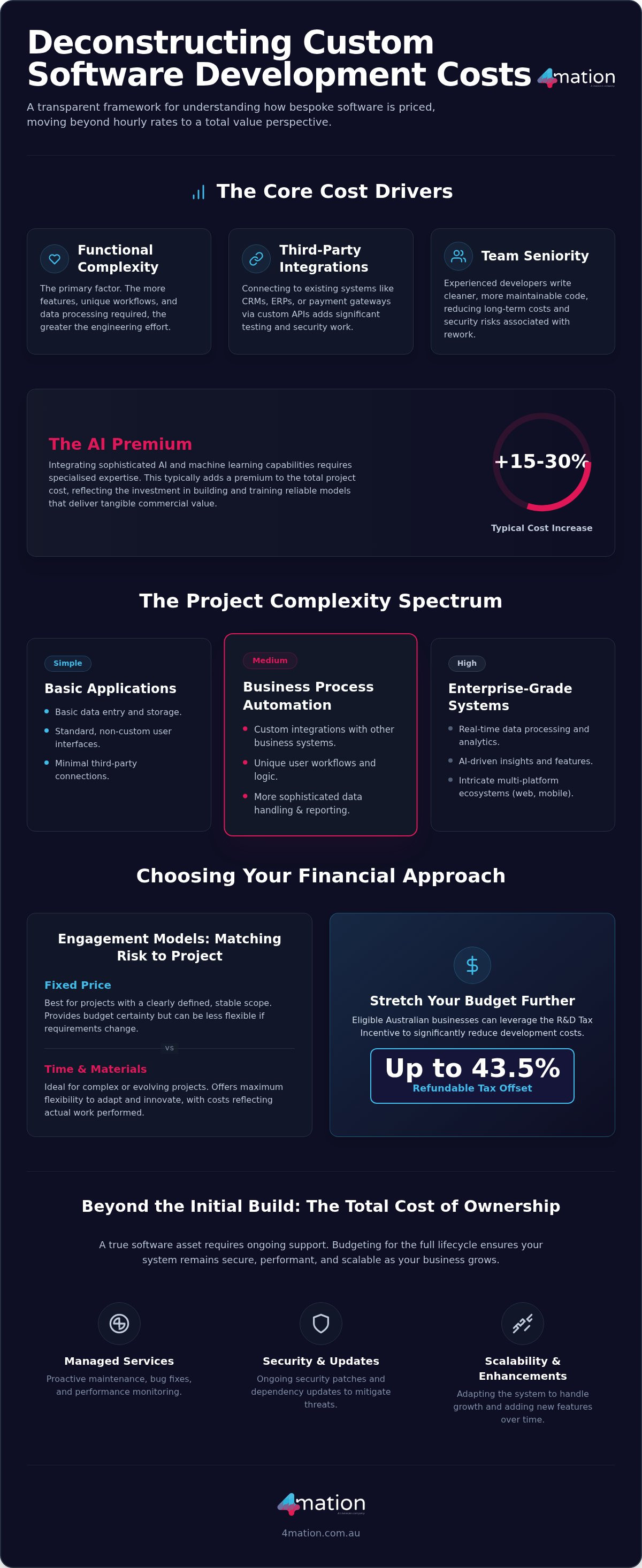
Strategic budgeting requires a deep dive into software cost estimation methods that account for the full lifecycle of the product. For instance, modernising a legacy system involves addressing years of technical debt, which can significantly influence the initial investment compared to building a clean-slate solution. Whether you’re starting with a Minimum Viable Product (MVP) to test a concept or embarking on a full-scale enterprise transformation, the scope of your vision dictates the architecture, security requirements, and integration needs. It’s also worth investigating the R&D Tax Incentive, which can provide up to a 43.5% refundable tax offset for eligible activities, effectively stretching your development budget further.
The Complexity Spectrum
We categorise projects based on their functional depth and technical requirements. Simple applications usually involve basic data entry and standard user interfaces with minimal third-party connections. Medium complexity projects introduce custom integrations, unique user workflows, and more sophisticated data handling. High complexity systems are the engine rooms of modern business; they often feature real-time data processing, AI-driven insights, and intricate multi-platform ecosystems that must remain performant under heavy load. The more moving parts and external dependencies your system has, the more rigorous the testing and architecture phases must be.
The Role of the Development Team
The seniority of the engineers directly impacts the quality and speed of delivery. Senior developers write cleaner, more maintainable code that reduces the risk of expensive rework later. When considering how we engage with partners, we find that hybrid delivery models often offer the best balance. By combining local strategic oversight in Sydney with high-quality global production, businesses can maintain 24/7 momentum without sacrificing the “safe pair of hands” reliability required for high-stakes projects. Remember, “cheap” code is often a false economy; if the foundation is weak, you’ll pay more in long-term maintenance and security patches than you saved on the initial build.
The Core Cost Drivers: From Functional Complexity to AI Integration
Technical requirements are the primary engine behind the fluctuation of custom software development costs. While a sleek user interface is often the focus, the most significant investment typically occurs beneath the surface in the back-end infrastructure and database architecture. High-performance systems require robust foundations to handle concurrent users and complex data processing without latency. When you’re investing in custom software development, you are essentially funding the engineering hours required to ensure these invisible components remain secure, scalable, and efficient as your business grows.
Integrations also play a pivotal role in the final quote. Connecting your new software to existing CRM, ERP, or payment gateways via custom APIs adds layers of testing and security verification. In 2026, we’re seeing an “AI Premium” become a standard consideration; adding sophisticated machine learning or generative capabilities typically increases build costs by 15% to 30%. This investment reflects the specialised expertise needed to build reliable models that deliver actual commercial value rather than just technical novelty. If you’re unsure which features will drive the most value for your specific industry, our team can help you identify the most impactful starting point for your project.
Modernising Legacy Systems
Modernising an older codebase is rarely a simple “lift and shift” operation. It requires a comprehensive audit to identify security vulnerabilities and refactor inefficient code to meet modern cloud-native standards. You must also account for the complexities of data migration and compliance with the latest mandates in the Privacy Act 1988 and the Cyber Security Rules 2025. These regulatory requirements ensure your data remains protected, but they do necessitate a more rigorous development and testing phase to mitigate risk.
AI and Data Science Implementation
The success of any AI feature depends heavily on the quality of the underlying data. Significant effort is often required for data preparation and cleaning before a machine learning model can be effectively trained or integrated via an API. You’ll need to decide between training a bespoke model for niche business logic or utilising existing enterprise APIs, each carrying different cost implications for initial setup and ongoing monitoring. We focus on ensuring these tools are implemented with a clear path to ROI, avoiding unnecessary complexity while maintaining the flexibility to refine models as your data matures.
Fixed Price vs. Time and Materials: Choosing the Right Engagement Model
Selecting an engagement model is a strategic decision that directly impacts your project’s risk profile and long-term success. While many executives gravitate towards a fixed cost project for its perceived certainty, this model requires a high degree of upfront clarity that isn’t always possible for complex enterprise systems. Understanding the nuances of how these contracts are structured is essential for managing custom software development costs without compromising on quality or functionality. The right choice depends on your project’s maturity, the clarity of your requirements, and your need for technical flexibility.
A hybrid approach often provides the most balanced path for digital transformation. By starting with a fixed-price discovery phase to define the roadmap and then transitioning to a flexible delivery model, you maintain financial accountability while allowing for the iterative improvements that drive a high ROI. This methodical progression ensures that you aren’t just paying for hours, but for the strategic execution of a well-defined business goal. When evaluating the cost of custom app development, it’s vital to consider which model allows your partner to act as a strategic ally rather than just a vendor.
The Fixed Price Trap
Fixed price contracts work well for small, well-defined projects with zero expected scope changes. However, for larger builds, they can unintentionally stifle innovation. If your requirements evolve after the contract is signed, you’ll likely face a cycle of “Change Requests” that can lead to budget blowouts and friction between teams. To avoid this, we focus on a rigorous discovery phase to uncover potential roadblocks early. This ensures the initial estimate is based on concrete data rather than optimistic assumptions, providing genuine certainty rather than a false sense of security.
Agile Delivery and T&M
For complex enterprise requirements, a Time and Materials (T&M) model is often the more pragmatic choice. This approach aligns with Agile delivery, where transparency and continuous feedback loops allow you to pivot as you learn more about your users’ needs. Managing budgets in an agile environment requires disciplined reporting and a focus on “Value Delivered” rather than just “Hours Spent.” This model ensures your investment is always directed towards the features that will have the most significant impact on your business performance, preventing wasted spend on low-value functionality.
Strategic Budgeting: How to Minimise Risk and Maximise ROI
Budget blowouts often stem from a lack of alignment between technical execution and commercial objectives. To manage custom software development costs effectively, you must define clear business goals before a single line of code is written. We work with you to identify the specific problems you’re trying to solve, whether that’s automating a manual process that wastes 20 hours a week or replacing a legacy system that’s hindering your ability to scale. This outcome-focused approach ensures your investment is always tied to a measurable business benefit.
A thorough discovery and digital strategy phase is the most reliable way to avoid expensive rework later. During this stage, we map out the technical architecture and prioritise features based on a “Value vs. Effort” matrix. By focusing on a Minimum Viable Product (MVP) strategy, you can launch a functional solution that addresses your core needs while gathering real-world data. This “build, measure, learn” cycle allows you to refine your roadmap based on actual user feedback rather than assumptions, significantly reducing the risk of over-investing in features that don’t drive results.
Preparing Your Project Brief
An accurate estimate depends on the quality of your project brief. You’ll need to clearly distinguish between functional requirements (what the software does) and non-functional requirements (how it performs, such as security and speed). Providing specific details about your existing data environment and required third-party integrations helps us identify potential complexities early. Setting realistic timelines is equally vital; rushing the development process often leads to technical debt that costs more to fix in the long run. If you’re ready to define your project’s scope, book a scoping consultation with our strategy team to ensure your brief is investor-ready.
Calculating Long-Term ROI
While the initial build requires capital expenditure, the long-term ROI of custom software often outweighs the ongoing “SaaS bloat” of monthly subscriptions. When you own the intellectual property (IP), you eliminate per-user licensing fees and gain a foundational business asset that can be capitalised on your balance sheet. We focus on delivering efficiency gains that directly reduce operational costs, such as consolidating three separate tools into one unified platform. This modernisation doesn’t just save money; it provides the competitive certainty you need to lead your industry without being restricted by the limitations of off-the-shelf products.
Beyond the Initial Build: Planning for Managed Services and Scalability
Launching your application is a significant milestone, but it isn’t the end of the journey. High-performance software is a living business asset that requires ongoing attention to remain secure, performant, and relevant. Neglecting this phase is where many organisations encounter unexpected custom software development costs later on. By viewing your solution as a platform for continuous growth rather than a static product, you ensure it remains a strategic advantage as your user base and data requirements expand. We work with you to transition from the intensity of the build phase into a steady rhythm of operational excellence and measured evolution.
A “set and forget” approach to bespoke technology often leads to technical debt and security vulnerabilities. To protect your investment, you must account for the reality that the external environment; including operating systems, browser standards, and security threats; is constantly shifting. Our role as a partner is to provide a steady hand during this lifecycle, ensuring your system doesn’t just survive but thrives in a volatile market. This long-term perspective shifts the focus from a one-off expense to a foundational asset that delivers compounding value over time.
Maintenance and Support Costs
Security updates and OS compatibility are non-negotiable for modern enterprise software. Industry data suggests budgeting between 15% and 25% of the initial development cost annually for technology support and maintenance. This proactive approach prevents the accumulation of bugs that can degrade the user experience and lead to costly emergency fixes. Utilising managed software support services is often more commercially viable than maintaining a full-time in-house team, as it gives you on-demand access to senior specialists who understand your codebase deeply without the overhead of permanent headcount.
Future-Proofing Your Investment
Scalability must be baked into your software’s architecture from the first day of development. As your business grows, your technology should support continuous improvement and development to meet evolving user expectations and market opportunities. This involves a disciplined feature roadmap that prioritises high-impact updates based on actual performance data and commercial feedback. We focus on building for longevity, ensuring your stack remains modern and capable of supporting your strategic goals for years to come. If you’re looking for a reliable partner to guide your digital journey, you can partner with 4mation for reliable, scalable software solutions that realise long-term business success.
Securing Long-Term Value from Your Software Investment
Investing in bespoke technology is a significant commercial decision that requires more than just a surface-level look at hourly rates. To truly master custom software development costs, you must balance the immediate needs of your build with the long-term requirements of maintenance, security, and scalability. By prioritising a thorough discovery phase and selecting an engagement model that aligns with your business goals, you transform a technical expense into a high-performance asset that drives operational efficiency.
As award-winning Sydney-based experts with over 20 years of digital transformation success, we understand how to navigate these complexities. Whether you’re modernising legacy systems or implementing sophisticated AI solutions, our end-to-end managed service capabilities ensure your platform remains a reliable engine for growth. We’re here to help you move from a vague vision to a concrete, scalable reality that delivers measurable ROI and a genuine competitive advantage.
Ready to build with certainty? Request a Strategic Consultation with 4mation to discuss your project requirements and gain a clear roadmap for success. We look forward to partnering with you to realise your technology goals.
Frequently Asked Questions
How much does a typical custom software project cost in Australia?
Most mid-complexity projects in the Australian market fall between $90,000 and $250,000. While a basic application might start around $50,000, enterprise-grade platforms often exceed $1,000,000 depending on their technical requirements. These figures reflect the engineering hours needed to build secure, scalable solutions. We recommend focusing on the business value delivered rather than the initial price, as high-quality architecture significantly reduces your long-term total cost of ownership.
Why is custom software more expensive than off-the-shelf solutions?
Bespoke solutions require a higher upfront investment because they are engineered specifically for your unique business logic and workflows. Unlike off-the-shelf products, you own the intellectual property and eliminate recurring per-user licensing fees. This removes “SaaS bloat” and ensures the software scales alongside your operations. You’re paying for a foundational business asset that provides a permanent competitive advantage rather than a temporary subscription to a generic tool.
How long does it take to get an accurate quote for software development?
Receiving a reliable quote generally requires a structured discovery process lasting between one and three weeks. While a high-level ballpark estimate can be provided quickly, a detailed breakdown requires a deep dive into your technical architecture and integration needs. This rigorous approach ensures your budget remains predictable. It prevents the common frustration of budget blowouts that often follow vague quotes based on incomplete project requirements.
What are the hidden costs of software development I should look out for?
You should account for infrastructure hosting, third-party API subscriptions, and ongoing regulatory compliance audits. Internal costs like staff training and change management are also frequently overlooked during the initial planning stages. Identifying these variables early in the digital strategy phase allows you to calculate the true custom software development costs. This transparency ensures you have a complete picture of the investment required to sustain a high-performance solution.
Can I reduce costs by using an offshore development team?
Offshore rates often appear lower initially, but they frequently lead to higher total costs due to communication friction and lower code quality. Many Australian businesses end up paying more to refactor “cheap” code that fails to meet local security standards. A hybrid model provides a safer alternative. By combining local strategic oversight in Sydney with global production, you maintain the “safe pair of hands” reliability needed for high-stakes enterprise projects.
How much should I budget for annual software maintenance and support?
We recommend budgeting approximately 15% to 25% of the initial development cost for annual maintenance and managed support. This investment covers essential security patches, operating system updates, and minor functional refinements. Investing in a managed service model ensures your software remains a secure, high-performance asset. It prevents the accumulation of technical debt that can occur when a system is left without professional oversight for extended periods.
Does 4mation provide fixed-price quotes for enterprise projects?
We provide fixed-price quotes for well-defined discovery phases or projects where the scope is clearly finalised. For larger enterprise transformations, we often recommend a flexible engagement model that aligns with agile delivery. This approach allows us to pivot based on real-world feedback and changing market conditions. It ensures your investment is always directed towards the features that deliver the highest commercial value rather than being locked into rigid contract terms.
What is the typical ROI timeline for a custom software investment?
Most organisations begin to see a positive return on their investment within 12 to 24 months of deployment. This ROI is driven by measurable efficiency gains, such as reduced manual labour hours and lower operational overheads. By owning your IP and automating core processes, you create a foundational asset that delivers compounding value. The long-term savings from eliminating per-user licensing fees further accelerate your path to a profitable technical investment.
About The Author
