Custom CRM: 2026 Guide for Australian Organisations
4mation Technologies

If your organisation is paying for a premium CRM subscription while your team still relies on manual spreadsheets to bridge the gaps, you aren’t just losing money; you’re losing your competitive edge. It’s a common frustration for Australian business leaders to feel trapped by rising licensing costs for features they never use, especially when their actual workflows remain fragmented across legacy systems. You likely agree that technology should adapt to your business, not the other way around.
This 2026 guide explores how custom CRM development allows you to reclaim control by building a bespoke solution that automates your unique processes and serves as a genuine source of truth. You’ll discover how to plan, build, and implement a CRM that delivers measurable business value through full software ownership and seamless integration with your existing tools. We’ll walk through the strategic roadmap for moving away from the “SaaS tax” and toward a scalable asset that reduces admin and supports your long-term growth. By focusing on outcomes rather than just features, we’ll show you how to turn your customer data into a high-performing business asset.
Key Takeaways
- Evaluate the strategic shift from restrictive SaaS licensing to full software ownership to eliminate recurring “SaaS tax” and technical debt.
- Master the process of documenting your “as-is” workflows to ensure your custom CRM development project targets high-value automation opportunities and eliminates manual workarounds.
- Identify how practical AI agents and custom BI dashboards can move your team beyond manual data entry toward proactive, data-driven decision-making.
- Learn the phases of an Agile development lifecycle that mitigate delivery risk and ensure your technology investment remains aligned with your commercial objectives.
- Recognise how structured managed services provide the security and scalability needed to keep your bespoke CRM compliant with evolving Australian privacy regulations.
Custom CRM Development vs. Off-the-Shelf: Making the Strategic Choice
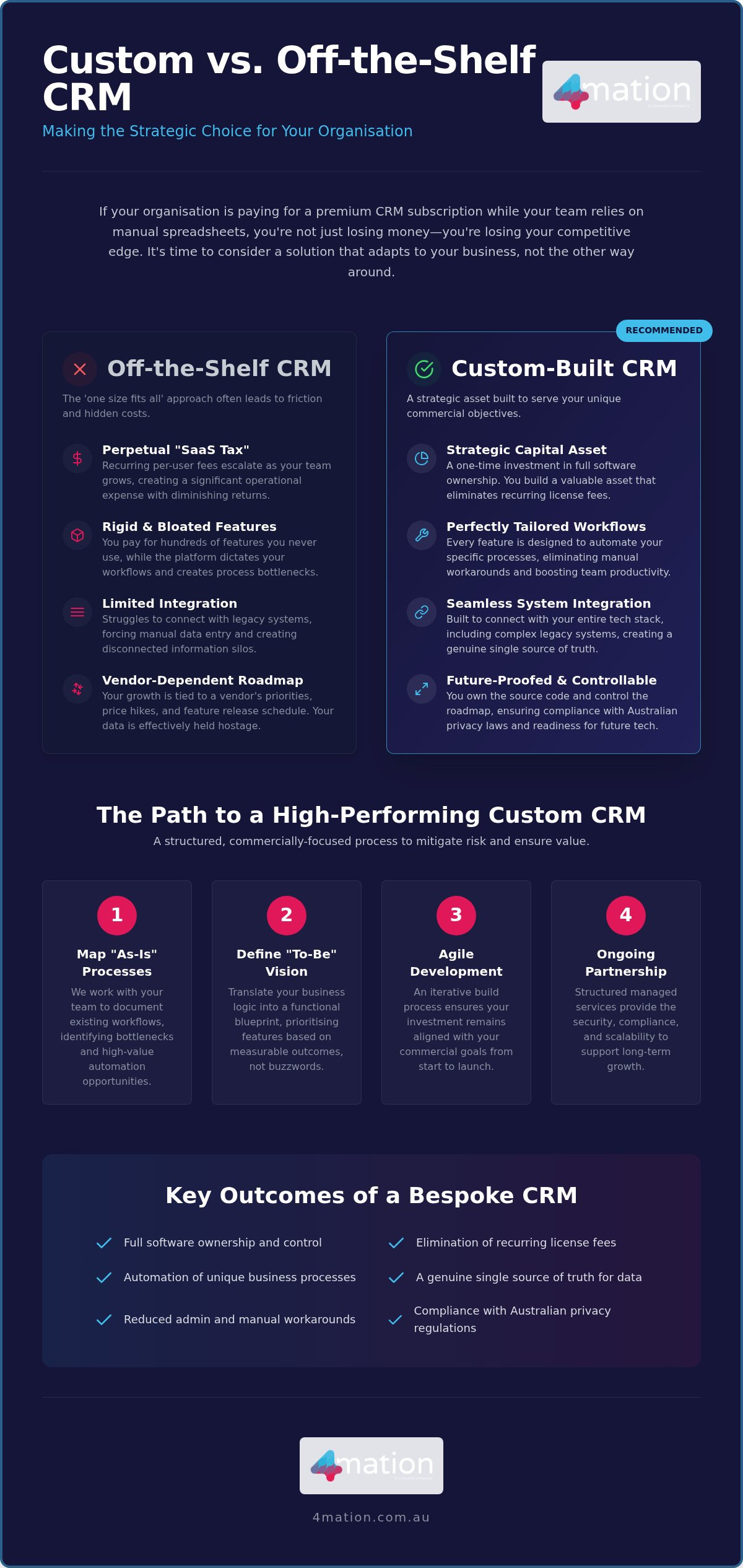
Many Australian organisations reach a point where their standard software begins to dictate their business processes. Instead of technology supporting growth, it creates friction through rigid workflows and disconnected data. When you find your team spending more time managing the software than managing customers, the system has become a hindrance. Choosing Customer Relationship Management (CRM) software that fits your specific operational DNA is a foundational strategic decision.
Custom CRM development offers a departure from the “one size fits all” model. While off-the-shelf products promise quick deployment, they often lead to a “SaaS tax” where you pay for hundreds of features your team never touches. Bespoke development ensures that every line of code serves a commercial purpose, whether that’s automating a niche industry requirement or integrating with a complex legacy system that generic platforms simply can’t talk to. This approach turns your software into a capital asset rather than a perpetual subscription cost.
Total Cost of Ownership (TCO) Analysis
Evaluating the true cost of a CRM requires looking beyond the initial setup. Off-the-shelf solutions typically rely on per-user monthly fees. As your organisation grows, these costs escalate rapidly, often without a corresponding increase in value. A custom build represents a shift from an ongoing operational expense to a strategic capital asset. By investing in your own software, you eliminate “licensing creep” and the high costs of hiring specialist consultants to “hack” a generic platform into a shape it wasn’t built for. You also save on the hidden cost of manual workarounds; every time an employee manually copies data between systems because the CRM lacks a specific integration, your bottom line takes a hit.
Scalability and Future-Proofing Your Data
Technology moves fast. By late 2026, the volume of data generated by AI agents and automated systems will require infrastructure that generic platforms may struggle to support without additional tier upgrades. Bespoke systems are built for modernisation from the ground up. Owning your source code means you aren’t at the mercy of a vendor’s roadmap or price hikes. You maintain full control over your data architecture, ensuring it remains compliant with Australian privacy regulations while being ready for the next wave of technological change. For organisations looking to build on a secure and scalable foundation, understanding custom cloud software development is an essential part of future-proofing your technology investment. This level of certainty is essential for long-term stability and operational health, particularly when supported by structured Managed Services to maintain platform performance.
How to Map Your Business Processes for a Custom CRM Build
Successful custom CRM development begins long before the first line of code is written. It starts with a deep understanding of how your organisation actually operates, rather than how a generic software vendor thinks it should. Mapping your processes ensures the final product eliminates friction instead of simply digitising it. This stage is about translating your unique business logic into a functional blueprint.
The first step involves identifying key stakeholders across sales, marketing, and operations. These are the people who feel the daily pain of fragmented data and manual workarounds. Once assembled, you must document the “as-is” process with brutal honesty. Highlight every manual touchpoint, spreadsheet workaround, and data silo that slows down your team. This audit often reveals that bottlenecks aren’t caused by a lack of effort, but by tools that don’t talk to each other.
Next, define your “to-be” state. Imagine how your team would function if technology were an enabler rather than a barrier. This vision allows you to prioritise features based on measurable business outcomes, such as reducing lead response times or improving data accuracy, rather than chasing “nice-to-have” features that add complexity without value. Following a structured Custom CRM Development Lifecycle helps keep this planning phase focused and commercially viable.
Conducting a User-Centric Discovery Phase
Internal adoption is the ultimate metric for CRM success. A discovery phase focused on User Experience (UX) design ensures the platform feels intuitive for your team from day one. We use rapid prototyping to validate workflows early, allowing users to provide feedback on a functional model before full-scale development begins. This process identifies “unmet needs”, those specific operational quirks unique to your business that off-the-shelf systems typically ignore. When users see their feedback reflected in the design, they’re far more likely to embrace the new system.
Defining Your Integration Requirements
A CRM is only as powerful as the data it can access. You need to map data flows between your CRM, accounting software, and ERP to create a single source of truth for your organisation. Relying on system integration services allows for the creation of custom APIs that facilitate seamless communication between tools. This level of connectivity ensures that when a sale is made, the information flows automatically to finance and operations without manual intervention. If you’re unsure where to start with your process mapping, our team can help you identify the highest-value opportunities for automation.
Essential Bespoke CRM Features that Drive Measurable Value
While off-the-shelf platforms provide a wide net of features, custom CRM development allows you to focus exclusively on the capabilities that move the needle for your organisation. By building specifically for your team’s needs, you ensure that every feature serves a commercial purpose rather than adding noise to the user interface. This targeted approach results in higher adoption rates and a direct impact on operational efficiency. When technology is designed around your people, it becomes a tool they want to use rather than a hurdle they have to clear.
Leveraging AI for Workflow Automation
Practical automation is where bespoke builds truly shine. We move beyond basic chatbots to implement autonomous AI agents that can handle complex, multi-step tasks without human intervention. These agents can automate repetitive data entry and provide intelligent lead scoring, allowing your sales team to focus on high-value conversations. By analysing historical data, AI can also predict customer churn and identify upsell opportunities before a human operator notices the trend. Engaging in professional AI consulting during the design phase ensures these tools are integrated into your CRM in a way that provides a genuine competitive advantage.
Data is only valuable if it’s accessible and actionable. Custom dashboards provide real-time visibility into ROI and operational health, allowing executives to make decisions based on evidence rather than intuition. These dashboards don’t just show historical data; they provide predictive insights into pipeline health. For sales teams on the road, mobile-first accessibility is non-negotiable. A bespoke CRM ensures your field representatives have the same processing power and data access on their devices as they do in the office. This eliminates the lag often found in generic mobile wrappers and allows for immediate updates after client meetings.
Custom Security and Permission Frameworks
Australian organisations face unique regulatory pressures that global SaaS providers often treat as an afterthought. Designing a custom security and permission framework allows you to create granular access controls that mirror your exact organisational structure. This ensures compliance with the Australian Privacy Act and provides certainty regarding data sovereignty. By hosting on secure, custom cloud software development environments like AWS, you gain the benefits of high-level infrastructure while maintaining full ownership of your data and its physical location. This level of control reduces delivery risk and protects your most valuable digital asset.
The Custom CRM Development Lifecycle: From Vision to Launch
Successful custom CRM development isn’t a linear path; it’s a disciplined, iterative cycle designed to mitigate delivery risk. By breaking the project into distinct, manageable phases, we ensure that the technology remains aligned with your commercial objectives at every stage. This methodical approach transforms a complex software build into a predictable business investment that delivers value from day one.
The journey begins with Strategy and Solution Design. During this phase, we align the technical roadmap with your business goals to ensure we’re building the right solution for your specific challenges. We then move into Agile Development. This phase involves iterative builds with regular feedback loops, allowing you to see the software as it’s created and make adjustments based on real-world use. This prevents the “big reveal” surprise that often leads to budget overruns in traditional development models.
Before any software reaches your team, it undergoes rigorous Testing and Quality Assurance. This ensures a bug-free experience and verifies that all custom integrations are functioning as intended. Once the platform is stable, we move to the critical stage of Data Migration, followed by structured Training and Deployment to organise a smooth rollout across the business. This end-to-end process ensures that your investment is protected and your team is ready to perform.
Managing the Data Migration Challenge
Moving information from fragmented legacy systems is often the most complex part of the lifecycle. You must clean and deduplicate your data before it enters the new environment to prevent “garbage in, garbage out” scenarios. We map old data structures to modern, scalable architectures that support future AI requirements and data volumes. If you’re concerned about the stability of your current setup, read our guide on modernising legacy applications to understand the strategic benefits of a clean transition.
Ensuring High User Adoption
Even the most advanced CRM will fail if your team refuses to use it. We recommend identifying internal “champions” early in the development process to provide ground-level insights and advocate for the new system. Their involvement helps us design intuitive interfaces that require minimal training and align with actual daily tasks. By organising structured feedback sessions during the MVP phase, we ensure the final product solves the specific bottlenecks your team faces. This collaborative approach builds trust and ensures the software becomes a foundational asset rather than an administrative burden.
Ready to map out your software roadmap? Contact our expert team today to discuss a fixed-cost delivery plan for your organisation.
Ensuring Long-Term Success with a Trusted Technology Partner
Launching your CRM is a significant milestone, but the true commercial value is realised through its longevity and evolution. A bespoke system is a living asset that must adapt as your organisation grows. Partnering with a Sydney-led team ensures real-time collaboration and clear accountability, removing the communication barriers often found with offshore vendors. This local presence allows for a deeper understanding of your specific market conditions and regulatory requirements.
Maintaining the health of your platform requires more than just reactive fixes. Utilising Managed Services provides the peace of mind that your system is being proactively monitored for performance and security. This steady hand ensures that your custom CRM development remains a reliable foundation for your operations, allowing your team to focus on growth rather than troubleshooting software issues.
Technology Insurance and Proactive Support
We view proactive support as “technology insurance” for your business-critical applications. Just as you wouldn’t leave a physical asset uninsured, your digital infrastructure requires protection against operational risk. This involves proactive monitoring and rapid incident response to ensure maximum uptime. Beyond mere maintenance, Continuous Improvement and Development cycles allow your CRM to evolve. You can roll out new features and optimisations based on user feedback, ensuring the software never becomes legacy debt.
Choosing the Right Engagement Model
Selecting the appropriate engagement model is vital for managing your budget and expectations. For many organisations, Fixed-Cost projects offer the highest level of certainty by eliminating the stress of budget overruns. Other scenarios may benefit from Agile delivery or Staff Augmentation to fill specific internal capability gaps. Our commitment to delivery certainty means we work with you to choose the model that best fits your risk profile and commercial goals. This structured approach reduces the “buyer’s remorse” often associated with large-scale technology investments.
Building a custom CRM is a strategic investment in your organisation’s future. By prioritising outcomes and long-term stability, you turn a complex technology project into a measurable business advantage. Ready to start your journey? Contact our strategic consultants today to discuss how we can build a solution that scales with your ambition.
Securing Your Competitive Advantage Through Bespoke Technology
Transitioning to a bespoke system is more than a software upgrade; it’s a strategic move to codify your organisation’s unique competitive advantage. By choosing custom CRM development, you eliminate the recurring “SaaS tax” and ensure your data architecture remains compliant with evolving Australian privacy standards. You now have a roadmap for mapping specific workflows and integrating practical AI agents that remove the manual bottlenecks stifling your team’s growth.
4mation brings 25 years of experience to every project, acting as a steady hand for organisations navigating complex digital transitions. As an Advanced Supplier in the NSW Government ICT Services Scheme, we provide the certainty of a fixed-cost, on-time, on-budget, and bug-free guarantee. This approach reduces delivery risk and ensures your technology investment delivers measurable commercial value from the outset. It’s about turning fragmented data into a scalable capital asset that grows alongside your ambition.
Discuss your custom CRM requirements with our Sydney-led team to discover how we can help you reclaim control of your operations. We’re ready to work together to build a solution that supports your team and secures your organisation’s future.
Frequently Asked Questions
How much does custom CRM development typically cost in Australia?
The investment for custom CRM development varies based on the complexity of your workflows and the number of required integrations. Instead of providing a generic estimate, we focus on a fixed-cost engagement model that provides commercial certainty from the outset. This approach eliminates the risk of budget creep often found in time and materials projects. By investing in a capital asset tailored to your organisation, you remove the perpetual “SaaS tax” associated with per-user licensing fees.
How long does it take to build a bespoke CRM from scratch?
The timeline for building a bespoke CRM depends on the scope of the project and the complexity of your existing data. Typically, a project moves through defined phases including discovery, solution design, agile development, and rigorous testing. We use iterative builds to ensure you see progress regularly rather than waiting months for a final reveal. This methodical process ensures the software is functional, secure, and ready to deliver value upon its national rollout across your business.
Can a custom CRM integrate with my existing accounting software like Xero or MYOB?
Yes, a custom CRM can integrate seamlessly with accounting platforms like Xero or MYOB through custom APIs. This connectivity ensures that financial data flows automatically between systems, reducing manual entry and improving accuracy across your organisation. By creating a single source of truth, your team gains real-time visibility into customer value and operational health. We specialise in complex system integrations that allow disparate tools to work together as a unified, high-performing ecosystem.
What are the main advantages of custom CRM over Salesforce or HubSpot?
The primary advantage is full ownership of a software asset that matches your unique business processes exactly. Unlike Salesforce or HubSpot, which often require expensive customisations or manual workarounds for niche requirements, a bespoke solution only includes the features you need. This eliminates feature bloat and simplifies the user interface, which leads to higher internal adoption rates. You also avoid rising subscription costs that don’t scale efficiently as your team and data volumes grow.
How do you handle data migration from our old legacy system?
Data migration involves a structured process of cleaning, deduplicating, and mapping your legacy information into a modern architecture. We work with you to ensure that historical customer data is preserved without loss or corruption during the transition. This critical step prevents the “garbage in, garbage out” problem that often plagues new software implementations. Our team handles the technical complexity of moving data from fragmented legacy systems into a secure, scalable environment designed for future growth.
What kind of ongoing support is required for a custom CRM?
Ongoing support for a custom CRM should include proactive monitoring, maintenance, and incident response to ensure platform health. We refer to this as “technology insurance” because it protects your business-critical applications from operational risk. A structured managed services plan also allows for continuous improvement, where the software evolves based on user feedback and changing market conditions. This ensures your technology remains a high-performing asset that supports your long-term commercial goals and stays compliant with local regulations.
Is it possible to add AI features to a custom CRM later on?
It’s entirely possible to add AI features to your custom CRM after the initial launch. We build systems using modular architectures that allow for the phased implementation of AI agents, predictive analytics, or automated lead scoring as your needs evolve. This allows you to start with a foundational tool and layer in advanced automation once your core data is centralised. It’s a practical way to modernise your operations without overcomplicating the initial build or increasing delivery risk.
How do you ensure the project stays on budget and on time?
We ensure delivery certainty through our fixed-cost, on-time, on-budget, and bug-free guarantee. By conducting a thorough discovery and solution design phase before development begins, we eliminate the ambiguity that typically leads to project delays. This methodical approach provides business leaders with the confidence that their technology investment will be delivered exactly as promised. With 25 years of experience, we’ve refined a process that prioritises accountability, transparency, and measurable outcomes for every client.
About The Author
