Third-Party Software Project Audit: 2026 Guide for Australian Organisations
4mation Technologies

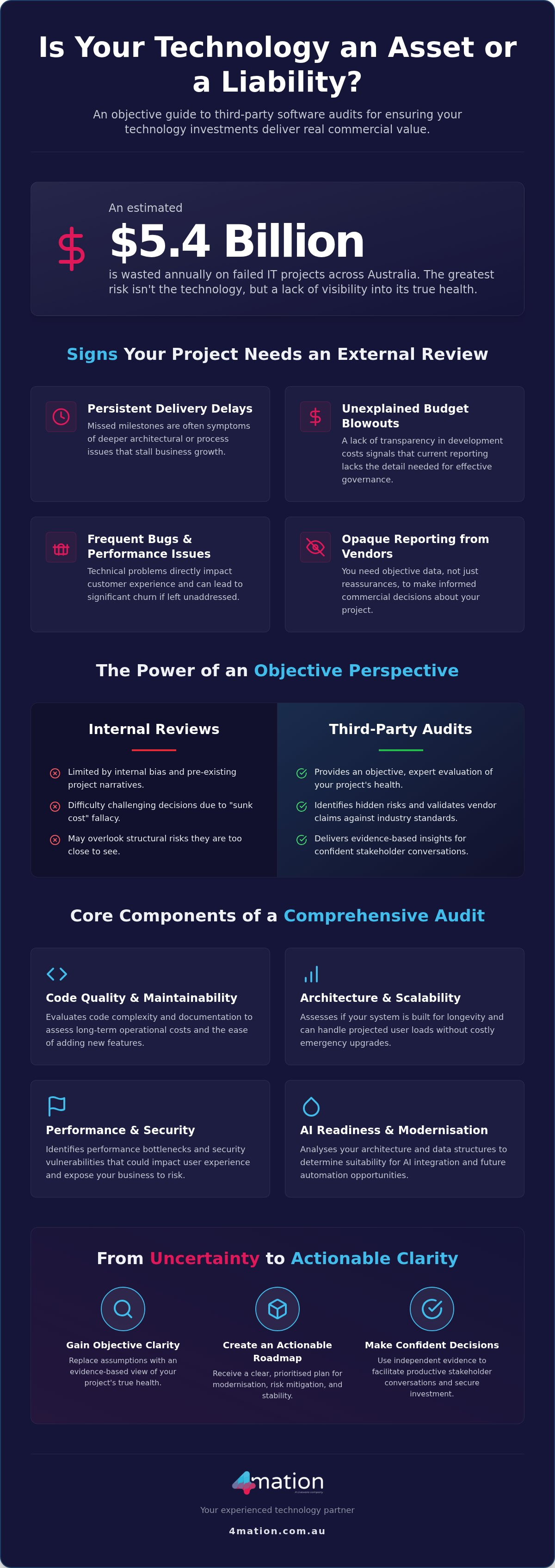
With an estimated $5.4 billion wasted annually on failed IT projects across Australia, the greatest risk to your business isn’t the technology itself, but a lack of visibility into its true health. You’ve likely felt the frustration of opaque reporting from developers or the concern that technical debt is stalling your progress. Commissioning a third party software project audit is the most effective way to replace this uncertainty with objective clarity and ensure your investments are building long-term value rather than future liabilities.
We understand that you need to know exactly where your project stands to make informed commercial decisions. This 2026 guide explains how a professional audit identifies hidden risks, recovers failing projects, and ensures your software delivers measurable results. We’ll preview the latest standards for software quality and provide a clear roadmap for modernisation, helping you turn technology from a source of anxiety into a reliable foundation for growth. By focusing on outcomes over technical jargon, we help you regain control and ensure your digital assets are ready for the challenges of a competitive market.
Key Takeaways
- Gain objective clarity on your project’s true health by identifying hidden risks that internal teams or current vendors may naturally overlook.
- Discover how a third party software project audit evaluates your technical ecosystem to ensure every technology investment aligns with your specific commercial goals.
- Learn the 4mation approach to project rescue, moving from initial discovery to a clear, actionable roadmap for modernisation and stability.
- Understand how addressing technical debt and legacy issues reduces long-term operational costs while improving your system’s scalability and security.
- Facilitate more productive stakeholder conversations through independent evidence, providing the certainty you need to make confident investment decisions.
What is a Third-Party Software Project Audit and Why is it Essential?
A third party software project audit is an objective, expert evaluation of your digital assets by a partner outside your immediate development circle. Rather than a simple code review, it’s a comprehensive diagnostic of your technology’s commercial and structural health. While your internal team or current vendor may be highly capable, they are often too close to the daily execution to identify emerging structural risks or subtle inefficiencies that could lead to project failure. Objectivity is the essential ingredient that allows for an honest assessment of whether your project is still on the right path.
The primary goal is to ensure your project aligns with your broader business objectives and provides a tangible return on investment. We often describe this as “Technology Insurance” for critical platforms. By securing an independent evaluation of conformance, you reduce the operational risk associated with large-scale custom software development investments. This process provides the certainty needed to either continue investing with confidence or pivot before more capital is wasted on a flawed trajectory.
Signs Your Organisation Needs an External Review
Recognising when to seek an external perspective is vital for maintaining momentum. Persistent delivery delays and missed milestones are rarely just minor scheduling errors; they are often symptoms of deeper architectural or process issues that stall business growth. If you’re experiencing unexplained budget blowouts or a lack of transparency regarding development hours, it’s a clear signal that your current reporting lacks the detail required for effective governance. Frequent bugs and performance issues don’t just frustrate your team; they directly impact customer experience and can lead to significant churn if left unaddressed.
The Strategic Advantage of Third-Party Objectivity
An external audit removes the internal bias and “sunk cost” fallacies that frequently cloud decision-making. When an organisation has invested heavily in a specific direction, it can be difficult for internal stakeholders to admit that a change is necessary. A third party software project audit provides a fresh perspective on legacy modernisation and technical debt, identifying where your current stack might be holding you back. This external lens is also invaluable for validating vendor claims against industry standards. It ensures that the technical reality of your project matches the promises made during the procurement phase, protecting your interests and ensuring long-term stability.
The Core Components of a Comprehensive Technical Audit in 2026
A modern software ecosystem is more than just lines of code; it’s a complex network of integrations, data pipelines, and infrastructure. Consequently, a third party software project audit in 2026 must look beyond syntax to evaluate how every component contributes to your commercial success. We focus on the entire development lifecycle, ensuring your processes are as robust as the technical output they produce. This holistic view allows us to identify where your technology is supporting your goals and where it might be creating hidden liabilities.
Code Quality, Architecture, and Performance
Many organisations want to adopt emerging technologies but lack the foundational data structures to do so effectively. We analyse your existing architecture to determine its suitability for AI consulting services and seamless integration. This involves identifying specific opportunities for automation through AI agents that can reduce manual processing and improve accuracy. We assess if your current tech stack supports generative AI capabilities, ensuring your software remains a competitive asset rather than a legacy burden. If you’re unsure if your system is ready for these advancements, it’s often helpful to discuss your specific requirements with a technical partner.
Security, Risk, and Compliance
Relying on internal teams to assess their own work is a common management trap that often leads to “marking your own homework.” While your developers are undoubtedly talented, they’re frequently constrained by daily delivery pressures and the natural bias that comes with being close to a project. A third party software project audit introduces a level of impartiality that internal reviews simply cannot replicate. It transforms “uncomfortable conversations” with current vendors from subjective arguments into data-driven discussions. By using an external partner, you gain a clear, evidence-based view of project health, which facilitates better outcomes for all stakeholders involved.
We position ourselves as a consultative partner rather than a critic. Our objective is to provide a “safe pair of hands” for your mission-critical systems, ensuring that any transition or modernisation effort is handled with professional discipline. We work together with your leadership team to identify the most efficient path forward. This ensures your technology investments are protected and aligned with your long-term commercial strategy. This collaborative approach ensures that the audit results in a roadmap you can actually execute, rather than a list of technical complaints.
The Limitations of Self-Auditing
Internal teams often lack the specialised tools and dedicated time required for a truly deep-dive audit. When developers are focused on meeting the next milestone, they may overlook systemic issues or architectural flaws that aren’t immediately visible. Familiarity with legacy systems can also create significant blind spots. Because the team has worked with the system for years, they might accept workarounds or inefficiencies as “just how it works,” missing critical opportunities for modernisation. An external auditor doesn’t have these biases, allowing them to see the project as it truly is.
Choosing the Right Audit Partner
Selecting the right partner is critical for a successful outcome. You should look for an organisation with a proven track record in software project rescue services and a deep understanding of the Australian business environment. It’s not enough to have technical expertise; your partner must be able to translate complex technical findings into clear business value. They should offer a stable delivery history and local presence, ensuring they understand the specific regulatory and commercial challenges your organisation faces. Choosing a partner with 25 years of experience provides the certainty that your audit will result in a practical, achievable roadmap for success.
Navigating the Audit Process: From Initial Assessment to Project Rescue
A third party software project audit shouldn’t be a black-box exercise that leaves you with more questions than answers. We follow a disciplined, four-stage approach designed to provide maximum transparency and actionable intelligence. By working together with your existing stakeholders, we ensure the findings reflect the commercial reality of your operations. Our process categorises every discovery into Critical, Strategic, or Optimisation priorities. This allows you to address immediate stability risks first while planning for long-term growth. If the audit reveals that a project is fundamentally failing, we provide a clear transition path into our rescue services to protect your investment.
Step 1: Discovery and Strategic Alignment
We start by defining the specific business problems your software is intended to solve. Without this strategic alignment, a technical review lacks context. We set clear KPIs for the audit to ensure the outcomes are measurable and relevant to your bottom line. During this phase, we gather existing documentation and secure access to your codebase and infrastructure. This collaborative start ensures we have a complete picture of your technology stack before the deep-dive begins.
Step 2: Technical Deep-Dive and Analysis
Our team conducts a rigorous technical analysis using both automated tools and manual code reviews. This identifies technical debt that might be slowing down your delivery or increasing maintenance costs. We also assess your infrastructure and cloud environment to identify opportunities for cost reduction and performance improvements. By reviewing your development workflow and team velocity, we provide an objective view of how efficiently your project is being delivered. This evidence-based approach removes guesswork from your decision-making process.
Step 3: Actionable Roadmap and Rescue Strategy
The final stage delivers a plain-English report that translates technical findings into business consequences. We provide an actionable roadmap that non-technical executives can use to drive strategic change. For projects requiring urgent remediation, we offer a fixed-cost project proposal to provide budget certainty during the rescue phase. This leads naturally into a model of continuous improvement and development, ensuring your software remains a high-performing asset. If you need clarity on your project’s current status, you can request a confidential assessment to begin the process.
Maximising ROI: How 4mation Translates Audit Findings into Business Outcomes
The true value of a third party software project audit is found in the commercial transformation that occurs after the initial assessment. We’ve spent 25 years helping Australian organisations turn technical challenges into high-performing strategic assets. By translating complex findings into a clear execution plan, we ensure your technology investments deliver measurable business value rather than just ongoing maintenance costs. Our goal is to provide you with the certainty that your software can support your growth objectives without the threat of technical debt dragging down your margins. This outcome-oriented approach makes technology investment feel less risky and more like a foundational business asset.
Once the audit and any necessary rescue phases are complete, maintaining that peak performance is vital for long-term ROI. Our service desk model acts as a form of technology insurance, providing the ongoing support and maintenance required to prevent the re-accumulation of technical debt. This proactive approach ensures that the clarity gained during the audit is sustained over the long term, protecting your capital and operational efficiency. We work together with your team to ensure that every update or enhancement aligns with your broader commercial goals, providing a steady hand in a complex technical environment.
Reducing Risk and Ambiguity in Delivery
A well-defined technical roadmap is your best defence against future budget blowouts. We work with you to ensure your software is secure, stable, and architected for future scaling. By choosing a predictable, Australian development partner, you gain access to local expertise that understands the nuances of the domestic market. This partnership reduces the ambiguity often associated with large-scale projects, allowing your leadership team to focus on core business strategy rather than troubleshooting software failures. We provide the professional discipline needed to turn a stagnant project into a reliable engine for growth, ensuring your roadmap is both achievable and valuable.
Modernising for the AI-Enabled Future
Modernisation is no longer just about fixing bugs; it’s about preparing your organisation for the next decade of digital innovation. We help you move beyond legacy constraints through AI workplace modernisation, transforming your data from a static liability into a competitive advantage. A successful third party software project audit identifies exactly where your current systems are falling short of modern standards and where automation can deliver the most impact. Together, we can build a technical foundation that supports generative AI and automated workflows. This forward-thinking approach ensures your business remains at the forefront of your industry while reducing long-term costs.
Securing Your Technology Investment for the Decade Ahead
A third party software project audit provides the objective clarity needed to protect your capital and ensure long-term operational stability. By identifying hidden risks and addressing technical debt now, you avoid the high cost of future budget blowouts and project failure. We’ve spent 25 years providing Australian organisations with delivery certainty, ensuring that technology remains a scalable asset rather than a source of frustration.
As an Advanced Supplier in the NSW Government ICT Services Scheme, 4mation brings the methodical discipline required for complex modernisation. Our fixed-cost, on-time, and bug-free guarantee for rescue projects provides the commercial confidence you need to move forward. We’re ready to work with you to turn your current technical challenges into strategic opportunities. This partnership ensures your digital assets are not only stable but also ready for the advancements in AI and automation that define the current market.
Request a Consultative Software Audit from 4mation to regain control of your digital roadmap. We look forward to helping you build a more certain and successful future for your organisation.
Frequently Asked Questions
How long does a third-party software project audit typically take?
A third party software project audit typically takes between two and four weeks to complete, depending on the complexity of your system and the depth of documentation available. We focus on delivering rapid clarity so you can make informed commercial decisions without delay. Our structured process ensures we gather the necessary data efficiently, allowing our specialists to provide a comprehensive report and actionable roadmap within a timeframe that respects your project’s momentum.
Will an external audit disrupt my current development team?
No, an external audit is designed to be a collaborative and minimally invasive process that doesn’t halt your daily operations. We work together with your existing developers to gather technical context through brief, structured interviews and codebase access. Our goal is to provide a fresh perspective that supports your team’s success, rather than creating friction. This objective evaluation often helps internal teams by identifying blockers that have been stalling their delivery progress.
What is the difference between a code audit and a project rescue?
A code audit is a diagnostic evaluation used to identify technical debt, security risks, and architectural flaws within your software. In contrast, a project rescue is the subsequent remediation phase where we take active steps to stabilise and recover a failing project. While a third party software project audit provides the evidence-based roadmap, the rescue phase focuses on executing that plan to deliver a functional, high-quality solution that aligns with your business goals.
Can a software audit help reduce our ongoing maintenance costs?
Yes, an audit identifies the specific technical debt and architectural inefficiencies that drive up your long-term operational costs. By modernising these components, you reduce the time and resources required for ongoing bug fixes and manual workarounds. We help you transition to a model of continuous improvement, where your technology investment is focused on building new value rather than simply maintaining a fragile legacy system; ultimately improving your bottom line and operational efficiency.
How much does a third-party software audit cost for an Australian business?
The cost of an audit is determined by the scope of your system and the specific commercial objectives you need to meet. We provide tailored proposals after an initial consultation to ensure the audit’s depth matches your requirements. While we don’t offer a one-size-fits-all price, we focus on delivering a high return on investment by identifying risks that could otherwise lead to significant budget blowouts or serious regulatory penalties for your organisation.
What happens if the audit reveals that the project cannot be saved?
If an audit reveals that a project is technically or commercially unviable, we provide an honest assessment to prevent further wasted investment. We’ll work with you to outline a clear path forward, which may involve rebuilding core components or migrating to a more stable architecture. Our priority is your long-term business success; we’ll help you make the difficult but necessary decisions required to secure a reliable and scalable technical foundation.
Do you provide audits for legacy systems that need AI integration?
Yes, we specialise in AI modernisation for legacy systems that need to remain competitive in a changing market. Our audit evaluates your existing data structures and architecture to determine their readiness for AI integration. We identify practical opportunities to implement AI agents and automated workflows that can reduce manual processing. This ensures your legacy assets are transformed into modern platforms capable of supporting the next decade of digital innovation and commercial growth.
How do we get started with a software project audit at 4mation?
Getting started is a straightforward process that begins with a confidential consultation to discuss your current challenges and goals. We’ll outline how our 25 years of experience can provide the certainty you need for your software project. From there, we define the audit’s scope and KPIs together, ensuring you have a clear understanding of the outcomes we’ll deliver. You can reach out to our Australian team today to begin the process.
About The Author
