IP Ownership in Custom Software: Australian Guide
Jowena BorralDigital Marketing Specialist

What if the custom software platform powering your entire operation isn’t actually an asset you own? It’s a sobering question that many Australian executives only face when they attempt to switch providers or prepare for a business sale. While you’re paying for the build, the default legal position in Australia often favours the creator; this means that without the right contractual framework, you could find yourself held hostage by vendor lock-in. Understanding intellectual property ownership in custom software development is essential for protecting your long-term business valuation and ensuring your technology remains a genuine proprietary asset.
We understand the anxiety that comes with navigating complex legalities while trying to drive digital transformation. You deserve full control over the tools that run your business. In this guide, we’ll clarify the confusion between Background IP and Project IP, and provide a clear framework for securing your rights. You’ll discover how to structure IP clauses that safeguard your assets against third-party infringement and ensure your software remains a strength on your balance sheet rather than a liability.
Key Takeaways
- Distinguish between Background and Project IP to ensure your software is correctly recorded as a proprietary asset on your balance sheet.
- Secure full intellectual property ownership in custom software development through assignment clauses that prevent vendor lock-in and protect your commercial freedom.
- Mitigate legal risks by ensuring your contracts address moral rights and avoid restrictive “exclusive licence” traps that limit your future options.
- Maintain technical sovereignty by requiring all source code to be hosted in your own repositories from the start of the project.
- Utilise a fixed-cost delivery model to achieve absolute clarity on ownership and deliverables, turning technology into a secure and measurable business investment.
Understanding Software IP: Why Ownership is a Critical Business Asset
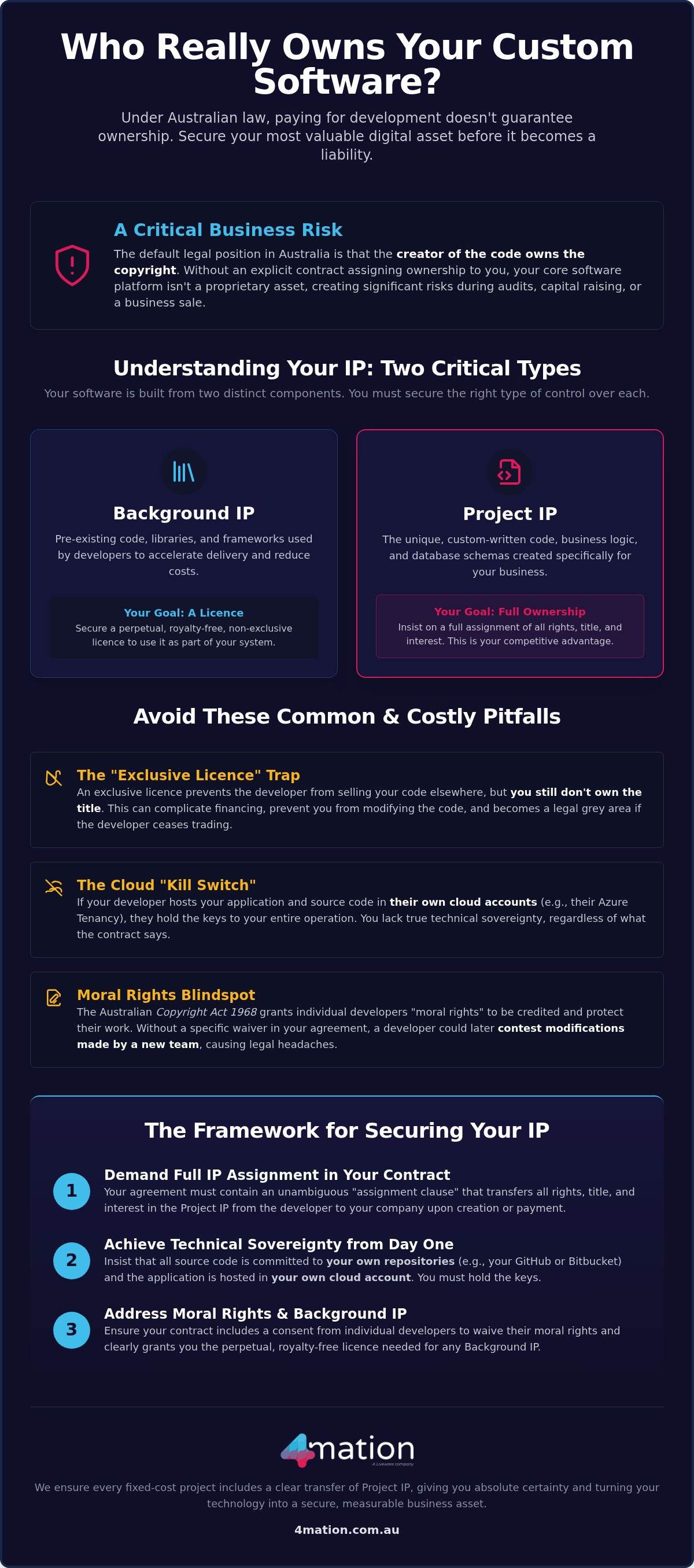
Many Australian business leaders mistakenly believe that paying a developer’s invoice automatically transfers ownership of the code. This assumption is a significant commercial risk. Under the Copyright Act 1968, the default position is that the author of the code owns the copyright. Unless your agreement explicitly states otherwise, you’re essentially renting your own software. Securing intellectual property ownership in custom software development is not a legal formality; it’s a foundational step in building a scalable business. Without it, you lack the technical sovereignty required to pivot, scale, or eventually sell your organisation.
Unclear IP rights frequently surface at the worst possible time, such as during a capital raise or a merger. Investors and auditors perform rigorous due diligence, looking for tangible proof that you own the assets you claim to. If a potential buyer finds that your core platform relies on code you don’t legally own, they see a massive liability. They won’t just lower their offer; they might walk away entirely because they cannot be certain they won’t face litigation or be forced to pay a third party for the right to continue operating.
Background IP vs. Project IP: Knowing the Difference
Experienced developers rarely build every component from scratch. They use pre-existing libraries and frameworks to accelerate delivery and reduce costs. This is known as Background IP. While it’s impractical to own the underlying frameworks, you must secure a perpetual, royalty-free licence to use them. Conversely, Project IP refers to the unique code, business logic, and database schemas created specifically for your requirements. This unique logic is what differentiates your business, and you must insist on full ownership of these assets to avoid being held hostage by a single vendor.
The Impact of IP on Business Valuation
Auditors categorise software as an intangible asset that must be clearly documented to appear on your balance sheet. Software copyright law treats code as a literary work, and without a clear chain of title, your business is built on borrowed ground. Intellectual property is a transferable asset that increases enterprise value by ensuring your technology can be audited, moved, or sold without external interference.
Failing to secure these rights also creates a specific type of technical debt. If you don’t own the code, you often don’t have the legal right to modify it, which prevents you from modernising your systems as your needs change. We work with you to ensure every fixed-cost project includes a clear transfer of Project IP, giving you the control needed for long-term growth and total certainty over your intellectual property ownership in custom software development.
Common Pitfalls in Australian Software Agreements
Securing clear intellectual property ownership in custom software development requires more than just a signature on a master services agreement. Many businesses fall into the trap of accepting an “exclusive licence” rather than a full assignment of rights. On paper, an exclusive licence sounds robust because it prevents the developer from selling your code to others. However, you don’t actually own the title to the software. This distinction becomes critical if you ever need to use the code as collateral for financing or if the development agency ceases trading, potentially leaving your “licence” in a legal grey area.
Another frequent oversight involves technical control, specifically the “Azure Tenancy” or cloud hosting problem. If your developer insists on hosting your application within their own cloud environment, you lack true technical sovereignty. Even if you legally own the code, they hold the “kill switch” to your entire operation. We always recommend that our clients maintain their own cloud accounts and code repositories. This ensures that you have the keys to the digital kingdom from day one, providing a level of security that a contract alone cannot offer.
Moral Rights and the Australian Copyright Act
In Australia, the Copyright Act 1968 grants individual creators “moral rights” regardless of who owns the economic copyright. These include the right to be attributed as the author and the right to protect the work from “derogatory treatment.” For a business, these rights can be problematic if an individual developer decides to contest how their code is being modified by a new team. A professional software agreement must include a comprehensive Moral Rights Waiver. At 4mation, we ensure all our engineers and contractors sign rigorous IP assignments and waivers, protecting your project from these personal legal claims.
The Risk of Vendor Lock-in
Vendor lock-in often starts with poorly defined IP clauses. If a dispute occurs and the developer refuses to hand over the latest source code, your business effectively grinds to a halt. The cost of “Project Rescue” in these scenarios is high because a new partner must often reverse-engineer the platform without the original documentation. You can avoid this by structuring clear exit clauses and ensuring regular code deliveries to your own repositories. If you’re unsure about the status of your current agreements, we can help you audit your technical assets to identify and mitigate these risks before they escalate.
Managing the “hidden” IP within your software is equally important. Most modern applications rely on third-party libraries and Open Source components. While you won’t own these specific elements, your contract must guarantee that the developer has the right to use them and that they don’t impose restrictive licences that could compromise your proprietary code. Transparency is the only way to ensure your software remains a clean, transferable asset.
Comparing IP Ownership Models: Which is Right for You?
Choosing the right ownership model is a strategic decision that depends on how central the software is to your value proposition. Not every line of code needs to be owned outright, but your core business logic certainly does. Clear intellectual property ownership in custom software development ensures that your most valuable digital assets are protected, transferable, and ready for future growth or exit. The model you select will dictate your long-term flexibility and the ultimate valuation of your business.
Full IP Assignment: The Gold Standard for Custom Build
For software that provides a competitive advantage, full IP assignment is the only logical choice. Under this model, you own everything created specifically for your project. This includes the source code, database structures, and unique algorithms. It provides total independence from your developer and ensures the asset sits cleanly on your balance sheet. We recommend this model for any bespoke platform where you need the freedom to scale, modify, or sell the technology without seeking third-party permission. You can see how this approach has empowered our clients by exploring our case studies.
Other models like exclusive licences or shared ownership carry inherent risks. An exclusive licence gives you the sole right to use the software but leaves the title with the developer. Shared ownership is even more complex; it often leads to legal ambiguity regarding who can commercialise the code. While SaaS or off-the-shelf solutions are excellent for non-core utilities like payroll or email, they offer zero IP ownership. This is acceptable for standard business functions, but it’s a dangerous path for your primary revenue-generating platforms.
The Nuances of AI and IP in 2026
As of 2026, the intersection of AI and software development has introduced new legal layers. Australian courts have affirmed that an inventor or author must be a natural person; this means purely AI-generated code cannot be copyrighted. To protect your investment, your development partner must ensure that human oversight is integrated into every stage of the build. This guarantees that the final product meets the legal threshold for copyright protection under the Copyright Act 1968.
Distinguishing between training data and the resulting model is also vital. While you may own the data used to train an AI, owning the model itself requires specific contractual language. We provide expert AI consulting and implementation to help you navigate these complexities. Together, we ensure your AI assets are legally sound and commercially secure, providing a clear framework for intellectual property ownership in custom software development that accounts for modern technical realities.
Beyond the Contract: Securing Technical Sovereignty
Legal ownership is often a paper tiger if it isn’t backed by practical control. While an airtight contract establishes your rights, technical sovereignty ensures you can actually exercise them. Many organisations discover too late that while they legally own their software, they lack the “keys” to the digital kingdom. This creates a functional dependency on a single vendor that is difficult and expensive to break. Securing intellectual property ownership in custom software development requires a proactive approach to infrastructure and asset management from the very first day of the project.
Possession is a vital part of protection. Your source code should never live exclusively on a developer’s private server. It must reside in a repository owned by your organisation, such as GitHub or Bitbucket. This gives you a complete “commit history,” which is a chronological record of every change made to the system. This history is essential for security audits and ensures that if you ever need to move to a new partner, they can understand the evolution of the code without starting from scratch. We work with you to establish these accounts early, ensuring your assets are always within your reach.
Establishing Technical Control from Day One
True sovereignty means having administrative access to every environment where your software runs. This includes your cloud hosting accounts, such as AWS or Azure, and any third-party APIs your platform relies on. We prioritise a transparent handover process that empowers your internal team. This isn’t just about handing over a zip file of code; it’s about providing the architecture diagrams, deployment scripts, and database schemas that make the code usable. Without this “soft” IP, the raw source code loses much of its commercial value.
The Role of Technology Insurance and Support
Software is a living asset that requires constant attention to maintain its value. Engaging in managed services and support acts as a form of technology insurance for your IP. These services provide proactive monitoring and regular audits of third-party dependencies. Because modern software is often a mosaic of custom code and open-source libraries, these audits ensure that your proprietary logic remains secure and functional as external standards change. This disciplined maintenance prevents your software from becoming a legacy liability.
If you’re unsure whether you have full control over your current digital assets, we can help you identify any gaps in your technical governance. You can contact us for a technical audit to ensure your intellectual property ownership in custom software development is supported by real-world technical sovereignty. Together, we can ensure your technology remains a secure, scalable, and fully portable asset for your business.
Ensuring IP Certainty with 4mation’s Delivery Model
Choosing a technology partner is as much about legal security as it is about technical capability. With 25 years of experience as a Sydney-led agency, we understand that long-term business stability relies on undisputed asset ownership. A vendor that lacks a disciplined delivery process can leave you with a fragmented trail of rights and permissions. We eliminate this risk by providing a structured framework that guarantees intellectual property ownership in custom software development is transferred to you clearly and completely. Our longevity in the Australian market offers the reassurance that your partner will be here to support your technical sovereignty for years to come.
The Fixed-Cost Guarantee: Outcomes You Can Own
Ambiguity is the enemy of ownership. In many agile or time-and-materials engagements, the lack of a defined endpoint can make it difficult to determine exactly when IP is assigned. Our Fixed-Cost projects solve this problem by tying IP transfer to specific, measurable milestones. When we define a project’s scope, we also define the deliverables you will own. This model ensures your project is delivered on-time and bug-free, while providing a legally secure transition of Project IP upon completion. This approach allows Australian organisations to solve complex operational problems without the fear of budget blowouts or ownership disputes.
We also take a pragmatic approach to Background IP. While we use established libraries to ensure your build is efficient and cost-effective, we provide a perpetual, royalty-free licence for these components. You get the benefit of rapid development without being tied to ongoing licensing fees or restrictive vendor dependencies. This ensures your unique business logic remains your own, giving you the flexibility to move, modify, or scale your platform as your strategy evolves.
Next Steps for Your Custom Software Project
Securing your digital future begins with a clear understanding of your current position. We recommend auditing your existing software agreements to identify any gaps in repository access, cloud tenancy, or moral rights waivers. If you find that your assets are not as secure as they should be, a consultation with an experienced partner is the most effective way to remediate these risks. We work with you to modernise legacy systems and implement practical AI solutions while ensuring every line of code adds value to your balance sheet.
Protecting your long-term valuation requires a partner who values transparency as much as you do. Contact 4mation today to discuss your project with our experienced team. Together, we can establish a clear roadmap for your next build, ensuring you achieve total certainty over your intellectual property ownership in custom software development and maintain full control over your digital assets.
Securing Your Technical Future and Business Valuation
Securing full intellectual property ownership in custom software development is a strategic necessity that protects your business from vendor lock-in and increases your enterprise value. By distinguishing between Project IP and Background IP, and maintaining control over your own code repositories and cloud environments, you ensure that your technology remains a portable, proprietary asset. A legally sound framework, combined with practical technical sovereignty, provides the foundation needed for long-term growth and successful commercial exits.
As an Advanced Supplier in the NSW Government ICT Services Scheme with 25 years of experience, we provide a stable and disciplined approach to software delivery. Our Fixed-Cost model offers an on-time and bug-free guarantee, ensuring you receive a high-quality solution with clear ownership milestones. We work with you to eliminate technical ambiguity and turn your software into a secure pillar of your organisation’s success. If you’re ready to build a platform you truly own, discuss your custom software project and IP requirements with our experts today. Together, we can create a solution that drives measurable results and long-term commercial certainty.
Frequently Asked Questions
Who owns the code if I hire an Australian software development agency?
Under the Copyright Act 1968, the author of the code is the default owner of the copyright. This means the agency owns the software unless your contract explicitly transfers those rights to you. We ensure that intellectual property ownership in custom software development is fully assigned to our clients upon project completion. This transfer includes all unique source code and business logic, ensuring your technology is a proprietary asset on your balance sheet.
Can a developer reuse the code they wrote for my project for another client?
If you have secured full ownership of the Project IP, the developer cannot legally reuse your unique business logic for other clients. They can, however, reuse their Background IP, which includes generic libraries or pre-existing frameworks. Clear contractual definitions are vital to prevent competitors from benefiting from the bespoke features you’ve funded. We prioritise this distinction to protect your competitive advantage and ensure your proprietary tools remain exclusive to your organisation.
What is the difference between Background IP and Project IP?
Background IP consists of the pre-existing tools and libraries a developer uses to accelerate your build. You typically receive a perpetual, royalty-free licence to use these components. Project IP is the unique code and architecture built specifically for your requirements. While the developer retains their Background IP for use with other clients, you should insist on full ownership of the Project IP to maintain technical sovereignty and long-term commercial control over your platform.
Do I need a specific clause for AI-generated code in my contract?
Yes, as of 2026, contracts should specifically address AI-generated components. Since Australian law requires a human author for copyright protection, you need a clause that ensures human oversight of any AI-generated code. This guarantees that your intellectual property ownership in custom software development is legally enforceable. We ensure all AI-assisted development is human-verified and correctly assigned to you, so your assets meet the legal threshold for copyright protection.
What happens to my IP if the software development company goes out of business?
Your protection depends on where the code is hosted. If the developer holds the only copy in their own repository, you face significant risk if they cease trading. If you maintain technical sovereignty by hosting the code in your own GitHub or Bitbucket account, you retain full access regardless of the developer’s status. This is why we insist on setting up your own repositories from day one, providing a safe pair of hands for your assets.
What are “Moral Rights” and why do I need a waiver for them?
Moral rights are personal legal rights held by individual creators, such as the right to be attributed as the author. These rights cannot be transferred, only waived. Without a written waiver, an individual programmer could theoretically object to future modifications of their work. We ensure that all our staff and contractors sign comprehensive waivers. This allows you to modify and evolve your software without legal interference or veto power from the original individual creators.
Is it possible to have shared IP ownership in a custom software project?
Shared ownership is possible but often leads to commercial and legal complications. It can create ambiguity regarding who has the right to sell, license, or modify the code in the future. For most organisations, a full assignment of Project IP is a much cleaner model. It provides the certainty needed for business valuations and future capital raises. We generally recommend avoiding shared models in favour of clear, undisputed ownership of your unique technology.
How do I ensure I own my cloud infrastructure and not the developer?
You must establish your own AWS, Azure, or Google Cloud tenancy in your company’s legal name. You then grant the developer administrative or contributor access to build the platform. This ensures you always hold the master keys to your infrastructure. If the developer manages the account under their own name, you lose technical control and face vendor lock-in. Maintaining your own tenancy is a non-negotiable step for true technical sovereignty and security.
About The Author
