Custom Cloud Software Development: A 2026 Strategic Reference for Australian Organisations
4mation Technologies

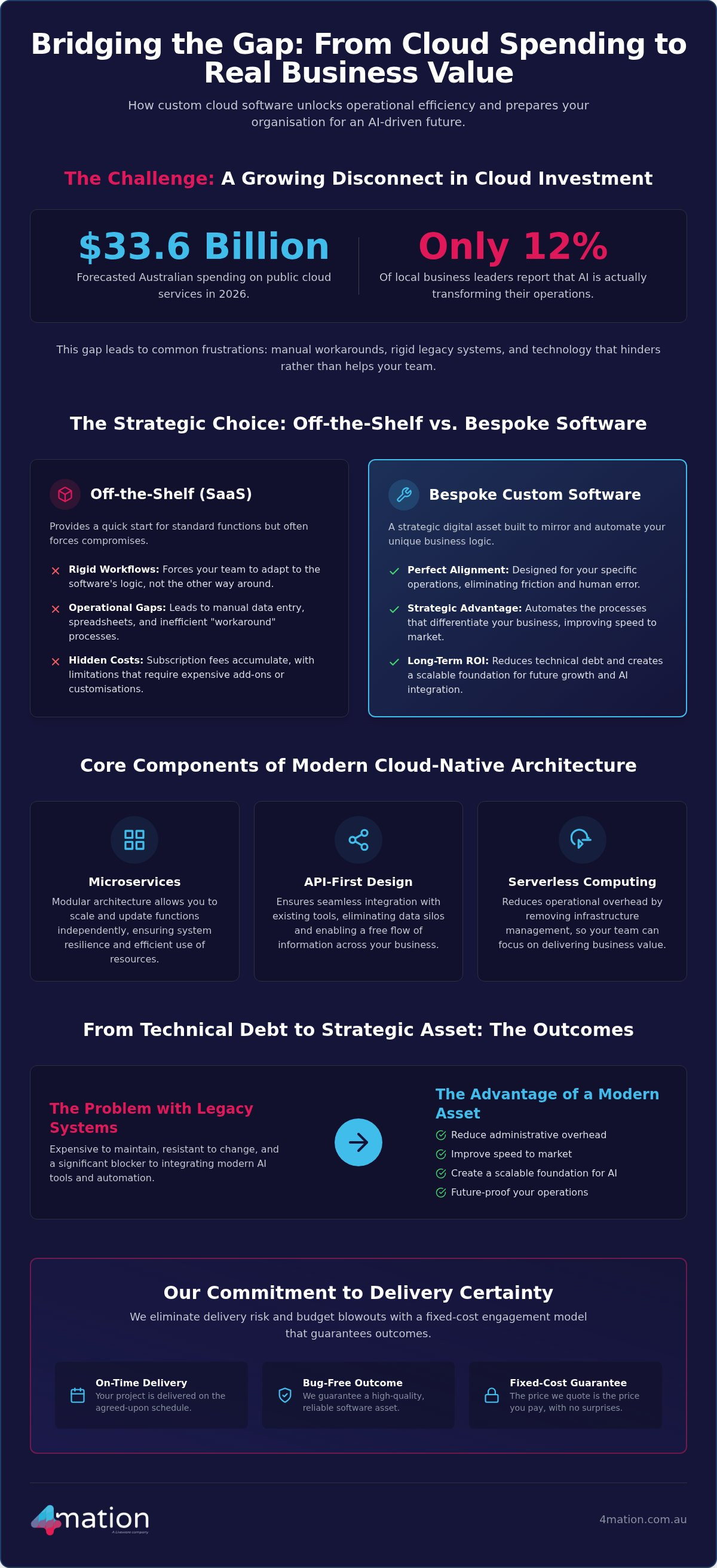
While Australian organisations are forecast to spend over $33.6 billion on public cloud services in 2026, only 12% of local business leaders report that AI is actually transforming their operations. You’ve likely felt this disconnect firsthand. It’s frustrating to invest in modern infrastructure only to find your team still hampered by manual workarounds and rigid legacy systems that simply won’t scale. You need technology that works for your specific business logic, not the other way around.
This strategic reference explains how custom cloud software development bridges the gap between high-level investment and tangible operational efficiency. We’ll show you how bespoke, cloud-native applications can automate your most complex workflows and provide the secure foundation necessary for practical AI integration. Together, we’ll explore a roadmap for digital transformation that prioritises delivery certainty and fixed costs. You’ll learn how to move beyond the anxiety of shifting regulations and technical debt to build a scalable platform that creates measurable value for your organisation’s future.
Key Takeaways
- Identify why bespoke software assets provide a strategic advantage over standard SaaS by aligning perfectly with your specific operational workflows.
- Learn how to evaluate the long-term ROI of custom cloud software development compared to the hidden costs and limitations of off-the-shelf subscriptions.
- Discover how to eliminate delivery risk and budget blowouts using a fixed-cost engagement model that guarantees an on-time, bug-free outcome.
- Understand the architectural requirements for AI readiness, moving beyond simple automation to create a scalable foundation for autonomous business agents.
- Recognise how cloud-native components like microservices ensure your software remains flexible and easier to maintain as your organisation grows.
The Strategic Role of Custom Cloud Software in 2026
In 2026, custom cloud software development isn’t just about moving applications to the internet. It represents a strategic shift toward building bespoke digital assets that mirror your unique business logic. While off-the-shelf SaaS provides a quick start for standard functions like payroll or basic CRM, it often forces your team into rigid workflows that don’t quite fit your operational reality. Custom platforms allow you to differentiate your service by automating the specific processes that make your organisation unique. By applying fundamental cloud computing principles, we help you build a foundation that scales with your commercial ambitions rather than limiting them.
Solving Operational Friction with Bespoke Logic
Standard software often leaves gaps in your processes. Your team likely fills these gaps with manual data entry, complex spreadsheets, or “workaround” emails. This friction wastes valuable time and introduces significant human error. Bespoke logic removes these hurdles by creating data structures and user journeys designed specifically for your operations. We’ve seen this impact firsthand in our case studies with organisations like Ego Pharmaceuticals and Load & Go. By replacing manual bottlenecks with automated, cloud-native workflows, these businesses regained control over their data and improved their speed to market. When your software reflects your actual business rules, you reduce administrative overhead and allow your staff to focus on higher-value tasks.
Reducing Technical Debt through Modernisation
Legacy systems are often the biggest blocker to growth for Australian companies. These monolithic applications are expensive to maintain and difficult to integrate with modern AI tools. Transitioning to an agile cloud environment allows you to break down these barriers. It’s about moving from a “maintenance-first” mindset to an “innovation-first” approach. If you’re still running on outdated infrastructure, you’re likely accumulating technical debt that will eventually stall your operations. Understanding the risks of not modernising legacy systems is essential for any leader planning for 2026. Together, we can transform these liabilities into scalable assets that support long-term stability and measurable success. This transition ensures your technology remains a foundational business asset rather than a growing cost centre.
Core Components of Modern Cloud-Native Architecture
API-first design is another essential pillar of modern custom cloud software development. It ensures your new platform doesn’t become an isolated island. Instead, it integrates seamlessly with your existing business tools, allowing data to flow freely between systems. This connectivity eliminates the data silos that often lead to manual reporting and administrative errors. When your systems speak the same language, you gain a clearer view of your operations and can make decisions based on real-time evidence.
Microservices are independent functional units that communicate via APIs. This modular architecture is a significant departure from older monolithic systems where a single bug could bring down the entire platform. By decoupling your software’s functions, you gain the ability to scale different parts of the business independently. For instance, if your customer-facing portal experiences high traffic but your backend reporting doesn’t, you only scale the portal. This precision prevents total system failure and ensures your technology investment is used efficiently. It allows for modular growth, meaning you can update one feature without risking the stability of the entire system.
Security and Resilience in the Cloud
Protecting your commercial data is non-negotiable. As an AWS Select Consulting Partner, we leverage enterprise-grade security protocols to ensure your information remains protected and compliant with Australian standards. Resilience isn’t just about building a strong wall; it’s about proactive monitoring to catch issues before they impact your customers. We view service desk and proactive maintenance as a form of Technology Insurance that maintains uptime and preserves your brand’s reputation. This methodical approach ensures that your software remains a reliable asset that your team can trust every day.
If you’re unsure whether your current architecture can support your 2026 growth targets, we can help you review your technical roadmap to ensure it’s fit for purpose.
Build vs Buy: Evaluating the ROI of Custom Development
Deciding whether to subscribe to a service or build your own is a critical commercial choice. Off-the-shelf SaaS is the right choice for commoditised functions like payroll or standard accounting. These processes are the same across most industries; there’s no competitive advantage in customising them. However, when you look at your core operations or the unique experience you provide to customers, standard tools often fall short. This is where custom cloud software development creates measurable value. Relying on rigid, third-party platforms for your primary business logic often leads to clunky integrations. Your team ends up fighting the tool rather than using it, which leads to staff frustration and data inconsistencies.
The Long-Term Value of Owned IP
Owning your software code is a strategic move that directly increases your business valuation. Instead of paying per-user licensing fees that penalise you as you grow, you invest in a permanent asset. We work with you to ensure your custom software development strategy aligns with these long-term commercial goals. By building on your own terms, you eliminate the risk of vendor lock-in and gain total control over your roadmap. This ownership means your technology evolves at the pace of your business, not at the whim of a software vendor’s update cycle. It transforms a recurring expense into a foundational asset that supports future stability.
Analysing the Opportunity Cost of Inefficiency
Many Australian organisations overlook the hours lost to manual data entry and spreadsheet silos. These hidden costs quickly outweigh the initial investment of a bespoke solution. When calculating ROI, we recommend comparing the build costs against the projected operational savings over a three-year period. It’s also important to consider the cost of an in-house team; a small, senior team can represent an annual salary outlay of over $500,000 before overheads. Custom cloud software development automates repetitive tasks, freeing your staff for higher-value work that actually drives revenue. This transition turns a recurring administrative expense into a scalable foundation for growth. By removing the friction of inefficient tools, you improve staff retention and ensure your data remains a reliable source of truth.
Delivery Certainty: Managing Risk in Software Projects
Ambiguity is the primary cause of budget blowouts in custom cloud software development. When project requirements are vague, scope creep becomes inevitable. This often leaves business leaders feeling out of control and anxious about their investment. We mitigate this risk through a disciplined, outcome-oriented approach that prioritises accountability. Our Fixed-Cost / Fixed-Outcome model provides you with total financial and operational certainty. It guarantees that your project is delivered on-time, on-budget, and bug-free. By using local Sydney-led leadership and experienced project management, we act as a “safe pair of hands” throughout the entire development lifecycle.
The Discovery Phase: Aligning Business Goals with Technology
Project failure is rarely a technical issue; it’s usually a failure of alignment. This is why we treat deep discovery as the most critical step in our process. We work with you to define clear requirements that reflect your commercial objectives. During this phase, we use User Experience (UX) design to ensure the final product is intuitive for both your staff and customers. High adoption rates are essential for achieving a measurable return on investment. A well-executed fixed-cost project engagement begins with this strategic clarity, ensuring the technology serves the business rather than the other way around.
Staff Augmentation and Continuous Improvement
Sometimes your internal team needs additional expertise to meet a deadline or handle a complex migration. Our staff augmentation services allow you to embed specialist engineers directly into your team, accelerating delivery without the overhead of permanent hiring. Beyond the initial build, we offer a “Service Desk” model for ongoing platform optimisation. This proactive approach acts as “Technology Insurance,” catching potential issues before they impact your operations. It ensures your custom cloud software development investment continues to provide value as your business evolves. We focus on long-term stability rather than just the initial launch, providing you with a clear roadmap for future enhancements.
If you are ready to secure a reliable partner for your next project, speak with our strategic consultants today to discuss your goals.
Future-Proofing: AI Integration and Cloud Evolution
AI integration depends entirely on the quality of your underlying data architecture. Custom cloud software development provides the “data plumbing” required to feed AI models with accurate, real-time information. Without this structured foundation, AI tools often return unreliable or generic results. By building on a cloud-native framework, you ensure your software can ingest, process, and act on data at scale. This allows you to modernise legacy applications by adding AI-enabled features that improve decision-making and automate routine data analysis. It’s about turning passive data into an active business asset that predicts trends and identifies operational bottlenecks before they impact your bottom line.
Practical AI for Workflow Automation
We focus on practical AI that drives commercial outcomes. Instead of simple chatbots, we build intelligent agents that automate complex business tasks. These agents can handle member onboarding, process customer enquiries, or provide intelligent search across vast internal databases. We’ve applied these principles in our case studies with NATA and Beatbox Music, where AI integration directly reduced manual processing times and improved user engagement. Our AI consulting and implementation services help you identify which workflows are best suited for automation. This methodical approach ensures your technology investment delivers measurable value rather than just following a trend.
Managed Services: The “Technology Insurance” for 2026
Software isn’t a “set and forget” investment. To remain secure and performant in 2026, your platform requires proactive monitoring and a commitment to continuous improvement. We view managed services as “Technology Insurance” that protects your brand’s reputation and maintains system uptime. This strategy allows you to stay ahead of competitors by incrementally updating your software based on real-world usage data and emerging security requirements. As an AWS Select Consulting Partner, we possess the technical depth to navigate the constant evolution of cloud services on your behalf. We ensure your architecture remains compliant with Australian standards while leveraging the latest efficiency gains from the AWS ecosystem.
Choosing a technology partner is a long-term commitment that requires trust and accountability. With 25 years of experience in the Australian market, 4mation provides the stability and commercial wisdom you need to succeed. We don’t just build software; we work with you to create a scalable foundation for your organisation’s future success. Together, we can transform your complex technology challenges into clear, achievable, and valuable business assets. By prioritising quality and delivery certainty, we help you build software that creates measurable value for years to come.
Securing Your Organisation’s Digital Future
Moving into 2026, the distinction between standard software and strategic digital assets has never been clearer. By prioritising custom cloud software development, you’re not just buying a tool; you’re building a foundation that aligns perfectly with your unique business logic and AI ambitions. You’ve seen how modern architecture and owned IP eliminate the friction of manual workarounds while providing a scalable platform for long-term growth.
Choosing the right partner is about more than technical skill; it’s about securing delivery certainty for your investment. With 25 years of experience delivering measurable business value, we provide the stability your organisation needs to modernise with confidence. As an AWS Select Consulting Partner, we’ve refined a Fixed-Cost model that ensures your project is delivered on-time and bug-free. This approach removes the anxiety of budget blowouts and allows you to focus on driving commercial success.
We’re ready to help you transform your operational challenges into clear competitive advantages. Contact 4mation today to discuss your custom cloud software requirements and take the first step toward a more efficient, future-proof organisation.
Frequently Asked Questions
What is the difference between custom cloud software and off-the-shelf SaaS?
Custom cloud software is built to match your specific business logic, whereas off-the-shelf SaaS provides generic workflows for standard functions. Choosing custom cloud software development means you own the intellectual property and avoid per-user licensing fees that penalise growth. While SaaS is suitable for payroll or basic CRM, bespoke platforms allow you to automate unique operational processes that create a competitive advantage and provide a better experience for your customers.
How does 4mation guarantee a fixed-cost project will be bug-free?
We achieve our bug-free guarantee through a disciplined discovery phase and rigorous quality assurance processes. Our Fixed-Outcome model relies on defining clear, unambiguous requirements before development begins. This methodical approach allows us to identify potential risks early and ensure the final product performs exactly as intended. By combining local leadership with a structured delivery framework, we provide the certainty that your software will be delivered on-time, on-budget, and without defects.
Why should Australian organisations choose a local cloud development partner?
Choosing a local partner ensures your technology aligns with Australian security standards and operational requirements. We understand the local regulatory landscape, including frameworks like the Hosting Certification Framework for government-related projects. Working with a Sydney-led team means you benefit from real-time collaboration and a partner who understands the specific commercial challenges of the Australian market. This proximity reduces communication risk and ensures your project remains a reliable asset for your organisation.
What industries can benefit most from custom cloud software development?
Any organisation with complex, manual workflows can benefit, particularly those in highly regulated or operationally intensive sectors. We have extensive experience in Education, Healthcare, Financial Services, and Transport and Logistics. Custom cloud software development is also highly effective for Construction and Manufacturing firms needing to integrate field operations with backend systems. If your industry relies on unique data structures or requires a high level of security, bespoke software provides the necessary flexibility to scale.
How long does a typical custom cloud software project take to deliver?
Delivery timelines depend on the complexity of your business goals and the scope defined during the initial discovery phase. We prioritise a business-first approach to ensure we build a solution that creates measurable value without unnecessary delays. By using a structured roadmap, we move from strategy and design to a functional prototype before full development. This process ensures we meet your specific deadlines while maintaining the high standards required for a secure, scalable cloud application.
Can custom cloud software be integrated with our existing legacy systems?
Yes, system integration is a core component of our custom development service. We specialise in building bridges between modern cloud applications and your existing legacy systems to ensure data flows seamlessly across your organisation. Using an API-first design, we can modernise your operations without requiring a complete rip and replace of your current infrastructure. This approach reduces delivery risk and allows you to leverage the value of your historical data within a modern environment.
What is “technology insurance” and why does my business need it?
Technology insurance refers to our proactive monitoring and maintenance services designed to protect your business-critical platforms. It’s a managed service that goes beyond basic support by identifying and resolving potential issues before they cause operational downtime. Your business needs this to maintain high uptime, ensure data security, and preserve your brand’s reputation. It provides a safe pair of hands for your software assets, allowing your team to focus on growth rather than technical maintenance.
How can custom software help my organisation prepare for AI implementation?
Bespoke software provides the essential data architecture and plumbing needed for successful AI implementation. We help you move beyond chatbots to practical AI agents that automate complex tasks like member onboarding or intelligent search. By structuring your data within a custom cloud environment, you create a foundation that AI models can use to provide accurate, actionable insights. This preparation ensures your AI investment delivers a clear ROI rather than just following a technical trend.
About The Author
