Technical Debt Reduction: A Guide for Australian Leaders
4mation Technologies

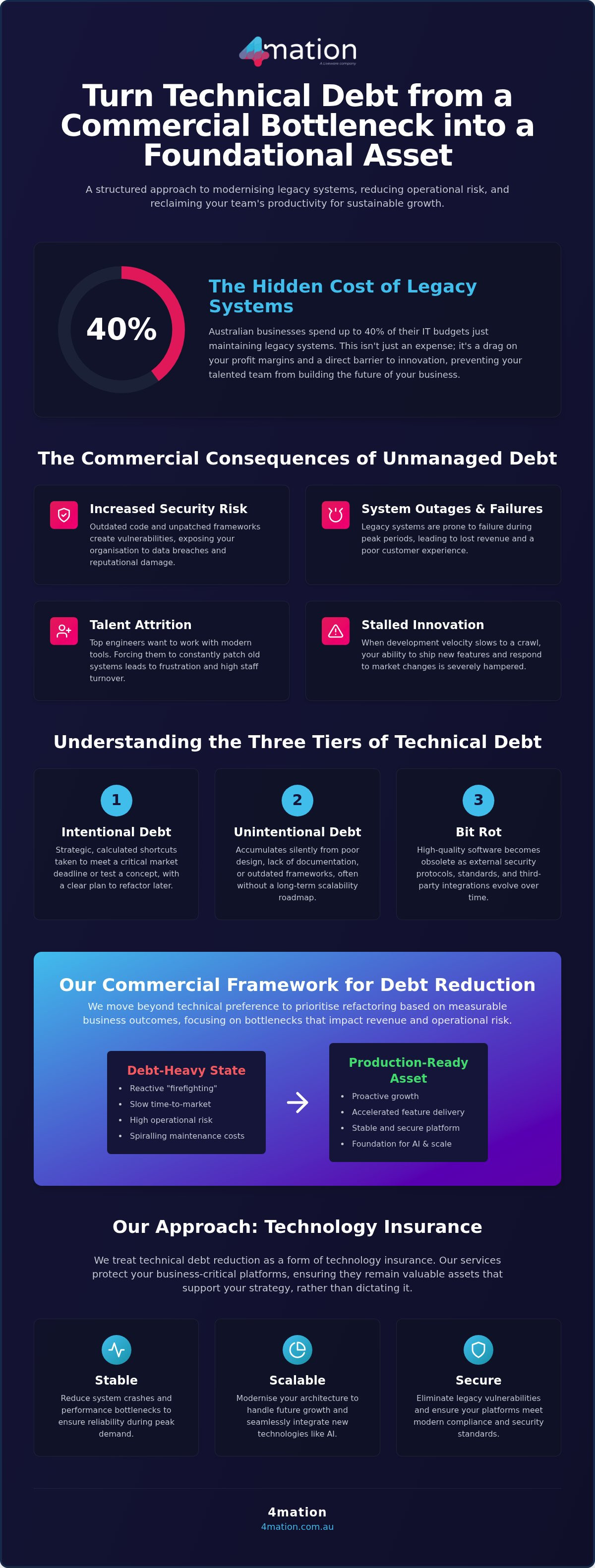
Did you know that Australian businesses are currently spending up to 40% of their IT budgets just to maintain legacy systems? It’s a staggering figure that represents more than just a line item on a balance sheet; it’s the sound of your competitive advantage stalling. When development velocity slows to a crawl and the fear of a system failure during peak periods becomes a constant worry, you aren’t just dealing with old code. You’re facing a commercial bottleneck that prevents real innovation. Professional technical debt reduction services offer a structured way to break this cycle, turning your technology from a silent burden back into a foundational business asset.
We understand the frustration of seeing your talented team spend more time patching holes than shipping new features. It’s a common challenge for leaders who want to move fast but feel anchored by past decisions. This guide will show you how to identify, prioritise, and eliminate the technical debt that’s holding your organisation back. We’ll explore how modernising your stack reduces operational risk and creates the scalable foundation you need for AI integration. You’ll learn how to reclaim your team’s productivity and build a clear roadmap for sustainable business growth.
Key Takeaways
- Learn how professional technical debt reduction services transform legacy code from a commercial bottleneck into a scalable asset through strategic refactoring and modernisation.
- Discover a five-step commercial framework designed to prioritise debt elimination based on revenue impact and operational risk rather than technical preference alone.
- Understand how to overcome the “bandwidth trap” by balancing internal team knowledge with the objective, outside-in perspective of a strategic technology partner.
- Explore practical methods for using AI to refactor legacy monoliths into scalable microservices while avoiding the long-term risks of poorly structured prototypes.
- Gain certainty in your modernisation journey with a roadmap that focuses on measurable business outcomes and fixed-cost delivery guarantees.
What are Technical Debt Reduction Services?
Professional technical debt reduction services provide a structured framework to refactor, modernise, and optimise legacy codebases that have become too complex or expensive to maintain. If you’ve ever asked What is Technical Debt?, it’s essentially the implied cost of future refactoring caused by choosing an easy or limited solution now instead of a better approach that would take longer. While it’s a common part of the software lifecycle, technical debt reduction services ensure these “short-term loans” don’t compound into a permanent commercial bottleneck.
At 4mation, we adopt the perspective of a Pragmatic Visionary. We believe debt isn’t inherently a sign of failure; it’s often a tool used strategically to hit a market window or test a concept. However, technology becomes a liability the moment it begins to dictate your business strategy rather than supporting it. When your team spends 40% of their time simply keeping the lights on, the debt has become a drag on your profit margins and innovation capacity.
Unmanaged debt carries heavy consequences for Australian leaders. It increases the risk of security vulnerabilities and system outages during peak periods, while simultaneously driving talent attrition as your best engineers tire of patching old systems. We position our technical debt reduction services as a form of “Technology Insurance”. This model protects your business-critical platforms by ensuring they remain stable, secure, and ready to support new features without the risk of a total system failure.
The Three Tiers of Technical Debt
- Intentional debt: These are strategic shortcuts taken to meet a critical market deadline. It’s a calculated decision where speed is prioritised over perfect architecture, with a plan to refactor later.
- Unintentional debt: This often stems from poor design, a lack of documentation, or outdated frameworks. It usually accumulates silently when systems are built without a long-term scalability roadmap.
- Bit rot: Software that was once high-quality can become obsolete as external standards shift. Security protocols evolve and third-party integrations change, turning yesterday’s clean code into today’s legacy burden.
Why Australian Organisations Face Unique Debt Challenges
Australian organisations often face a unique set of pressures. The local talent gap makes it difficult to find engineers who understand both early programming languages and modern cloud-native requirements. This often leads to high-risk builds that, while seemingly cost-effective initially, create significant unintentional debt over time. Additionally, industries like Finance and Healthcare must navigate strict local compliance requirements, making custom software development a matter of regulatory necessity. By engaging with technical debt reduction services, you can transition from a reactive “firefighting” mode to a proactive growth strategy that secures your organisation’s future.
A Commercial Framework for Reducing Technical Debt
Managing technology requires more than just tracking tickets in a backlog; it demands a clear Commercial Framework for Reducing Technical Debt to ensure every hour of refactoring generates a measurable return. Professional technical debt reduction services bridge the gap between engineering needs and commercial goals by moving your organisation from a “debt-heavy” state to being “production-ready.” This process avoids the trap of “refactoring for the sake of it” by prioritising business outcomes first, focusing on the specific code bottlenecks that impact revenue or pose the highest operational risk.
Securing stakeholder buy-in is often the most significant hurdle for technology leaders. To overcome this, you must translate the technical concept of “refactoring” into the commercial language of “ROI.” When you can demonstrate how reducing debt will lower your total cost of ownership and accelerate time-to-market for new features, the conversation shifts from a technical expense to a strategic investment. This clarity helps the C-suite understand that technology is a foundational asset that requires active maintenance to remain valuable.
Step 1: The Comprehensive Code Quality Audit
The journey begins with a deep-dive assessment using static and runtime analysis to identify architectural bottlenecks that slow down your developers. We look beyond the surface to assess security risks and third-party dependency vulnerabilities that could lead to costly breaches or compliance failures. The ultimate goal of this audit is creating a transparent risk-map for the executive team. This document provides a clear, evidence-based view of where the system is fragile and where it is strong, allowing for informed decision-making rather than guesswork.
Step 2: Prioritisation via the Debt-Value Matrix
Not all debt is created equal, and trying to fix everything at once is a recipe for project fatigue. We categorise every finding by “Ease of Fix” versus “Business Impact” to identify high-value “Quick Wins.” These small, targeted changes demonstrate immediate value to stakeholders and build the necessary momentum for larger modernisation efforts. This approach ensures your technical efforts align perfectly with your broader digital transformation strategy, ensuring that every dollar spent on technical debt reduction services contributes to long-term scalability.
To prevent debt from creeping back into the system, we implement robust automated testing and CI/CD pipelines. These guardrails ensure that new code meets high standards before it ever reaches production, effectively future-proofing your platform. If you’re ready to see how a structured approach can reclaim your team’s velocity and reduce delivery risk, you can discuss your roadmap with our senior architects.
Managed Services vs. Internal Teams: Finding the Right Balance
Many Australian leaders find their internal engineering teams caught in a “bandwidth trap.” While these teams possess deep domain knowledge, they’re often consumed by Business As Usual (BAU) tasks and urgent feature requests. This leaves little room for the deep, focused work required for effective technical debt reduction services. Relying solely on internal resources to pay down debt is like trying to change a car’s tyres while driving at 100 km/h; it’s technically difficult and risks stalling your core operations.
External partners provide an objective, “outside-in” perspective that’s vital for Modernising Legacy Systems. Because they aren’t entrenched in the daily pressures of your organisation, they can identify structural flaws and architectural shortcuts that internal teams might overlook. Unlike a one-off “project rescue” that merely patches symptoms, a strategic partner focuses on the root causes of instability to ensure long-term system health. This allows for a more disciplined approach to refactoring that balances immediate stability with future scalability.
The Role of Staff Augmentation
When you need to clear a significant debt backlog without halting your product roadmap, 4mation’s Staff Augmentation services offer a flexible solution. We embed specialist engineers directly into your workflow to tackle high-priority refactoring tasks. This approach allows your core team to stay focused on high-value features while our experts handle the heavy lifting of modernisation. It’s a collaborative model that ensures knowledge sharing and maintains your internal culture without the long-term overhead of permanent hires. Together, we work to ensure your team regains the velocity needed to compete in a fast-moving market.
Technology Insurance and Proactive Maintenance
True stability comes from moving beyond reactive support to a model we call “Technology Insurance.” Through our Service Desk, we provide ongoing managed support that treats maintenance as a continuous improvement process. By implementing proactive monitoring and regular code reviews, we prevent debt from accumulating again. This ensures your business-critical applications remain performant and secure, providing the certainty you need to scale. Instead of waiting for a system failure during a peak period, you benefit from a disciplined development process that keeps your foundation strong. This proactive stance protects your technology investment and ensures your platforms are always ready for the next phase of growth.
Modernising Legacy Systems with Practical AI
Moving from a “vibe-coded” app to an enterprise-grade solution requires a shift from experimental hype to disciplined engineering. It’s not just about what the AI can do; it’s about how that AI is integrated into your broader ecosystem. Without a stable foundation, you’re merely adding more complexity to an already fragile system. We help you bridge this gap by ensuring your AI implementations are secure, performant, and aligned with your long-term business goals. For CEOs and investors, TechAxis Advisors provides the executive-level oversight required to ensure these AI initiatives remain strictly aligned with broader business strategy and cybersecurity standards.
Refactoring Monoliths for the AI Era
Integrating AI into a legacy monolith is often counterproductive. A rigid, interconnected codebase prevents AI agents from accessing specific data points or executing isolated tasks efficiently. Modern architecture is a non-negotiable prerequisite for effective integration. By refactoring your monolith into scalable microservices, you reduce dependencies and create an environment where AI can actually drive productivity. This structural clarity allows for the faster deployment of sophisticated tools, as outlined in our AI Consulting: 2026 Guide.
Securing AI-Generated Code
AI-assisted development offers speed but introduces hidden liabilities. Code generated by AI often contains “hallucinations” or subtle security flaws that can remain undetected without expert oversight. We implement rigorous human-in-the-loop code reviews to ensure every line of AI-generated code meets enterprise-grade standards. This disciplined approach prevents the accumulation of unintentional debt and ensures your AI implementations deliver measurable business outcomes. We focus on creating a secure environment where technology serves as a foundational business asset rather than a source of future risk.
Ready to turn your AI prototype into a secure, scalable platform? Speak with our AI consultants today to ensure your technology foundation is ready for the future.
Partnering with 4mation: Certainty in Debt Reduction
4mation brings 25 years of experience to every modernisation project, positioning us as a “safe pair of hands” in the Australian technology sector. We don’t just write code; we solve complex business problems with a disciplined, outcome-oriented approach. Our technical debt reduction services are designed to provide the certainty leaders need when investing in legacy systems. With a local team of 40+ tech specialists, we ensure that your technology becomes a foundational asset that supports long-term stability and measurable success. We understand that technology is a strategic investment, and we treat it with the commercial wisdom your organisation deserves.
Our reputation is built on accountability and transparency. We avoid the frantic energy of typical startups in favour of a methodical, project-led rhythm. This ensures that every stage of the journey, from the initial audit to ongoing support, is handled with professional excellence. By choosing a partner that values longevity and reliability, you can alleviate the anxiety often associated with large-scale technology shifts and focus on driving your business forward.
The Fixed-Cost Project Model
Legacy rebuilds often carry the perception of being expensive and unpredictable. We remove this financial risk through our Fixed-Cost Project engagement model, which offers a bug-free guarantee and on-time delivery. From day one, we define clear outcomes and milestones so you know exactly what value will be delivered and when. This transparency eliminates the “buyer’s remorse” often associated with technology investments and ensures your modernisation journey stays on track. By providing a fixed price for a defined scope, we allow you to budget with confidence and focus on the strategic benefits of your new system.
Case Study: Real-World Debt Reduction
Our track record includes successful partnerships with leading organisations such as Altus Traffic and SG Fleet. These collaborations aren’t just about technical fixes; they’re about creating a stable foundation for ongoing growth. By addressing deep-seated architectural issues, we’ve helped our clients reclaim their development velocity and reduce operational risk. This consistent delivery of high-quality solutions has made us a trusted partner for mid-market and enterprise businesses across Australia. We value long-term stability over fleeting trends, ensuring the solutions we build today remain functional and scalable for years to come.
If you’re ready to reclaim your team’s productivity and accelerate business growth, the next step is simple. We work with you to understand your organisation’s specific goals before recommending a tailored solution. You can enquire about a technical debt assessment today to start building a more scalable, resilient future for your business. Together, we’ll transform your legacy burden into a powerful engine for innovation.
Reclaiming Your Organisation’s Technical Agility
Technical debt isn’t just a coding issue; it’s a commercial bottleneck that limits your organisation’s ability to innovate and scale. By implementing a structured framework for prioritisation and refactoring, you can transition from reactive firefighting to a proactive growth strategy. Whether you’re modernising a legacy monolith or securing an AI-driven prototype, the goal is to ensure your technology remains a foundational business asset rather than a silent liability.
Engaging professional technical debt reduction services provides the objective perspective and specialist bandwidth needed to bypass the internal “bandwidth trap.” With 25 years of experience, 4mation offers a “safe pair of hands” for your modernisation journey. We remove the financial uncertainty of complex rebuilds through our Fixed-Cost, on-time, and bug-free guarantee.
The path to a more resilient, scalable platform starts with a clear roadmap. Reclaim your team’s productivity and accelerate your business growth by partnering with a team that understands the intersection of deep technology and commercial wisdom. Book a Strategic Consultation with 4mation to begin your transformation today. Together, we’ll build the certain foundation your future requires.
Frequently Asked Questions
What exactly is included in technical debt reduction services?
Technical debt reduction services include a structured audit of your codebase to identify architectural bottlenecks and security risks. We focus on refactoring legacy code, updating outdated libraries, and improving system documentation. Our approach also integrates automated testing and CI/CD pipelines to ensure future code meets high standards. This end to end service transforms fragile legacy systems into stable, scalable foundations that allow your team to ship new features with greater speed and reliability.
How do I know if my organisation’s technical debt has reached a critical level?
Your debt has reached a critical level when development velocity slows to a crawl and your team spends more than 40% of their time on maintenance. Other warning signs include a high frequency of bugs in core features or a growing fear of system failure during peak periods. If your developers are reluctant to touch certain parts of the codebase for fear of breaking them, it’s a clear signal that your technology is no longer supporting your commercial goals.
Can we reduce technical debt without stopping our current development roadmap?
Yes, you can reduce debt while maintaining your current roadmap by using a “refactor and change” approach or leveraging staff augmentation. We embed specialist engineers who focus specifically on technical debt reduction services while your internal team continues to deliver new features. This dual track strategy ensures that you don’t lose market momentum. By addressing the most impactful bottlenecks first, we gradually clear the path for your team to work more efficiently without requiring a complete development freeze.
How does 4mation’s Fixed-Cost guarantee apply to refactoring projects?
Our Fixed-Cost guarantee applies to scoped modernisation projects by providing a firm price, a clear delivery date, and a bug-free outcome. We start with a detailed solution design phase to define the exact scope of the refactoring work. This removes the financial risk and ambiguity often associated with legacy software projects. You receive a guaranteed result that aligns with your budget and timeline, providing the commercial certainty required for large scale technology investments.
What is the difference between legacy modernisation and technical debt reduction?
Technical debt reduction is a targeted process of fixing specific inefficiencies and shortcuts within an existing codebase. Legacy modernisation is a broader strategic effort that might involve re-platforming, re-architecting, or moving a system to the cloud. While debt reduction focuses on immediate stability and velocity, modernisation aims for a complete transformation of your technology stack. Both approaches are essential for long-term scalability, but they differ in scope and the level of structural change required for the organisation.
How long does a typical technical debt reduction engagement take?
The duration of an engagement varies based on the size of your codebase and the depth of the debt. A comprehensive audit typically takes two to four weeks, while the subsequent reduction phase can range from three months for targeted refactoring to over a year for complex systems. We break the work into manageable milestones to ensure you see incremental value early in the process. This phased approach maintains project momentum and allows for regular progress assessments by your leadership team.
Will reducing technical debt improve our system security and compliance?
Reducing technical debt directly improves security by eliminating vulnerabilities found in outdated frameworks and unpatched libraries. Modernising your codebase ensures that your systems meet current Australian industry standards for data protection and privacy. We also focus on improving system documentation and logging, which are critical for maintaining compliance in regulated sectors like finance and healthcare. This proactive approach reduces the risk of data breaches and ensures your platforms remain secure during high-traffic periods.
How can I justify the cost of debt reduction to my Board or CEO?
Justify the investment by translating technical refactoring into commercial ROI and risk reduction. Explain how debt currently inflates your operational costs and slows your time-to-market for new features. Highlight the potential cost of a system failure during peak periods compared to the fixed cost of a modernisation project. By presenting a clear roadmap that leads to a more scalable and reliable foundation, you demonstrate that debt reduction is a strategic commercial investment, not just a technical expense.
About The Author
