2026 eCommerce Strategy Guide for Australian Organisations
4mation Technologies

In 2026, an online shopfront is no longer a standalone asset; it’s either the engine of your operational efficiency or the primary source of your technical debt. Many Australian executives are finding that rigid, off-the-shelf platforms are failing to keep pace with complex B2B pricing or multi-warehouse synchronisation. You’ve likely felt the friction of manual workflows between your digital store and your ERP, or the anxiety of a checkout that struggles under high-volume demand. We agree that technology should be a foundational asset that simplifies your business, which is why a more sophisticated approach to ecommerce website development is now a commercial necessity.
This guide provides a clear roadmap for building a scalable, high-performance engine that integrates practical AI and bespoke architecture to drive measurable value. You’ll discover how to automate processes and ensure your platform remains secure and compliant with upcoming Australian regulations, such as the December 2026 Privacy Act disclosures. We’ll preview the strategic shift from “app bloat” to composable systems, showing you how to build a reliable, automated platform that delivers long-term stability and certain growth for your organisation.
Key Takeaways
- Identify the “ceiling” of standard SaaS platforms to avoid the rising costs of technical debt as your transaction volume and operational complexity grow.
- Compare monolithic, headless, and custom architectures to determine the most effective path for your ecommerce website development and long-term business goals.
- Drive operational ROI by integrating AI agents and ERP systems to automate manual workflows and ensure data accuracy across your entire organisation.
- De-risk your technology investment with a fixed-cost project model that provides commercial certainty and a guarantee of on-time, bug-free delivery.
- Maintain a competitive edge through “Technology Insurance,” a proactive support model that prevents platform stagnation and secures your digital reliability.
Scaling Beyond the Constraints of Off-the-Shelf Ecommerce Platforms
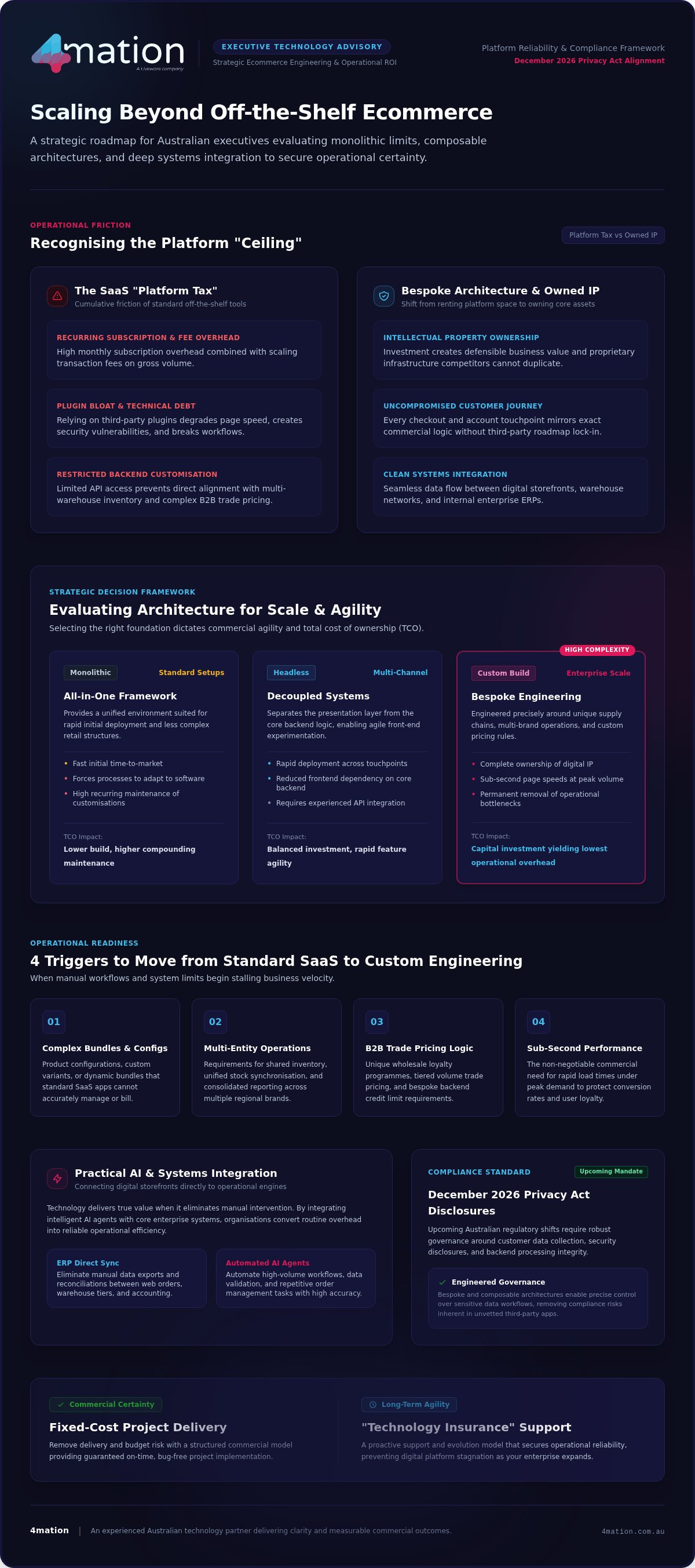
Many Australian organisations reach a “ceiling” where their off-the-shelf platform no longer bends to their operational needs. At this point, trying to force a standard SaaS tool to handle complex B2B trade pricing or unique logistics workflows leads to diminishing returns. You end up paying a “platform tax” through high monthly subscriptions and transaction fees while spending more on workarounds than you would on a bespoke build. We’ve seen this cycle frequently; it’s the point where a tool designed for speed becomes a barrier to scale.
Investing in custom ecommerce website development represents a strategic shift from renting space to owning your infrastructure. It’s an investment in intellectual property that your competitors can’t simply buy off a shelf. When you own the core architecture, you’re no longer at the mercy of a third-party roadmap or sudden pricing changes. You gain the freedom to innovate on the customer journey, ensuring every touchpoint reflects your business’s unique value proposition and service standards.
The Hidden Costs of Rigid Software Architecture
Relying on third-party plugins to fill functional gaps often results in “plugin bloat.” This slows down site speed, creates security vulnerabilities, and complicates maintenance. Limited API access further restricts your ability to pivot or integrate with modern headless commerce architecture. Technical debt is the cumulative cost of choosing easy workarounds over scalable solutions. By moving toward a cleaner, more integrated architecture, you reduce these maintenance overheads and improve your overall security posture.
When to Move from SaaS to Custom Engineering
Knowing when to transition is vital for maintaining business velocity and protecting your margins. If your team spends more time managing manual data exports or fixing broken integrations than growing the brand, you’ve reached the limit of your current system. Moving to custom software development allows you to remove these operational bottlenecks permanently and create a platform that scales with your ambition.
Consider these triggers as signs that your organisation is ready for a more robust solution:
- Complex product configurations or bundles that standard apps can’t accurately manage.
- Multi-entity requirements with shared inventory and reporting across different brands or regions.
- Unique loyalty programmes or trade pricing logic that requires deep backend customisation.
- The need for sub-second page performance to meet rising user expectations.
Transitioning from a vendor-focused mindset to a strategic partnership ensures your technology evolves alongside your business. By choosing a partner who understands the commercial impact of technology, you move from managing software to leading a high-performance digital organisation. For B2C founders, this evolution often requires a parallel focus on executive growth; strategic mentorship from Founder Freedom, led by an experienced CEO and CFO, can help leaders navigate the complexities of scaling both their team and their technology.
Evaluating Ecommerce Architectures: Monolithic vs. Headless vs. Custom
Selecting an architecture is a pivotal decision that dictates your organisation’s agility for years to come. Monolithic platforms offer a unified environment, which is often ideal for rapid deployment and simpler setups. However, as business requirements evolve, these “all-in-one” systems can become restrictive, often forcing you to adapt your processes to the software. For a broader view on digital commerce standards, the Australian Government eCommerce guide provides useful context on platform selection and compliance for growing enterprises.
When evaluating the total cost of ownership (TCO), it’s essential to look beyond the initial build. You must account for subscription fees, transaction costs, and the long-term expense of maintaining customisations within a rigid framework. Choosing a stack that your internal team or a reliable technology partner can support long-term is just as important as the technology itself. A well-chosen architecture ensures that ecommerce website development remains a driver of growth rather than a recurring cost centre.
Headless Ecommerce: Flexibility for Multi-Channel Growth
Headless architecture decouples the frontend presentation layer from the backend commerce logic. This separation allows you to deliver consistent, high-performance experiences across web browsers, mobile apps, and even IoT devices. You can update your frontend design or user interface rapidly without risking the stability of your core transaction engine. This agility is vital when responding to shifting market trends or customer expectations.
While this approach offers immense flexibility, it does introduce additional technical complexity. Managing multiple APIs and ensuring seamless data flow requires professional web application development expertise to execute correctly. It’s a powerful strategy for brands that prioritise sub-second page speeds and a truly unique customer experience across every digital touchpoint.
Bespoke Development for Complex Business Logic
There are instances where neither monolithic nor headless SaaS platforms can accommodate the intricate rules of your industry. In sectors like construction or manufacturing, you might deal with complex ordering workflows, variable trade pricing, or intricate multi-warehouse logic. In these scenarios, a build-from-scratch approach allows you to digitise your exact business rules without compromise.
By building a solution tailored to your specific operational needs, you eliminate the friction inherent in off-the-shelf tools. For example, our work with industrial supplier Steel Builders involved migrating to an optimised architecture that managed complex product data more effectively. This strategic shift resulted in a conversion rate increase of more than 15%. If you’re unsure which architecture fits your 2026 strategy, you can reach out to our team for a consultative review of your requirements.
Leveraging Practical AI and Systems Integration for Operational ROI
In 2026, the competitive advantage in digital commerce has shifted from how a site looks to how it thinks and connects. While many organisations focus solely on the user interface, the real ROI is found in the deep integration of systems and the deployment of practical AI. According to McKinsey research on next-gen eCommerce, modular technology stacks and seamless integration are now make-or-break factors for enterprise growth. By moving beyond basic chatbots to sophisticated AI agents, you can automate complex customer service queries and order processing workflows that previously required manual intervention.
We’ve seen this drive measurable value through highly personalised user experiences. For instance, AI can personalise the skincare journey for Ego Pharmaceuticals or refine the music search experience for Beatbox Music, turning high-volume data into tailored customer outcomes. This isn’t about chasing trends; it’s about using technology to reduce human error in the warehouse and office. When your technology stack handles the heavy lifting of data processing, your team is free to focus on high-value strategic tasks.
System Integration: The Backbone of Scalable Ecommerce
Connecting your ecommerce engine to inventory management, logistics, and financial systems is the only way to achieve true scale. When these systems remain siloed, you face the “double handling” of data, which inevitably leads to inaccuracies and customer frustration. For specialised retailers, such as those providing mobility scooters for sale brisbane, this connectivity is essential to manage complex delivery logistics and stock levels. Our approach to ecommerce website development starts with a business-first integration strategy, ensuring data flows cleanly between your storefront and your ERP or CRM to provide a single source of truth that powers every operational decision and ensures customer expectations are always met.
Practical AI delivers ROI by solving specific operational problems rather than just generating content. Implementing predictive analytics for inventory forecasting allows you to anticipate demand and optimise stock levels, which reduces capital tied up in slow-moving goods. On the storefront, AI-driven product recommendations can significantly increase average order value (AOV) by presenting the right item at the optimal moment in the buyer journey. Beyond the customer experience, using AI for workplace modernisation empowers your internal teams to work faster and more accurately. This turns your technology stack into a genuine productivity multiplier that supports long-term commercial goals.
Navigating the Development Process with Commercial Certainty
Many Australian organisations hesitate to commit to large-scale ecommerce website development because of the perceived risk of budget blowouts and missed deadlines. We address this anxiety by providing a structured, transparent journey that moves from Digital Strategy and UX/UI Design through to Prototyping, Development, and ongoing Support. This roadmap ensures that every stakeholder understands the project’s direction before a single line of code is written. By utilising Rapid Prototyping early in the process, we reduce ambiguity and allow you to test functionality in a low-risk environment, ensuring the final build aligns perfectly with your operational needs.
Strategy and Design: Prioritising the User Experience
Effective design is about much more than aesthetics. We focus on data-led UX design to bridge the gap between a site that looks good and one that converts well. During our discovery phase, we conduct thorough user research to identify friction points in your current purchase path, ensuring the new platform solves real-world customer problems. This business-first approach ensures that your technology investment is directly tied to your commercial goals, rather than just being a cosmetic update. We align your technology with your business objectives from the outset to ensure the final product delivers measurable value.
Delivery Certainty and Risk Mitigation
One of the most significant risks in complex software projects is “requirement creep,” where a lack of clear scope leads to escalating costs. We mitigate this through our Fixed-Cost project model, which guarantees that your platform is delivered on-time, on-budget, and bug-free. This model provides the commercial certainty that CEOs and CFOs require when approving significant capital expenditure. A fixed-outcome guarantee is the ultimate hedge against technology delivery risk, providing you with peace of mind that your mission-critical platform is in a safe pair of hands.
Clear communication is the foundation of this certainty. Our Australian-led project management team ensures that you have a local point of contact who understands your business context and can translate complex technical requirements into clear outcomes. We work with you to define the scope precisely, ensuring that the final delivery meets every functional requirement without unexpected costs. If you’re ready to discuss a project with a partner that values transparency and results, you can contact our team to start the conversation.
Future-Proofing Your Platform with Technology Insurance
Technology is a foundational business asset, not a one-off purchase. Many organisations suffer from vendors who deliver a project and then provide little ongoing support, often referred to as a “build and bolt” approach. We view ecommerce website development as the start of a long-term strategic alliance. Our “Technology Insurance” model provides a safety net for your investment. It’s a disciplined approach to operational stability that ensures your platform remains a high-performance engine rather than a legacy system. A dedicated Service Desk provides the accountability and incident response needed to maintain business continuity in a volatile market.
Proactive Maintenance and Support
Reliability is non-negotiable for high-traffic sites. Unexpected downtime during peak periods like Black Friday or seasonal sales leads to immediate revenue loss and long-term brand damage. Robust technology support and maintenance acts as a preventative measure. We identify potential bottlenecks before they impact your users. As an AWS Select Consulting Partner, we manage secure and scalable cloud infrastructure that flexes with your demand. This proactive monitoring ensures your checkout remains functional and secure, even under extreme volume.
Continuous Improvement for Competitive Advantage
A platform that doesn’t evolve is already falling behind. We use post-launch performance data to prioritise continuous improvement and development. This ensures your features align with actual user behaviour rather than assumptions. This iterative process allows you to test new ideas and refine your customer journey without the risk of a full re-platforming every few years. If your organisation experiences rapid growth, you can leverage staff augmentation to scale your technical capacity quickly. This flexibility ensures you always have the right expertise to maintain your competitive edge.
Building a scalable, integrated ecommerce engine requires a partner that values longevity. With 25 years of experience, we provide the steady hand needed to navigate complex digital transformations. If you’re ready to secure your organisation’s future, you can contact 4mation today to discuss your ecommerce modernisation roadmap.
Securing Your Digital Future through Strategic Engineering
The shift toward custom architecture and practical automation is a fundamental requirement for Australian organisations aiming to maintain a competitive edge. By decoupling your frontend from complex backend logic and integrating AI agents into your core workflows, you transform your digital presence from a simple shopfront into a high-performance business engine. This approach ensures you own your data and customer journey while eliminating the technical debt often found in rigid platforms.
With 25 years of experience, we’re specialists in Ecommerce and complex integrations. We understand that successful ecommerce website development requires both technical precision and commercial wisdom. We remove the anxiety of technology investment through our Fixed-Cost model, guaranteeing your project is delivered on-time, on-budget, and bug-free. As your strategic partner, we provide the steady hand needed to manage mission-critical platforms with certainty.
Ready to build a scalable platform that drives measurable value? Book a consultation with our ecommerce specialists to discuss your 2026 roadmap. We look forward to helping you turn your technology into a lasting business asset.
Frequently Asked Questions
What are the benefits of custom ecommerce development over platforms like Shopify?
Custom development removes the ceiling of standard platforms by allowing for bespoke business logic and complex trade pricing. Unlike off-the-shelf tools, custom builds eliminate plugin bloat to improve site speed and security. This approach ensures your ecommerce website development investment builds long-term intellectual property that you own entirely. It provides the flexibility to scale your operations without being restricted by a third-party vendor’s roadmap or pricing structure.
How does 4mation guarantee a fixed-cost and bug-free project?
We provide commercial certainty through our Fixed-Cost project model. This engagement includes a guarantee that your project is delivered on-time, on-budget, and bug-free. We achieve this through a disciplined discovery process and rapid prototyping, which identifies and resolves potential issues before full-scale development begins. This methodical approach removes the financial and delivery risks often associated with complex software builds, ensuring you receive a high-performance digital asset.
Can you integrate my ecommerce site with my existing ERP or CRM?
We specialise in seamless system integrations that connect your storefront to existing ERP or CRM platforms. Our team ensures data flows accurately between your ecommerce engine and your inventory, logistics, or financial systems. This connectivity eliminates the double handling of data and provides a single source of truth for your organisation. We work with various ecosystems, including AWS and Microsoft, to build a unified technology stack that supports your growth.
How long does a typical custom ecommerce development project take?
Project timelines are determined by the specific complexity and integration requirements of your business. We move methodically through strategy, design, and prototyping to ensure the final build meets your exact needs. While we don’t rush the quality of our engineering, our fixed-outcome model provides a clear delivery schedule that we strictly follow. We discuss specific milestones during the discovery phase to align the project with your commercial deadlines.
What is “Technology Insurance” and why does my business need it?
Technology Insurance is our proactive Service Desk model that focuses on operational stability and risk reduction. It includes proactive monitoring, maintenance, and incident response to protect your business-critical platforms from unexpected downtime. This model ensures your technology remains secure and compliant while preventing the stagnation that often affects legacy systems. It provides the peace of mind that a safe pair of hands is managing your digital infrastructure 24/7.
Do you provide ongoing support after the ecommerce site is launched?
We provide ongoing support through our Service Desk and managed services models after your platform is launched. This includes technology support and maintenance to ensure long-term reliability and performance. Our partnership approach also covers continuous improvement and development, allowing you to refine your site based on real-world user data. We offer staff augmentation for organisations that need to scale their internal technical teams quickly with specialist Australian-led expertise.
How can AI be used to improve my ecommerce business operations?
Practical AI improves operations by automating repetitive manual tasks and reducing human error in the office or warehouse. We implement AI agents to manage complex customer queries and predictive analytics to optimise inventory forecasting. These tools are designed to drive measurable ROI by improving workplace productivity and enhancing the customer experience. Our focus remains on using AI to solve defined business problems rather than chasing superficial digital hype.
What industries has 4mation helped with ecommerce solutions?
We have delivered successful solutions for organisations in Education, Healthcare, and Financial Services. Our expertise also extends to Transport, Construction, Manufacturing, and Marketing sectors. Whether we’re building integrated ordering systems for building suppliers or AI-powered search tools for media companies, we focus on solving industry-specific problems. This broad experience ensures our ecommerce website development strategies are grounded in practical, commercial reality for every Australian client we partner with.
About The Author
