How to Deploy a Vibe Coded App for Professional Scale
Jowena BorralDigital Marketing Specialist

What happens when the prototype your team assembled over a weekend suddenly has to handle sensitive customer records and commercial traffic? Prompt-driven development has dramatically shortened the path from concept to validation, but learning how to safely deploy vibe coded app builds to production is where real business value is won or lost. It’s exciting to watch a working interface come alive in hours, yet sandboxed prototypes often conceal exposed API keys, unvetted third-party packages, and fragile queries that buckle under real user concurrency.
You don’t have to discard that early momentum to achieve enterprise reliability. In this guide, you’ll discover how to transition your working prototype into a secure, scalable, and commercially viable web application that meets rigorous corporate standards. We’ll unpack the cloud architecture, automated deployment pipelines, and proactive governance needed to protect your organisation’s reputation and turn an experimental sprint into a resilient, long-term digital asset.
Key Takeaways
- How to successfully deploy vibe coded app builds by shifting from rapid prompt generation to disciplined engineering standards that protect commercial uptime.
- Why a structured pre-launch audit of authentication logic, dependencies, and database queries prevents costly security exposures and platform crashes.
- How to select the right cloud infrastructure and automated delivery pipelines to balance immediate speed with predictable long-term operational costs.
- The essential observability and monitoring practices needed to pinpoint system bottlenecks before they impact your end-users.
- A clear governance framework to manage architectural drift and convert an experimental prototype into a durable enterprise asset.
What Does It Mean to Deploy a Vibe Coded App to Production?
Vibe coding has democratised rapid software prototyping. By using natural language prompts inside generative AI tools, founders and teams can assemble functional software in hours. But understanding what does it mean to deploy software to production reveals a distinct gap between an impressive local demonstration and commercial reality. Pushing source code to a public server isn’t enough; true production deployment demands that an application remains secure, compliant, and cost-effective under fluctuating user load.
For Australian organisations, balancing rapid innovation with strict governance is essential. Turning an AI-assisted build into an enterprise-ready digital asset requires intentional engineering. When you deploy vibe coded app assets without addressing this gap, you risk exposing commercial data and degrading customer trust on day one.
The Core Difference Between Working Prototypes and Production Systems
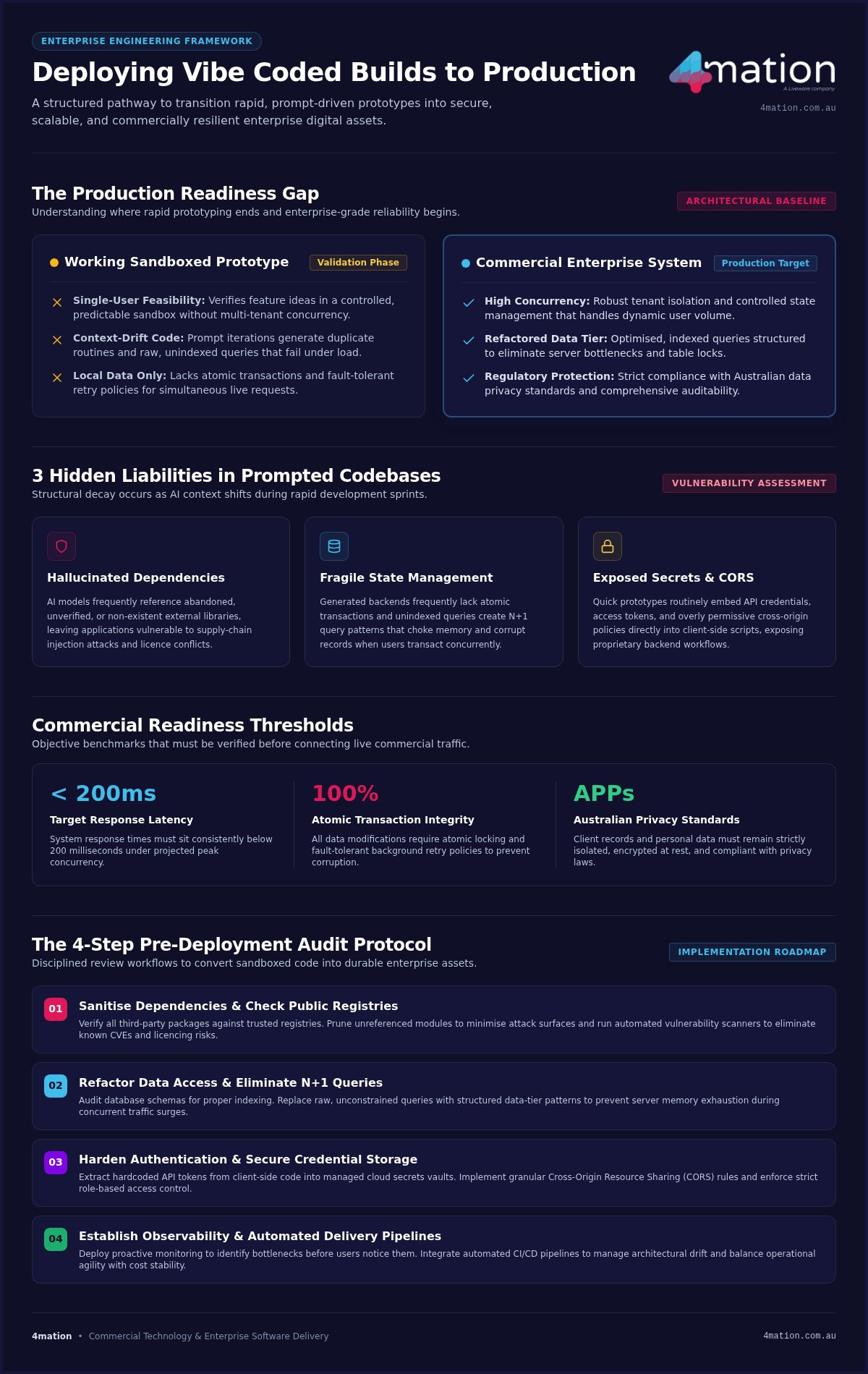
A prototype verifies feature feasibility. It proves an idea works for a single user in a predictable sandbox. In contrast, enterprise web systems must govern concurrency, enforce strict tenant isolation, and handle complex failure states gracefully. Prompt-driven code often generates duplicate routines and messy database queries that seem responsive during testing, yet instantly lock tables when dozens of real users interact simultaneously.
Hidden Risks in Prompt-Generated Codebases
As iterative prompting continues, AI code generation suffers from context drift. This structural decay introduces severe liabilities across three key areas:
- Hallucinated dependencies: Generative models regularly reference abandoned or non-existent external libraries, leaving platforms open to supply-chain injection attacks.
- Fragile state management: Prompt-crafted backends frequently lack atomic transactions, leading to data corruption when requests process simultaneously.
- Exposed secrets: Sandboxed builds routinely embed API credentials, access tokens, and overly permissive cross-origin policies directly into client-side scripts.
Establishing Your Commercial Readiness Criteria
Before moving code into a live environment, define objective commercial thresholds. Response times must sit well below 200 milliseconds under load, and background jobs need fault-tolerant retry policies. From a governance perspective, handling Australian client records means aligning with national data privacy standards and ensuring personal data remains isolated and encrypted. Bridging this gap through structured AI consulting transforms an experimental project into an asset that safeguards revenue and enhances your operational reputation.
The Pre-Deployment Code and Architecture Audit
Conducting a disciplined engineering review before release prevents platform downtime, emergency patches, and operational disruption. When teams prepare to deploy vibe coded app projects, they often discover that AI-generated prototypes obscure critical architectural flaws beneath a functional interface. Australian organisations must safeguard proprietary workflows and customer records before connecting external portals. Investing in structured web application development practices ensures these vulnerabilities are eliminated well before your product reaches live users.
Sanitising Dependencies and Removing Hallucinated Libraries
Prompt-driven coding tools routinely pull in bloated, unverified, or entirely fabricated software packages. A robust pre-flight audit verifies every third-party package against public registry records, pruning unreferenced modules to reduce container attack surfaces. Automated vulnerability scanners identify known Common Vulnerabilities and Exposures (CVEs) while confirming that open-source licencing permits commercial use. Addressing these dependencies early protects your intellectual property and avoids severe supply chain risks.
Refactoring State Management and Database Queries
AI tools excel at solving immediate interface requests, but they frequently generate unindexed, raw database queries. Left unaddressed, hidden N+1 query patterns quickly choke server memory as concurrent transactions rise. Refactoring your data tier to align with proven scalable web application architecture standards replaces fragile data access with parameterised, atomic routines that safeguard database integrity under sudden spikes in traffic.
Hardening Authentication, Permissions, and Data Access
Sandboxed applications rarely implement proper isolation between client roles. Establishing enterprise-grade security means auditing session lifecycles, enforcing multi-factor authentication, and extracting sensitive API keys into dedicated secret management vaults. Evaluating these requirements alongside your infrastructure options, such as choosing the right cloud hosting setup, creates a defensible perimeter around sensitive corporate assets.
A systematic audit gives your leadership team clarity and commercial confidence. If you want an objective review of your prototype’s security and architectural readiness, our engineering specialists can help you audit your application before launch.
Choosing the Right Cloud Hosting and Deployment Pipeline
Selecting your hosting environment requires balancing deployment speed against operational cost. When teams deploy vibe coded app projects, they often gravitate towards one-click Platform-as-a-Service (PaaS) providers. While these platforms let you launch an initial build quickly, they often lead to unpredictable bandwidth bills, vendor lock-in, and limited regional governance as compute demands increase. Establishing commercial longevity requires selecting an infrastructure foundation that can scale alongside your organisation.
Evaluating PaaS vs Public Cloud Infrastructure
PaaS solutions work well for early validation, but established public cloud providers offer far greater control over data sovereignty and long-term costs. As an AWS Select Consulting Partner, 4mation designs enterprise cloud architecture that complies with Australian data storage standards while keeping hosting budgets predictable. Deploying containerised services on managed cloud infrastructure isolates compute resources, prevents multi-tenant noisy-neighbour issues, and gives you total ownership of your networking perimeter.
Configuring Production-Grade CI/CD Pipelines
Relying on manual code pushes introduces human error and creates delivery risk. A production-ready continuous integration and continuous deployment (CI/CD) pipeline automates quality control before any release reaches your users. Your pipeline should enforce the following delivery controls:
- Automated gatekeeping: Run linting, dependency vulnerability audits, and unit tests on every pull request to catch logic regressions immediately.
- Infrastructure as Code: Define cloud environments using tools like Terraform or AWS CloudFormation, ensuring staging mirrors production precisely.
- Zero-downtime releases: Utilise rolling updates or blue-green deployments so users never encounter maintenance windows or service outages during routine updates.
Integrating External APIs and Background Workers
Prompt-generated applications frequently attempt to execute synchronous API calls and complex operations directly within the main user request lifecycle. Under commercial concurrency, this design quickly causes gateway timeouts and browser crashes. Decoupling resource-intensive jobs into asynchronous queue workers keeps your front-end snappy and resilient. Implementing exponential backoff logic ensures reliable communication with external services. Reviewing best practices for custom API development services helps you design resilient integration points that keep your web application dependable under heavy usage.
Preparing for Launch: Observability, Security, and Scalability
Pushing code live is only the start of platform reliability. Even after dependencies are scrubbed and pipelines are green, unmonitored systems remain vulnerable to sudden traffic spikes and malicious exploits. When you deploy vibe coded app projects into commercial environments, implementing active observability and perimeter defence is critical. Aligning your launch strategy with proven enterprise web application development benchmarks ensures your platform remains resilient under real-world operating conditions.
Setting Up Comprehensive Logging, Metrics, and Tracing
You cannot fix what you cannot see. Prototype builds often scatter logs across ephemeral containers, making root-cause diagnostics impossible during an outage. Consolidating application, server, and access logs into a single telemetry dashboard provides immediate operational visibility. Engineering teams need to track key telemetry metrics:
- System health: Monitor CPU usage, memory thresholds, and disk I/O to catch resource starvation early.
- Latency distribution: Track 95th and 99th percentile response times to identify slow endpoints before they frustrate users.
- Actionable alerting: Route automated alerts directly to on-call communication channels when error rates breach predetermined thresholds.
Implementing Web Application Firewalls and Edge Protection
Public-facing applications attract automated bots, credential stuffing, and injection attempts within minutes of going live. Placing a managed Web Application Firewall (WAF) such as AWS WAF or Cloudflare at your digital perimeter blocks suspicious IP patterns and mitigates DDoS attempts before traffic reaches your servers. Enforcing modern TLS certificates, strict Content Security Policies (CSP), and restrictive HTTP headers prevents cross-site scripting and unauthorised framing.
Simulating User Load and Concurrency Bottlenecks
Never rely on live users to discover your platform breaking points. Executing synthetic stress tests reveals how your backend handles concurrent traffic surges. These simulations expose connection pool limits between your containers and relational databases, allowing you to configure connection pooling tools before launching. Pairing these database adjustments with aggressive edge caching for static assets ensures your web application delivers fast, consistent page loads under intense commercial demand.
Preparing for launch requires methodical testing and seasoned technical oversight. To ensure your digital platform handles live commercial traffic without unexpected disruptions, speak with our engineering team today to plan your production deployment.
Post-Deployment Governance: Transitioning from Prototype to Long-Term Asset
Software value depreciates rapidly without continuous architectural governance. After you deploy vibe coded app software to live users, the thrill of an initial release quickly gives way to operational realities. AI-generated modules often function as discrete silos, meaning small downstream changes can trigger unexpected regressions across the platform. Establishing clear operational accountability ensures your build transitions smoothly from an experimental prototype into a dependable commercial engine. Leveraging 4mation’s custom software development services bridges this gap, transforming rapid builds into lasting commercial assets.
Managing Technical Debt and Ongoing Code Governance
Left unmanaged, prompt-derived codebases accumulate compounding technical debt that slows future innovation. Resolving this friction requires structured engineering routines:
- Refactoring cycles: Schedule dedicated development sprints to standardise conversational code snippets into clean, reusable modules.
- Architectural records: Document system decisions, schema changes, and third-party contracts so future engineers understand the underlying design logic.
- Pull request policies: Enforce strict peer-review workflows to stop unvetted, prompt-generated snippets from merging directly into production branches.
Securing Dedicated Technology Support and Proactive Maintenance
Production environments demand continuous vigilance. Outdated frameworks and neglected dependencies introduce security vulnerabilities that jeopardise business continuity. Proactive patch management across container runtimes and core operating systems prevents security drift. Securing structured technology support and maintenance provides your organisation with essential technology insurance, backed by formal service-level agreements that guarantee prompt defect resolution and reliable uptime.
Engaging a Proven Engineering Partner for Guaranteed Delivery
Scaling software successfully means eliminating delivery uncertainty. Backed by 25 years of engineering experience delivering resilient systems nationally, 4mation helps business leaders de-risk their technology investments. Our Fixed-Cost project delivery model gives you budgetary certainty, ensuring your application evolves on schedule without unexpected cost blowouts. Whether augmenting your team with senior engineers or stewarding an end-to-end cloud modernisation, we provide the disciplined oversight needed to sustain your digital assets.
Ready to deploy vibe coded app solutions safely and protect your organisation’s reputation? Book a consultation with 4mation to establish your production deployment roadmap.
Turn Your Rapid Prototype into an Enterprise Digital Asset
Prompt-driven development offers an exceptional advantage for initial validation, but commercial success hinges on disciplined software engineering. To safely deploy vibe coded app builds at an enterprise level, organisations must move beyond sandboxed environments. Auditing hidden dependencies, refactoring data queries, and establishing automated delivery pipelines ensure your system handles concurrent user traffic without compromising customer data or uptime.
You don’t need to sacrifice development momentum to achieve enterprise stability. With 25 years of engineering success delivering resilient software solutions nationally, 4mation provides the technical governance your platform needs. As an AWS Select Consulting Partner, we architect secure cloud environments supported by our Fixed-Cost project delivery framework, guaranteeing your deployment arrives on-time, on-budget, and bug-free. Speak with our team to deploy your application with complete certainty and turn your prototype into a high-performing digital asset.
Frequently Asked Questions
Can I deploy a vibe coded application directly to production without changes?
No, deploying an unvetted prototype directly to a live environment introduces severe commercial risk. AI-generated code frequently contains insecure default configurations, unoptimised queries, and unverified package dependencies. Before you deploy vibe coded app software to real customers, you must audit the repository for hardcoded secrets, test concurrency limits, and refactor brittle logic to prevent platform crashes during high-traffic periods.
What are the biggest security risks when deploying an AI-built app?
The primary security threats include hardcoded API keys, exposed database credentials, and hallucinated third-party dependencies vulnerable to supply-chain attacks. AI models also tend to omit essential authorisation checks, leaving routes susceptible to cross-tenant data exposure and injection flaws. Without automated vulnerability scanning and proper edge firewalls, your customer data and underlying infrastructure remain exposed to automated exploitation from day one.
How much does it cost to prepare a vibe coded prototype for production?
Total preparation costs depend on codebase complexity, database readiness, and integration requirements. Rather than dealing with unpredictable hourly consulting rates, working with an experienced development partner allows you to scope requirements upfront. 4mation offers a Fixed-Cost project delivery model, providing complete commercial certainty by guaranteeing your production upgrade arrives on-time, on-budget, and bug-free without unexpected financial surprises.
Which cloud provider is best for deploying an AI-generated web application in Australia?
Amazon Web Services (AWS) provides the strongest governance, regional data residency, and enterprise scalability for Australian organisations. As an AWS Select Consulting Partner, 4mation recommends leveraging managed container platforms and serverless databases to decouple workloads. This infrastructure gives your organisation complete control over data privacy compliance and operational costs as your user traffic scales nationally.
How do I ensure an AI-generated database schema will scale with user growth?
You must inspect all prompt-generated schemas for missing indices, unparameterised queries, and structural bottlenecks like N+1 access loops. Implementing connection pooling and isolating read replicas helps relational databases manage multi-user concurrency without locking tables. Conducting synthetic load testing prior to launch highlights memory saturation points early, allowing developers to refactor transactional boundaries before customer volume impacts responsiveness.
What is the difference between a prototype built with AI and enterprise software?
A prototype demonstrates visual functionality and feature viability for a single user in an isolated sandbox. Enterprise software delivers high availability, data isolation, automated CI/CD pipelines, and proactive observability under concurrent commercial load. Transitioning to production requires hardening the architecture to ensure long-term maintainability, strict regulatory compliance, and predictable operating costs over years of continuous operation.
How can 4mation assist my team in deploying our vibe coded prototype safely?
With 25 years of software delivery success nationally, 4mation bridges the gap between rapid proof-of-concept builds and scalable systems. We help your team deploy vibe coded app prototypes through thorough architectural audits, AWS cloud implementation, and ongoing Managed Services. Our Fixed-Cost delivery framework guarantees your platform deploys on-time, on-budget, and bug-free, protecting your commercial reputation.
About The Author
