Scalable Web Architecture for Australian Organisations
Jowena BorralDigital Marketing Specialist

Scaling a digital platform is often viewed as a technical insurance policy, but it’s actually a vital commercial strategy for any growing Australian organisation. When you invest in a scalable web application architecture, you’re doing more than just preventing system outages during peak traffic; you’re ensuring your business can seize new opportunities without being held back by its own tools. We know the frustration of managing legacy systems that cost more to maintain than they deliver in value. Many executives face a difficult choice between different architectural patterns, fearing that the wrong decision today will lead to expensive rework tomorrow.
You need a reliable system that supports your ambitions rather than limiting them. This article explores how to architect web applications that handle rapid growth and reduce technical debt without the trap of over-engineering. We’ll show you how to calculate the return on investment for these decisions and provide a clear roadmap for modernisation. Together, we’ll move past the technical jargon to focus on the outcomes that matter: stability, efficiency, and a platform that’s ready for whatever comes next.
Key Takeaways
- Understand the vital difference between growth and scaling to ensure your digital platform remains performant as your user base expands.
- Explore why a scalable web application architecture relies on horizontal scaling to provide long-term flexibility and avoid the limitations of traditional hardware upgrades.
- Learn to identify when to move from a monolithic structure to microservices to improve your team’s delivery speed and reduce the burden of legacy code.
- Discover how specific technical choices, such as API-first design and caching, create measurable business value by reducing server load and improving user experience.
- See how a fixed-cost delivery model and local expertise can remove financial ambiguity from complex software modernisation projects.
What is Scalable Web Application Architecture and Why Does It Matter?
In simple terms, Scalability is the property of a system to handle a growing amount of work, whether that involves more users, larger datasets, or higher transaction volumes, without a drop in performance. For many Australian leaders, a scalable web application architecture represents the difference between a platform that enables expansion and one that acts as a bottleneck. It’s about building a system that doesn’t just survive growth; it thrives because of it.
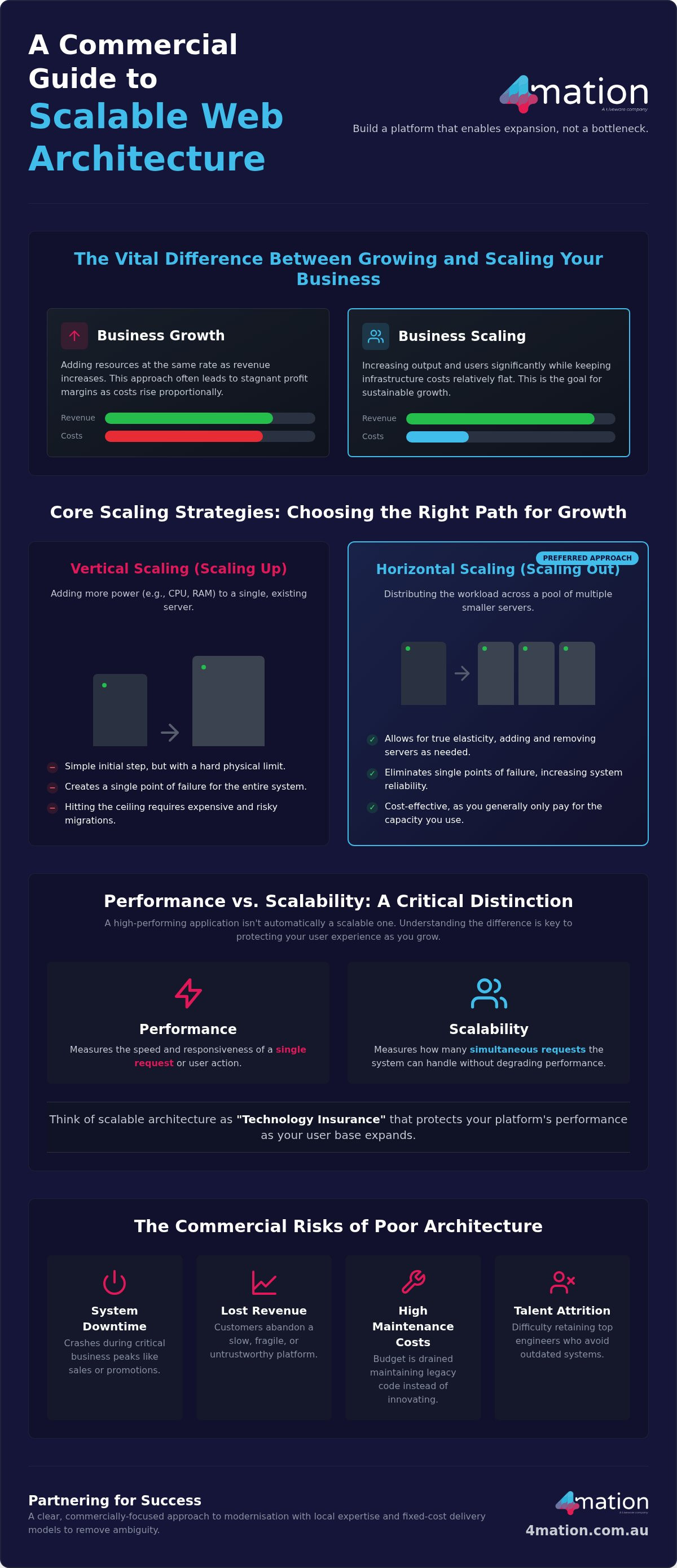
It’s vital to distinguish between growth and scaling in a commercial context. Growth often implies adding resources at the same rate as revenue increases, which can lead to stagnant margins. Scaling, however, allows you to increase your output and user base significantly while keeping costs relatively flat. Without the right architecture, you risk accumulating technical debt. This is a hidden cost where short-term fixes create long-term maintenance burdens that drain your budget and prevent innovation. Poorly architected systems lead to more than just slow loading times. They result in:
- System downtime during critical business peaks.
- Lost revenue from customers who abandon a fragile platform.
- High costs associated with maintaining outdated legacy code.
- Difficulty in attracting and retaining top-tier technical talent.
We believe in a business-first approach to technology. This means we don’t build for the sake of complexity; we architect for your specific operational goals. Whether you’re looking to automate manual processes or expand into new markets, your technology must be a foundational asset that supports those ambitions. For example, Tyrian Trade establishes a trust layer for modern financial markets through verified participation and community engagement, ensuring their platform can scale alongside their growing user base.
The Business Case for Scalability in Australian Organisations
Australian customers expect seamless digital experiences. If your system struggles during a promotion or a seasonal peak, you don’t just lose a transaction; you lose customer trust. Investing in a scalable foundation reduces the risk of expensive, total system rebuilds every few years. For organisations looking to start fresh with a professional new build, Rice Web Design provides the expertise needed to create a high-quality digital presence. It allows you to add features and users with confidence. Scalable architecture is the foundation for sustainable business growth.
Scalability vs. Performance: Clearing the Confusion
A common misconception is that a fast application is naturally a scalable one. Performance refers to the speed of a single request, while scalability is about how many of those requests the system can handle simultaneously. You might have a high-performing app that crashes the moment a hundred people use it at once. We view scalable architecture as a form of “Technology Insurance” that protects your speed as you grow. For a deeper look at modern standards, see our Web Application Development: 2026 Australian Guide. This distinction ensures your platform remains reliable as your business reaches new heights.
Core Principles of Scaling: Horizontal vs. Vertical Strategies
When building a scalable web application architecture, leaders generally face two primary paths: scaling up or scaling out. Vertical scaling, or scaling up, involves adding more resources like memory or processing power to your existing server. It’s often the simplest first step for Australian mid-market organisations because it requires minimal code changes. However, every server has a physical ceiling. Once you hit that limit, further growth becomes impossible without a complete and costly migration, which introduces significant delivery risk to your operations.
Horizontal scaling, or scaling out, is the preferred approach for modern, high-growth systems. Instead of relying on one giant server, you distribute the workload across a pool of smaller servers. This method allows for true elasticity, where your infrastructure automatically expands during peak traffic and shrinks when demand drops to save costs. By adopting Modern Architectural Patterns, you ensure your application isn’t tied to a single point of failure. This approach also extends to your data. Techniques like replication, which creates copies of your data for faster reading, or sharding, which splits data across multiple databases, prevent your storage layer from becoming a bottleneck as your dataset grows.
Choosing the Right Strategy for Your Load
Cost is a primary driver in these decisions. Vertical scaling can be cheaper initially, but it becomes exponentially expensive as you reach the high-end of hardware capabilities. Horizontal scaling offers a more linear cost-to-performance ratio. We often work with organisations to transition from vertical to horizontal models as their operational needs evolve. This shift requires a disciplined approach to manage delivery risk and ensure that code remains compatible with a distributed environment. If you’re unsure which path fits your current growth trajectory, it’s worth discussing your roadmap with a specialist.
The Role of Load Balancing
A horizontal strategy relies on a load balancer to act as a traffic warden. It directs incoming user requests to the server with the most available capacity at that moment. This setup ensures high availability; if one server fails, the load balancer simply reroutes traffic to the others without the user noticing. This failover capability is essential for maintaining a reliable service that customers can trust. Proper Solution Design ensures these components work together to provide a seamless experience for your users while protecting your bottom line from the costs of unexpected downtime.
Modern Architectural Patterns: Monoliths to Microservices
Choosing the right structure for your scalable web application architecture is a commercial decision that dictates how quickly your business can pivot. Most organisations begin with a monolithic architecture, where every component of the application is bundled together. This approach is straightforward to build and deploy initially. However, as your user base grows and features become more complex, the monolith often turns into a legacy burden. It slows down release cycles and makes the entire system fragile, where a small change in one area can cause unexpected failures elsewhere.
To achieve greater speed and team autonomy, many Australian firms move toward microservices. This pattern involves breaking the application into smaller, independent services that communicate with each other. The primary benefit is the ability to scale specific parts of your application without needing to scale the entire system. For example, if your checkout process is under heavy load but your product catalogue isn’t, you can allocate resources only to the checkout service. For specific tasks, serverless architecture further optimises costs by allowing you to run code without managing servers at all, ensuring you only pay for the exact processing power used.
We often assist with “Project Rescue” when an organisation’s current architecture hits a performance wall. Whether it’s a monolith that can’t handle traffic or a system that has become too expensive to maintain, we help pivot the technology toward a more stable and cost-effective foundation. This ensures your platform remains an asset rather than a liability.
When to Modernise Your Legacy Application
If your team is struggling with slow release cycles or frequent bugs, it’s a clear sign your architecture is stalling your growth. We often recommend the “Strangler Fig” pattern for modernisation. This involves gradually replacing legacy components with modern services until the old system is eventually phased out. This approach reduces delivery risk by delivering value in stages rather than through a single, risky “big bang” migration. For more on navigating these transitions, see our Digital Transformation: 2026 Australian Mid-Market Guide.
Avoiding the Over-Engineering Trap
It’s vital to focus on ROI rather than following technical hype. You don’t always need microservices on day one; sometimes, a well-structured monolith is the more commercial choice. Modern architecture must also support practical AI application development. Whether you’re integrating AI agents or chatbots, your system needs to handle the high concurrency these tools require without unnecessary complexity. We work with you to ensure your tech stack delivers measurable business value while remaining simple enough to maintain efficiently.
Essential Components of a Scalable Tech Stack
Building a scalable web application architecture requires more than just choosing between a monolith or microservices. You need the right components to act as the glue and engine of your platform. An API-first design ensures your system remains flexible, allowing different services to communicate seamlessly while making it easier to integrate future mobile apps or third-party tools. This approach reduces the risk of being locked into a rigid structure that can’t adapt as your commercial requirements change.
To deliver the speed your users expect, caching strategies are indispensable. By using tools like Redis or Memcached, we store frequently accessed data in memory. This significantly reduces the load on your database and slashes response times. For Australian organisations with a national or global footprint, Content Delivery Networks (CDNs) are equally vital. They distribute your static assets across a network of servers, ensuring users across the country experience consistent speed regardless of their physical distance from your primary data centre. We also implement asynchronous processing using message queues like RabbitMQ. This allows your application to handle heavy tasks, such as generating reports or processing payments, in the background without slowing down the user interface.
Data Management and Security
Your choice of database often dictates your scaling ceiling. While SQL databases are excellent for structured data and complex relationships, NoSQL options offer superior horizontal scaling for massive, unstructured datasets. Managing this in a distributed environment requires a disciplined approach to data integrity and security. As an AWS Select Consulting Partner, we bring verified infrastructure expertise to ensure your data remains secure and accessible, regardless of how much your traffic grows. For organisations looking to consolidate fragmented data silos into a unified interface, custom web portal development can provide a centralised single source of truth that complements a well-architected backend.
The Importance of Ongoing Support and Maintenance
A set and forget mentality is the fastest way to accumulate technical debt. Scalable architectures require proactive monitoring and incident response to maintain peak performance. We view this as Technology Insurance; it’s a way to protect your investment through Technology Support and proactive maintenance. Continuous improvement ensures your platform evolves alongside your business, removing the fear of system outages during critical growth phases. If you’re ready to future-proof your digital assets, contact our Sydney-led team today to discuss a roadmap for your organisation.
Partnering for Success: 4mation’s Approach to Scalable Delivery
Implementing a scalable web application architecture is a significant investment that requires a partner who values long-term stability over fleeting trends. We’ve spent 25 years helping Australian organisations navigate these complexities, moving from initial strategy to reliable, ongoing support. Our Sydney-led team of specialists understands the local business environment, ensuring your technology aligns with your commercial goals while removing the delivery risks often associated with large-scale modernisation. We pride ourselves on being a steady, reliable hand in a complex industry, focusing on measurable success rather than unnecessary technical jargon.
We don’t just build software; we provide a foundation for your business to grow with certainty. By combining high-level strategic consulting with deep technical knowledge, we ensure your platform is ready for the next wave of automation and practical AI implementation. This end-to-end journey includes everything from initial Solution Design to the proactive maintenance provided by our Service Desk. Our local expertise means we’re available when you need us, providing a “safe pair of hands” for your most critical digital assets and ensuring your architecture remains a foundational business asset.
Reducing Risk with Fixed-Outcome Projects
Budget anxiety is a common barrier to architectural modernisation. We address this directly through our Fixed-Cost Project Engagement model. This guarantee provides certainty on both budget and outcomes, ensuring your project is delivered on time and bug-free. By eliminating the ambiguity in architectural planning, we work with you to solve complex problems without the fear of hidden costs or scope creep. This disciplined approach allows you to invest in your digital future with total confidence in the eventual ROI.
Your Roadmap to a Scalable Future
Every organisation’s path to scalability is unique. We often begin with a practical AI audit or a digital strategy session to identify where technology can create the most value for your operations. This audit looks beyond the hype to see how automation can reduce manual processing and improve efficiency. For larger organisations evaluating a more comprehensive platform strategy, our guide to enterprise web application development provides a detailed roadmap for achieving delivery certainty and measurable ROI. If your internal resources are stretched, we offer Staff Augmentation to scale your team’s capabilities quickly and effectively with experienced developers. Together, we’ll build secure, scalable software that doesn’t just meet your current needs but is prepared for the future growth of your organisation.
Secure Your Digital Foundation for Future Growth
Building a scalable web application architecture is about more than just managing traffic; it’s about ensuring your technology remains a flexible asset that drives revenue and efficiency. We’ve explored how moving beyond legacy bottlenecks and adopting modern patterns can reduce technical debt. By focusing on essential components like API-first design and proactive maintenance, you protect your organisation from the high costs of system outages and rebuilds.
With 25 years of client success and our status as an AWS Select Consulting Partner, we provide the steady hand you need for complex modernisation. Our fixed-cost, bug-free guarantee removes financial ambiguity, allowing you to focus on your commercial objectives with total peace of mind. Together, we can transform your digital platform into a reliable engine for long-term expansion.
Ready to future-proof your systems? Book a Consultation with 4mation to Scale Your Business and take the next step toward a more resilient digital future.
Frequently Asked Questions
What is the difference between horizontal and vertical scaling?
Vertical scaling involves adding more memory or processing power to a single server, which is often a quick fix but has a physical limit. Horizontal scaling adds more servers to a pool, allowing for a more flexible scalable web application architecture. While vertical scaling is simpler initially, horizontal scaling provides true elasticity and prevents a single point of failure, making it the standard for high-growth Australian businesses.
When should my business move from a monolith to microservices?
You should consider moving when your monolithic system begins to stall your growth through slow release cycles or frequent, unpredictable bugs. If a small update in one area risks breaking the entire platform, the complexity has likely outgrown the structure. Transitioning to microservices allows your teams to work independently on different features, improving delivery speed and ensuring that specific components can scale without affecting the rest of the system.
How much does it cost to build a scalable web application?
The investment required depends heavily on your specific operational goals and the complexity of the required features. Rather than focusing on a generic price point, we prioritise deliverable business value and return on investment. To remove financial ambiguity, we offer a fixed-cost project delivery guarantee. This ensures your modernisation project stays on budget while providing a secure, high-performing foundation that reduces long-term maintenance costs and technical debt.
Can legacy systems be made scalable without a total rebuild?
Yes, legacy systems can often be modernised incrementally without the risk of a total rebuild. We frequently use the Strangler Fig pattern, where we gradually replace outdated components with modern, scalable services. This approach allows you to maintain business continuity while slowly shifting your platform toward a more robust scalable web application architecture, delivering measurable improvements in performance and reliability at every stage of the journey.
How does cloud hosting (like AWS) help with scalability?
Cloud platforms like AWS provide the infrastructure needed for auto-scaling, allowing your application to automatically adjust resources based on real-time demand. As an AWS Select Consulting Partner, we use these tools to ensure your platform handles traffic spikes without manual intervention. This elasticity means you only pay for the resources you actually use, significantly reducing overheads while providing the high availability and security expected by modern Australian organisations.
What role does AI play in modern web application architecture?
AI integration requires an architecture capable of handling high concurrency and large data flows. Modern systems must be designed to support AI agents and automated decision-making processes without degrading overall performance. By using an API-first approach, we ensure your platform can seamlessly connect with AI models, allowing you to automate manual tasks and provide more personalised user experiences while maintaining the core stability of your digital infrastructure.
What is ‘technology insurance’ and why is it important for scaling?
We define technology insurance as a proactive approach to maintenance and support that protects your digital investment. It involves continuous monitoring and regular updates to prevent system outages before they occur. For a scaling business, this is vital because it ensures your platform remains reliable during periods of rapid growth. It removes the anxiety associated with large-scale technology investments by providing a safe pair of hands for your ongoing operations.
How do I choose the right technology stack for a scalable app?
Choosing the right stack involves balancing your immediate commercial needs with long-term flexibility. We look for technologies with strong community support, such as .NET 10 or React 19, to ensure your application remains maintainable for years. The decision should be based on your specific load requirements and the ability of the stack to support horizontal scaling. We work with you to select a stack that delivers the best return on investment. Organisations that also need to unify their users’ experience across multiple systems may benefit from exploring custom web portal development as a complementary strategy for consolidating workflows and reducing operational friction.
About The Author
