AI Solution Integration: Strategic Enterprise Guide for 2026
Jowena BorralDigital Marketing Specialist

Most enterprise leaders know the frustration of isolated technology pilots that look promising in testing yet fail to generate sustained value across daily operations. The reality is that successful ai solution integration does not require rebuilding your core software from scratch or exposing proprietary data to unnecessary risk. Rather than forcing an expensive rip-and-replace overhaul, true operational progress comes from establishing reliable, secure connections between intelligent models and the business platforms your teams use every day.
If your organisation is wrestling with disconnected data silos, tightening compliance obligations, and boardroom scrutiny around commercial returns, that caution is entirely sensible. This guide provides a strategic roadmap to integrate AI solutions into your core systems securely, reliably, and with clear commercial returns. We explore the architectural patterns, governance frameworks, and practical deployment methods that safeguard enterprise continuity while driving measurable gains in productivity and operational accuracy.
Key Takeaways
- Enterprise AI adoption succeeds by connecting intelligent models directly into existing operational workflows rather than undertaking costly system rewrites.
- Selecting the right architectural pattern across Direct APIs, RAG, and autonomous agents ensures manageable engineering complexity and predictable compute expenses.
- A structured five-stage delivery roadmap mitigates disruption while delivering practical ai solution integration with clear commercial returns.
- Robust governance and local data privacy protocols protect proprietary IP from being exposed or used to train external public models.
- Partnering with an experienced engineering team provides fixed-scope delivery certainty and long-term support across the entire software lifecycle.
What Is AI Solution Integration in Enterprise Environments?
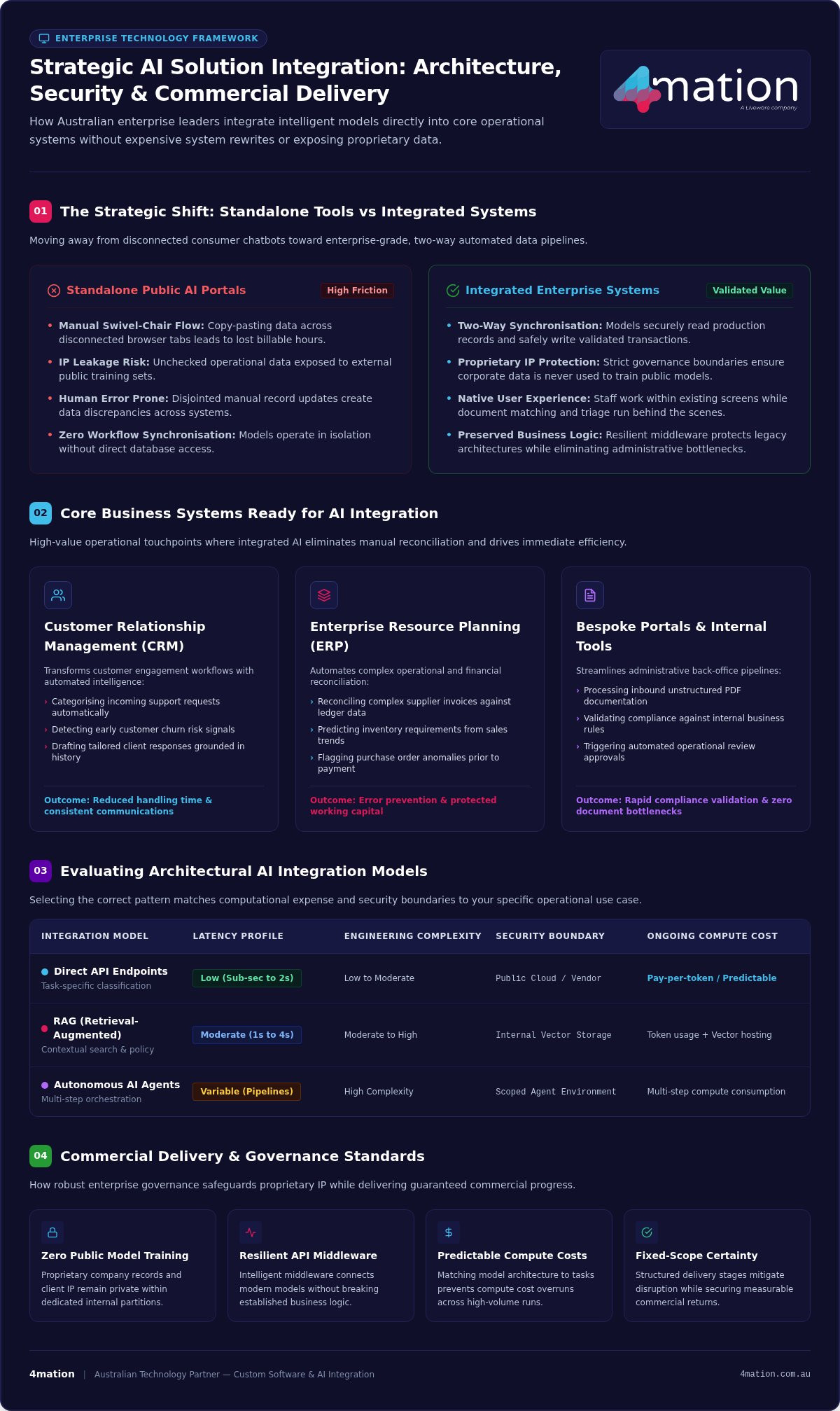
Enterprise ai solution integration is the deliberate engineering process of embedding intelligent models directly into your existing software ecosystem. Rather than treating artificial intelligence as a separate experiment, integration connects machine learning capabilities straight into your databases, enterprise resource planning, and customer relationship software. The broad academic field of Artificial intelligence systems integration focuses on making disparate software components interoperable; in a commercial setting, this means turning standalone algorithms into practical, automated business workflows.
Many Australian enterprises have moved past consumer-grade chatbots. While testing external tools proved that generative technology has real utility, isolated applications don’t deliver enterprise value. True operational automation happens when an AI model can securely read from your production records, process unstructured inputs, and safely write validated transactions back to your core database. Crucially, this transformation doesn’t require tearing down your legacy software. By introducing intelligent middleware and resilient application programming interfaces (APIs), you preserve your established business logic while eliminating repetitive administrative bottlenecks.
The Distinction Between Standalone AI Tools and Integrated Systems
Relying on public web portals creates friction. When team members copy and paste operational data between disconnected browser tabs, you face significant data leakage risks, human error, and lost billable hours. This manual swivel-chair workflow undermines the productivity gains AI promises to deliver.
A unified system establishes automated, two-way synchronisation between the AI layer and your software stack. Staff continue working within familiar user interfaces while models process complex document matching, sentiment analysis, and record triage behind the scenes. This seamless connection reduces manual data entry and provides accurate, real-time insights without staff having to leave their primary operational screens.
Core Business Systems Ready for AI Solution Integration
High-value opportunities generally exist where team members spend hours reconciling fragmented information across disparate records:
- Customer Relationship Management (CRM): Automatically categorising incoming support requests, detecting customer churn signals, and drafting tailored responses grounded in historical client notes.
- Enterprise Resource Planning (ERP): Reconciling complex supplier invoices, predicting inventory requirements based on seasonal sales patterns, and flagging purchase order anomalies before payment runs occur.
- Bespoke Portals and Internal Tools: Processing inbound PDF forms, validating compliance documents against internal operational rules, and triggering automated approvals.
Modernising these workflows often involves enhancing legacy applications through dedicated custom software development services, ensuring your underlying digital infrastructure handles modern computational workloads cleanly and securely.
Evaluating Modern AI Integration Models for Your Architecture
Every enterprise technology stack presents unique operational boundaries. Selecting the appropriate architectural pattern for your ai solution integration directly dictates your ongoing hosting expenses, response latency, and data governance posture. Rather than forcing a single approach across all workflows, commercial stability relies on matching each business use case to the right integration model.
| Integration Model | Latency Profile | Engineering Complexity | Security Boundary | Ongoing Compute Cost |
|---|---|---|---|---|
| Direct API Endpoints | Low (Sub-second to 2s) | Low to Moderate | Public Cloud / Vendor Boundary | Pay-per-token / Predictable |
| Retrieval-Augmented Generation (RAG) | Moderate (1s to 4s) | Moderate to High | Internal Vector Storage | Token usage plus vector index hosting |
| Autonomous AI Agents | Variable (Multi-step pipelines) | High | Strictly Scoped System Permissions | Compounded API calls per task execution |
A hybrid configuration frequently delivers the greatest commercial return. Highly sensitive data remains secured on private cloud infrastructure, while non-sensitive generative processing routes through scalable third-party APIs. Incorporating established guidelines from the NIST AI Risk Management Framework ensures your hybrid integration maintains reliable controls around data integrity and system reliability.
API Middleware and Microservices Architecture
Decoupled microservices create a protective barrier between legacy codebases and external AI endpoints. By routing calls through a dedicated middleware gateway, you implement essential rate limiting, intelligent response caching, and graceful fallbacks. If an upstream AI model encounters downtime, your operational software continues functioning without disruptions. Asynchronous event queues handle heavy document analysis or batch processing in the background, keeping front-end systems responsive for staff.
Retrieval-Augmented Generation (RAG) for Proprietary Data
Retrieval-Augmented Generation connects machine learning capabilities directly to your commercial facts without costly model retraining. A vector database converts internal policies, product specifications, and past project notes into searchable numerical representations. When a staff member submits a query, semantic search retrieves only the relevant corporate context to generate an accurate, hallucination-free response.
Access-controlled data chunking ensures users only retrieve information matching their existing enterprise permissions. If you need clarity on configuring vector pipelines securely, consulting specialized AI consulting services will help validate your architectural roadmap before deployment.
Custom Autonomous AI Agents in Operational Workflows
Autonomous agents handle multi-stage business tasks across disparate platforms. An agent can read an inbound supplier notice, extract line items, cross-check current ERP inventory levels, and stage a draft order. To prevent rogue actions, these workflows operate within strict role-based access rules. Critical operational junctures, like approving large disbursements or releasing compliance documents, consistently mandate a human-in-the-loop review before final execution.
If you want to evaluate which architecture best suits your legacy platforms, you can speak with our engineering team to assess your current systems.
A Step-by-Step Framework for Successful AI Solution Integration
Moving from an experimental pilot to production software demands a disciplined engineering roadmap. Research from IBM on navigating AI integration challenges underscores that project failures rarely stem from model limitations; they result from unaddressed data fragmentation and operational friction. A structured five-stage framework ensures your ai solution integration delivers predictable commercial returns without disrupting business continuity:
- Commercial and Technical Audit: Define measurable business metrics, such as processing turnaround times or error reduction targets, and confirm legacy system compatibility.
- Data Pipeline Sanitisation: Normalise data schemas, resolve duplicate records, and establish filtering protocols to protect sensitive records.
- Isolated Prototyping: Build a sandboxed Proof of Concept (PoC) to benchmark latency, output consistency, and compute efficiency.
- Middleware and Security Hardening: Implement rate limiting, encrypted transmission tunnels, and granular role-based access controls.
- Phased Operational Rollout: Deploy the integration to a single internal team first, validating workflows before scaling enterprise-wide.
Data Preparation and Schema Standardisation
Machine learning models require clean, deterministic data inputs to deliver reliable outputs. Unstandardised database records, duplicate CRM entries, and inconsistent field formatting will degrade your integration results. Engineering teams build automated sanitisation pipelines that strip out unnecessary personal details before sending payloads to inference endpoints.
Establishing rigid JSON schemas ensures model outputs map directly back into your database fields, eliminating manual data correction. Assessing legacy code health prior to deployment guarantees your existing infrastructure handles high-frequency API calls reliably.
Validating Integrations Through Rapid Prototyping
Validate technical feasibility with a tightly scoped Proof of Concept before touching core business processes. Isolating the prototype to one specific bottleneck, like invoice reconciliation or customer query routing, lets you benchmark real-world response times, accuracy rates, and team adoption.
Sandboxed testing enables engineers to fine-tune context windows, vector embeddings, and fallback routines without operational risk. Engaging through structured fixed-cost project delivery removes financial ambiguity, keeping project scope tightly bound to verified commercial outcomes.
Overcoming Data Security, Privacy and Technical Governance Risks
Executive hesitation around enterprise AI rarely stems from doubts about capability; it centres on data privacy, trade secret protection, and regulatory exposure. Under the Australian Privacy Principles, organisations must manage customer and commercial records with verifiable care. With statutory obligations increasingly requiring businesses to disclose automated decision-making systems, achieving compliant ai solution integration requires an architecture that prevents corporate IP from leaking into public training datasets while keeping every transaction auditable.
Securing Sensitive Corporate Data and Intellectual Property
Commercial tier cloud infrastructure allows organisations to execute legal and technical boundaries that guarantee customer inputs are never used to train public foundational models. Robust enterprise integrations enforce this boundary through four primary security layers:
- Private Virtual Cloud Endpoints: Routing all inference traffic through dedicated virtual private clouds (VPCs) rather than open internet gateways.
- Automated Data Tokenisation: Sanitising customer records and proprietary figures before payloads reach model layers, replacing identifiable details with synthetic placeholders.
- End-to-End Encryption: Enforcing TLS 1.3 for data in transit and AES-256 for data at rest across all vector indexes and intermediary databases.
- Granular Role-Based Access Control (RBAC): Synchronising user authentication with existing enterprise directory services so personnel cannot query data above their established security clearance.
Mitigating Hallucinations and Managing System Failures
Enterprise systems require deterministic reliability. While large language models are inherently probabilistic, business software cannot tolerate erratic outputs. Protecting your operational integrity means wrapping AI models in strict engineering guardrails. Setting low model temperatures and tight confidence thresholds ensures outputs remain factual and grounded in approved data.
Secondary validation rules test generated responses against predefined database schemas before any transaction commits to your core software. When an output fails validation or falls beneath a set confidence score, the system executes an automated fallback, routing the task to a staff member for manual review. Pairing automated safeguards with long-term technology support and maintenance ensures your pipelines remain secure, calibrated, and resilient against unexpected edge cases.
To evaluate your current data workflows and implement integration security tailored to your compliance environment, contact our team today.
Partnering for Commercial Certainty: The 4mation Integration Approach
Adopting advanced automation shouldn’t feel like an expensive gamble. While experimental agencies frequently chase novel algorithms without considering enterprise viability, 4mation takes a disciplined, business-first approach. With 25 years of engineering experience delivering complex enterprise software, we design ai solution integration architectures that solve tangible operational problems, increase team capacity, and protect bottom-line performance.
Our multidisciplinary team of over 40 local tech specialists works across Australia alongside global engineering resources to deliver enterprise outcomes without unnecessary technical debt. As an AWS Select Consulting Partner and an Advanced Supplier on the NSW Government ICT Services Scheme, we adhere to stringent security standards and formal technical governance on every engagement. Delivery risk is eliminated through our fixed-cost model, ensuring your project arrives on time, on budget, and bug-free.
From Initial Discovery to Long-Term Technology Insurance
Every successful project begins with collaborative discovery. We analyse your existing database schemas, user workflows, and operational pain points to verify commercial viability before writing code. Once we validate technical feasibility in a sandboxed staging environment, our team manages the phased transition into live production.
Post-deployment care is equally critical. Our dedicated Service Desk provides ongoing monitoring, performance tuning, and preventive maintenance to ensure your integration remains reliable as data volumes scale. When internal teams require specialised engineering capacity to accelerate wider digital initiatives, we supply flexible staff augmentation resources that embed seamlessly into your existing technical squads.
Evaluating the Real Value of an Experienced Partner
Poorly architected integrations create brittle dependencies that lead to system outages, unpredictable compute costs, and operational disruption. Partnering with an established technology firm gives you direct access to battle-tested design patterns developed across financial services, healthcare, transport, and manufacturing sectors.
We ensure your internal teams maintain complete ownership of your new systems. Our engineers deliver thorough architectural documentation, conduct hands-on administrative training, and implement clear observability dashboards. If you are ready to explore practical ai solution integration for your core systems, reach out to our senior team to schedule a strategic consultation.
Turning Practical AI Integration into Enterprise Value
Successful enterprise transformation doesn’t require high-risk software overhauls or unproven experiments. Sustainable commercial returns come from disciplined engineering: embedding intelligent models into the applications your teams already rely on, standardising data pipelines, and maintaining uncompromising security boundaries. A measured approach to ai solution integration safeguards proprietary corporate data while turning routine operational friction into measurable efficiency gains.
With 25 years of engineering experience, over 40 local tech specialists, and verified credentials as an AWS Select Consulting Partner and NSW Government Advanced Supplier, 4mation delivers technical governance you can trust. Our fixed-cost delivery commitment ensures your implementation arrives on time, on budget, and bug-free. When you’re ready to modernise your operational software with confidence, discuss your AI integration project with 4mation to establish a clear, commercially validated roadmap.
Frequently Asked Questions
How long does a typical enterprise AI solution integration project take?
Project timelines depend on your architectural maturity and integration scope. A focused Proof of Concept typically takes four to six weeks to validate technical feasibility and commercial viability. Production-grade enterprise rollouts generally take between three and six months, accommodating legacy data hygiene, middleware construction, security reviews, and phased team adoption. We establish clear milestone delivery so your organisation sees measurable progress early.
Can we integrate modern AI capabilities with our legacy software systems?
Yes, you can modernise your capabilities without undertaking a costly system rebuild. We build custom API middleware and microservices that sit between your legacy databases and modern model endpoints. This decoupled layer handles data transformation, query caching, and rate limiting safely. Your core business logic remains untouched, allowing your organisation to achieve seamless ai solution integration while preserving existing operational stability.
Will our private business data be used to train public AI models?
No, your proprietary commercial data and customer records are never used to train public models. We configure dedicated enterprise-tier infrastructure through secure cloud environments like AWS, enforcing strict contractual and technical boundaries. All data transmissions are encrypted using modern protocols, and automated sanitisation pipelines strip sensitive identifiers before processing, ensuring complete compliance with the Australian Privacy Act.
What is the difference between custom AI integration and off-the-shelf software?
Off-the-shelf software forces your business to adapt its internal processes to rigid, third-party constraints, often creating new data silos and recurring licensing fees. Custom integration connects intelligent models directly into your bespoke databases, ERPs, and customer portals. You maintain full ownership of your intellectual property, retain complete control over your security posture, and automate workflows tailored exactly to your established business logic.
How do you prevent AI hallucinations from affecting critical business workflows?
We eliminate hallucinations by combining Retrieval-Augmented Generation with strict programmatic guardrails. Instead of relying on open-ended generation, models are forced to retrieve answers solely from your verified internal documentation. We apply low temperature settings, deterministic JSON schema validation, and confidence scoring. If a response falls below our verified accuracy threshold, automated fallbacks instantly redirect the transaction to human personnel for review.
What engagement models does 4mation offer for AI integration projects?
4mation offers four flexible engagement models structured around your commercial needs. Our Fixed-Cost project delivery guarantees your scope arrives on time, on budget, and bug-free to remove financial risk. We also provide Ongoing Agile development for evolving platforms, dedicated Staff Augmentation to expand your internal technical teams, and ongoing Service Desk support to deliver proactive technology maintenance and platform insurance.
How do we measure the return on investment from AI solution integration?
Return on investment is measured against tangible operational outcomes established during initial project discovery. Successful ai solution integration tracks concrete metrics such as reduced manual data handling hours, faster customer enquiry resolution, improved invoicing accuracy, and increased capacity across existing teams. Tying technical implementation directly to business overhead reductions and revenue acceleration ensures your leadership team achieves verifiable commercial returns on technology expenditure.
About The Author
