2026 Strategic Guide to the Software Development Life Cycle
Jowena BorralDigital Marketing Specialist

What if your software project could be managed as a business investment, not an open-ended technical build? The software development lifecycle for business owners provides a practical framework to set clear goals, track progress and make informed decisions before costs or complexity start to grow.
If you’re concerned about spiralling budgets, limited visibility or a system that creates more technical debt than value, you’re right to look beyond the code. A project needs a clear roadmap, agreed priorities and regular opportunities to check that the solution still meets your operational needs. No process removes every uncertainty, but a disciplined lifecycle helps bring risks into view early.
This guide explains how to use each stage of the lifecycle to improve delivery certainty, control spending and keep technology aligned with measurable business outcomes. We’ll cover how to define the problem, plan and build the right solution, test it before release, and support it as your needs change. With an experienced partner working alongside you, software development becomes a structured path towards a scalable product, rather than an endless build.
Key Takeaways
- Use the software development lifecycle for business owners to connect project decisions with commercial goals, manage risk and keep delivery on track.
- Clarify the problem and user needs before choosing a solution, so the software supports real work and is more likely to be adopted.
- Compare Agile, Waterfall and Hybrid approaches against your project’s priorities, then agree how scope, budget and outcomes will be managed.
- Consider how AI, security and scalability fit your requirements, with practical oversight to keep the solution reliable as it grows.
- Plan for the full lifecycle, including ongoing support, so your software can adapt as your organisation’s needs change.
Demystifying the SDLC: Why It’s Your Business’s Most Critical Risk Management Tool
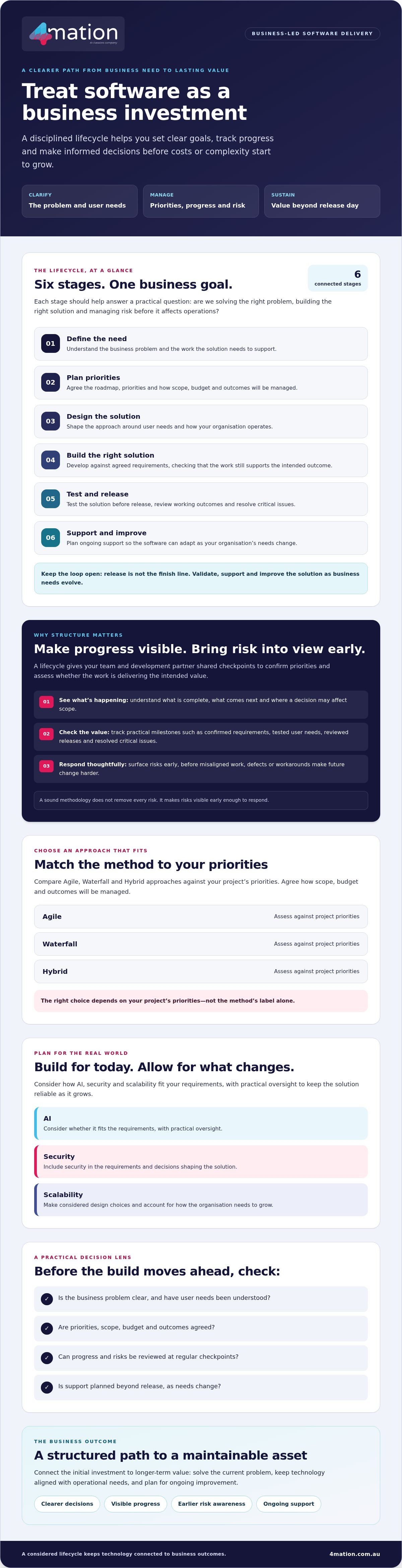
A software project can appear to be progressing while still drifting away from the problem it needs to solve. The Software Development Life Cycle (SDLC) helps prevent that drift. It’s a structured business process for defining a need, planning and designing a solution, building and testing it, then supporting and improving it over time. For business leaders, the software development lifecycle for business owners makes progress easier to understand and decisions easier to manage.
The SDLC isn’t paperwork for its own sake. It gives your team and development partner shared checkpoints to confirm priorities, surface risks and assess whether the work is delivering the intended value. For a neutral overview of lifecycle concepts and methodologies, see the Software development process.
From Complexity to Clarity: The Business Case for Structure
A robust lifecycle replaces assumptions with agreed outcomes. Instead of measuring progress by technical activity alone, you can track practical milestones: requirements confirmed, user needs tested, a working release reviewed, or critical issues resolved. That clarity helps decision-makers see what has been completed, what comes next and where a choice or change may affect scope.
Winging it creates avoidable exposure. If teams start building before they understand how work gets done, they may automate the wrong task or miss a key user need. Skipping design or testing can leave defects and workarounds that take time to address later. This technical debt makes future changes harder and can limit the system’s ability to scale. A sound methodology doesn’t remove every risk, but it makes risks visible early enough to respond thoughtfully.
That’s the “safe pair of hands” difference: translate technical work into clear decisions, responsibilities and outcomes. At 4mation, we focus on solving complex business problems, working with you to understand the operational need before shaping the technology around it.
The 2026 Commercial Reality of Software Investment
Software is rarely a one-off purchase. It can become part of how your organisation serves customers, manages information and runs daily operations. Like any foundational asset, it needs to remain useful as the business changes. The SDLC connects the initial investment to that longer-term value by building in planning, validation and ongoing improvement.
This matters in a competitive Australian market, where poorly aligned technology can slow teams down or make change more difficult. A lifecycle gives you a way to check that investment against business priorities, user needs and future requirements, rather than treating release day as the finish line.
When standard tools don’t fit your processes, custom software development can help shape a solution around how your organisation works and needs to grow. The right process keeps that flexibility purposeful: solve the current problem, make considered design choices and plan for support after launch. That’s how a software project can become a maintainable business asset, rather than another system your team has to work around.
The 6 Key Stages of Software Development: Translating Technical Milestones into Value
Each stage of the software development lifecycle should answer a business question: are we solving the right problem, building the right solution and managing risk before it affects your operations? For business leaders, the software development lifecycle for business owners turns technical work into visible decisions and outcomes. IBM’s guide to the SDLC also explains how lifecycle stages help teams manage project risks and stakeholder expectations.
- 1. Strategy and discovery: Define the business problem, users, priorities and measures of success before committing to a solution.
- 2. Solution design and UX: Map how people will use the software. Prototypes can help validate workflows early, before they become expensive to change.
- 3. Development and engineering: Build the agreed solution with security, performance and future growth in mind.
- 4. Testing and quality assurance: Check that features work as intended, identify defects and confirm the software meets agreed requirements.
- 5. Deployment: Plan the release, user readiness and transition into day-to-day operations to help limit disruption.
- 6. Maintenance and evolution: Address issues, maintain reliability and adapt the software as business needs change. Ongoing technology support helps protect the investment beyond launch.
Discovery and Design: Where ROI Is Won or Lost
Starting with a feature list can lead to software that works technically but misses the business need. 4mation works with you to understand goals, processes and user needs first, then shapes the solution around them. Prototyping gives stakeholders an early way to review key workflows and provide feedback. Industry context matters too: construction teams, for example, may need software that reflects the practical demands of their operations.
Engineering and QA: Building for Longevity
Good engineering balances delivery with security, stability and maintainability. Testing throughout development can reveal defects before release, when they’re easier to investigate and resolve. If quality checks happen too late, gaps may surface during rollout or under real operating conditions, prompting urgent rework that could have been identified earlier. In financial software, careful validation of important workflows supports confidence in reliable day-to-day use.
These stages work together, not as isolated hand-offs. Clear requirements guide design; design informs development; testing checks the result against the original need. That structure supports 4mation’s focus on solving complex business problems with a practical, full-lifecycle approach. If you’re considering a software project, talk with our team about your goals and the outcomes you need the solution to deliver.
Choosing the Right Methodology: Agile, Fixed-Cost, and Delivery Certainty
The right development approach depends on how clearly you can define the work, how much flexibility you need and how you want to manage budget risk. The software development lifecycle for business owners is most useful when the methodology supports those commercial needs, rather than being chosen simply because it’s familiar to a delivery team.
Waterfall follows a sequence of defined stages. It can suit projects with stable requirements and clear approval points, but changes made late in the process may require careful replanning. Agile delivers work in short cycles, allowing teams to learn from feedback and adjust priorities as they go. It can suit evolving products, but flexibility still needs budget limits and decision rules. A Hybrid approach sets firm boundaries around scope, funding or key milestones, while allowing iteration within those boundaries.
Fixed-Cost vs. Agile: Which Fits Your Risk Profile?
Fixed-cost delivery is generally a better fit when you can define the scope, budget and deadline up front. Agile or ongoing development may be more suitable when user feedback or changing requirements will shape the product over time. The choice is not simply “certainty or flexibility”. It’s about deciding where you need certainty and where change is valuable.
Agile shouldn’t mean an unlimited commitment. Agree a budget or time limit for each delivery period, set priorities, review completed work and decide together what comes next. That keeps adaptation deliberate and gives you regular opportunities to assess value. Businesses with an internal development team may also use staff augmentation to add specialist capacity while retaining their own direction and product knowledge.
Delivery Certainty: The 4mation Guarantee
4mation’s Fixed-Cost / Fixed-Outcome model is designed for projects where defined scope and predictable delivery matter. The stated guarantee is on-time, on-budget and bug-free delivery. A structured SDLC supports that commitment by clarifying requirements, agreeing milestones, reviewing progress and testing against the expected outcome before release.
Those checkpoints make project conversations more transparent. You can see what’s complete, what decisions are needed and whether a proposed change affects the agreed scope or plan. If requirements shift, discuss the impact before changing direction. That way, you and your delivery partner can make informed trade-offs without losing sight of the business outcome.
For a product that will keep evolving, ongoing Agile Development can provide a planned way to prioritise improvements after an initial release. The key is to maintain clear ownership, a visible backlog and regular budget reviews. If you’re weighing up which approach best fits your goals, discuss your project requirements with 4mation.
The Modern SDLC in 2026: Incorporating AI, Security, and Scalability
AI, security and growth needs shouldn’t be added as afterthoughts once a system is already built. They belong in early SDLC decisions, where you can assess business value, risks and integration needs before committing to an approach. For the software development lifecycle for business owners, this means treating modern technology as a practical choice tied to operational outcomes, not a trend to adopt by default.
Practical AI: Beyond the Hype
AI can change discovery by helping teams identify suitable tasks, examine workflow bottlenecks and test assumptions about where automation may save time. 4mation’s AI application development should begin with the business problem: what work could be improved, what information is available, and how will people review the result?
A prototype can help test an idea, but it isn’t the same as a production-ready solution. Before moving beyond experimentation, consider data quality, privacy, integration with existing systems, exception handling and human oversight. These decisions matter even more for AI agents, which can take actions across connected systems. Define what an agent can access and do, where a person must approve decisions, and how activity will be monitored. That helps keep automation useful and accountable.
Future-Proofing Your Technology Stack
Modernising a legacy system is not simply replacing old technology. It’s an opportunity to address operational constraints, reduce reliance on fragile workarounds and make future changes easier to manage. In discovery, identify which systems need to connect, what information they exchange and which parts of the business depend on them. This gives your team a clearer basis for planning the transition.
Security should be designed into requirements, architecture, development and testing, rather than left until launch. The OWASP Top 10 2025 highlights risks including broken access control and software supply chain failures. For a business, that makes practical questions important from the outset: who should access sensitive functions, how will third-party components be managed, and how will the system respond when something goes wrong?
Scalability also starts with business needs. A cloud-native architecture may support growth and flexible deployment, but the right design depends on your workloads, integrations and operating requirements. 4mation is an AWS Select Consulting Partner, and technology choices should still be made to fit your situation, not selected by default. After launch, ongoing support and continuous improvement help keep software secure, useful and aligned with changing priorities.
To assess where AI, modernisation or security should fit in your development plans, talk with 4mation about your technology goals.
Partnering for Success: How 4mation Navigates the Lifecycle with You
A successful software project depends on more than a sound technical plan. You also need a partner who understands your business priorities, communicates clearly and stays accountable beyond launch. The software development lifecycle gives that relationship structure, from early decisions about what to build through to the support that helps keep it useful.
4mation takes a business-first approach to custom software and AI, working with you to understand the problem before recommending a solution. With 25 years of client success, we bring experience across the full lifecycle, from strategy and delivery to ongoing technology support. The aim is a long-term partnership focused on solving the right problem, not a one-off transaction that ends when the software goes live.
The Path from Strategy to Support
Launch is a transition, not the finish line. Once people rely on a system in their daily work, support matters. 4mation’s Service Desk can provide what we describe as “Technology Insurance”, a way to help protect the value of your software through ongoing support and improvement. Depending on your needs, this can include addressing issues, reviewing platform performance and identifying opportunities to refine the solution.
For example, Altus Traffic is a client associated with platform growth. Its experience points to an important lifecycle principle: software needs to keep pace as operational needs develop. Explore how continuous improvement and development can help keep a solution aligned with changing business priorities.
Taking the First Step Toward Your Digital Transformation
A useful discovery conversation starts with the business challenge, not a list of features. Before speaking with a potential partner, consider preparing:
- The problem: Which process, customer experience or operational constraint needs attention?
- The desired outcome: What should improve, and how will you recognise progress?
- The current environment: Which systems, data and teams will the solution need to work with?
- The constraints: What matters most around timing, budget, security and internal capacity?
Look for a partner who asks about your users and business goals, explains trade-offs in plain English, and makes scope, risks and progress visible. A reliable partner should help you assess whether custom software is appropriate, rather than add complexity for its own sake. They should also discuss how the solution will be supported after release.
Bring your current challenges and goals to the conversation, even if the solution isn’t clear yet. Contact 4mation to discuss your project and business needs.
Turn your software investment into lasting business value
A clear lifecycle helps you keep software projects tied to business goals, make informed choices about delivery and plan for what happens after launch. The software development lifecycle for business owners isn’t just a development framework. It’s a practical way to manage risk and give your technology a stronger chance of delivering lasting value.
The right approach depends on your goals, how defined the scope is and how much change you expect. Whichever model you choose, clear milestones, open communication and ongoing support help keep progress visible and your solution relevant as your organisation grows.
4mation brings 25 years of experience to software delivery, with a Fixed-Cost / Fixed-Outcome guarantee covering on-time, on-budget and bug-free delivery. We work with you to understand the business problem, agree on a suitable path and support the technology beyond its initial build.
Ready to bring more certainty to your next software project? Contact the 4mation team to discuss your goals. With a clear plan and the right partner, your next technology investment can become a practical foundation for progress.
Frequently Asked Questions
What is the most important stage of the software development lifecycle for a business owner?
Discovery is often the most important starting point because it confirms the business problem before you commit to a solution. Define who needs the software, what should improve and how you’ll assess success. This gives design, development and testing a shared direction. The other stages remain essential, but without clear goals early on, even well-built software can solve the wrong problem or fail to meet user needs.
How long does a typical custom software project take from discovery to launch?
There’s no reliable standard timeframe for every custom software project. Timing depends on the scope, integrations, user needs, technical complexity and how quickly your team can review decisions and provide feedback. A small initial release may have different requirements from a platform that replaces several systems. Ask your development partner to map the work into stages, explain key dependencies and provide a project-specific estimate after discovery.
Why is a fixed-cost model often better for business owners than pure Agile?
A fixed-cost model can suit you when requirements, scope and outcomes are clear, because it provides an agreed basis for managing delivery and budget. Agile is useful when priorities are expected to evolve, but it still needs spending limits, regular reviews and clear decision-making. Neither model is best for every project. Choose based on how much is known, how much may change and the level of budget certainty your organisation needs.
What happens to the software after the development lifecycle is complete?
Software needs support after launch. Your organisation may need maintenance, technical assistance, updates, performance reviews or further development as users and business requirements change. Agree who will manage these responsibilities before the project ends, including how your team will report issues and prioritise improvements. 4mation offers Managed Services & Support, including ongoing maintenance and technical support to help maintain the reliability and performance of digital solutions.
How does AI integration impact the cost and timeline of the SDLC in 2026?
AI can affect project scope and timing, but the impact depends on the use case, data, integrations and level of human oversight required. Discovery should establish whether AI addresses a defined business need, what information it can use and how people will check its outputs. Prototyping can test assumptions before a production build. Don’t treat AI as an automatic shortcut; include integration, testing and ongoing support in your delivery plan.
What is ‘technology insurance’ and why does my business need it?
Technology insurance is 4mation’s term for ongoing support that helps reduce operational risk for business-critical software. It can include proactive monitoring, maintenance, technical support and incident response. After launch, these services help your organisation address issues and maintain platform performance, rather than relying on a one-off build alone. Consider it if staff or customers depend on your software and you need a plan for support and continued improvement.
How can I ensure my new software will integrate with my existing legacy systems?
Identify integration needs during discovery, before the solution design is settled. List the systems involved, the information that must move between them, who owns each system and any known access or data constraints. Ask your development partner to assess the connections and explain how they’ll be tested. A practical integration plan can expose dependencies early and help avoid building a solution that creates extra manual work for your team.
What are the risks of skipping the discovery and design phases?
Skipping discovery and design can leave important assumptions unchecked, such as how staff complete a task or which systems the new software must connect to. The result may include missing features, poor user adoption, rework or technical debt that makes later changes harder. A focused discovery and design phase helps confirm the business need, map user workflows and review the proposed solution before development turns those decisions into code.
About The Author
