Legacy System Modernisation for Australian Organisations
Jowena BorralDigital Marketing Specialist

What if the safest way to modernise a legacy system isn’t to replace it all at once? When critical workflows depend on technology that’s difficult to change or integrate, it’s understandable to worry that modernisation could disrupt operations or absorb resources without a clear return. The right legacy system modernization services start with your business priorities, not a predetermined technology project.
Modernisation can happen in manageable stages. This lets you preserve the value of systems your people rely on while addressing the constraints that slow your organisation down. The goal is practical progress: more reliable operations, easier integration and greater capacity to adapt as your needs change.
This article explains how to assess your options, choose an approach that fits your goals and system constraints, and plan change around continuity and measurable outcomes. At 4mation, we work with you across strategy, design, development, integration and ongoing support to shape a business-led path forward, without making change for its own sake.
Key Takeaways
- Assess legacy systems by how they affect workflows, integration and customer experience, not by age alone.
- Compare improving, re-platforming, re-engineering and replacing a system against your business needs and continuity requirements.
- Use legacy system modernization services to prioritise work around clear business outcomes and evidence of value.
- Plan each stage around what your organisation needs to understand, decide and measure before moving forward.
- Choose a delivery model that suits your scope, from a defined fixed-cost project to ongoing Agile development or added team capacity.
Why legacy system modernisation services matter to business performance
Manual workarounds, disconnected data and inconsistent customer experiences can make routine operations harder than they need to be. Staff may re-enter information across systems, wait for updates to pass between teams or rely on a process that’s difficult to change. These pressures can signal that a system no longer supports the business well, even if it still performs its original function. Effective legacy system modernization services identify where technology is limiting performance and connect proposed changes to a business need.
Legacy system modernisation is the process of improving the technology a business relies on so it can better support current operations and future needs. The term “legacy” describes a system’s role and constraints, not simply its age. An established application may still be dependable and valuable. This Legacy System overview explains why organisations continue to use these systems, but your business context determines whether change makes sense.
When an established system becomes a business constraint
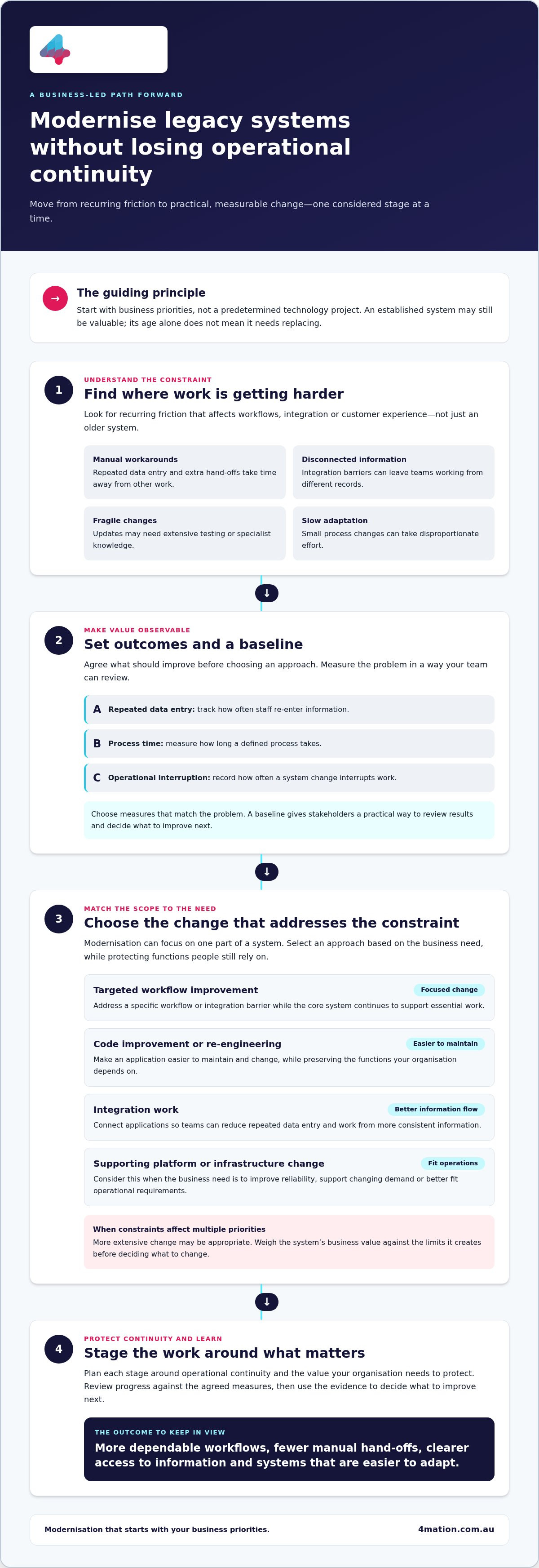
A system becomes a constraint when its limitations create recurring friction or make necessary change too difficult. Fragile updates may require extensive testing or specialist knowledge. Integration barriers can leave teams working from different records, while duplicated tasks take time away from serving customers or improving operations.
Consider a service team that transfers customer details manually between an older application and a newer platform. The issue isn’t necessarily the age of either system. It’s the extra effort, the risk of inconsistent information and the delay before staff can act. If even a small process change takes disproportionate effort, the organisation may also struggle to respond to new customer expectations or business priorities.
These are reasons to investigate, not proof that a system must be replaced. An older application may still meet important needs, and replacing it could introduce unnecessary disruption. Weigh its business value against the practical limits it creates before deciding what to change.
What a successful modernisation should deliver
Start with observable outcomes. You might want more dependable workflows, fewer manual hand-offs, clearer access to information or a system that’s easier to adapt. These objectives help you judge whether a proposed change addresses the underlying problem rather than simply shifting it to different technology.
Agree how you’ll assess progress before selecting an approach. For example, your team could track how often staff repeat data entry, how long a defined process takes or how frequently a system change interrupts operations. The right measures depend on the problem. Establishing a baseline gives stakeholders a practical way to review results and decide what to improve next.
Modernisation doesn’t automatically mean a full replacement. A targeted improvement may address a specific workflow or integration barrier while the core system continues to support essential work. More extensive change may be appropriate when constraints affect multiple business priorities. In either case, plan around operational continuity and the value your organisation needs to protect.
For a closer look at the strategic context and potential consequences of leaving constraints unresolved, explore the risks of not modernising legacy systems. This perspective can help you assess urgency without treating age alone as a reason to act.
How legacy system modernisation services improve the systems you rely on
Modernisation improves an existing application or its supporting environment so it can meet current business needs. The work might focus on one part of the system rather than a complete rebuild. A useful distinction is this: application modernisation improves how an existing system works; it doesn’t automatically mean replacing every system around it.
The right scope depends on what’s getting in the way. It could involve code that’s difficult to maintain, an architecture that limits change, integrations that create manual hand-offs, workflows that no longer suit users or operating support that needs attention. Carnegie Mellon University’s Software Engineering Institute research on Modernizing Legacy Systems also explores incremental approaches and risk management, reinforcing the value of matching change to the system and its business context.
Modernise the application, architecture or integrations
Code improvement or re-engineering can make an application easier to maintain and change. This can help when a small enhancement currently takes considerable effort, or when the people who understand the code are also needed for routine support. The aim is to make future work more manageable while preserving the functions your organisation still depends on.
Integration work addresses a different constraint: systems that hold useful information but don’t share it effectively. Connecting applications can reduce repeated data entry and help teams work from more consistent information. Where the application itself no longer fits a business process, custom software development can deliver tailored application changes and integration based on how your teams and users work.
Changes to the supporting platform or infrastructure may also be appropriate. The business case could be to improve reliability, support changing demand or better fit operational requirements. Choose an approach based on the need, not a preference for a particular technology. AI may help with a defined business problem, but it isn’t a required part of modernisation.
Improve the system after the initial change
A modernised application still needs care after changes go live. Ongoing monitoring, maintenance and support help teams identify issues, keep essential workflows dependable and manage changes as business needs evolve. They also help preserve organisational knowledge, so future improvements don’t depend solely on one person remembering how a system works.
Agree who will handle operational issues, how change requests will be prioritised and what information will help assess system performance. This gives business and technology teams a shared basis for deciding what needs attention, instead of waiting for disruption to dictate the next step. Ongoing technology support and maintenance can form part of a broader modernisation effort where reliability remains a priority.
Legacy system modernization services should connect each technical change to a clear operational purpose. If you’re weighing which part of an application or its supporting environment to improve, discuss your modernisation priorities with our team.
Which legacy system modernisation approach fits your organisation?
The right route depends on what needs to change, what the system supports and how much change your organisation can absorb. A system with one difficult integration may need a different response from one that restricts several core workflows. Use the comparison below as a decision aid, not a universal ranking or technical prescription. Consider each option alongside dependencies, business priorities and available change capacity.
| Approach | Purpose and likely scope | Continuity considerations | May suit when |
|---|---|---|---|
| Improve in place | Address a defined constraint while retaining the existing application and core design. | Can keep familiar workflows in use, though changes still need careful testing and release planning. | The system remains fit for purpose overall, but a specific issue is limiting teams. |
| Re-platform | Move the application to a different supporting platform while keeping much of its behaviour. | Plan around dependencies and how users access the system during the transition. | The application still meets business needs, but its current operating environment no longer fits. |
| Re-engineer | Restructure or redesign parts of the application to address broader constraints. | Staged releases may help preserve essential workflows while changes are introduced. | Maintainability or design limitations make future changes increasingly difficult. |
| Replace | Build or adopt a different application to take over the system’s role. | Plan data, process and user transitions carefully to maintain business operations. | Persistent limitations mean the existing system no longer supports important business needs. |
These approaches aren’t always mutually exclusive. You might improve an application first, then re-platform it later, or replace one component while retaining others. Legacy system modernization services should clarify the options against your organisation’s actual needs, rather than steer every system towards the same solution.
When incremental change may be the practical route
Incremental change can suit a system that still supports essential work but has a specific pain point, such as a fragile workflow or a gap between applications. Divide the work into stages, each with a defined business outcome, a clear boundary and a review point. After each release, assess what changed for users and operations before committing to the next stage. This keeps scope visible and gives teams a structured way to manage operational change.
When a larger redesign or replacement deserves consideration
A broader redesign or replacement may be worth investigating when constraints affect multiple workflows or stem from the system’s underlying design. Before changing it, capture the business rules, exceptions and staff knowledge that keep work moving. Otherwise, a redesigned process could overlook important requirements that aren’t documented in the software. Consider the decision within your digital transformation strategy, particularly when modernisation connects to wider changes in how your organisation serves customers or operates. For businesses where operational transformation also involves expanding physical facilities or distribution networks, coordinating with transport and traffic planning specialists such as mltraffic.com.au ensures site requirements are addressed alongside software upgrades.
The best-fit approach preserves what remains valuable while creating a considered path to what the business needs next.
How to plan legacy modernisation around value, continuity and risk
A clear plan helps leaders make deliberate choices before technical work begins. It should connect business priorities to system dependencies, user needs, data flows and the operational steps required to keep essential work moving. Modernisation should have measurable business objectives, so your organisation can assess progress by what changes for users and operations, not by technology activity alone.
Use this sequence to turn priorities into a manageable programme. Legacy system modernization services are most useful when each stage has a clear purpose and a way to assess its value.
- Align outcomes. Agree what the organisation needs to improve, such as a workflow that takes too much manual effort or a process that’s difficult to adapt. Identify who benefits and why the outcome matters to the business.
- Understand the systems. Map the applications, information flows and people involved in the relevant work. Record dependencies on other systems and identify critical activities, users and data that must remain available during change.
- Prioritise the scope. Separate essential requirements from optional improvements. Focus first on constraints with a material effect on operations, customer experience or the ability to make further changes. This helps keep delivery focused when competing needs arise.
- Deliver in stages. Define what each stage will change, how users will be involved and what needs to remain operational. Set review points so the team can resolve issues and apply feedback before progressing.
- Review the results. Compare outcomes with the baseline, gather feedback from affected users and decide whether to continue, adjust or reprioritise. Record what the organisation has learned for subsequent work.
Set priorities and establish a useful baseline
Start with the workflows where friction has a material business impact. Speak with the people who use and support the system, including those who handle exceptions that may not appear in formal process documents. Note where work is repeated, delayed or dependent on manual checks, then agree how your organisation will observe change.
Use measures that fit your organisation as the baseline. These could include process completion time, repeated data entry or interruptions to a critical workflow, where relevant. Don’t assume a benchmark: the useful comparison is between your current position and the outcome you’ve agreed to pursue. Keep essential requirements distinct from desirable additions so scope remains clear.
Deliver change in a controlled, collaborative way
Staged delivery creates regular opportunities for users and stakeholders to review what’s changing and raise operational concerns. A defined scope may suit a fixed-cost project. 4mation’s fixed-cost projects are delivered fixed cost, on time, on budget and bug-free. Where priorities may evolve as the team learns, ongoing Agile development supports work in increments, with review points guiding what comes next.
For related considerations when deciding whether bespoke software fits your needs, see this custom software development strategy guide. If you’re ready to discuss a business-led plan for your systems, talk with 4mation about your modernisation priorities.
How 4mation delivers legacy system modernisation services
Modernising a business-critical system calls for more than technical change. 4mation starts by understanding your organisation’s goals, the people who rely on the system and the operational constraints that shape what can change. This connects decisions about scope and delivery to the work your systems need to support.
From strategy and design through development and integration, we work with you to plan changes around business priorities. Support, maintenance and continuous improvement can then help sustain the system as your organisation’s needs evolve. The aim is a considered path from current constraints to practical progress, while recognising the value of knowledge and workflows already embedded in your systems.
4mation brings 25 years of client success and more than 40 local technology specialists to this work. One relevant example is Hillsong Church, where 4mation modernised global multi-site web infrastructure. Explore this and other work in 4mation case studies, noting that each example reflects its own business context.
Choose an engagement model that suits the work
The right engagement model depends on how clearly you can define the work and how your priorities may change during delivery. A defined scope may suit a fixed-cost project. 4mation’s fixed-cost projects are delivered fixed cost, on time, on budget and bug-free. For work that needs regular feedback and reprioritisation, ongoing Agile development supports iterative delivery and continuous improvement.
If you need to add capability to an existing team, staff augmentation can provide additional people to contribute to the work. Service Desk support can address ongoing operational needs. These models can support different parts of a modernisation programme, from a clearly scoped change to continued development and support after delivery.
Move from modernisation goals to a practical conversation
Before discussing solutions, bring together three points: the business challenge, the system or workflow involved, and the outcome you want to achieve. It also helps to note who uses the system, what must continue during change and any dependencies that could affect delivery. You don’t need every technical detail resolved. A clear account of the business need gives the conversation a practical starting point.
From there, 4mation can work with you to clarify priorities, shape the scope and consider a suitable way to deliver the work. This keeps the discussion grounded in what your organisation needs rather than assuming a particular technology or a full replacement is the answer.
If you’re considering legacy system modernization services, discuss your legacy system modernisation goals with 4mation. A focused conversation can help clarify the problem to address, the value to protect and a sensible next step.
Take the next step towards systems that support your goals
Modernisation doesn’t need to begin with a decision about technology. Start with a business question: which workflow, customer need or operational constraint would make the greatest difference if addressed? A focused starting point can help your organisation build a practical case for change and decide what to examine next.
Choosing legacy system modernization services is ultimately about making considered decisions for your business, with a clear view of what matters today and what you may need tomorrow. 4mation is an AWS Select Consulting Partner and an Advanced Supplier in the NSW Government ICT Services Scheme.
You don’t need a complete plan before starting a conversation. Bring the challenge you’re working through, the system involved and the outcome you want to pursue. Together, we can explore a sensible next step that respects your operational needs and keeps the focus on business value.
Discuss your modernisation goals with 4mation and start shaping a practical path forward.
Frequently Asked Questions
What are legacy system modernisation services?
Legacy system modernisation services improve software an organisation already uses. Depending on the project, the work might include documenting how a system behaves, agreeing requirements, updating application components, changing integrations, testing and operational handover. For example, recording important system rules known mainly by a long-serving staff member can help future teams maintain the application and make informed changes.
Why should a business modernise a legacy system?
A business may review a system when a planned service or product change depends on software that’s difficult to update. Another signal is when only one or two people can explain how an important process works, creating a knowledge gap if they’re unavailable. Mapping that knowledge and understanding where the system constrains business plans can help leaders decide whether to act, what to protect and who needs to be involved.
How can you modernise a legacy system without disrupting operations?
Before a change goes live, agree who can approve the release and what should happen if a critical check fails. Define acceptance checks using real business scenarios, name the person responsible for the go or no-go decision, and make sure staff know where to report issues. For changes that affect customers or frontline teams, prepare clear communications about what will change and where people can get help.
Which legacy system modernisation strategy is best?
There’s no single strategy that suits every organisation. To make the decision easier to revisit, document the intended business outcome, essential process rules, assumptions and options considered, including why one route was preferred. Involve business, technology and operations representatives. A concise record gives future teams useful context if priorities shift, new dependencies emerge or the original assumptions no longer hold.
How long does legacy system modernisation take?
The timeframe depends on the work and how quickly the organisation can make decisions and provide input. Data that needs review, access to people who understand specialised workflows, approval steps and suitable release windows can all affect the schedule. Ask the delivery team to distinguish active work from time spent waiting on decisions or business input. That makes progress easier to interpret and helps identify delays the organisation can address.
How much do legacy system modernisation services cost?
There’s no single figure that applies to every project. For a more complete view, consider not only the change itself but also the time your staff need to contribute, testing, transition activities and any ongoing support. Comparing options on the same basis helps decision-makers understand what each proposal includes and which assumptions affect its scope, without relying on a broad estimate that may not fit the work.
Can AI be part of legacy system modernisation?
AI can be considered if it supports a specific task or user need. Before adopting it, define the task, decide how staff will judge whether its output is useful, and consider how they’ll handle errors or uncertain results. Test it against examples that reflect the work it would support, and clarify when a person needs to review the output. These checks help assess whether AI suits the intended use.
About The Author
