AI Code Audit: Securing Your Enterprise Software
Jowena BorralDigital Marketing Specialist

What if code that helps your team move faster also introduces risks your usual checks don’t catch? An AI code audit can help establish whether generated code is secure, maintainable and suitable for its intended use. But a list of flagged issues alone won’t tell you what to do next.
It’s reasonable to ask whether AI-generated code meets the same standards as the rest of your software. It can also be difficult to distinguish a thorough audit from an automated scan or a routine pull request review. Each can provide useful evidence, but they have different scopes and limits.
This article explains what an AI code audit can assess, from code quality and security to dependencies and the context in which the software runs. You’ll learn how to weigh findings by business impact and supporting evidence, then turn the results into a practical improvement plan. The aim is to connect technical assessment with your business goals, so you can agree on a clear next step rather than inherit an unprioritised list.
Key Takeaways
- An AI code audit should consider how software supports your business, not just what appears in the source code.
- Automated scans, AI-assisted reviews and human assessment provide different kinds of evidence, each with its own limits.
- Set the audit scope around the decision you need to make, the system’s purpose, its users and its operational dependencies.
- Prioritise findings by their potential business impact and the strength of the evidence, rather than treating every flag as equally urgent.
- Turn AI code audit findings into clear actions: remediate, monitor, redesign or defer, with responsibility and next steps agreed.
What an AI code audit assesses and why it matters to your business
Software can pass a routine check and still be difficult to maintain, unreliable under real operating conditions or poorly suited to the way your organisation works. An AI code audit looks beyond whether code runs. It considers the available evidence, the software’s role and the business outcome it needs to support.
An AI code audit is a structured assessment of software code, supporting evidence and business context, designed to identify risks and improvement opportunities without relying on any single tool to verify everything. Its findings can help you make a more informed decision about reliability, security and ongoing investment. A code audit can draw on tools and human expertise, with its scope shaped by the questions your organisation needs answered.
Context matters. A defect in a rarely used internal function may have a different operational impact from a weakness in software that supports a core customer or business process. The assessment should connect technical observations to how the system is used, what depends on it and what your organisation needs it to do.
For organisations considering AI-supported development or existing AI-enabled software, AI consulting and implementation can connect technology decisions with business goals and lifecycle needs.
How an AI code audit differs from code review and scanning
These activities can work together, but they answer different questions. A code review examines proposed changes in a development workflow, helping reviewers assess whether a change is understandable and appropriate before it is merged. Static analysis checks code against defined patterns and rules, such as coding errors or potential weaknesses. Both provide useful signals, but neither automatically gives you a complete view of the software’s business fit. For a focused approach to assessing individual changes, see these strategies to review AI-generated code safely.
An audit takes a broader, deliberately scoped view. It can bring together review findings, scan results, technical documentation and operational context to assess the questions that matter for a specific system. The scope should reflect the software’s importance, its architecture and the decision you need to make. It does not have to cover every part of the system.
When an AI code audit may be useful
An assessment may be useful when an application contains code generated or assisted by AI, particularly if your team needs confidence in its quality or supportability. It can also help when you inherit an application, before a major change, or as software is prepared for broader use. The right scope depends on the system and the decision at hand.
That doesn’t mean every AI-assisted change needs a full codebase audit. A focused review of a feature or integration may be more proportionate. Match the depth of assessment to the potential business impact so your team can address relevant concerns without creating unnecessary work.
Before setting the scope, consider what the software does and what could be affected if it fails or becomes difficult to change. For example, an application that supports a critical workflow may need closer attention to how it behaves in that workflow than a low-impact internal tool. Useful context includes:
- Purpose: the business process or user need the software supports.
- Dependencies: the systems, data and teams that rely on it.
- Intended outcomes: the reliability, security and maintainability your organisation expects.
With this context, technical evidence is easier to interpret. Next, decide what the assessment should examine and how tools and human judgement can contribute.
What an AI code audit should examine beyond generated code
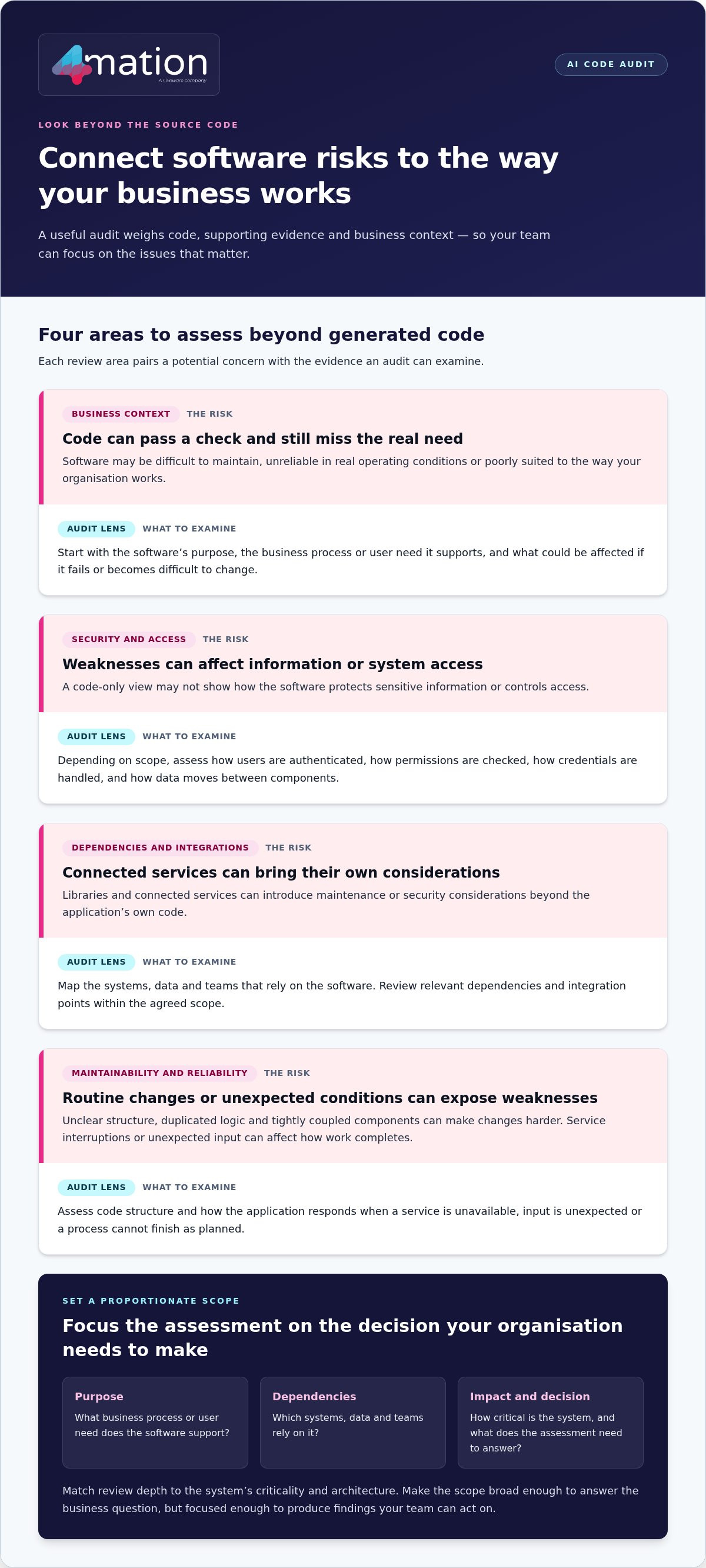
Code tells only part of the story. A useful assessment also considers how the software handles access, data, failure and change, and whether it supports the workflows it was built for. Audit scope should reflect the software’s purpose and business impact, focusing effort on risks and decisions that matter to your organisation.
The depth of an AI code audit depends on the system’s criticality, architecture and the decision you need to make. A component supporting a core business process may warrant closer attention to its integrations and failure paths than a low-impact internal tool. The assessment should be broad enough to answer the business question, but focused enough to produce findings your team can act on.
Security, access and software dependencies
Review areas where a weakness could affect sensitive information, system access or connected services. Depending on the agreed scope, this may include how the software authenticates users, checks their permissions, handles secrets such as credentials, and moves data between components.
Dependencies and integration points matter too. A library or connected service can introduce maintenance or security considerations beyond the code written for the application. For software that uses large language models, the OWASP Top 10 for LLM Applications can help frame application-specific risks. Its guidance is a reference point, not a substitute for assessing your system’s design and use.
Maintainability, reliability and business logic
Code quality affects how safely and efficiently teams can adapt software. An assessment may identify unclear structure, duplicated logic or tightly coupled components that make routine changes harder. It can also examine how the application responds when a service is unavailable, input is unexpected or a process cannot finish as planned.
Business rules need context. A system may technically process an order but apply the wrong approval condition for your workflow. Reviewing expected behaviour with people who understand the process can help surface gaps that code patterns alone may not reveal.
Separate evidence from interpretation
Findings should distinguish what was observed from what a tool inferred or a reviewer still needs to investigate. A scan might flag a code pattern for review, but that result alone doesn’t prove a vulnerability exists. Equally, a clean scan doesn’t establish that the software has no weaknesses.
- Observed evidence: the code, configuration or behaviour identified during assessment.
- Tool output: a warning or result that needs context before you decide what it means.
- Human interpretation: an assessment of relevance, likely impact and appropriate response.
This distinction helps leaders understand both the confidence and limits of a finding. An assessment can inform a decision, but it can’t guarantee that software is defect-free or secure in every situation.
To define a proportionate scope around your system’s purpose and priorities, you can discuss your software goals with 4mation.
AI code audit tools, human review and evidence: what each can tell you
Different assessment methods reveal different parts of a software risk picture. Automated scanning can process code consistently, AI-assisted review can help explain changes, and human assessment can interpret the system in context. An AI code audit is more useful when these inputs are treated as evidence to evaluate, not as a verdict from any one source.
| Assessment method | What it can indicate | What needs further judgement |
|---|---|---|
| Automated scanning | Patterns that match configured checks across the code or dependencies in scope. | Whether a flagged pattern creates a real issue in this application, and whether unflagged areas have other risks. |
| AI-assisted review | Possible concerns or explanations related to a code change, based on the input and context available. | Whether the explanation is accurate, complete and relevant to the software’s design and use. |
| Scoped human assessment | How architecture, user journeys and business rules affect the interpretation of technical evidence. | Conclusions remain limited by the agreed scope and information available. |
What automated tools can and cannot establish
Tools can flag patterns within their configured scope and the information they can access. Their outputs can help a team spot code that needs closer attention or identify areas to investigate. But a result is not proof that an issue exists, and the absence of a warning does not prove that an issue is absent. Interpretation depends on how the application works and what it is meant to do.
For example, a flagged access check needs to be assessed against the relevant user journey and intended permissions. A reviewer may need to reproduce the behaviour or examine related code before judging its significance. When adding AI to existing software, consider how it fits with your organisation’s systems and workflows.
Why human assessment still matters
People can connect technical evidence to architecture, business rules and the way users complete a task. They can test whether a reported problem can be reproduced, identify a workflow the tool didn’t consider, or find that a warning reflects an intentional design choice. Independent evidence, such as a repeatable test or relevant documentation, can support or challenge an automated finding.
Record the basis for each finding: what was observed, how it was checked, which workflow or component it affects, and what uncertainty remains. This gives decision-makers a clearer basis for judging impact and avoids treating every tool output as equally important. Broader implementation decisions also depend on organisational goals and constraints.
Used together, tools and human judgement can provide a more balanced view. The practical question is not simply how many findings appear, but what the evidence shows, how confidently it can be reproduced, and what the issue could mean for your users and operations.
How to scope an AI code audit and turn findings into decisions
A useful assessment starts with a decision, not a tool. Are you deciding whether software is ready to deploy, planning remediation, or identifying improvements for a system already in use? Defining the purpose first keeps the work focused and gives leaders a clear basis for acting on the results.
Before an AI code audit begins, map the system’s purpose, users, integrations and operational dependencies. A software component that supports a time-sensitive workflow may need a different level of attention from one used for a less critical task. This context helps the team assess technical evidence against real business consequences.
Set scope around a business decision
Agree which repositories, components, integrations and code history are relevant to the decision. Then record the boundaries, such as whether the assessment covers a particular feature or connected service, and which environments or behaviours it doesn’t examine. Clear limits help stakeholders understand what the findings can support and where uncertainty remains.
A practical sequence keeps the assessment connected to action:
- Define the decision. State what leaders need to decide and by when, such as whether a change can proceed or what to improve next.
- Select the scope. Identify the software components, integrations and workflows that influence that decision.
- Gather evidence. Bring together relevant code, tool outputs, documentation and observations from people who understand the system.
- Assess each finding. Check the evidence, whether the issue can be reproduced, and how it may affect users or operations.
- Agree actions. Decide what to remediate, monitor, redesign or defer, and assign an owner.
Convert findings into a prioritised improvement plan
Prioritise findings by weighing four factors together: the strength of the evidence, the potential business consequence, the system’s exposure, and the effort or dependencies involved in remediation. Don’t treat a tool’s severity label as a complete business priority. A finding that affects a key workflow may deserve attention before a more dramatic-sounding issue with little operational relevance.
Audit findings become useful when each has evidence, impact and an owner. Record what was observed and how it was validated, which users or operations could be affected, who will lead the response, and the next review point if action is deferred. This gives decision-makers a practical way to balance risk with available delivery capacity.
Where findings point to changes in an AI-enabled product, AI application development can form part of a follow-up pathway, alongside software engineering or integration work. 4mation delivers AI application development as part of its software development services. The response should fit the problem, rather than assume every finding calls for a rebuild.
If you’re ready to turn assessment priorities into a clear decision and action plan, talk with our team about your software goals.
From AI code audit findings to a practical software improvement plan
An assessment creates value when its findings lead to proportionate action. Not every issue needs the same response: a contained problem may call for a targeted fix, while a pattern across the system could point to a design or modernisation need. The right path depends on the evidence, potential impact, dependencies and your organisation’s priorities.
Choose a follow-up path that fits the findings
Agree what will happen to each finding, who will own it and when the decision will be reviewed. A practical plan can group actions into four paths:
- Remediate: Fix a well-understood issue with a defined impact, such as correcting a specific error in a feature.
- Monitor: Track an issue where the current impact is limited, but a change in usage or conditions could make it more important.
- Redesign: Address a systemic concern where repeated workarounds or structural constraints make reliable change difficult.
- Defer: Schedule a lower-priority action for later, documenting the rationale, owner and conditions that would prompt a review.
Contained findings may fit into planned development work. Broader concerns can require strategy and design before implementation, especially if changes affect connected systems or established workflows. Staging the work helps teams manage dependencies and test changes without assuming that every finding calls for a major rebuild.
Where agreed actions involve building or changing AI-enabled software, 4mation can support the work through AI application development. We connect business goals, design, development and integration, with the scope shaped around the improvement needed.
Plan for support after the assessment
Changes need clear ownership after delivery. Decide who will maintain the software, review outstanding items and assess new issues as business needs evolve. Ongoing development and support can help teams make staged improvements while keeping software aligned with its intended use.
4mation brings 25 years of client success and a team of 40+ local technology specialists. We work with organisations across the software lifecycle, connecting business priorities with practical AI and software engineering decisions. The next step may be targeted development, broader modernisation, integration work or ongoing support, depending on what the findings show.
Keep the plan usable: record the agreed action, accountable owner, dependencies and review point for each priority. This gives leaders visibility of progress and helps teams revisit decisions when circumstances change, rather than letting findings remain in a report without a clear path forward.
Plan a practical next step with our team.
Make your next software decision with confidence
Your next step doesn’t need to be a large-scale transformation. Start with the business decision in front of you: what needs to change, what can wait, and what evidence would help you proceed with confidence? A focused AI code audit can support that decision and give your team a clear basis for planning the work.
From there, you can build an improvement path that fits your priorities, delivery capacity and software lifecycle. The right plan may begin with one targeted change and develop over time as your organisation’s needs evolve. What matters is having a practical direction and clear ownership.
At 4mation, we work with you to connect software and AI decisions to your business goals. Discuss your software and AI goals with our team and take a considered next step towards software that better supports your organisation.
Frequently Asked Questions
What is an AI code audit?
An AI code audit gives an organisation a documented view of selected software so it can make a decision about investment, release or improvement. It can consider code alongside information such as system purpose, operating requirements and relevant technical records. The resulting report should make clear what was examined, what evidence supports each observation and where further investigation may be needed, giving teams a useful baseline for future changes.
Can AI-generated code be secure?
AI assistance alone establishes neither security nor insecurity. Treat generated code like any other contribution: check that it follows your engineering practices, test expected and unexpected inputs, and review how it handles access and data. For example, a team adding a new API endpoint can include tests for unauthorised requests and invalid values. The right checks depend on the function’s role and the sensitivity of the systems it touches.
How is an AI code audit different from an AI code review?
An AI code review is usually tied to a particular proposed change, such as a pull request, and helps the team decide what to address before merging it. An audit can inform a wider management decision, such as whether to invest in an application or prepare it for a new operating environment. Teams can use review feedback as one input while keeping the audit’s decision, evidence and boundaries clear.
What does an AI code audit check?
The agreed checks may include whether important user actions produce the intended result, whether the software can recover from an interrupted operation, and whether changes can be made without unintended effects elsewhere. For a workflow that updates customer records, for instance, the assessment might consider validation and error handling around that update. The scope should reflect the system’s design and the questions stakeholders need answered, rather than assume identical checks for every application.
Can an AI code audit guarantee that software is secure?
No assessment can guarantee that software will remain secure under every future condition. Findings describe what the assessment examined and observed at that point. Later changes to code, configuration or connected services can alter the picture. To keep assurance useful, record the version and environment assessed, retain relevant test results, and decide how changes will be checked before release. This creates a clearer trail for future technical and business decisions.
When should a business audit AI-generated code?
Consider an assessment when a decision has material consequences and your existing information doesn’t give leaders enough confidence to proceed. Examples include moving an application into a new operating environment, adding a feature that changes a key workflow, or taking over software without clear technical records. A planned release review can also be a sensible checkpoint. The assessment can focus on the changed areas and their dependencies, rather than automatically covering every repository.
What should a business do with AI code audit findings?
Translate each confirmed finding into a work item that developers and decision-makers can track. Include the relevant evidence, the affected function, the agreed response, an owner and any dependency that could delay delivery. After a change, define how the team will verify it, such as a repeatable test or review of the updated behaviour. This creates a link between the original observation and the completed work, and helps teams report progress clearly.
About The Author
