Maximise Software Value with a Code Quality Audit
Jowena BorralDigital Marketing Specialist

Code that still works can still make every change slower, riskier and more expensive to deliver. A code quality audit can show what is creating that friction, where reliability or security concerns may sit, and whether the software can support your organisation’s plans.
If routine updates are taking longer, it can be hard to tell whether a specific technical issue or a broader maintainability problem is responsible. Findings can also feel disconnected from business priorities when the scope is vague or the next steps aren’t clear. The value isn’t in a pass-or-fail verdict. It’s in understanding which issues matter to your organisation and why.
This article explains what a code quality audit examines, how to assess findings against your goals, and how to prioritise improvements by business impact and risk. It also shows how to turn findings into manageable next steps. At 4mation, we work with you to connect technical insights with practical improvements, so your software can better support reliable ongoing development.
Key Takeaways
- A code quality audit can clarify how maintainable your software is and where code health may affect changes, reliability and business needs.
- Set the audit scope around your application and the decisions you need to make. Consider testing, documentation, architecture and security.
- Weigh findings by business impact, technical severity and remediation effort to focus on the issues that matter most.
- Prepare by defining the decisions the audit should support, describing the system and identifying critical functions and current delivery concerns.
- Turn priority findings into owned, staged improvements, then reassess them as business needs and delivery priorities change.
What a code quality audit reveals about your software
A code quality audit is a structured assessment of an application’s source code and how readily a team can understand, maintain and change it. It looks beyond whether the software works today to assess whether its foundations can support reliable updates and your organisation’s future needs.
A code quality audit shows where the structure and condition of your software may help or hinder change, so you can make informed decisions about what to improve. The review may identify repeated logic, complex components, gaps in automated tests or dependencies that are difficult to update. These findings can help explain why a routine change takes longer than expected or where a defect could affect reliability.
Quality is broader than code alone. Software Quality Assurance (SQA) covers practices for monitoring software engineering processes and checking that they meet defined standards, an area where software testing and DevOps specialists like Test Triangle help organisations strengthen delivery pipelines. An audit can contribute to this wider effort by giving teams a considered view of the existing codebase and the implications for ongoing development.
Findings are evidence for decisions, not an automatic instruction to rebuild. An audit also doesn’t have to reduce a complex system to a single pass-or-fail score. A sound assessment gives decision-makers context: what was examined, what was found, why it matters and what options are available. The right response might be to address a specific risk, improve testing around a critical function or plan changes gradually.
Code quality audit, code review and security audit: what differs?
A code review is usually a narrower, recurring check of a proposed change, such as a feature or bug fix. It helps a team catch issues before that change becomes part of the wider application. A quality audit looks across broader patterns in the codebase and can reveal structural concerns that individual reviews may not expose.
A security audit focuses on security risks, such as weaknesses that could allow unauthorised access or expose sensitive information. It may overlap with a broader quality assessment, since poor structure or outdated dependencies can affect security, but the scopes aren’t interchangeable. Make clear which questions the assessment is designed to answer.
Why software quality matters to business leaders
Code health has practical consequences. When components are difficult to understand or tightly connected, a change in one area may require extra investigation and testing elsewhere. This can slow delivery, divert team effort into maintenance and make it harder to respond to changing customer or operational needs. Clearer structure and suitable tests can make future changes easier to assess, although the value depends on the application and its role in the business.
Reliability matters just as much. If software supports a customer-facing service or an essential internal process, defects can disrupt the experience or create workarounds for staff. An audit helps connect technical observations to these real-world effects. Leaders and technical teams can then decide what to address now, what to monitor and what can wait, without assuming every finding carries the same business risk.
What a code quality audit should examine
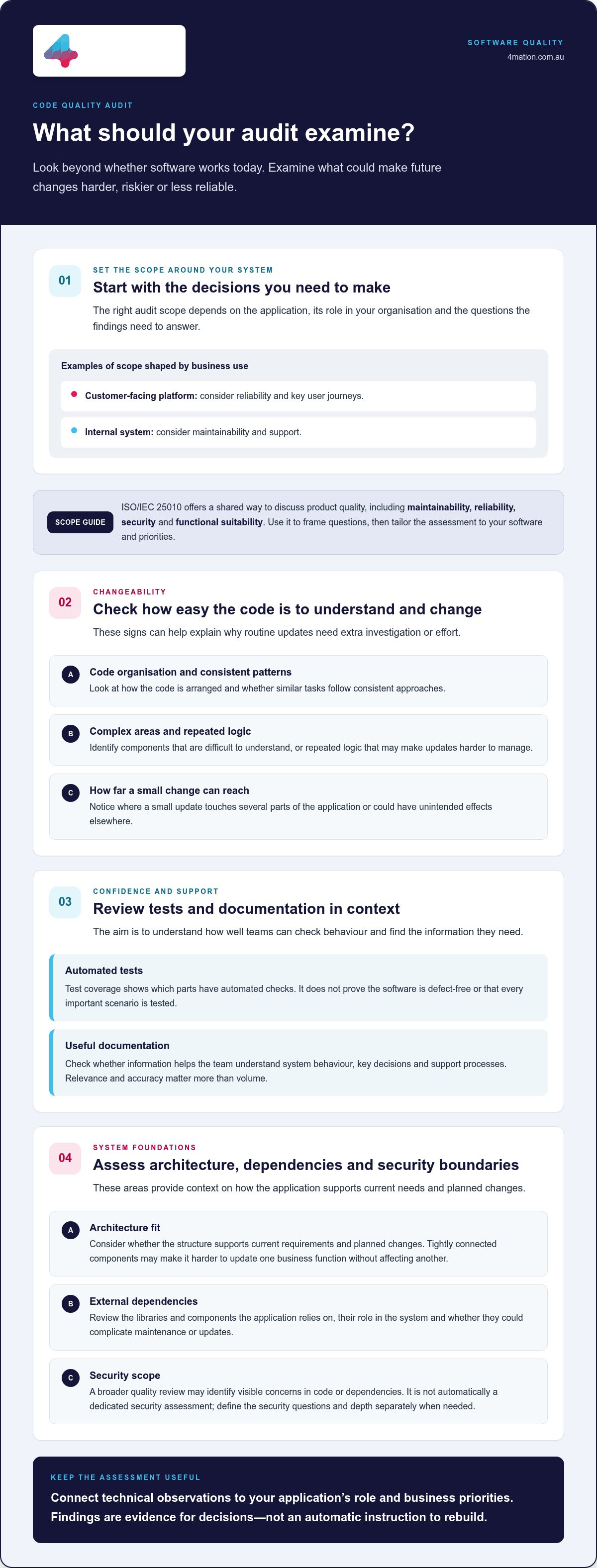
A useful code quality audit examines the parts of a software system that affect how safely and efficiently it can be changed. The right scope depends on the application, its role in your organisation and the decisions the findings need to support. A customer-facing platform, for example, may call for close attention to reliability and key user journeys. An internal system might need more focus on maintainability and support.
The ISO/IEC 25010 Software Quality Model offers a shared way to discuss product quality characteristics, including maintainability, reliability, security and functional suitability. It can help frame assessment questions, but the audit should still reflect your system and business priorities.
Maintainability, testing and documentation
Reviewers look at how code is organised, whether similar tasks follow consistent patterns and whether complex areas are difficult to understand. These qualities affect how readily a team can make changes without causing unintended effects. Evidence might include component structure, repeated logic and areas where a small update touches several parts of the application.
Testing and documentation add important context. Test coverage shows which parts of the system have automated checks, but it doesn’t prove the software is free from defects or that every important scenario is tested. Documentation is useful when it helps a team understand system behaviour, key decisions and support processes. Its value comes from helping people act on accurate, relevant information, not from its volume.
Architecture, dependencies and security considerations
An assessment can consider whether the system’s architecture supports its current requirements and planned changes. For instance, tightly connected components may make it harder to update one business function without affecting another. Reviewers can also examine dependencies, the external libraries and components the application relies on, to understand their role and whether they could complicate maintenance or updates.
Security observations should be clear about their boundaries. A broader quality review may identify visible concerns in code or dependencies, but that doesn’t automatically make it a dedicated security assessment. If security assurance is a decision your organisation needs to make, define the relevant scope and depth separately. Automated code analysis and dependency checks are examples of ways to gather evidence. The right methods depend on the system and assessment goals.
Clear scope keeps the review useful. Agree which application areas, environments and evidence are in scope, then connect each area to a practical question: can the team safely change this feature, understand how it works or support it as needs evolve? Findings can then distinguish observed evidence from assumptions and identify where further investigation may be needed. If you’re shaping an assessment around your software priorities, you can discuss your software goals with 4mation.
How to interpret audit findings and prioritise improvements
A list of technical observations becomes useful when each finding explains what it could mean for your organisation. A code quality audit should provide more than jargon or a severity label. It should connect the evidence to an affected system, user or business process, then describe the likely consequence and the effort involved in addressing it.
Audit findings need context before teams set priorities, because the same technical issue can carry very different business risks in different applications. A weakness in a system that supports a critical customer transaction may deserve prompt attention. A similar issue in a low-use internal tool could be scheduled alongside planned maintenance. The finding matters, but so do the software’s purpose, the evidence behind the assessment and your organisation’s priorities.
Separate urgent risks from improvement opportunities
Start by distinguishing issues that could disrupt an important function or expose a meaningful security weakness from improvements that mainly make future work easier. A security observation can be considered alongside the Common Weakness Enumeration (CWE), a reference for describing common software weaknesses. It can help clarify the type of issue, but its priority still depends on evidence about your system and its use.
For each finding, record what the reviewer observed, which system area it affects and who or what could be affected. Note assumptions and evidence gaps too. If the impact is unclear, identify what further investigation is needed before committing to remediation. This helps avoid treating an unverified concern as a confirmed operational risk or overlooking a well-supported issue because its technical description is unfamiliar.
Turn technical observations into a business case
Translate each issue into plain language. Instead of reporting only that a component has high complexity, explain that changes to it may require more investigation and testing. Then weigh the likely benefit of addressing it against the work required, dependencies and consequences of delaying it. This comparison supports decisions without promising a particular saving or return.
Prioritised risk should also inform how teams plan software development, including how they sequence changes and manage the potential effect on existing functions. Use the categories below as a starting point, not as a fixed scoring system.
| Priority | Criteria | Typical response |
|---|---|---|
| Address now | Evidence points to a credible, material risk to a critical function, users or operations. | Confirm ownership and plan prompt action or further investigation. |
| Plan next | The finding creates ongoing maintenance friction or could complicate a known change, but no immediate impact is evident. | Schedule work around delivery priorities and related changes. |
| Monitor | Current evidence suggests limited impact, or the concern depends on assumptions that need validation. | Track relevant changes and revisit the finding when context shifts. |
These categories help decision-makers and technical teams discuss trade-offs consistently. Review them together, check whether the business impact is supported by evidence and update the priority if the system’s role or requirements change.
Prepare for a code quality audit with a practical checklist
A focused review starts with clear business questions, not a request to inspect everything. Before a code quality audit begins, identify the decision you need to make. You might be assessing whether the software can support a planned feature, understanding recurring maintenance effort or clarifying risks in a business-critical process. A defined purpose keeps the assessment relevant and makes its findings easier to act on.
Preparation also gives reviewers useful context. They need to understand what the application does, who relies on it and where your team experiences friction. If the system is bespoke, a custom software development guide can help frame how its design and requirements relate to the way it supports your organisation.
Set audit objectives and boundaries
Agree the questions the assessment should answer, then define which parts of the application and quality areas are in scope. For example, you may focus on a customer-facing workflow and its maintainability, testing and reliability, rather than request a broad review without a clear decision in mind. Set out exclusions too, so everyone understands what the findings can and can’t conclude.
Use this sequence to prepare the review:
- Define the decisions. Write down what you need to decide after the assessment, such as whether to proceed with a planned change or address a known maintenance concern.
- Describe the system. Summarise the application’s purpose, users, important integrations and business-critical functions. Note where a fault or delay could interrupt customer service or an internal process.
- Agree the scope. Identify the application areas and quality dimensions to assess, along with relevant boundaries. Confirm whether the focus is maintainability, testing, architecture, security considerations or a combination.
- Review available evidence. Gather useful system context, such as architecture notes, development practices, test information, documentation and known delivery or maintenance concerns. Record what is missing rather than assuming it exists.
Gather context and prepare stakeholders
Technical evidence explains how the software is structured; people explain how it behaves in practice. Identify the technical stakeholders who understand its design and development, as well as operational or product stakeholders who can describe real workflows and pain points. Their input helps reviewers connect findings to the functions and users that matter.
Agree how findings will be recorded and reviewed with decision-makers. A clear format can capture the observation, affected area, available evidence, potential business relevance and open questions. Arrange appropriate access to code and supporting materials, and make time for relevant stakeholders to clarify details. Access, documentation and people’s availability can shape the review process, so align expectations early rather than assuming a set timeframe.
With objectives, boundaries and context in place, the assessment can focus on useful evidence and practical decisions. Discuss your software goals with 4mation to explore how a review can be shaped around your organisation’s priorities.
Turn audit findings into a sustainable software improvement plan
An audit creates value when its findings lead to work with a clear owner, a reason for doing it and a place in the delivery plan. Use the code quality audit results to group related actions, then connect each group to a business goal, such as supporting a planned feature, improving a key workflow or making future updates easier to manage.
Not every issue needs the same response. A discrete, well-understood problem may suit targeted remediation. Broader concerns, such as tangled components or gaps in testing across several parts of an application, may need staged work so teams can manage dependencies and maintain service continuity. The plan should state who owns each action, what needs to happen first and how the team will judge whether the change has addressed the finding.
Choose a delivery approach that fits the findings
Shape the work to fit its scale and your organisation’s priorities. A contained change may be scheduled as a defined task. More involved improvements can be broken into manageable stages and reviewed as each stage progresses. This helps teams make deliberate progress without treating the audit as a reason to pause other business priorities.
If the software needs regular adjustments as requirements evolve, continuous improvement and development can address agreed findings alongside ongoing changes. 4mation works collaboratively with you to connect technical work to business goals and plan improvements that suit the application, its users and delivery priorities.
Keep quality visible after the audit
Track agreed actions in a shared plan, including the responsible owner, dependencies, intended outcome and current status. Once a change is complete, review whether it achieved its purpose. For example, if an action aimed to make a critical workflow easier to update, check whether relevant changes can now be made with clearer tests or fewer connected components. Record remaining limitations so the team has an accurate basis for future decisions.
Revisit priorities as requirements, user needs and delivery plans change. An improvement that can wait today may become more important if the system takes on a new role. Work planned for a feature may also be better addressed as part of that feature’s delivery. Ongoing technology support and maintenance from 4mation can help teams monitor the system, respond to emerging needs and keep agreed improvements moving over time.
A sustainable plan isn’t a one-off list. It gives your team a way to keep software quality visible, make considered trade-offs and adjust the work as the business changes. Talk with 4mation about your software and the practical improvements that can support your goals.
Make your next software decision with confidence
A code quality audit can be a starting point for a more deliberate approach to software investment. Decide which improvements will best support your organisation’s goals, then give that work clear ownership and a practical place in your delivery plans. You don’t need to tackle every finding at once. What matters is making informed choices and keeping progress visible as your needs change.
4mation brings 25 years of client success and a team of more than 40 local tech specialists to custom software development and ongoing improvement. As an AWS Select Consulting Partner, we work collaboratively to connect technical decisions with the outcomes that matter to your business.
Plan your next software improvement with 4mation. Together, we can turn your priorities into a clear, achievable path forward.
Frequently Asked Questions
What is included in a code quality audit?
The scope should match the decisions you need to make about your software. Clarify which code repositories, application versions and supporting materials reviewers can examine. Also define how the review will distinguish confirmed observations from areas that need further investigation. This helps you understand what the results represent and whether they provide enough evidence for the decision at hand.
How is a code quality audit different from a code review?
A code review is generally part of the process for checking a proposed code change, while an audit supports a broader management decision about existing software. For example, a delivery lead may use reviews to assess changes during development, while a technology leader may use audit findings to inform planning or investment. Both activities can contribute to sound development practices, but they serve different decision points.
How much does a code quality audit cost?
There isn’t one standard fee. The effort depends on the application’s size and complexity, the depth of investigation and the evidence available. Define the expected deliverables as well as the areas under review. Set out whether the work includes a findings report, a decision-making discussion or follow-up investigation. A clear brief makes it easier to understand what the proposed work covers without relying on a headline price alone.
When should a business arrange a code quality audit?
Consider arranging one before a major technology investment, a handover between teams or a change in software ownership. These moments can make it valuable to establish a clear view of the application before setting expectations or committing resources. An assessment may also help if leaders need evidence to support a roadmap decision. The most useful timing is when the organisation has a defined question and can act on what it learns.
Can a code quality audit find security vulnerabilities?
It can identify potential weaknesses in the code or its dependencies if the review includes security analysis. A finding is a signal to assess, not necessarily proof that an attacker can exploit the issue. Decision-makers should understand what evidence supports the finding, what further validation may be needed and whether the review examined relevant parts of the application. This distinction helps teams respond proportionately and avoid treating every observation as a confirmed incident.
What happens after a code quality audit?
The results can inform decisions beyond technical work, including release planning, investment discussions and how the organisation communicates remaining risks. Leaders can use the report to record which findings they’ll address, which need more evidence and which risks they’ve chosen to accept for now. Keeping that reasoning alongside the relevant business decision helps future teams understand why priorities were set and revisit them if circumstances change.
Does a code quality audit mean software needs to be rebuilt?
No. A rebuild is one possible response, but deciding whether it’s appropriate involves more than reviewing code. Consider whether the existing system can support future business requirements, then weigh replacement against transition considerations such as integrations, data and continuity of service. If targeted changes can meet the need, replacing the whole application may add unnecessary complexity. The choice should follow the business case, not the audit label.
About The Author
