Software Project Rescue Guide for Australian Organisations
Jowena BorralDigital Marketing Specialist

When milestones slip, defects keep returning and integration issues drain the budget, adding pressure rarely creates a clearer path forward. 4mation’s software project rescue services start by understanding what is affecting delivery and which business outcomes matter most. The first priority is to stabilise the situation, not simply try to move faster.
You need a practical plan, not another round of optimistic deadlines. A structured assessment can give you a clearer view of the project’s condition, the risks that need attention and the work to prioritise. From there, you can decide whether to stabilise, re-plan, rebuild or take another route, with progress measured against business goals.
This guide explains how to recognise the causes of delivery trouble, assess the project and choose a recovery approach that fits your organisation. It also covers how clearer priorities, reliable system integration and the right development support can help restore stability and make delivery more predictable.
Key Takeaways
- Use missed commitments, recurring defects and workarounds as signals to examine delivery health and business impact.
- Software project rescue services can establish an evidence-based view of what is wrong and which risks need attention first.
- Compare rescue, rebuild and replacement against business fit, system condition and the disruption each option could create.
- Set clear ownership, decision points and measures of progress so recovery decisions stay connected to business goals.
- Development, system integration, technology support and embedded specialists can all contribute to a recovery path that lasts.
When do software project rescue services make sense?
A delayed milestone doesn’t automatically mean a project needs rescuing. A short setback may have a clear cause, an agreed response and a credible revised date. Intervention becomes more useful when problems keep returning, plans no longer reflect what the team can deliver, or leaders can’t explain what is working and what needs attention.
Software project rescue is a focused effort to understand delivery problems and restore a workable path forward. It gives decision-makers a structured basis for choosing what to stabilise, change or stop. The aim is not to assign blame, but to connect evidence about delivery and system behaviour to the business goals the software must support.
What signs suggest a software project needs intervention?
Look for patterns across four areas, rather than treating one missed date as proof the project is failing:
- Delivery: milestones move repeatedly, estimates change without clear reasons, or planned work is regularly deferred.
- Quality: defects return after fixes, testing reveals recurring issues, or teams spend more time reworking features than completing planned improvements.
- Integration: connections to other systems fail or behave inconsistently, disrupting workflows that depend on reliable data exchange.
- Stakeholder visibility: reports don’t explain what is complete, what remains at risk or which decisions are needed.
The effects can extend beyond the project plan. Staff may rely on manual workarounds, customers or internal users may face inconsistent processes, and leaders may lose confidence in delivery commitments. Rework also takes skilled people away from improvements intended to support growth or efficiency.
Keep observations separate from assumptions about individual performance or intent. Record examples such as repeated defects, blocked dependencies, changed acceptance criteria and unresolved decisions. A review of software project management failures can provide useful context, but your own project evidence should guide the diagnosis.
What should a rescue aim to achieve?
A practical intervention should leave you with clearer priorities, a more stable system and a delivery plan grounded in the work that remains. Define progress in business terms as well as technical ones. For example, consider whether users can complete an essential process reliably or whether the work is addressing a key operational problem.
The right response may be to stabilise the existing system, adapt its scope or recommend a different path if it no longer fits the need. Base that decision on user needs, system condition and business priorities, not simply on the effort already invested.
Agreeing how work will be managed is another part of setting expectations. If a fixed-cost project approach is being considered, treat the engagement model as a planning decision, separate from diagnosing a troubled project. A useful rescue starts with a clear view of the problem and a realistic basis for deciding what happens next.
How software project rescue services assess and stabilise delivery
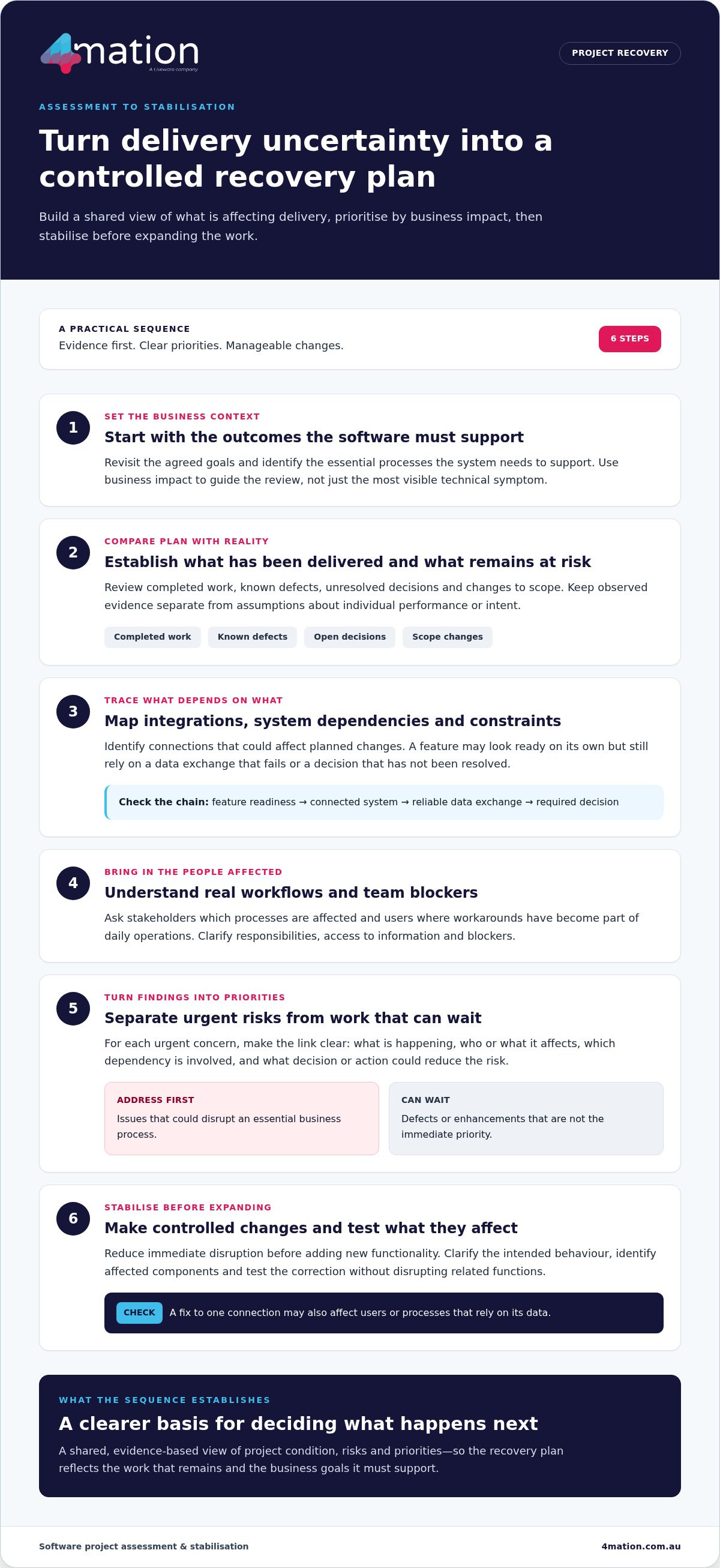
A useful assessment replaces competing explanations with a shared, evidence-based view of the project. Software project rescue services should examine what the organisation needs the software to achieve, what the team has delivered, how the system behaves and which dependencies are affecting progress. This helps leaders prioritise actions by business impact, rather than reacting only to the most visible technical symptom.
What does a project rescue assessment examine?
Start with the agreed outcomes and compare them with current progress. Review completed work, known defects, unresolved decisions and changes to scope. Then map key integrations, system dependencies and constraints that could affect planned changes. A feature may appear ready in isolation, for example, but still depend on a data exchange that fails or a decision that no one has resolved.
Include the people who use or depend on the software. Stakeholders can explain which processes are affected, while users can show where workarounds have become part of daily operations. Team context matters too: clarify responsibilities, access to information and blockers without treating assumptions about performance or intent as established facts.
Bring the findings together in a prioritised view. Separate issues that could disrupt an essential business process from defects or enhancements that can wait. For each urgent concern, make the connection clear: what is happening, who or what it affects, which dependency is involved and what decision or action could reduce the risk. A structured assessment turns symptoms into recovery actions tied to business impact and delivery dependencies.
If you’re weighing up the next step, you can discuss your software project with 4mation and its business priorities.
How should a team stabilise a troubled build?
Stabilisation means reducing immediate disruption before expanding the feature backlog. If a system integration is causing incomplete records, for instance, first understand the failure, manage its operational effect and test a controlled correction before adding new functionality. The right action depends on the evidence and on which business process needs protection.
Make changes in manageable steps. Clarify the intended behaviour, identify affected components and test that the change works without disrupting related functions. Testing should reflect the risks in the change: a fix to one connection may also affect the users or processes that rely on its data. Keep decisions visible so stakeholders understand what is changing, why it takes priority and what remains unresolved.
Assessment findings should lead to a focused next step, not an open-ended technical review. That might mean addressing a critical defect, resolving a dependency, revising the work sequence or investigating a specific uncertainty. Agree who owns the action and what evidence will show whether it helped. This creates a practical basis for reassessing priorities as the system and delivery conditions become clearer.
Rescue, rebuild or replace: how to choose a recovery path
The right recovery path depends on whether the software still fits the business, where its limitations sit and how much disruption each option could create. A troubled project doesn’t automatically need a rewrite. Software project rescue services can help you determine whether targeted changes will address the problem or whether a broader change is justified.
Compare the options against the same considerations:
Rescue: Best when the solution still supports important workflows and its main problems can be addressed in specific areas. This can preserve useful work and limit disruption, but it won’t resolve a fundamental mismatch between the system and business needs.
Rebuild: Worth considering when the overall solution remains appropriate, but key components or structural constraints make ongoing changes difficult. A rebuild can retain suitable parts while replacing or reworking others. The level of disruption depends on the scope and dependencies.
Replace: May suit a project when business needs have changed substantially or the current solution no longer provides a workable foundation. Replacement creates an opportunity to address broader fit, but involves transition work and potential disruption to users and connected processes.
These are not fixed categories. A system may need a targeted repair in one area and deeper modernisation in another. Consider the risks of not modernising legacy systems in terms of long-term platform fit, the organisation’s ability to maintain the solution and its capacity to support changing needs. Base the decision on evidence and business priorities, not a preference for the newest technology.
When can targeted rescue work preserve value?
Targeted rescue makes sense when the system still supports essential workflows and users can achieve the outcomes the business needs, even if parts of delivery or system behaviour need attention. Assess whether defects and constraints are isolated enough to address incrementally. Preserving usable components keeps effort focused on the problem instead of expanding the scope to replace work that still serves its purpose.
When might a rebuild or replacement be more suitable?
Consider a broader change if requirements have shifted materially since the project began, or if constraints affect the system widely rather than specific components. A rebuild may retain a suitable overall approach while changing how key parts work. Replacement may be more appropriate if the underlying solution no longer fits user needs or business goals. For wider redevelopment, custom software development can shape a solution around those requirements.
A new team shouldn’t rush straight into a rewrite. First, it needs to understand how the system supports the business, which components remain useful, where dependencies sit and what changes could affect users. Then it can control the scope of proposed changes and explain the trade-offs. This gives leaders a reasoned basis to choose a recovery path rather than committing to a major rebuild before understanding what already works.
A practical software project rescue plan from assessment to recovery
A recovery plan needs more than a task list. It needs agreed boundaries, accountable decision-makers and a way to keep delivery aligned with business priorities as circumstances change. Software project rescue services provide a framework for moving from an agreed direction to responsible delivery and a clear handover.
Set the outcome, establish ownership, govern decisions, deliver against agreed commitments and confirm ongoing responsibility. This sequence gives leaders a practical way to maintain oversight without bringing every delivery decision into executive forums.
Agree scope, ownership and measures of progress
Define the business outcome the recovery effort must support, then make its boundaries explicit. Record what the work includes, what it excludes and how proposed additions will be assessed. This prevents urgent requests from quietly broadening the engagement and makes trade-offs visible before they affect agreed commitments.
Set out who is accountable for delivery, who can approve scope changes and which decisions need executive input. Identify the people who can explain business processes and represent user needs. Agree how the team will raise a decision that is blocking work, and who has authority to resolve it. Clear decision rights reduce delays and maintain accountability across business and technical teams.
Choose measures that show whether the agreed outcome is being achieved. These might include completion of named deliverables, acceptance by the business owner or whether a defined user task can be completed as intended. Agree how often progress will be reviewed and what evidence stakeholders need to make the next decision.
Deliver changes in controlled stages
Turn the agreed scope into a sequence of commitments with a named owner and a decision point for each stage:
- Confirm the mandate. Record the intended business outcome, boundaries and decision-makers so everyone is working to the same brief.
- Plan the work. Break the agreed scope into deliverables, dependencies and ownership, making assumptions visible to the people responsible for delivery.
- Manage change. When new information or requests emerge, assess their effect on scope and commitments, then record whether to accept, defer or decline them.
- Review against agreed measures. Give business owners a concise view of completed work, decisions required and any change to expected outcomes.
- Confirm handover. Document remaining responsibilities, open decisions and the owner of the next phase so accountability continues beyond the rescue effort.
A dependable cadence keeps governance useful: the right people see progress, make decisions and understand the consequences of changing direction. Keep records concise and accessible, so teams can refer to the agreed scope and decisions without relying on informal conversations or individual memory.
If you’re ready to establish clear ownership and a recovery approach shaped around your business goals, talk through a practical recovery plan with 4mation.
How 4mation supports software project rescue beyond the immediate fix
A successful recovery should leave your organisation with more than a resolved defect. 4mation’s Project Rescue starts by understanding your business priorities, users and the impact of delivery problems. We work with you to recommend a practical response, whether that means stabilising existing software, addressing system integration issues or planning further development.
Software project rescue services can also clarify what support the project needs after urgent issues have been addressed. The right next step depends on the work to be done, how priorities may change and the capability your team needs to sustain delivery.
Match the engagement model to the recovery need
Choose an engagement model that fits the shape of the work, not simply the label attached to it. A defined scope and outcome may suit a Fixed-Cost project engagement, where the work can be clearly specified. Fixed-Cost projects are marketed with a fixed-cost, on-time, on-budget and bug-free guarantee. This guarantee applies to those projects, not automatically to every rescue engagement.
If priorities need to evolve as the team learns, Ongoing Agile Development can support continuous planning and delivery. Staff Augmentation can add specialists to an internal team, while a Service Desk can provide structured ongoing support. Match the model to your decision-making needs, delivery context and internal capability.
Build continuity after the rescue
Once immediate delivery risks are under control, ongoing support and maintenance can help sustain platform reliability. Regular attention helps teams respond to issues and keep essential systems supported. As your business and users’ needs change, continuous improvement and development provide a way to prioritise enhancements without treating recovery as a one-off fix.
Depending on the project, follow-on work may include software development to address agreed requirements, system integration to improve how applications exchange information, or embedded specialists to work alongside your team. These options should follow from the recovery priorities, rather than expand the work without a clear business reason. Linking technical changes to operational needs keeps subsequent investment focused on useful outcomes.
4mation brings 25 years of client success and a team of 40+ local tech specialists. We can connect the immediate recovery effort with the ongoing development or support that suits your organisation. For example, technology support and maintenance can help your team sustain a stable platform as recovery work moves into ongoing operations.
To discuss your project, its business impact and a sensible next step, discuss your software project with 4mation.
Make the next project decision with confidence
A recovery can be a turning point, not just an effort to get delivery moving again. The decisions you make now can shape how your organisation manages change, supports users and invests in software over time. A clear view of business priorities helps ensure the next step addresses what matters, whether that means continuing with the current system or changing direction.
With 4mation, software project rescue services start with your organisation’s goals and the impact of the project on your business. 4mation is also an AWS Select Consulting Partner, bringing practical technology experience to the conversation.
Share what’s happening, what it’s affecting and what a better outcome would look like. Start a conversation about your project’s recovery options and take a considered step towards more dependable progress.
Frequently Asked Questions
How long do software project rescue services take?
There’s no standard timeframe. Duration depends on the technical work, access to decision-makers and system environments, and any planned release windows. Changes may also need to be coordinated with other teams or suppliers, which can affect sequencing. Once the work is understood, ask for a staged view of expected activities and decision points rather than relying on a single end date that may hide important dependencies.
Can we keep using our software while a project is being rescued?
That depends on how the software is used and what operational controls are available. Agree with the business owner which activities users can continue, where they should record issues and who can authorise a pause if needed. You might also limit unrelated changes to the live system while recovery work proceeds in a separate environment. Clear user guidance helps avoid confusion during the work.
Can our existing developers stay involved during a software project rescue?
Yes. Their involvement can be organised around specific tasks, such as walkthroughs of important workflows, pairing on unfamiliar components or reviewing proposed changes. Set aside time for this work so rescue activity doesn’t quietly displace every existing responsibility. A planned knowledge-transfer record also helps capture key decisions and practical details that may otherwise remain with individual developers.
What information should we prepare before discussing a project rescue?
Alongside project documents, prepare practical details that can make early conversations productive. These might include how access to development and test environments is arranged, any release blackout periods, the process for approving system changes and relevant supplier contacts. You can also identify who can explain day-to-day operations. If some information is missing, note that clearly rather than delaying a discussion while you assemble a complete pack.
Can a software project rescue work with an external development team?
Yes. An external team can work alongside your existing developers or another supplier when responsibilities and working arrangements are clear. Engaging external providers such as DELPHITEK can supply the engineering capability and dedicated delivery resources needed to support complex technical environments during critical phases. Set expectations for repository access, review and approval of changes, deployment responsibilities and how teams will share updates. Where different teams own connected parts of the product, agree who coordinates cross-team decisions. This helps prevent duplicated work and makes handovers easier to manage.
What happens after the immediate software project rescue?
Close out the rescue by recording which agreed items are complete, which remain open and who owns each outstanding decision. Hold a short review with the people involved to capture what affected delivery and what the organisation wants to do differently next time. Then decide whether deferred requests belong in a future work plan, need further investigation or no longer support current priorities.
About The Author
