Making Your Vibe-Coded App Production-Ready
Jowena BorralDigital Marketing Specialist
A prototype that simply ‘vibes’ is a brilliant start, but it isn’t a commercial asset until it’s engineered for the rigours of the real world. You’ve likely experienced the speed of modern AI coding tools, watching a functional interface appear in hours rather than weeks. It’s an exciting milestone, yet it often leaves business leaders wondering if their vibe coded app production ready status is a reality or a risk. While the initial logic might hold up during a demo, the transition to a live environment requires more than just a clever prompt; it demands architectural discipline.
We understand the unique pressure of wanting to launch quickly while needing to ensure your intellectual property is secure and your code is maintainable. This article outlines the essential steps to transform your AI-generated scripts into a stable, scalable application ready for the Australian market. You’ll learn how to identify hidden vulnerabilities, plan for growth, and establish a clear roadmap that moves your project from a promising experiment to a reliable foundation for your organisation’s future.
Key Takeaways
- Recognise that while AI-generated prototypes provide a fast start, they often lack the underlying structural integrity needed for a successful commercial launch.
- Identify hidden risks in AI-generated code, including security vulnerabilities like hardcoded credentials and the long-term operational costs of unmanaged technical debt.
- Use a structured checklist to ensure your vibe coded app production ready status is backed by scalable, cloud-native architecture and robust encryption.
- Establish a clear roadmap for code audits and refactoring to transform experimental scripts into a stable, maintainable asset that supports your business growth.
- Understand how a fixed-cost delivery model can remove budget ambiguity and provide the certainty required when moving from a prototype to a live product.
Vibe Coded Apps: Why They’re Rarely Production Ready
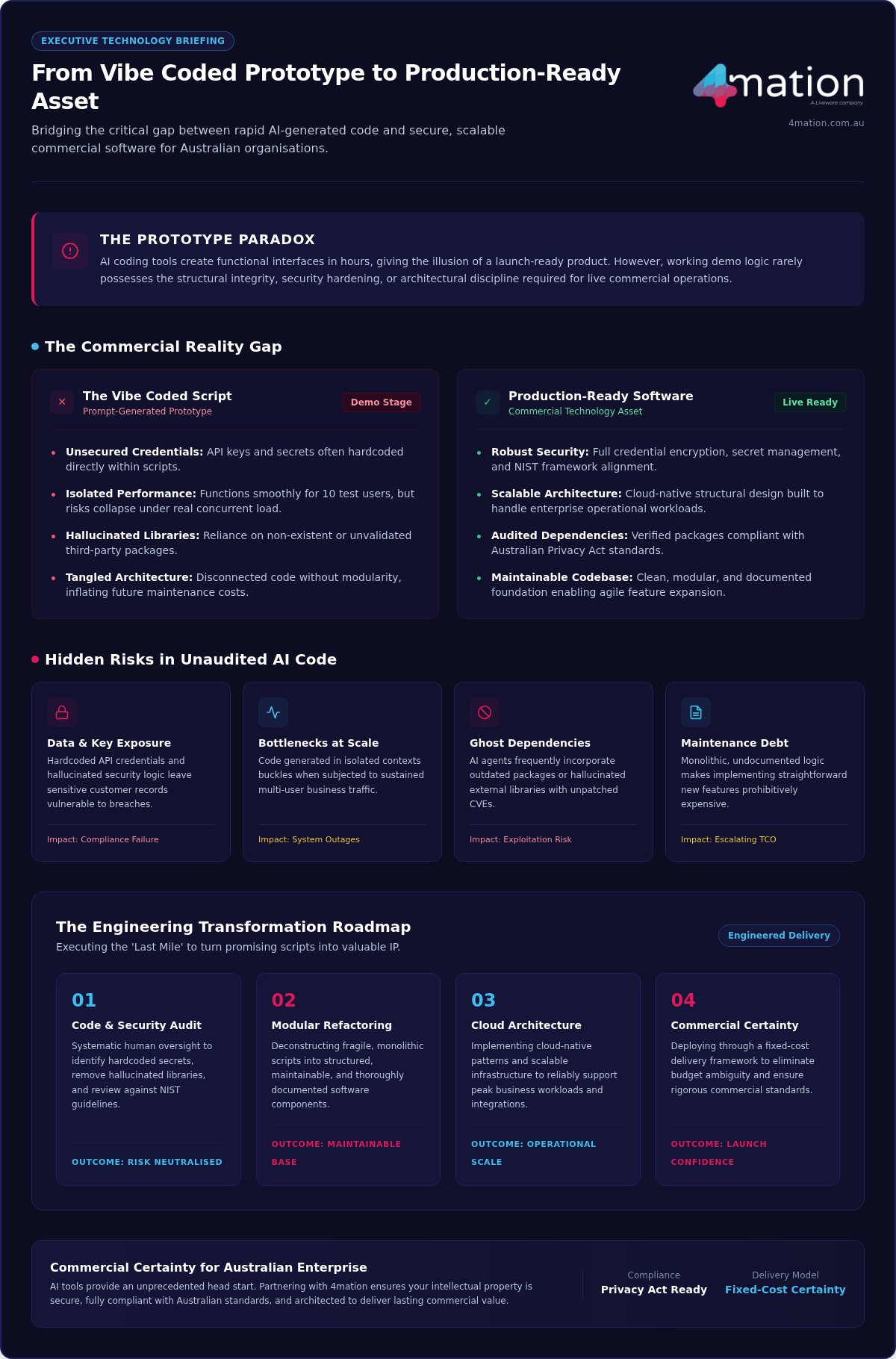
Vibe coding represents a significant shift in how we approach software creation. By using natural language prompts to direct Large Language Models (LLMs) and AI agents, developers and founders can generate code at unprecedented speeds. However, this velocity often masks a fundamental lack of structural integrity. While a prototype might “vibe” correctly during a demonstration, it rarely means your vibe coded app production ready without further engineering. To be truly commercial, it must meet the rigorous software quality standards required for a professional business environment.
This creates what we call the ‘Prototype Paradox’. You see a functional interface and smooth user flows, leading you to believe the application is ready for market. In reality, the underlying code is often a collection of disconnected scripts that lack modularity or proper documentation. Without professional intervention, these apps face severe risks:
- Data leaks: Hallucinated security protocols that fail to protect sensitive user information or customer data.
- Performance bottlenecks: Code that functions in isolation but collapses under the pressure of concurrent user load.
- Maintenance debt: A codebase so tangled that adding a single new feature becomes prohibitively expensive and time-consuming.
Launching without refined code turns a promising asset into a significant business liability, regardless of how impressive the initial build speed appeared.
The Rise of Agentic Development in Australian Business
Tools like Cursor and Replit Agent have fundamentally lowered the barrier to entry for Australian entrepreneurs. It’s now possible to build a Minimum Viable Product (MVP) without a traditional development team. This creates a tempting illusion of low-cost development. While these tools are excellent for validating an idea, they often fail to address enterprise-grade requirements like security, scalability, and integration. A “vibe coded” app might handle ten users perfectly, but it will likely buckle under the weight of real-world operational load or a sophisticated cyber threat.
Identifying the ‘Last Mile’ Problem
The transition from a working demo to a launchable asset is often where projects stall. This ‘last mile’ requires a shift in focus from the speed of the build to the certainty of delivery. Professional human oversight is essential to audit AI-generated scripts, ensuring they don’t contain hardcoded credentials or hallucinated libraries. You need to know that your vibe coded app production ready status isn’t just a hopeful guess, but a verified technical fact. Vibe coding is a rapid prototyping method that requires professional validation to transform a concept into a secure, commercial-grade product.
The Hidden Risks of Deploying Vibe Coded Software
Deploying a prototype built through natural language prompts involves more than just technical hurdles; it introduces significant commercial liabilities. While the speed of code generation is impressive, the resulting scripts often lack the documentation and modular design required for longevity. This means your vibe coded app production ready status is often an illusion until the underlying logic is audited and secured. Without this rigour, you risk building your business on a foundation that is difficult to support and easy to exploit.
Security remains the most pressing concern for any executive responsible for technology investment. AI models frequently suggest outdated libraries or hallucinate dependencies that don’t actually exist. They might also hardcode credentials or API keys directly into the script, creating an open door for attackers. Adhering to the NIST cybersecurity framework is essential to mitigate these risks. Without a structured approach, you risk exposing sensitive customer data to preventable breaches that could damage your reputation permanently.
Security and Cybersecurity Concerns
Unvalidated third-party dependencies are a common trap in agentic development. AI agents prioritising “working code” over “secure code” can inadvertently pull in packages with known vulnerabilities. Our AI code audit identifies these hidden weaknesses before they become active threats. For Australian organisations, this isn’t just about technical safety; it’s about meeting the legal obligations of the Privacy Act and protecting your brand’s reputation in a highly regulated market.
Long-term Maintainability and Technical Debt
Many businesses encounter the ‘Black Box’ problem. This occurs when an application is built using prompts that your internal team didn’t write and doesn’t fully understand. If a bug appears in a vibe-coded script, fixing it can lead to a cascade of failures elsewhere because the original logic wasn’t architected with maintainability in mind. The cost of constant patching and emergency fixes often far outweighs the initial savings of AI generation. Refactoring these critical paths early is a pragmatic way to avoid a total rebuild later.
Scalability is another frequent point of failure. Architectures that “vibe” well for a dozen users often collapse when traffic increases or data sets grow. Transitioning to a professional, cloud-native structure ensures your application can scale alongside your business goals without constant downtime. If you’re concerned about the stability or security of your current build, you can speak with our consultants to evaluate your path forward and ensure your technology remains a foundational business asset.
The Production-Ready Checklist for 2026
Transforming a high-potential prototype into a commercial asset requires a disciplined transition from “working code” to “engineered solution”. While the initial build speed of AI tools is impressive, your vibe coded app production ready status depends on meeting specific technical and operational benchmarks. A structured checklist ensures that your application doesn’t just function, but excels in a competitive Australian market where users expect reliability and speed.
To move beyond the prototype stage, your development roadmap should prioritise these four pillars of professional software:
- Architecture: Transitioning from “spaghetti” logic to a scalable, cloud-native structure that allows for future feature development without breaking existing functionality.
- Security: Implementing robust authentication protocols and end-to-end encryption. Aligning your build with AI risk management standards is a pragmatic way to ensure long-term compliance and user trust.
- Performance: Optimising database queries and API response times. For Australian users, this often means ensuring your infrastructure is tuned for local latency and connectivity conditions.
- Supportability: Establishing comprehensive monitoring and logging. Integrating a managed services framework ensures that when issues arise, they are identified and resolved before they impact your customers.
Infrastructure and Cloud Optimisation
A launch-ready application must be resilient. Leveraging AWS for your infrastructure provides the scalability and reliability required to handle sudden traffic spikes without a total system crash. This isn’t just about raw power; it’s about cost-optimisation. By using cloud-native services, you can ensure your AI-driven features only consume resources when they are actually delivering value, keeping your operational costs predictable and sustainable.
Quality Assurance and User Experience (UX)
AI agents are excellent at generating functional interfaces, but they often lack the nuance of professional UX design. A production-ready app must be intuitive and accessible to a diverse Australian audience. Human-led quality assurance plays a critical role here, catching the subtle edge cases and accessibility gaps that automated tools frequently miss. This human oversight ensures that your final product isn’t just a collection of AI-generated scripts, but a polished tool that users actually enjoy using. Professional validation at this stage reduces delivery risk and provides the certainty you need to launch with confidence.
How to Make Your Vibe Coded App Production Ready
Moving from a functional prototype to a commercial product requires a transition from experimentation to execution. While AI agents provide the raw materials for your application, professional engineering provides the structure. To ensure your vibe coded app production ready status is more than just a hope, you must follow a tactical roadmap that prioritises stability and security. This process moves beyond simple prompting and into the disciplined world of software lifecycles.
The Audit and Refactor Phase
A professional audit is the first step in de-risking any AI build. During this phase, engineers identify ‘dead code’ and redundant logic that AI often generates when trying to satisfy a prompt. These redundancies might not stop the app from working, but they create significant performance bottlenecks and security gaps. By standardising the codebase, you improve developer onboarding and ensure that future updates can be implemented with speed and precision.
- Step 1: Conduct a comprehensive code quality and security audit to find hidden vulnerabilities.
- Step 2: Refactor critical paths, such as payment gateways or data handling, to ensure architectural integrity.
- Step 3: Implement automated CI/CD pipelines to ensure every deployment is tested and reliable.
- Step 4: Establish a long-term maintenance and continuous improvement plan to support your growth.
Deploying with Confidence
Reliability in production comes from rigorous testing in isolated environments. You should never hit the ‘launch’ button on AI-generated code without first validating it in a staging environment that mirrors your live setup. This allows you to implement error tracking and real-time monitoring, catching bugs before they reach your customers. Transitioning to a Fixed-Cost Project model provides the budget certainty needed for this transition, ensuring your project is delivered on time and without financial surprises.
If you’ve built a prototype that shows promise but lacks the stability for a full launch, we can help you bridge the gap. You can contact our team for a code audit to verify your application’s security and prepare it for the Australian market.
Partnering with 4mation for AI Delivery Certainty
Technology should be a foundational business asset, not a source of operational anxiety. While AI tools have accelerated the initial build phase, the transition to a commercial product requires a disciplined approach to risk and quality. We’ve spent 25 years helping Australian organisations solve complex problems with custom software, providing the “safe pair of hands” needed in a complex industry. Our local expertise ensures that your vibe coded app production ready status is backed by rigorous engineering and national accountability.
We reduce delivery risk by combining deep technical knowledge with commercial wisdom. Every project we undertake is governed by the 4mation guarantee: we deliver fixed-cost projects that are on-time, on-budget, and bug-free. This model removes the budget ambiguity often associated with modernising experimental code, giving you the certainty required to scale your operations without financial surprises.
Beyond the Hype: Practical AI Integration
Our focus remains on ROI and operational efficiency rather than chasing fleeting trends. We work with you to ensure your technology creates measurable value for your users and your organisation. Through professional AI application development, we’ve helped clients transform fragmented prototypes into secure, high-performing systems. Whether you need an end-to-end build or want to embed specialists directly into your team via our staff augmentation model, we provide the specific skills needed to professionalise your codebase.
Your Roadmap to a Launch-Ready Product
Successful digital transformation starts with a business-first mindset. We don’t just look at the code; we look at what that code needs to achieve for your customers and your bottom line. This pragmatic approach ensures that your vibe coded app production ready transition leads to a sustainable competitive advantage rather than a mounting pile of technical debt.
Getting started is straightforward. An initial AI consulting engagement allows us to understand your goals, audit your existing build, and provide a clear roadmap for future development. This process removes the “buyer’s remorse” often felt when technology fails to meet enterprise standards. Contact the 4mation team today to audit and professionalise your AI-built app, ensuring it’s ready for the rigours of the Australian market.
Securing Your Technical Foundation for Growth
Moving from a high-speed prototype to a stable commercial product is a defining moment for any organisation. While AI tools provide a remarkable head start, the transition to a vibe coded app production ready state requires the architectural rigour that only experienced engineering can provide. By addressing technical debt, implementing robust security protocols, and optimising for cloud scalability, you transform a promising experiment into a durable business asset.
With 25 years of client success, 4mation provides the strategic expertise needed to professionalise your build. We work with you to remove delivery risk through our fixed-cost, bug-free guarantee, ensuring your technology remains reliable and maintainable as your user base grows. Our methodical approach replaces uncertainty with a clear roadmap for long-term operational efficiency and measurable success.
Take the next step in your development journey with confidence. Book an AI Code Audit with 4mation today to verify your application’s integrity and prepare for a successful market launch. We look forward to helping you build a high-quality solution that delivers value for your organisation and your users for years to come.
Frequently Asked Questions
Is it safe to deploy a vibe coded app without a professional review?
It’s generally not advisable to launch an application built through natural language prompts without a professional technical review. While the functional logic might appear sound, AI models often hallucinate security protocols or introduce unvalidated third-party dependencies. Professional validation ensures your vibe coded app production ready status is a technical reality rather than a commercial risk. This review identifies hidden vulnerabilities and structural weaknesses that could lead to data breaches or system failures under load.
How much does it cost to make an AI-generated app production-ready?
Investment levels depend on the complexity of your current build and the specific requirements of your industry. We focus on a business-first approach that prioritises high-value features and risk reduction. 4mation provides a Fixed-Cost project model for these transitions, which guarantees your project is delivered on-time, on-budget, and bug-free. This approach removes the financial ambiguity often associated with fixing experimental code and ensures you receive a commercial-grade product without unexpected expenses.
Can 4mation help fix an AI-built app that keeps breaking?
Yes, we specialise in project rescue and modernising applications that have become unstable. If your AI-generated software is experiencing frequent crashes or performance bottlenecks, it’s likely due to a lack of underlying architectural rigour. Our team conducts deep-code audits to identify the root cause of these failures. We then refactor the critical paths to ensure long-term stability. This methodical process transforms a fragile script into a reliable foundation for your organisation’s ongoing growth.
What are the biggest security risks in AI-generated code?
The primary security concerns include hardcoded credentials, hallucinated libraries, and insecure data handling practices. AI agents often prioritise speed over safety, which can result in scripts that expose API keys or fail to meet Australian data privacy standards. Without a professional audit, these vulnerabilities remain hidden until they are exploited. We align your application with recognised security frameworks to protect your sensitive customer data and ensure your intellectual property remains secure in a production environment.
How long does a production-readiness audit typically take?
The duration of an audit varies based on the size of the codebase and the complexity of the integrations. Most initial reviews are completed within a few weeks, providing you with a clear roadmap of necessary improvements. This timeframe allows our specialists to thoroughly evaluate your security, architecture, and performance. We focus on delivering actionable insights quickly so you can move from the prototype phase to a launch-ready state without unnecessary delays to your project timeline.
Does 4mation offer ongoing support for AI applications?
We provide comprehensive ongoing support through our Service Desk and Managed Services framework. This “technology insurance” includes proactive monitoring, maintenance, and incident response to reduce operational risk for your business-critical platforms. Beyond simple maintenance, we offer continuous improvement and development to ensure your AI application evolves alongside your business goals. This partnership model provides the certainty that your technology will remain secure, scalable, and high-performing long after the initial launch.
What is the difference between a prototype and production-ready software?
A prototype is designed to validate an idea or “vibe” through a functional interface, while production-ready software is engineered for reliability, security, and scale. Professional applications must handle concurrent user loads, protect sensitive data, and remain maintainable for years. While a vibe coded app production ready prototype might look finished, it often lacks the modular architecture and documentation required for a commercial environment. The production-ready version is a stable asset that supports measurable business value.
Can you integrate my vibe coded app with existing enterprise systems?
Yes, system integration is a core part of our expertise. We help Australian organisations connect their AI-built prototypes with existing enterprise systems, such as CRMs, ERPs, or legacy databases. This ensures your new application doesn’t operate in a silo and can leverage your organisation’s existing data assets. Our team handles the complex API connections and data mapping required to create a seamless workflow, improving operational efficiency and reducing manual processing across your entire technology stack.
About The Author
