Modernising Legacy Applications: A Strategic Roadmap for Australian Organisations
4mation Technologies

Did you know that some Australian organisations are currently losing up to 40% of their IT budget just to keep legacy systems on life support? It’s a staggering figure that represents more than just a financial drain; it’s a barrier to the very innovation your business needs to stay competitive. Developing a clear legacy application migration strategy is no longer a technical luxury, but a commercial necessity for those looking to reclaim that capital and reinvest it where it matters most.
You’ve likely felt the friction of technical debt, whether it’s the rising cost of maintenance or the frustration of being unable to integrate modern AI tools because of an outdated codebase. It’s a common challenge for established local firms where the scarcity of developers for older languages makes even minor updates feel like a high-risk operation. We’ve developed this roadmap to show you how to transform these ageing systems into scalable, AI-ready assets that drive commercial value without the typical delivery risk. We’ll explore a pragmatic approach that prioritises stability and measurable outcomes, ensuring your technology becomes a foundation for growth rather than a liability.
Key Takeaways
- Understand why maintaining ageing software has become a significant commercial risk and how to reclaim the capital currently lost to technical debt.
- Learn how to apply the 7 Rs framework to select a legacy application migration strategy that aligns with your specific business value and operational goals.
- Discover why modernising your data architecture is the essential prerequisite for implementing practical AI and automating complex business processes.
- Follow a disciplined five-step roadmap designed to identify commercial opportunities while eliminating the ambiguity and risk of large-scale technology shifts.
- See how integrated managed support protects your investment by ensuring long-term stability and preventing the accumulation of new technical debt.
Why Legacy App Modernisation is Critical in 2026
At its core, software modernization involves the strategic update of ageing systems to modern architectures, languages, and cloud-native platforms. While “legacy” often implies something inherited, in a commercial context, it usually means software that has become a bottleneck to growth. In 2026, waiting is no longer a viable strategy. Australian organisations report spending up to 40% of their IT budgets just managing legacy technology debt. This is capital that should be funding your next market-leading feature, not patching holes in a sinking ship.
These systems carry hidden burdens that go beyond simple maintenance fees. Security vulnerabilities are a primary concern, especially as the Australian Signals Directorate (ASD) warns that legacy IT presents significant and enduring risks to national cybersecurity. Integration hurdles also prevent you from adopting the latest AI tools that your competitors are likely already using. At 4mation, we bring 25 years of experience to these complex transitions. We act as a steady hand, ensuring your legacy application migration strategy moves you toward stability without the delivery risk often associated with large-scale shifts.
The Consequences of Technical Debt
Technical debt acts like a silent tax on every new initiative. When your foundation is brittle, a simple feature that should take two weeks ends up taking two months because developers must navigate layers of “spaghetti code.” There’s also a significant talent gap to consider. Modern developers are increasingly reluctant to work on monolithic stacks or obsolete languages. They want to build with modern frameworks. If your tech is 15 years old, you’ll struggle to attract and retain the people you need to grow. The operational risk is equally real. Brittle systems lead to outages that can damage your brand. We’ve managed high-stakes environments for organisations like the ABC, where system reliability isn’t just a goal; it’s a fundamental requirement.
Commercial Drivers for Strategic Change
The conversation needs to shift from “keeping the lights on” to driving commercial value. A poor customer experience (CX) driven by slow, clunky legacy interfaces is a direct path to churn. In an era where users expect seamless, mobile-first interactions, a legacy backend that can’t support a modern frontend is a liability. Modernising allows you to pivot from reactive maintenance to proactive innovation. For a deeper look at the operational dangers, you can read our guide on The Risks of Not Modernising Legacy Systems. By refining your legacy application migration strategy, you ensure your platform is ready for the practical implementation of AI and automated workflows that define the current market.
Selecting the Right Legacy Application Migration Strategy for Your Business
The 7 Rs framework provides a structured menu of options for updating your software, ranging from simple relocation to a complete replacement. Selecting the most effective legacy application migration strategy begins with a pragmatic audit of your current assets. We evaluate each application by weighing its business value against its technical health. A critical system with sound logic but an outdated hosting environment requires a different approach than a technically “healthy” application that no longer aligns with your commercial goals. For a comprehensive look at these technical pathways, IBM’s guide to legacy application modernization offers a helpful baseline of these industry definitions.
Our Digital Strategy & Consulting team works with you to navigate these choices. We focus on identifying the path that offers the highest ROI while minimising delivery risk. Whether you are looking to reduce infrastructure overheads or unlock new revenue streams through AI, your strategy must be grounded in business outcomes rather than just technical preference. Selecting the right enterprise digital transformation agency is equally critical to ensuring these decisions are backed by commercial accountability and delivery certainty. If you are unsure where your systems sit on the spectrum of technical health, we can help you assess your options through a strategic audit.
Refactoring vs. Replatforming: Evaluating the ROI
Refactoring involves improving the internal code structure without changing the external behaviour of the software. This approach is best for high-value bespoke applications where the core logic is a competitive advantage but the technical debt has become a “tax” on innovation. Replatforming, often described as “lift and reshape,” involves moving the application to a cloud environment with minimal changes to the code. This is typically the fastest way to reduce on-premises infrastructure costs and improve basic scalability.
| Strategy | Relative Cost | Risk Level | Time-to-Value |
|---|---|---|---|
| Replatforming | Low to Medium | Low | Fast |
| Refactoring | Medium to High | Moderate | Moderate |
The Rebuild Option: When to Start from Scratch
There are instances where a legacy system is too far gone for incremental updates. If the original programming language is obsolete or the architecture is fundamentally unable to support modern integrations, a total rebuild is often the most cost-effective long-term choice. In these scenarios, we use our custom software development services to create a future-proof foundation. We employ rapid prototyping to validate the new system’s core features early in the process. This ensures the solution meets actual user needs before you commit to a full-scale build. We prioritise user-centred design to ensure the final product improves both staff productivity and the customer experience.
Modernising Data Architecture for AI Workflows
Successful enterprise AI implementation is not a bolt-on feature; it is the direct result of a modernised foundation. If you attempt to run sophisticated Large Language Models (LLMs) against a fragmented legacy database, the results will be inconsistent and unreliable. A robust legacy application migration strategy must account for data liquidity. This ensures your valuable business information is no longer trapped in silos but is ready to fuel the next generation of AI workplace modernisation.
We are seeing a fundamental shift from static software, where users manually input and retrieve data, to agentic workflows. These workflows use AI agents to automate complex business processes by understanding context and making informed decisions. To reach this level of automation, your data must be “AI-liquid.” We define AI-liquid data as data that is structured, accessible, and ready for AI processing. Transitioning your architecture to support this liquidity is the primary prerequisite for any organisation looking to lead in 2026.
Making Legacy Data Accessible for AI Agents
Many Australian organisations sit on decades of “dirty data” buried within legacy databases. This information is often unstructured, redundant, or stored in obsolete formats that modern AI cannot interpret. To solve this, we focus on cleaning and structuring this data to feed Retrieval-Augmented Generation (RAG) systems. RAG allows an AI to look at your specific business documents and data to provide accurate, context-aware answers rather than generic responses.
Connecting these old systems to modern LLMs requires the development of secure, high-performance APIs. These interfaces act as a bridge, allowing an AI agent to “talk” to your legacy backend without compromising security or system integrity. By creating this connectivity, you transform a dormant archive into a live asset that can actively support decision-making and customer service. For organisations looking to eliminate data silos and unify their technology ecosystem, professional system integration services are often the critical next step after modernising a legacy platform.
Outcome-Focused AI Modernisation
At 4mation, we prioritise measurable commercial outcomes over technical experimentation. We’ve worked with organisations like NATA and Ego Pharmaceuticals to implement AI-enabled efficiency that delivers real-world results. The goal is always to provide a platform that enables reduced manual processing and improved accuracy for your staff. When your team no longer spends hours on repetitive data entry or manual reconciliations, they can focus on high-value strategic work that grows the business.
This pragmatic approach to AI ensures that your technology investment is directly tied to operational improvements. Our AI consulting services help you identify which parts of your legacy stack are ready for modernisation and which offer the greatest potential for automation. By focusing on these high-impact areas, we reduce the ambiguity of the project and provide a clear path to a measurable return on investment.
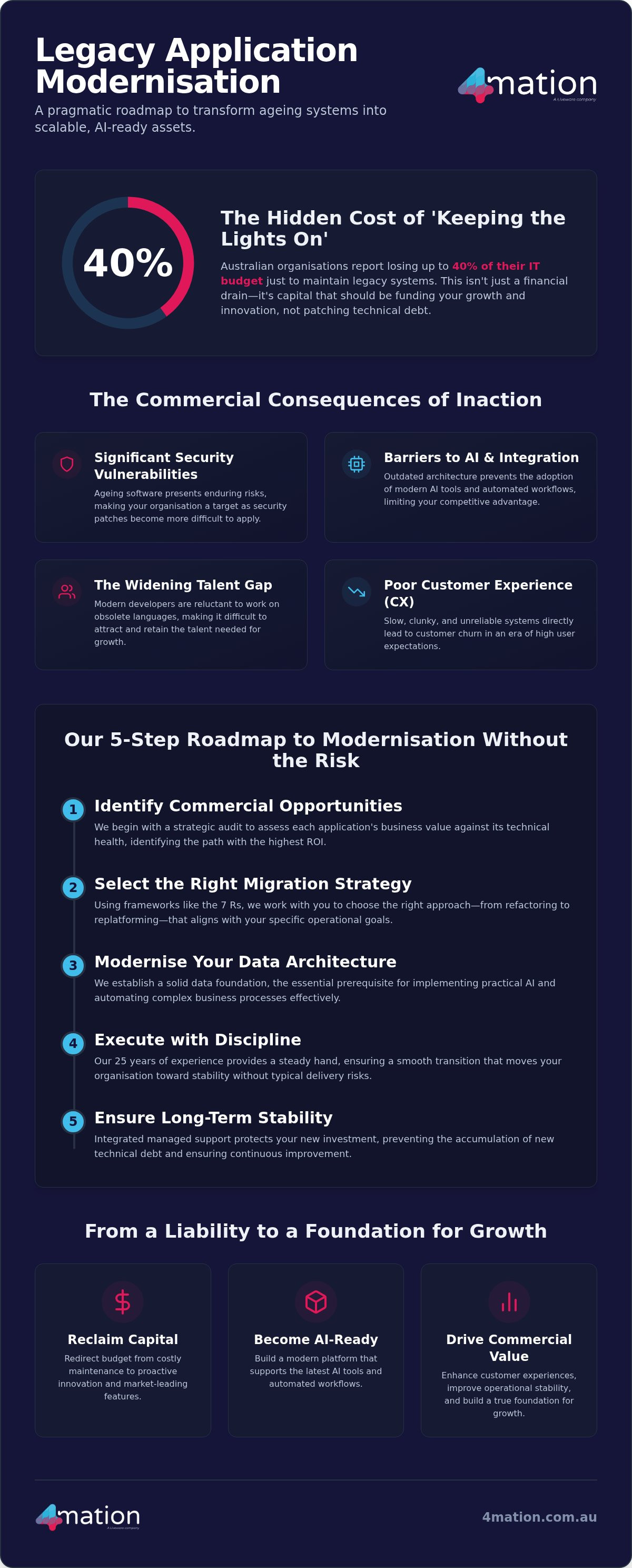
A 5-Step Roadmap to Modernising Your Legacy Software Assets
Modernising a core business system is a significant undertaking that requires more than just technical skill. It demands a disciplined, outcome-oriented approach to ensure the project delivers commercial value without compromising operational stability. We follow a structured five-step roadmap designed to eliminate ambiguity and move your legacy application migration strategy from a visionary concept to a functional reality.
- Step 1: Discovery & Business Alignment – We begin by identifying the “commercial why.” We work with you to define the specific business problems you need to solve, whether that’s reducing maintenance costs or enabling new revenue streams through AI.
- Step 2: Technical Audit & Risk Assessment – Our team conducts a deep dive into your existing codebase and infrastructure. We identify the “technical what,” mapping out dependencies and potential risks to ensure a smooth transition.
- Step 3: Strategy Selection & Prototyping – Based on the audit, we select the most pragmatic migration path from the 7 Rs framework. We often build a rapid prototype to validate the “how” and prove the concept before you commit to a full-scale investment.
- Step 4: Iterative Execution & Managed Migration – We deliver the “do” with certainty. By using an iterative approach, we provide regular updates and measurable progress, ensuring the project remains aligned with your goals throughout the build.
- Step 5: Ongoing Optimisation & Support – Modernisation isn’t a one-off event. We provide the support needed to ensure your new platform continues to evolve, preventing the accumulation of fresh technical debt.
Mitigating Delivery Risk with Fixed-Cost Projects
One of the biggest anxieties in software modernisation is the “budget blowout” caused by unknown technical hurdles. We address this directly through our Fixed-Cost project guarantee. This model ensures your project is delivered on time, on budget, and bug-free. With 25 years of experience as a “safe pair of hands” in the Australian market, we take on the delivery risk so you don’t have to. It’s a disciplined approach that provides the financial certainty executives need when approving large-scale technology investments.
Managing Stakeholders and Minimising Disruption
Clear communication is essential when explaining the value of a legacy application migration strategy to non-technical stakeholders. We help you translate technical requirements into commercial outcomes that resonate with the board, such as improved staff productivity or enhanced customer retention. To ensure zero business disruption, we often employ “parallel running” strategies. This involves running the new system alongside the old one during the cutover phase to verify accuracy and performance. If your internal team is already stretched, we can provide staff augmentation to support them through the transition without slowing down your daily operations.
If you’re ready to move away from the high costs of technical debt, we can help you book a strategy session to map your roadmap.
Ensuring Long-Term Success: Managed Support and Continuous Improvement
Modernising your software is not a “set and forget” task; it is a commitment to a cycle of continuous improvement. Once you have executed your legacy application migration strategy, the focus shifts to protecting that investment and ensuring it remains a competitive advantage. Without a disciplined approach to ongoing maintenance, even the most modern systems can eventually begin to accumulate new technical debt. Our Continuous Improvement & Development model is designed to prevent this by providing the regular updates and refinements needed to scale your operations with certainty.
Proactive monitoring is essential for business-critical platforms. It allows us to identify and resolve potential issues before they impact your staff or customers. By moving away from the “break-fix” model that often characterises legacy environments, you gain a platform that is consistently reliable. This proactive stance ensures your technology remains a foundational asset that supports your commercial goals rather than a liability that requires constant emergency attention.
The 4mation Service Desk: Your Technology Insurance
We view managed support as “technology insurance” for your organisation. This approach involves proactive monitoring, regular security maintenance, and a structured incident response plan. Having a local, Australian-based team available for immediate support ensures that your systems are managed by experts who understand the domestic business context and regulatory environment. Our Technology Support & Maintenance model is built on accountability and long-term partnership, providing a steady hand to manage the complexities of your new environment. This allows your internal leadership to focus on strategic growth rather than being bogged down by technical troubleshooting.
Scaling with Confidence
A successful modernisation project enables your business to move with greater speed and agility. By replacing ageing software with a scalable, cloud-native architecture, you shift from a legacy mindset to a future-ready digital strategy. This transformation allows you to integrate new AI capabilities and respond to market changes without the delivery risk that previously held you back, reinforcing the long-term value of your legacy application migration strategy. The ultimate outcome is a resilient foundation that supports long-term commercial value and a superior customer experience. Modernisation is the first step toward a more efficient, data-driven organisation that can confidently navigate the complexities of 2026 and beyond. To see how this fits into a broader vision, you can read our guide to the Digital Transformation Pillar.
If you are ready to secure the future of your technology assets and reclaim your IT budget from technical debt, we invite you to organise a consultation to discuss your legacy modernisation roadmap.
Future-Proof Your Organisation with a Disciplined Modernisation Roadmap
Modernising your software is the most effective way to reclaim the capital currently lost to technical debt and maintenance. By implementing a disciplined legacy application migration strategy, you don’t just fix old problems; you build a foundation for AI-driven growth and superior customer experiences. We’ve explored how the 7 Rs framework and a structured five-step roadmap can eliminate the ambiguity that often stalls these critical projects.
At 4mation, we bring 25 years of experience to every transition, acting as a steady hand for Australian organisations. As a highly vetted and trusted supplier for organisations across the country, we provide the accountability you need through our Fixed-Cost, on-time, and bug-free project guarantee. This model removes the financial uncertainty and delivery risk often associated with complex system updates. Working with a proven enterprise digital transformation agency ensures that this accountability extends across every phase of your modernisation journey, from initial audit through to ongoing optimisation.
It’s time to move from reactive maintenance to proactive innovation. You can discuss your modernisation roadmap with a 4mation strategist to see how we can help you transform your legacy assets into high-value commercial tools. We look forward to helping you build a platform that is ready for the future.
Frequently Asked Questions
What are the main risks of modernising legacy applications?
Risks include delivery ambiguity, data migration errors, and business downtime. Many organisations fear “unknown unknowns” that can derail timelines and budgets. We mitigate these risks through a comprehensive technical audit and our Fixed-Cost model. This ensures that your legacy application migration strategy is grounded in a clear scope, preventing the common pitfalls of scope creep and unexpected technical hurdles that often plague complex software transitions.
How much does it cost to modernise a legacy system in Australia?
Costs vary significantly based on the complexity of your stack and the chosen modernisation path. Research indicates that mid-sized projects in Australia can range from A$70,000 to A$700,000, while enterprise-level transformations often exceed A$1 million. Because every business environment is unique, we focus on identifying the most pragmatic path that delivers measurable ROI. This approach ensures you aren’t over-investing in unnecessary features while still achieving your core commercial objectives.
How long does a typical application modernisation project take?
Timelines are determined by the scale of the system and the specific strategy used. A simple replatforming project might take three to six months, whereas a full architectural rebuild can span a year or more. We use an iterative execution model to deliver functional components throughout the journey. This allows your team to see progress early and ensures the final delivery aligns perfectly with your evolving business requirements and operational goals.
Can we modernise our system without taking it offline?
Yes, it’s possible to maintain business continuity throughout the transition. We often employ parallel running strategies, where the new system operates alongside the legacy platform during the cutover phase. This method allows for rigorous testing and data validation without risking an outage. By prioritising a “zero disruption” approach, we ensure that your daily operations remain stable while we transition your core assets to a more modern, scalable architecture.
What is the difference between refactoring and rebuilding software?
Refactoring involves updating the internal code to improve performance and maintainability without changing how the software behaves for the user. Rebuilding means starting from scratch to create a completely new system, often with a modern language and improved user interface. While refactoring is faster, a rebuild is often necessary if the original technology is obsolete or if your current legacy application migration strategy requires a foundation for advanced AI automation.
How does 4mation guarantee that a modernisation project stays on budget?
We provide financial certainty through our Fixed-Cost project guarantee. This promise ensures your project is delivered on time, on budget, and bug-free. By conducting a thorough discovery and technical audit before we begin, we identify potential blockers early. This disciplined approach removes the ambiguity of “time and materials” billing, giving your board and executive team the confidence that the investment will meet its stated commercial outcomes.
Do we need to move to the cloud to modernise our legacy software?
While not strictly mandatory, moving to the cloud is often the most effective way to unlock scalability and modern security features. Many Australian organisations now opt for a hybrid cloud model, keeping sensitive data on-premises while using the cloud for high-performance AI processing. Modernising your software makes it “cloud-ready,” providing the flexibility to choose the hosting environment that best balances your compliance needs with your requirements for growth.
How can AI be integrated into an older legacy application?
About The Author
